Film Review: THE MEYEROWITZ STORIES (NEW AND SELECTED) (USA 2017) ****

Submit your Screenplay to the Festival TODAY
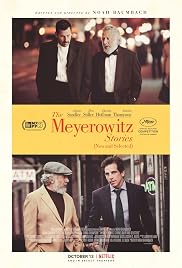
The Meyerowitz Stories (New and Selected) Poster
Trailer
An estranged family gathers together in New York for an event celebrating the artistic work of their father.

Director:

Noah Baumbach

Writer:

Noah Baumbach


The one of two Netflix originals that premiered at Cannes this year (with OKJA), THE MEYEROWITZ STORIES took critics by surprise (despite being booed at the screenings for being a NETFLIX film) with many hailing it as one of their favourite Top 10 at Cannes.

The film is so-called THE MEYEROWITZ STORIES as it revolves around multiple stories among the different members of the Meyerowitz family.  It starts off with Danny driving around the city with his daughter cussing while trying to find parking.  “Garage it,” the daughter says.  The family patriarch is Harold (Oscar Winner Dustin Hoffman sporting a full beard).  He is old, hospitalized at one point and is more interested in his art and coming-up museum showcase opening than in his family.  His new wife is alcoholic recovered, Maureen (Emma Thompson) wanting to seek the family house.  Their sons include Danny (Adam Sadler) who is recently separated and moving ingot he parents house and who has never worked a day in his life.  The successful son, making the money is Matt (Ben Stiller) who the family resents because of jealousy that he is capable to making the most money.  The daughter is Jenny (Elizabeth Marvel) into into making movies.  Everyone comes together in this dysfunctional family with drastic and comedic results.  Bambauch has mastered this genre with his film flowing smoothly.

Director Bambauch (THE SQUID AND THE WHALE, MISTRESS AMERICA, FRANCES HA) allow each actor their freedom to do their own thing and inhabit the characters they portray.  Adam Sandler and Ben Stiller in their rare serious roles shine in their performances.  They show both angst and desperation as men that been betrayed by the artistic father (Dustin Hoffman sporting a full white beard.)  Emma Thompson sporting elderly age makeup plays the step-mother reminiscent of a similar motherly role in the British film THE LEGEND OF BARNEY THOMSON. 

The film has a Jewish cast and crew, led by its director Bambauch.  The film has definitely a Jewish impression that leaves a fine imprint and is not overpowering.  It runs a bit long at 2 hours, but the free flowing characteristic of the film allows it to keep going, without it getting monotonous or boring.  One can always count on Bamnauch to add another story to his list.

The film’s best moments are in the script’s sharp dialogue.  The best line comes from Dr. Soni after the children abruptly questions her saying it isn’t fair for on her leaving for vacation in China while leaving their father in an induced coma.  (This current state of affairs is already really funny in itself)  Her reply: “yes, it isn’t!”  The response sums up what each of the siblings have gone through being a member of the Meyerowitz family.

THE MEYEROWITZ STORIES establishes Bambauch once again as the Master of films on dysfunctional families and quirky characters.

The film is available on NETFLIX for on-line streaming to subscribers.

Trailer: https://www.youtube.com/watch?v=czyMIIm12JY

Submit your Screenplay to the Festival TODAY

Film Review: OFFICE (Hong Kong 2015) ***

Submit your Screenplay to the Festival TODAY

Office Poster
A musical set mainly in a corporate high-rise. Two assistants, Lee Xiang and Kat, start new jobs at the financial firm Jones & Sunn.

Director:

Johnnie To

Writer:

Sylvia Chang


Hong Kong action director Johnny To (TRIAD ELECTION, BLIND DETECTIVE among 70 directorial credits) does a Chinese musical satirizing office culture in the mildly amusing but ambitious OFFICE.  OFFICE was screened at the Toronto International Film Festival in 2015 before release though it never made it to Canada.  And OFFICE is full of unexpected surprises.

The story of OFFICE follows the IPO (Initial Public Offering) of shares by a major  company led by the Chairman (Chow Yun-Fat) and his CEO who also happens to be his mistress (Sylvia Chang).  Meanwhile, his wife is comatose in the hospital.   But they are clever people as they control money and not let money control them, as the CEO advises a newbie at one point in the film.

The film opens as two new interns show up at the posh financial company Jones & Sunn.  Lee Xiang (Ziyi Wang) and Kat-Ho (Yueting Lang), start new jobs but learn that there are lots of kissing asses and dirty business that need be done in order to be successful.  Lee Xiang is earnest and naive.  He goes about saying his name Lee is from Ang Lee (the Taiwanese director) and Xiang means thinking.   Two other characters that play a part in the plot are high flyers Sophie (Wei Tang) and David (Eason Chan) who forge financial figures.

OFFICE is pleasant to the eyes – great set decoration and design.  The fathomless office space with countess desks and faceless employees at each desk not only look stunning (credit to production designer William Cheung) but gets the point across.  Each office space is designed artistically and modern, often with crystalline and curved shapes.  Wardrobe, especially those worn by Sylvia Chang are haute couture.

The characters break into song at any time with the film looking a bit similar as a result, to LALA LAND.  But the songs are often clumsily inserted, and break the flow of the narrative, despite a few being really inventive, especially if one understands Chinese in order to get the innuendo.  Songs are by 1980s pop icon Lo Ta-yu.

OFFICE is based on the play “Design For Living” written (as is the film ) by screen veteran Sylvia Chang who also plays a lead as the company CEO.  The film is shot in both Mandarin (when they speak in the office) and Cantonese (when they speak more casually to friends and family).

OFFICE barely succeeds as a musical and satire and runs a bit long at just under two hours.  The novelty of the sets and songs wears off quite soon.  Being a Johnny To film, one feels that guns could start blazing at various points in the film.  Still for sheer courage of ingenuity, OFFICE is worth a look for its eccentricity.

OFFICE has a special screening at the TIFF Bell Lightbox on October the 28th at 930 pm.  OFFICE is screened as part of TIFF Cinematheque’s first retrospective on Johnny To entitled “Expect the Unexpected”.

Trailer: https://www.youtube.com/watch?v=hFS1sdkSOwQ

Submit your Screenplay to the Festival TODAY

Deadline Oct. 15th: Screenplay Festival Submissions (Feature or Short)

WILDsound Festival's avatarWILDsound Festival

SCREENPLAY CONTESTSUBMIT your FEATURE Script
FULL FEEDBACK on all entries. Get your script performed

Deadline: Screenplay Festival – Get FULL FEEDBACK. Get script performed by professional actors
http://www.wildsound.ca/screenplaycontest.html

Watch WINNING Screenplay Readings – Watch videos of past winners performed by professional actors
http://www.wildsoundfestival.com/feature_script_readings.html

READ 100s of testimonials from past submitters –
https://wildsoundfestivalreview.com/feature-screenplay-submission-testimonials-wildsound-screenplay-contest-review

WILDsound is a screenwriter’s treasure! They take enormous time to provide the most expert, detailed feedback, even allowing my choice to incorporate all the committee’s ideas or stay with my draft. With caring support, they’ve honored each deadline and every award they promised, and I’m forever grateful for their right-on insightful niggles to enhance my story. WILDsound provides everything a screenwriter needs to find the way to a story’s successful completion. I’m forever grateful!
– Elan Carlton, Cahoots, Feature Script

I have taken the time to review your feedback and have found your comments and suggested invaluable. As an…

View original post 400 more words

Deadline Oct. 15th: TV Festival Submissions (Pilot or Spec)

WILDsound Festival's avatarWILDsound Festival

SUBMIT your TV PILOT or TV SPEC Script
Voted #1 TV Contest in North America.

Deadline: TV PILOT/SPEC Script Festival – Get FULL FEEDBACK. Get script performed by professional actors
http://www.wildsound.ca/tvscreenplaycontest.html

Watch WINNING TV PILOT Screenplay Readings
http://www.wildsoundfestival.com/tv_pilot_readings.html

Watch WINNING TV SPEC Screenplay Readings
http://www.wildsoundfestival.com/tv_spec_readings.html

READ 100s of testimonials for past submitters –
TV Screenplay Testimonials from the WILDsound Festival

This is most excellent. I loved the thorough feedback, and some of the fixes or easy and some require a little more thinking but regardless, I’m glad to be getting your feedback.
– David Baugnon, (The Messiah Project)

Thank you for your encouraging words and for this great chance you are giving me. If I had to rate your feedback, I would give it 110 over 100 !! In fact, it is thanks to your previous feedback that I was able to improve this piece: even when they are harsh, your…

View original post 593 more words

Deadline Oct. 15th: Novel Festival Submissions (1st. Ch., Novel, Transcript)

WILDsound Festival's avatarWILDsound Festival

1st CHAPTER or FULL NOVEL CONTEST
Get full feedback! Winners get their novel made into a video!

DEADLINE: 1st CHAPTER/FULL NOVEL Festival. Get your story performed at the Writing Festival. FULL FEEDBACK on all entries.
http://www.wildsound.ca/book_contest.html

NEW OPTION: Or, just submit for an actor performance reading transcript of your novel (any 5 pages of your book). Great way to promote the sales of your book if you’re already published. (see examples on the video playlist below)

Watch the Recent Winners. At least 3-10 winners every month:
http://novelwritingfestival.com

Thank you. thank you for your honest & detailed appraisal of my work! It is extremely helpful & insightful.
– Michelle Desgagne
The Distracted Yogi, Novel

I appreciate WILDsound’s committee feedback on the first chapter/prologue submission of my memoir Am doing a rewrite to address your recommendations and, per your suggestion, will send back my revised submission as soon as possible.
– Danielle…

View original post 529 more words

1957 Movie Review: KRONOS, 1957

Submit your Screenplay to the Festival TODAY

KRONOS,  MOVIE POSTERKRONOS, 1957
Movie Reviews

Directed by Kurt Neumann
Starring: Jeff Morrow, Barbara Lawrence, John Emery, George O’Hanlon, Morris Ankrum, Kenneth Alton, John Parrish
Review by Kevin Johnson

SYNOPSIS:

A scientist possessed by an alien lifeform controls a massive, energy-consuming machine, leaving a few choice scientists to stop him and the machine before it absorbs all the earth’s energy

CLICK HERE and watch 2009 MOVIES FOR FREE!

What is WILDsound?

REVIEW:

Not all B-movies are relegated to automatic mediocrity or downright awfulness. While The Black Scorpion left a lot to be desired, Kronos, on the other hand, seems to showcase what a more competent and clear-headed, low-budget film can accomplish. It still has its flaws of course – what B-movie doesn’t? – but it masks them rather well for an intriguing story.

Part of what makes Kronos works is the lack of explanation for a large part of the film. Weird stuff happens, strange things are witnessed, characters act oddly – but by not over explaining them, there’s a better overall sense of tension developed. Also, the need for a sexualized female is competently done, even if the typical “swimming on the beach” scene is bluntly out of place.

An alien “spirit” arrives in the midst of a desert and possesses an innocent person, who manages to break into an astronomy lab and possess Hubbell Elliot, a scientist who works there. He uses long-distance telepathy to communicate to a huge, monstrous, metal spacecraft, which crashed into the Pacific near Mexico. It sucks and absorbs all the energy thrown at it, and even drains a power plant dry of its energy. Fellow scientist Leslie Gaskell and his partner Vera Hunter has to figure out how to stop the mechanical beast as well as stop the possessed scientist from completing his plan.

The special effects unfortunately do not live up to the quality that one would expect from films of this time period. The budget was cut right before filming began. Yet given what they were stuck with, one still might be mildly impressed. The Kronos design is simplistic enough, and it took me a while to realize that the generic box-like shape with the odd-looking antennae was supposed to be a battery. Still, a little more creativity for some visual appeal wouldn’t hurt. What’s way off, however, is how the machine moves. Four up-and-down poles pump like pistons work around a spinning drill-like device somehow creates motion, which is just impossible. (The use of animation for the long shots of Kronos is even worse).

Speaking of which, I don’t know much about science or power, so it’s interesting to see the plot delve somewhat deeply into pseudo-scientific explanations to progress itself. The actors and writing definitely assist to clarify what audiences wouldn’t understand. But even with the mumbo-jumbo, it still seems rather far-fetched, just a number of random words to confuse the viewer to make it seem like they know what they’re doing.

It works though; as mentioned earlier, the film is very intriguing by controlling out plot points are divulged. In addition, actor John Emery is quite good (in the haming-it-up sense), playing the possessed scientist, struggling to maintain his humanity as the alien inside forces him to do his long-distance bidding. In fact, I personally thought his were the best scenes in the movie.

Also impressive is the surprisingly pro-environmentalist, anti-atomic weaponry commentary throughout the script. While nothing too much on the nose or overly overt, there are a few moments, a few key lines that question America’s excessive consumption of energy and power (is Kronos essentially us, making America our own enemy?), and the quick-to-jump trigger finger hovering over the button to launch nuclear weapons. Instead of using such power against those enemies, which will only strike back, perhaps it would be better to use that power to benefit our own people. It suggests this, anyway.

Kronos is certainly one of the better sci-fi B-films from the 50s, and with its short running time, it’s a good one to sit and enjoy, especially with Neumann’s steady handle on the material and direction. If you’re looking for a good one that represents the average-made sci-fi 50s film – the “Fifth Element” of the 50s – Kronos is for you.


Submit your Screenplay to the Festival TODAY

1957 Movie Review: THE INCREDIBLE SHRINKING MAN, 1957

Submit your Screenplay to the Festival TODAY

THE INCREDIBLE SHRINKING MAN,  MOVIE POSTERTHE INCREDIBLE SHRINKING MAN, 1957
Movie Reviews

Director: Jack Arnold

Starring: Grant Williams, Randy Stuart, April Kent, Helene Marshall
Review by Kevin Johnson

SYNOPSIS:

A man is exposed to a freak radiation cloud while on vacation, causing him to gradually shrink.

CLICK HERE and watch TV SHOWS FOR FREE!

What is WILDsound?

REVIEW:

I was actually rather surprised by The Incredible Shrinking Man, which began typically like the average B-film but dovetailed into a dark yet intrinsic inspirational tale without the classic Hollywood revisioning. It is a film that espouses more novel or short story-like elements than cinematic ones.

Since this is based on Richard Matheson’s novel of the same name, and since he also penned the screenplay, it’s to be expected. But the lack of specific changes to make the film more engaging to audiences, such as happier ending and a satisfying explanation of the shrinking, is rather audacious, especially taking in account the time period. This gives the film a deeper resonance now, but I can’t imagine audiences being too receptive to it back in 1957.

When a happily-married couple is vacationing on a boat by themselves, the husband (a overly-dashing Grant Williams) is exposed to a random radiation cloud, causing him to shrink daily. He and his wife hold out hope that a cure will be found in time, but Williams soon becomes a celebrity freak show, and then, a miniscule prisoner in his own basement.

Williams’s size changes are accomplished by a judicious use of large props, camera angles, and efficient editing. I was rather impressed by the accuracy and details of the oversized household goods, and crafty camera work is a long dead art, replaced by CGI and green-screens. Which is why I was disappointed with the use of projections in some scenes; but, to be fair, they were used for the more complex scenes, such as when Williams battles the spider.

The sets rival that of some modern-day films, most notably Honey, I Shrunk the Kids. Both movies exercise a swath of campy elements, but Honey, I Shrunk the Kids mixed its miniscule fear with a childlike wonder; The Incredible Shrinking Man strove for a more overly-serious, overly-dramatic venture into the undersized unknown. It does get rather ridiculous, with Williams narration over his predicament delving into bad epic poetry, and one can’t help but notice how grim he gets within five minutes of his situation. Considering man can go a few weeks without food, did he REALLY need to go through hell-and-high-water to reach a cake? And, really, was the spider THAT much of a threat?

Prior to this, reaching his three-foot stature made him an object of the media, a spectacle for prying eyes and curious voyeurs. His inability to handle such attention is remedied, at least for a while, when he meets the most beautiful midget in the whole world! No, it’s a generic Hollywood pretty face clambering over the same oversized props at our protagonist. Needless to say, it is somewhat uncomfortable watching such an obvious misrepresentation of the life (and physicality) of a small person, but the 50s didn’t care too much in the way of political correctness – except for the Hayes code, which seemed to discourage a budding romantic relationship between Grant and the “midget.” After all, we wouldn’t want to showcase something as evil as sympathetic adultery, now would we?

Shrinking Man works its strongest points as a polemic, at the points where the narrator and leading man discuss the emotional and spiritual toll the incident is taking on him. And, again, it pushes way too much into the over-dramatic, but in a way, it works, especially when he comes to the realization that his shrinking will not stop. After losing his wife, livelihood, and even his identity, he avoids certain madness with a casual, cool, and serene acceptance of his fate, of acknowledging God’s role in all this, in his gradual decent into the atomic, which, in some metaphysical circles, reflect the very nature of the elliptical universe itself. By becoming small, he becomes large. By dwindling into nothing, he becomes part of everything. (The speech at the end spouts it better than I do.)

The Incredible Shrinking Man certainly over-dramatize its story and over-sexualizes its characters; from the swimsuit-clad wife at the beginning, to the attractive circus midget in the middle, and to the Amazonian garb Williams somehow sports when stalking his basement-jungle, the movie does little to present any problems with showcasing perfect bodies. But the technological aspects of the film are well done, and its novelistic readings are impressive. While the latter may be better served in book format, it was still brave to fit such deep, dark overtones in the film. That’s something on which The Incredible Shrinking Man should be commended.


THE INCREDIBLE SHRINKING MAN

Submit your Screenplay to the Festival TODAY

1957 Movie Review: GUNFIGHT AT THE OK CORRAL, 1957

Submit your Screenplay to the Festival TODAY

GUNFIGHT AT THE OK CORRALGUNFIGHT AT THE OK CORRAL, 1957
Movie Reviews

Directed by: John Sturges

Cast: Burt Lancaster, Kirk Douglas, Rhonda Fleming, Jo Van Fleet, John Ireland
Review by Jarred Thomas

SYNOPSIS:

After the long career of lawman that made him a legend, Wyatt Earp decides to quit and join his brothers in Tombstone, Arizona. There he would see them in feud with Clantons, local clan of thugs and cattle thieves. When the showdown becomes inevitable, the help will come from Doc Holliday, terminally-ill gambler who happens to be another Wild West legend.

REVIEW:

The O.K. Corral is one of the most legendary moments in history that epitomized the lore of the old west. This event solidified the legacy of Wyatt Earp as well as Doc Holliday and as most talked about moments in time, it was immortalized in literature, stories, TV and film adaptations. In 1957, John Sturges took an interest in the popular history and cast Burt Lancaster and Kirk Douglas in the lead roles.

This was the second of the seven films Lancaster and Douglas starred in together. The two became a famous Hollywood pair which usually involved Lancaster getting top billing over Douglas. An interesting note however is that despite their professional relationship the two weren’t exactly friends, at least that’s how Douglas felt towards Lancaster.

He was not as good of a friend with Burt Lancaster as was often perceived. The closeness of their friendship was largely fabricated by the publicity-wise Douglas, while, in reality, Lancaster was often cruel and dismissive to Douglas. In an interview, Douglas stated that he never really thought Lancaster was a good actor, that’s not to say he thought he was bad, just not particularly good.

He said, “John Wayne was a great star. But he always played Wayne. Anything else he didn’t regard as manly. Now someone like Burt Lancaster is just the opposite. The living proof that you can be a sensitive actor and macho at the same time.”

Whatever their feelings, the two made quite a formidable team on the screen and Gunfight at the OK Corral shows just that. The film explores the friendship between Wyatt Earp and Doc Holliday who are both known not only for their infamous reputation but their friendship rooted in mutual respect. Their relationship is some ways mirrors that of the professional relationship between Douglas and Lancaster.

The climax of the film centers on the epic gun battle. The actual gunfight took place on 26 October 1881 and lasted a mere 30 seconds, resulting in three dead men after an exchange of 34 bullets. Compared to this adaptation, the movie gunfight took 4 days to film and produced an on-screen bloodbath that lasted 5 minutes.

Of course for the purpose of entertainment and story, there are embellishments to what actually happened. But that’s okay since no one really knows what happened anyway and those watch are just looking to be more entertained than informed. I can’t help but think about that famous line from the “Man who shot Liberty Valance” in which the reporter said, “When the legend becomes fact, print the legend.” Sturges created an excellent and fun film, and the two leads are great in their roles, working well off each other and providing some compelling characters. If you’re a fan of westerns, you’ll enjoy this film.

GUNFIGHT AT THE OK CORRAL

Submit your Screenplay to the Festival TODAY

1957 Movie Review: FUNNY FACE, 1957

Submit your Screenplay to the Festival TODAY

FUNNY FACE, 1957
Movie Reviews

Directed by: Stanley Donen

Starring: Audrey Hepburn, Fred Astaire, Kay Thompson, Michel Auclair
Review by Jayvibha Vaidya

SYNOPSIS:

Jo Stockton’s bookstore is invaded by the glamourous team at Quality Magazine for an impromptu photo shoot and is forced to be a subject in the photos. When photographer Dick Avery notices her ‘funny face’ and recommends her for ‘The Quality Woman,’ Jo’s life is changed as she is forced to choose between her intellectual life and the glitzy fashion world.

NOMINATED FOR 4 OSCARS – Art Direction, Cinematography, Costume and Writing

REVIEW:

“Your empathy is a little one-sided for me, baby.”

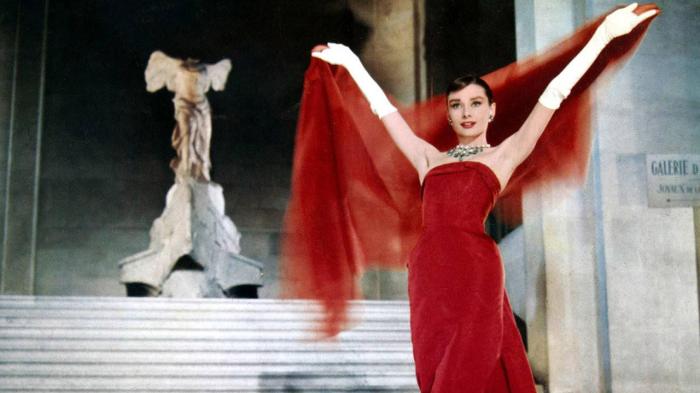
Opening with a camera tracking through a stark white room and into a world of pink, Funny Face begins with a mission: find the next ‘It’ woman; a woman who is so fashionable, she’s “not interested in clothes.” Editor of Quality Magazine, Maggie Prescott (Kay Thompson), has an idea for a photo feature: plop a glamourous model in a Greenwich Village bookstore and watch the intelligence jump off the page. But the shop clerk at the bookstore is not impressed. Opinionated and appalled, Jo Stockton (the lovely Audrey Hepburn) refuses to allow the photo shoot to happen, but in a flurry of taffeta, shouting and flashbulbs, photos are taken – with her as an involuntary model. Noticing her beauty, photographer Dick Avery (Fred Astaire) encourages Jo to be the “Quality Woman.’ Jo reluctantly accepts the magazine’s offer in order to fulfill her dream of traveling to Paris to meet her idol, the philosopher Emile Flostre (Michel Auclair).

Arriving in Paris, Jo is immediately caught up with the Beatnik culture, talking to fellow intellectuals about the philosophy of Empathicalism (putting oneself in another’s place, emotionally). But she’s reminded that she’s there to do a job – and she does so reluctantly. With Dick behind the camera, directing her through the gorgeous backdrop of Parisian architecture and culture, Jo’s pictures turn out stunning. As Jo and Dick spend more time together, arguing about principles, values and materialism, they naturally begin to fall in love. But on the big night, when Jo is required to appear and unveil a new fashion line, she hears of Professor’s Flostre’s presence at a local café. Running to meet him, she loses track of time until Dick arrives and drags her away. In an amusing scene, Jo and Dick get into a heated argument and she pushes him into the stage set, destroying all the props and sets just as the curtain is pulled back in front of international press.

Utilizing two of the 50’s biggest stars, the film succeeds in showing the skill and talent of Astaire and Hepburn. While Hepburn’s singing is not as perfect as her contemporaries, her voice is clear and sweet. Her modern dance number in the café has become one of the most famous scenes in the film. Hepburn dancing is remarkable, displaying control, grace and fluidity. Astaire’s voice is simply lovely and his dancing is laid-back and loose; a pleasure to watch. And while the romance between Jo and Dick is believable, the chemistry between them seems more like old dear friends, than two people who find themselves in love despite their vastly different lifestyles. But there is a kindness between them that makes the audience root for their union; both actors are incredibly charming.

Written and arranged by George and Ira Gershwin, the songs in the film are sweet but not entirely catchy. The performers do well in each song, with “Funny Face,” “Bonjour, Paris!” and “He Loves and She Loves” as highlights. The musical numbers mostly work because of the locations in which the characters traipse through. Gorgeous parks, streams, Paris landmarks and stylized sets serve as back-drop to their musical moments. The look of the film is quite beautiful as the filmmakers choose to play with colours; using negatives, sepia tones and freeze frames to heighten certain images. Costumes are by the famously talented Edith Head with Ms. Hepburn’s high-fashion outfits by Givenchy (a designer to whom she was extremely loyal). The dresses drape beautifully around Hepburn and each outfit compliments her beauty, making her character’s modeling career entirely believable.

The film jabs fun at philosophy, elite movements and phony intellectuals in a silly manner. Professor Flostre is a young charismatic man who recruits followers in a covert fashion, only allowing them access to him by making it on a list or idolizing him. When Dick and Maggie go ‘undercover’ as a spiritual band from Tallahassee, they encounter a depressed French singer, a weeping groupie and security around Professor Flostre. It takes a while for Jo to realize the foolishness of her idol and his followers. However, she does not falter in her belief in empathy, finally seeing a situation from Dick’s point of view. The film treats the world of fashion the same way, showing models who are unintelligent, fads as silly and people who take themselves way too seriously. The ending is slightly melodramatic and romanticized, but it fits with the conventions of a 1950s American musical. Fun and entertaining, the film wraps up with a happy ending in a gorgeously stylized last scene: the two lovers float by on a wooden raft trailed by swans.

Funny Face is a charming film made all the more charming by Audrey Hepburn and Fred Astaire. In their only screen pairing, they bring a light, sweet performance. Both ooze class and poise and are simply lovely to watch. Kay Thompson as Maggie Prescott has some of the best lines “She put herself in your place…you put yourself in her place and the two of you are bound to run into each other in somebody’s place!” Funny Face is one of Paramount’s great musicals capturing the absurdity of fashion and silly intellectual movements while showcasing one of most beautiful cities in the world.


FUNNY FACE

Submit your Screenplay to the Festival TODAY


1957 Movie Review: FEAR STRIKES OUT, 1957

Submit your Screenplay to the Festival TODAY

  MOVIE POSTERFEAR STRIKES OUT, 1957 
Movie Reviews

Director: Robert Mulligan

Stars: Anthony Perkins, Karl Malden, Norma Moore

SYNOPSIS:

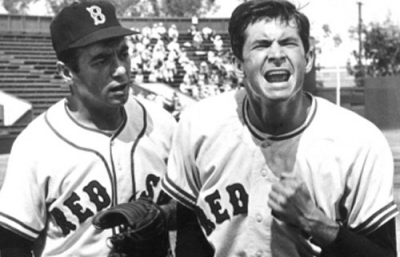
True story of the life of Jimmy Piersall, who battled mental illness to achieve stardom in major league baseball.

Here’s what the critics have to say: 

Fear holds up well, and the climactic showdown between father and son offers a tremendously appealing resolution.

March 4, 2011 | Rating: A- | Full Review…
 —————

Fear Strikes Out rolls Frank Merriwell and Sigmund Freud into a ball and then lines it out for a solid hit.

March 4, 2011 | Full Review…
 Top Critic
 —————

Anthony Perkins, in the young Piersall role, delivers a remarkably sustained performance of a sensitive young man, pushed too fast to the limits of his ability to cope with life’s pressures.

March 26, 2009 | Full Review…
 Top Critic
 ———————–

Mr. Perkins plays the young fellow excellently, not only conveying the gathering torment but also actually looking like a ballplayer on the field.

March 25, 2006 | Full Review…
 —————–

It’s a little poky and tentative, but a promising start by the Pakula-Mulligan team.

January 26, 2006 | Full Review…
 Top Critic
 —————-

Absorbing, but rather clinical, in the rubber-gloves style of 50s television drama.

January 1, 2000 | Full Review…
 Top Critic

fear strikes out

Submit your Screenplay to the Festival TODAY