Film Review: THE NUT JOB 2: NUTTY NY NATURE (USA 2017) ***

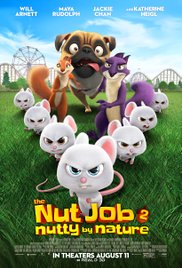
the_nut_job_2.jpgFollowing the events of the first film, Surly and his friends must stop Oakton City’s mayor from destroying their home to make way for a dysfunctional amusement park.

Director: Cal Brunker
Writers: Bob Barlen, Cal Brunker
Stars: Will Arnett, Katherine Heigl, Maya Rudolph

Review by Gilbert Seah 

The sequel to THE NUT JOB delivers much more of the same with the coloured squirrels and other rodent park animals, led by Sury and his rat sidekick Buddy, voiced by mostly the same actors.

Surly (Will Arnett) and the park animals must band together to prevent Oakton City’s crooked mayor (Bobby Moynihan) from bulldozing Liberty Park and replacing it with a dangerous amusement park. Surly even gets help from the territorial street mouse gang leader Mr. Feng (Jackie Chan) into thwarting the mayor’s plot.
The sequel introduces three new and welcome characters that provide most of the film’s freshness and humour. These are Bobby Moynihan as the Mayor of Oakton City, Isabela Moner as Heather, the mayor’s spoiled daughter and Jackie Chan as Mr. Feng. Credit should also definitely go to the animators of these three creatures.

When Mr. Feng, the white mouse first appears in the film, speaking with a strong Chinese impression, the immediate thought that will come to mind is racism. Society has progressed a far way since Mickey Rooney could get away doing really awful and unacceptable Japanese impressions with fake teeth in Blake Edwards’ BREAKFAST AT TIFFANY’S. But the credits list Jackie Chan as the voice behind Mr. Feng, and Chan does speak that way with a strong Hong Kong accent. The animators are also smart enough to make sure all he mice characters including Mr. Feng have really round and no slanted eyes.

THE NUT JOB films are the lower breed of animated films after films like SHREK, MADAGASCAR, HAPPY FEET, KUNG FU PANDA, HOW TO SAVE YOUR DRAGON, MEATBALLS. The NUT JOB films are have nothing really new to offer. Despite a few relatively new ideas (such as the mice and Mr. Fend who refuse to be cute – a sort of direct attack at cutest animated characters), parents will find the whole enterprise a chore to watch while children will undoubtedly be entertained.
Though the film is listed as an American production, there is a lot of Asian input (especially in the animation) as mentioned in the closing credits. Not only that but two asian companies are credited as with producing credits at the start of the film.

THE NUTJOB films are modest productions. The first cost only $42 million to make and went on to gross $120 million thus green lighting a sequel. The original director, a Canadian Peter Lepeniotis who based the first film on characters he created in his short was supposed to co-write the sequel but his name is missing from the list. Number 2 is co-written by Cal Brunker
Bob Barlen andScott Bindley.

The closing credits in the first THE NUT JOB film featuring an animated version of South Korean rapper Psi performing “Gangam Style” dancing with the park rodents were so irresistible that almost the entire audience stayed to the end. This was indeed a difficult act to follow and the rap sequence the closing credits of NUT JOB 2 unfortunately emptied the theatre in no time, thus allowing almost everyone to miss a last sequence of animation that appears once the closing credits rolled over.

Trailer: https://www.youtube.com/watch?v=4Lpw2gJt9Us

Also, Free logline submissions. The Writing Festival network averages over 95,000 unique visitors a day.
Great way to get your story out: http://www.wildsound.ca/logline.html

Deadlines to Submit your Screenplay, Novel, Story, or Poem to the festival:http://www.wildsound.ca

Watch recent Writing Festival Videos. At least 15 winning videos a month:http://www.wildsoundfestival.com

Interview with Festival Director Chris Grigsby (Cinevision Film Festival)

festreviews's avatarFestival Reviews

Cinevision Film Festival is an international competition for short filmmakers located in Santa Fe, NM at the heart of the city.  We aim to help amateur filmmakers make the professional leap.  This year’s competition is a little bit different than in the past.  We’re focusing more on shorter films to allow more directors the opportunity to be seen.  This year’s festival is directed by Chris Grigsby who is partnering with film4change and this is our film to help create the best program we’ve had yet.

http://cinevisionsfuad.com/

Interview with Chris Grigsby:

Matthew Toffolo: What is your Film Festival succeeding at doing for filmmakers?

Chris Grigsby: Cinevision Film Festival is located in Santa Fe, New Mexico. For those who don’t know, Santa Fe, Nm is indeed a real place and it happens to be a film and artist hub. Independence Day 2, Seth Rogan’s new project, “Preacher” and the ever popular Netflix show…

View original post 592 more words

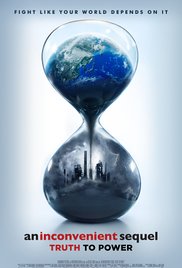
Film Review: AN INCONVENIENT SEQUEL: TRUTH TO POWER (USA 2017) ***

AN INCONVENIENT SEQUEL TRUTH TO POWER.jpgA decade after An Inconvenient Truth (2006) brought climate change into the heart of popular culture comes the follow-up that shows just how close we are to a real energy revolution.

Directors: Bonni Cohen, Jon Shenk
Stars: Al Gore, George W. Bush, John Kerry

Review by Gilbert Seah
 

AN INCONVENIENT SEQUEL: TRUTH TO POWER is the sequel to the 2006 Academy Award Winner for Best Documentary AN INCONVENIENT TRUTH starring Al Gore where the former Vice-President of the United States championed the fight on global warming. In that film, the effects of global warming were convincingly portrayed on screen, rallying uncountable numbers of followers to fight against global warming. After more than 10 years, many of that film’s predictions (the best example used being the flooding of the World Trade Centre grounds), laughed upon by skeptics have come to pass. This sequel is timely and premiered at Sundance early this year.

The film follows the efforts made to tackle climate change and Al Gore’s attempts to persuade governmental leaders to invest in renewable energy, culminating in the signing of the Paris Climate Agreement in 2016.

The film begins lightly with references to the 2006 film and with Al Gore in lighter mode shown joking and laughing. His joke about a lady (not recognizing him) telling him that if dyed his hair black, he would look like Al Gore is funny enough, enabling the film to transition slowly to a more serious nature. Gore is also shown, in the film’s best moments giving his climate speeches, while getting fully worked up in the process.

Gore is undoubtedly presented in the film as the conquering hero, besides a champion for the climate change movement. Well, better a hero for a crucial course that no hero at all.

While the film traces Gore’s attendance at the Paris talks in 2016, it narrows the events to his victory at convincing India to cooperate. At the same time, the film shows how each country contributes to the reduction of global warming and where the problems lie. The film’s high is the revelation of how much Chile has done in the construction of solar powered plants. Another high is how Geogetown, Texas through its comical mayor has also championed itself towards 100% renewal energy. He emphasizes the saying that we should leave the world a better place in terms of renewal energy.

The ultimate question asked is whether AN INCONVENIENT SEQUEL is better than the original INCONVENIENT TRUTH. The truth is that it is difficult for anyone who has seen the 2006 film to remember, especially after 11 years have passed. A fellow critic colleague mentioned that SEQUEL is the better film, being more focused, also claiming that he has just re-watched the original for comparison. For myself, I remember being more moved by the first film, and understandably so, for the more disturbing images of the effects of global warming shown. In SEQUEL, though many images are still shown, most of these are the catastrophes like the flooding and drought scenes, but the melting ice and the depletion of ice created the greater impact.

Still in SEQUEL, directors Cohen and Shenk have re-edited the film following President Donald Trump’s withdrawal from the Paris Agreement, to expand Trump’s role as antagonist before the film hits theatres. All the better to incite the workers for climate change to have a common enemy, and an easy target at that.
The film ends, predictably though necessarily, with how everyone can contribute to the cause, with the website they can log on to.

Trailer: https://www.youtube.com/watch?v=huX1bmfdkyA
 

Also, Free logline submissions. The Writing Festival network averages over 95,000 unique visitors a day.
Great way to get your story out: http://www.wildsound.ca/logline.html

Deadlines to Submit your Screenplay, Novel, Story, or Poem to the festival:http://www.wildsound.ca

Watch recent Writing Festival Videos. At least 15 winning videos a month:http://www.wildsoundfestival.com

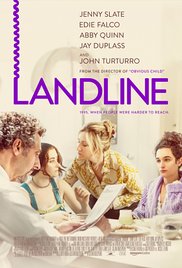
Film Review: LANDLINE (USA 2017) ***

landline.jpgIn 1995, a teenager living with her sister and parents in Manhattan discovers that her father is having an affair.

Director: Gillian Robespierre
Writers: Elisabeth Holm (story by), Gillian Robespierre (story by)
Stars: Jenny Slate, Jay Duplass, Abby Quinn

Review by Gilbert Seah

 
Director Gillian Robespierre and actress Jenny Slate team up once again after their mildly successful film, OBVIOUS CHILD. Their new film LANDLINE opens to a couple having sex in the woods. There is no full nudity, just trousers and skirts down or up as the case may be. It is a comical scene as the orgasm is interrupted by what she calls a woodchuck’s peter pater. Most people can relate to this scene, as most people would have had sex in the outdoors at least once in their lifetime and the scene would be a familiar if not an amusing one.

LANDLINE is a female point of view relationship romantic comedy/drama involving three females of the Jacobs family – the mother Pat (Edie Falco), and the two daughters, Dana (Jenny Slate) and the younger, Ali (Abby Quinn). The main plot involves the sisters finding out, by accident that their father, Alan (John Turturro) is having an affair. They decide to find out who his mistress is but they debate on whether they should inform their mother.

A simple premise of a father’s secret infidelity in a slightly dysfunctional household is not enough material to keep an audience interested throughout an entire movie. So, the scriptwriters (the majority of whom are female, as is obvious from the film) have inserted other subplots or distractions. Two are the relationships of the two daughters. Another is the use of drugs, heroin by the youngest daughter. And another involves the film’s setting in the 1990’s. The setting means no use of cell phones as they were not invented yet, hence the film title of LANDLINE. Robespierre also has the excuse to put in plenty of 90’s period music which include lots of really popular songs like “Higher Love” by Steve Winwood and My favourite song “Two of Hearts” by Stacey Q.

The film tries too hard at times making it look too smart for its own good.

Many of these involve Dana and her boyfriend, Ben (Jay Duplass). The bath tub scene looks too manipulative and false, only there to create an artificial ‘cool’ segment. Their corny dialogue in the scene does not help either. Working better is the relationship between the younger sister Ali and her drug using boyfriend. Their banter and relationship appear more natural and comes across as not only more spontaneous but credible.

Of all the performances, Edie Falco (the mother) is the most winning. John Turturro does well as the hapless asshole who cheats and then expects to be forgiven for his errors by his smart talk. This confrontation between Alan and Pat forms the film’ s best part with the audience clearly on the side of the female’s.

Despite the film’s flaws, it succeeds on the performances of its cast. The humour is slight but the drama is real. The sibling interactions work. The feeling is that the dysfunctional family onscreen could be yours.

Trailer: https://www.youtube.com/watch?v=llmki0lioMs


Also, Free logline submissions. The Writing Festival network averages over 95,000 unique visitors a day.
Great way to get your story out: http://www.wildsound.ca/logline.html

Deadlines to Submit your Screenplay, Novel, Story, or Poem to the festival:http://www.wildsound.ca

Watch recent Writing Festival Videos. At least 15 winning videos a month:http://www.wildsoundfestival.com

1977 Movie Review: EXORCIST II THE HERETIC, 1977

  MOVIE POSTEREXORCIST II THE HERETIC, 1977 
Movie Reviews

Director: John Boorman

Stars: Richard Burton, Linda Blair, Louise Fletcher

Review by Mark Engberg

SYNOPSIS:

A girl once possessed by a demon finds that it still lurks within her. Meanwhile, a priest investigates the death of the girl’s exorcist.

MOVIE REVIEW:

During our podcast discussion regarding the best horror films of all time, WILDsound founder Matthew Toffolo asked me a brilliant question: what defines a horror movie?

Cheating an answer out of Wikipedia, I said that a horror movie tries to evoke a negative reaction from the audience by playing on their primal fears and anxieties. So, here is a follow-up question: what makes a bad horror movie?

Is it bad acting? Like any other genre, bad acting in a horror feature can certainly damage its integrity. But it seems unfair to blame a movie’s appeal based solely on the acting abilities, or lack thereof, of its principle stars. Besides, if you were going to condemn a horror movie for its unbelievable acting, the list of bad ones would be endless.

Is it bad because of its unbelievability? That hardly seems the case. A Nightmare on Elm Street and Child’s Play are among some of the most beloved and successful horror films released in the past twenty-five years. And you would be hard pressed to explain that the premise for either franchise is in any way plausible.

Or does it only appear bad based on its low budget? I can’t go with that one either. Henry: The Portrait of a Serial Killer and The Blair Witch Project are two of my favorite horror films of all time. The production team behind Henry spent about $110 grand on its budget, while The Blair Witch spent about half of that amount.

It can be inferred that a bad horror film fails to elicit a reaction from the audience by playing on their own emotions. In other words, it is boring.

And if Exorcist II: The Heretic were merely a boring picture, I could still look past its narrative shortcomings and acknowledge that sequels rarely live up to their predecessors. But Boorman’s take on the story is an incomprehensible mish-mash of locust swarms and doppelgangers. The story loses so much focus in its final act, I thought I was possessed by a demon spirit myself because all I wanted to do was vomit green bile all over the place.

Richard Burton and Linda Blair seem to be playing a game as to who can do the worst acting throughout the picture. Burton constantly undercuts his Father Lamont with sad, motionless expressions that convey nothing. Blair might as well be doing a spot for an Informercial reenactment.

She herself blames the flawed story structure on the fact that it went through too many rewrites due to creative differences between Boorman and screenwriter William Goodhart. Eventually, Goodhart was replaced by Rospo Pallenberg, who rewrote the script with Boorman. Even though I never read Goodhart’s original script, I feel bad for the playwright, who must have endured a lifetime of harsh criticism for something he did not write.

The production crew had its own set of problems. Burton, allegedly, started drinking again. Boorman contracted a respiratory fungal infection, which offset production for a costly month. Blair refused to wear the demon make-up this time, which meant that her demon scenes had to be performed by a double. The animal wranglers had trouble with the grasshoppers they needed for the ridiculous locust scenes. The City of Washington DC denied the crew permission to film at the famous staircase in Georgetown.

The entire filmed seemed doomed from its inception. Even one of the producers, Richard Lederer, admits in Bob McCabe’s book The Exorcist: Out of the Shadows that the sequel was conceived as a low-budget rehash of the original, using deleted scenes from the original to give audiences something new.

When the film opened, it was laughed off the screen by crowds who were probably initially intimidated when the lights first dimmed. In fact, Boorman yanked the film out of theaters and attempted numerous re-cuts and alternate endings to no avail. When there is so much wrong with your picture, there is only so much you can do.

The plot is a dull concept regarding Burton’s Father Lamont and his assignment to investigate the death of Father Merrin (once again played by the great Max von Sydow). When Lamont visits the tormented yet oblivious Regan MacNeil at a NYC psychiatric institute, the plot quickly sinks into absurdity. They experience synchronized hypnosis together using a pair of wires and headbands when Lamont discovers an unquiet spirit still residing within Regan.

The rest of the movie mostly consists of terrible looking sets of African tribes that were filmed at the Warner Bros’ backlot. Lamont has delusions and unintentionally hilarious visions of James Earl Jones in a locust costume. But the most troubling aspect comes at the end, when Father Lamont confronts the evil Pazuzu spirit dwelling within Regan’s body . . . even though she is standing behind him. I don’t understand why there were two Regans in the final act. More importantly, I didn’t care. I just wanted it to end.

For those looking for some of the old metaphysical and supernatural nerve of the original, be advised to skip this entry and check out The Exorcist III: Legion instead. That movie was written and directed by William Peter Blatty, the author of the original novel. It goes without saying that he is thankful for having nothing to do with this absurd chapter. Wisely, he chose to ignore its subject matter in his own feature.

ACTORJohn Boorman
Best of the ARTIST
ACTORLinda Blair
Best of the ARTIST
ACTORRichard Burton
Best of the ARTIST
ACTORLouise Fletcher
Best of the ARTIST
ACTORMax von Sydow
Best of the ARTIST
ACTORKitty Winn
Best of the ARTIST
ACTORPaul Henreid
Best of the ARTIST
ACTORJames Earl Jones
Best of the ARTIST
ACTORNed Beatty
Best of the ARTIST

exorcist 2.jpg

1977 Movie Review: TENTACLES, 1977

TENTACLES, 1977 
Movie Reviews

Director: Ovidio G. Assonitis

Stars: John Huston, Shelley Winters and Bo Hopkins 

SYNOPSIS:

Several people disappear from and at the sea. Their bodies are found gnawed to the skeleton, even the marrow is missing…

CRITICS REVIEWS:

It’s pretty rancid, although it’s the perfect party picture to screen in the background as your guests get suitably soused.

June 16, 2015 | Rating: 1.5/4 | Full Review…

A Jaw’s rip-off.

May 8, 2010 | Rating: C | Full Review…

Indesculpável.

December 18, 2007 | Rating: 1/5

John Huston and Shelley Winters in a clunky monster movie? Even the Octopus is up in arms.

August 1, 2005 | Rating: 0/5

TENTACLES

1977 Movie Review: STROSZEK, 1977


STROSZEK,   MOVIE POSTERSTROSZEK, 1977
Movie Reviews

Directed by Werner Herzog
Starring: Bruno S., Eva Mattes, Clemens Scheitz, Wilhelm von Homburg, Burkhard Driest, Clayton Szalpinski
Review by Jordan Young

SYNOPSIS:

In Berlin, an alcoholic man, recently released from prison, joins his elderly friend and a prostitute in a determined dream to leave Germany and seek a better life in Wisconsin.

REVIEW:

Herzog continues to blow minds of the viewer’s of 1977’s Stroszek. This film depicts three pariah’s in their native Berlin, and their overseas quest to find happiness in Plainfield, Wisconsin. The pariah’s include a prostitute (Eva), a ex-con alcoholic (the titular character Bruno Stroszek) and an old, reclusive, brittle Scheitz.

Roger Ebert wrote that this film is “one of the oddest films evermade.” This is because of it’s seemingly non sequitur segments,jarring examples of music, and it’s drastic setting changes. Not to mention that this is almost cinema en plein air, meaning this entire film is comprised of found people and places that add dramatically to the overall feel of the movie.

Bruno himself was a street musician, found by Herzog, Bruno was also a diagnosed schizophrenic… which apparently added to his troubled character due to his magnificent performance. I found myself however, sympathizing with the character of Eva much more in the beginning. She goes through some pretty miserable times, but then seems to adjust rather well to American life.

Bruno and his pack of friends quickly realize that the American dream, is just that… a dream. This reality arrives to them at the exact same time that the banker starts pestering them about their mortgage payments. This banker again was found by Herzog, but his character is just miserly enough, to make any viewer want to punch him in the face.

As Scott McCloud theorizes in Understanding Comics, no non sequitur is actually in fact a non sequitur. The fun part is about these scenes in Stroszek is, any meaning that you can create from these scenes, is the correct answer… it’s what you take from it. Therein lies, the genius of Herzog, the readers (or viewers) create their meaning. DON’T BELIEVE ANY CRITIC ABOUT THE CHICKEN SCENE! Let the chicken mean what you want it to mean. (You will know what I’m talking about.)

See this movie for Bruno’s magnificent performance, as he takes you off the beaten path of the typical character you have to love, and sets you up for his endearing depiction of a man trying to earnestly find happiness.

Very touching view of the struggles that we all go through. My belief is that Herzog tried to depict how utterly confounding life can be at any given point and time. Except where a mainstream director shows a tough life through a montage and a stereotypical song, Herzog shows a side of America we wish we could distance ourselves from. Keep in mind viewer, this is German Art House film. It will be a challenging, but extremely rewarding experience.

stroszek.jpg
 

1977 Movie Review: STAR WARS, 1977

STAR WARS, 1977
Movie Review
Directed by George Lucas
Starring: Mark Hamill, Carrie Fisher, Harrison Ford
Review by Andrew Kosarko

SYNOPSIS:

As the adventure begins, Luke Skywalker (Mark Hamill), an impulsive but goodhearted young man who lives on the dusty planet of Tatooine with his aunt and uncle, longs for the exciting life of a Rebel soldier. The Rebels, led by the headstrong Princess Leia (Carrie Fisher), are fighting against the evil Empire, which has set about destroying planets inhabited by innocent citizens with the Death Star, a fearsome planetlike craft commanded by Grand Moff Tarkin (Peter Cushing) and the eternally frightful Darth Vader (David Prowse, with the voice of James Earl Jones). When Luke’s aunt and uncle are murdered by the Empire’s imperial stormtroopers and he mysteriously finds a distress message from Princess Leia in one of his androids, R2-D2 (Kenny Baker), he must set out to find Obi-Wan Kenobi (Alec Guinness), a mysterious old hermit with incredible powers. On his journey, Luke is aided by the roguish, sarcastic mercenary Han Solo (Harrison Ford) and his towering furry sidekick Chewbacca (Peter Mayhew) as they run into a host of perilous situations while trying to rescue the princess–and the entire galaxy.

REVIEW:

A long time ago, in a Hollywood far, far away…..George Lucas was an innovative film maker. Well, I’m a little shocked. I can’t believe this film series has been reviewed yet. So I’m doing it before anyone else beats me to the punch. I also think it’s kind of interesting seeing as I’m one of the few people to “review the first Star Wars Film” after the prequels have come out. So lets get into it, shall we?

The Story: The perfect depiction of “the heroes’ journey.” Anyone who has an interest in storytelling should study this film along with the ideals of the Heroes’ Journey. The structure is perfect. There’s never a boring moment, the story is always pushing forward and revealing more and more about our characters. Those characters are also, near perfect with defining attributes that you would never question their purpose of involvement. Luke Skywalker is at the start of his journey under the guidance of Obi-wan Kenobi. Accompanied by our outside eyes and ears, the druids of C3PO and R2D2, they join forced with the rugged pirate Han Solo and his furry side kick, Chewbacca. Not only does Lucas have excellent stories to tell, but he tells it in a masterful of ways. Chewbacca never speaks a word of English, nor has subtitles and yet we understand everything he’s saying by others’ retorts. Same with R2D2. Obi-wan is wise and mysterious, teaching without teaching. Han Solo, well, one of my favorite words in my reviews is “badass.” And there is no other word that can describe him. And last but not least, we have our strong heroin who is just as tough, if not stronger, than her farm boy brother. The real strength in this film is the story. Luke progresses from farm boy, to new adventurer to growing hero, to a savior of the rebellion. And of course, no one can forget the greatest villain of all time, Darth Vader. It just doesn’t get more evil and sinister than him.

Acting: In the documentary, “Empire of Dreams” which I would suggest to anyone after they’ve seen the Original Trilogy, Carrie Fisher speaks of George Lucas’ dialogue; “You can write this stuff but you can’t speak it.” Which is why the acting is so extraordinary in this film. It’s the same dialogue in the new prequels, but notice how it’s not hard to listen to when Luke or Leia speak it, opposed to Hayden Christianson.

Mark Hamill / Luke Skywalker – Now, Star Wars, in a sense, is “before my time.” I know absolutely nothing of Mark Hamill’s early work. All I know is he did a Christmas episode with the muppets and later went on to portray the voice of the Joker on Batman the animated series. Nevertheless, Hamill is the perfect casting for the young farm boy with a heart of gold and the naïve courage to march into a detention center.

Carrie Fisher / Princess Leia Organa – Now I wasn’t around during the feminist era, but I’m sure this was a product or lightning rod of it. Fisher plays the role strong and intelligent. She’s a damsel in distress, but she fights back instead of waiting for the hero to come save her. She is the personification of the Rebellion.

Harrison Ford / Han Solo – I know this role has lead to so many other things for Ford, but I don’t think he’s had a better role. Blade Runner comes close, but still. Han Solo is his defining role. He’s smart, charming, clever, bold, head strong and selfish. I can’t think of a more enjoyable role to play without being a bad guy.

Alec Guinness / Obi Wan Kenobi – The man delivers every line like it’s Shakespeare, and it was just what was needed seeing as these films are the closest we’ve gotten since Billy-Bob Shakespeare put his pen down. Guinness is strikes us as honorable, wise and trustworthy from the second he shows up. Although, to this day I still wonder how he made that weird ass whistling noise to scare off the sand people.

Directing: “Faster and more intense” was Lucas’ main direction to his cast. Which I wish he could have resurrected that phrase when directing the slow prequels. He’s at his best here with the limitations that he had to deal with. This was hard, dirty, gritty rough hands work. Which is one of the strengths of the film. It’s realism in it’s production design and even in the visual and special effects. Lucas did the best he could with what he had.

Cinematography: Old school 70’s cinematography. While there isn’t any really ground breaking shots or techniques in the realistic shots, it’s still well covered.

Production Design: Very strong. It’s futuristic, er, well, in this case, historic. Well, it’s far more advanced than what we ever, at the time of it’s release, thought possible. Or even dreamed. Yet it has a slightly gritty look to it. Not a Bladerunner look per say, but still, not sterile either. It really helps establish the world(s) that we’re playing in as believable.

Editing: For the most part it’s sufficient for what it does. I still don’t know how the shot of the storm trooper bumping his head on the door when they bust in and find C3PO and R2D2 was left in, but ok, whatever. Where I do have to give it some credit is covering the lightsaber duel between Vader and Kenobi. Guinness being his age and only instructed in proper swordsman ship was limited in what he could do (Check out some of the special features and the footage from it all). The edit makes it look like he still has some fight in him.

STAR WARS IMAGESScore: One of the truly remarkable aspects of the entire film. It lifts the material from the scale of amazing to epic. John Williams hit two big scores (no pun intended) in this era with both Star Wars and Jaws. He establishes himself as one who doesn’t resort to gimmicks and remains with the classical approach to music writing, while keeping in tune with the emotional context of the story.

Special Effects: Now this is what’s groundbreaking. There’s a great collaboration between the production team and the visual effects team. The ships combined with the green screens and compilations of layers create some of the most realistic and invigorating elements in the film. The shots and editing can’t really be complimented, seeing as most of them are ripped off from old stock footage of dog fights.

In closing: The beginning of great film making starts here, and ends in the same place. George Lucas both created the most amazing aspects of the film world and then bastardized them by abusing them too much. Letting them spew out into other films and basically demolishing the “aww factor” in movies. The work done in this film was earned and hard done. Lately the cinema business has become lazy and cheaper with the same mind set. Sadly, it takes all the fun out of the movies. Regardless of it’s lasting effects in movies, this film still stands the test of time. It’s engaging, entertaining, interesting and fun. And it’s got a little bit, ok, a LOT of moral lesson whipped into it. But it’s neither preachy nor too subtle. Star Wars is the movie of our century. It still effects film making today, and will remain to for many years to come.
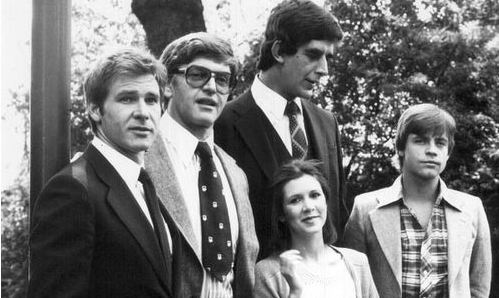
star wars

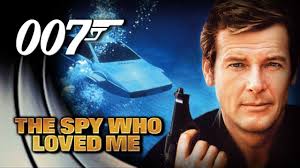
1977 Movie Review: THE SPY WHO LOVED ME, 1977

The Spy Who Loved Me, MOVIE POSTERTHE SPY WHO LOVED ME, 1977
James Bond Movie Review

Directed by Lewis Gilbert
Starring: Roger Moore, Barbara Bach, Curt Jurgens, Richard Kiel and Bernard Lee
Review by Jesse Ryder Hughes

SYNOPSIS:

Seven foot tall, steel toothed nemesis Jaws chases Bond around while Bond and Russian Agent triple X try to stop megalomaniac Stromberg, who is obsessed with life at sea, from starting a global war. All the while Triple X is bent on revenge of the murder of her lover who Bond had killed on a previous mission.

REVIEW:

The reason I think The Spy Who Loved Me was so successful was that they found a balance with Bond that they were aiming to get back since Goldfinger. Stromberg is a classic Bond megalomaniac and Jaws a menacing unstoppable nemesis to Bond. Moore feels more balanced even with playing Bond with a great sense of humor and seriousness.

Although it is over the top the film lends itself well to the world where Bond lives. Another great Bond car appears, the Lotus Esprit, that one ups the Aston Martin by turning into a submarine.

The relationship Bond has with his leading lady, Russian agent Triple X Anya Amasova, played by Barbara Bach is an interesting change. She is a rival to bond in all respects. License to kill, has her own gadgets and openly and willingly will betray bond to bring what information she needs to the KGB. It is the first time Bond is pitted with a female that is portrayed as an equal, or even better, to him. There are more to come, a new string of Bond girls where they are less objects to Bond which is a great thing and test to the times changing.

Part of the fun in this film is the on going battle between bond and Jaws, who becomes a classic Bond bad guy. How can Bond destroy an impossible enemy? He can’t in this film, so he battles Jaws out of his way constantly throughout the movie to get to his main objectives. When the audience sees Jaws there is a sense of dread for Bond every time, because we never know when he is coming next, but he is always in the back of our minds that he will be there soon to try and kill Bond.

The Spy Who Loved Me is considered by most the best Roger Moore film. It is grandiose, flashy and action packed. Carly Simon’s theme Nobody Does it Better is also a great song, but the questions about Bond using his license to kill without disregard to whom he is killing make the film deeper than some of the previous films. The fact that Bond takes away Amasova’s lover is very powerful and she is forced to forgive him, because of the nature of their work. The one flaw in this film is that she sleeps with Bond anyway, which doesn’t seem all that realistic, but Bond always gets the girl no matter what he has done.

THE SPY WHO LOVED ME.jpg

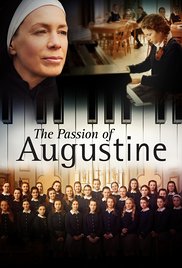
Film Review: LA PASSION D’AUGUSTINE (The Passion of Augustine) (Canada 2015) ***1/2

LA PASSION D’AUGUSTINE.jpgIn a small convent school in rural Quebec, Mother Augustine provides a musical education to young women no matter their socio-economic background. However, with the looming changes brought by Vatican II and Quebec’s Quiet Revolution, the school’s future is at peril.

Director: Léa Pool
Writers: Marie Vien (scenario), Léa Pool (scenario)
Stars: Céline Bonnier, Lysandre Ménard, Valérie Blais

Review by Gilbert Seah

 A small but talented music school is at risk of being closed for good due to financial difficulties. The school must win a music contest in order to survive. Into the school arrives a spirited but sometimes troublesome new girl. It does not take a genius to guess that this girl will save the school from financial ruin.

If this sounds like the typical predictable commercial film plot, one must note that this is a film written and directed by Léa Pool.

Léa Pool was born in Genève, Switzerland though a majority of her films are made in Quebec. Her films are mostly serious and many deal with human emotions. She has made over 20 films her most famous works being SET ME FREE (my favourite and her best) in 1999, LOST AND DELIRIOUS (2001) and ANNE TRISTER (1986).
The setting is in a convent school in beautiful rural Quebec in the 1960s . Mother Augustine (Celine Bonnier), a Roman Catholic nun who teaches music is fighting to preserve her school against the backdrop of the social changes wrought by Vatican II and Quebec’s Quiet Revolution. When her talented but rebellious niece joins the convent, and when the government threatens to shut down the school in favour of public education, her world is suddenly turned upside down. She and her fellow nuns are forced to confront the waves of modernity, and Mother Augustine herself must search her soul for a new calling. In the words of Mother Augustine: “The convent is to close down short of a miracle. We have not said our last word. We are going to fight for our convictions, our girls and music, for everything we think is right. But most of all, because I love the convent.”

Pool’s story of an important school that stands firm on the grounds Mother Augustine’s faith in music and Christianity is perhaps reflective on Pool’s making of important non-commercial films. Her films like the school face difficulty in modern times, when audiences flock to see Hollywood blockbusters. And together, they must resist and show that quality matters. Still LA PASSION D’AUGUSTINE is an important film, unconventional in its outlook and plot but still a rewarding a watch as any Hollywood blockbuster.

Despite the sombre nature of Pool’s piece, she inserts occasional bouts of refreshing humour such as the scene of two nuns laughing and skating one the ice outside the school.

A scene in the film that deserves mention is the modern performance of song with guitar at a Catholic church in attendance by the nuns and pupils. The camera pans the faces of the spectators as they express different emotions, some of approval, some of glee, some of horror at the modernization and others of disproval. It is a great scene, reminiscent and obviously re-used from the variety of children’s faces as they watch a Punch and Judy Show in Francois Truffaut’s magnificent LES QUATRES CENT COUPS (400 BLOWS).

Pool’s film is not just as beautiful as the Bach, Beethoven and Chopin pieces performed on the piano but just a moving and alas, inspiring!

THE PASSION OF AUGUSTINE garnered two Canadian Screen Awards at the 4th Canadian Screen Awards in 2016, for Best Actress (Céline Bonnier) and Best Original Score (François Dompierre). For the 18th Quebec Cinema Awards (formerly known as the Prix Jutra), the film won 6, including Best Picture, Best Director and Best Actress, Céline Bonnier.

THE PASSION OF AUGUSTINE is released VOD Nationwide on Tuesday, August 15 on all major platforms including: iTunes, Google Play, Amazon, Microsoft, Vudu, Comcast, Charter, Cox, Vimeo, and various other cable operators.. In French with English sub-titles.

Trailer: https://www.youtube.com/watch?v=egvqwdSPATs


Also, Free logline submissions. The Writing Festival network averages over 95,000 unique visitors a day.
Great way to get your story out: http://www.wildsound.ca/logline.html

Deadlines to Submit your Screenplay, Novel, Story, or Poem to the festival:http://www.wildsound.ca

Watch recent Writing Festival Videos. At least 15 winning videos a month:http://www.wildsoundfestival.com