Film Review: AFTER THE WEDDING (USA 2019) ***

After the Wedding Poster
Trailer

A manager of an orphanage in Kolkata travels to New York to meet a benefactor.

Director:

Bart Freundlich

Writers:

Susanne Bier (original screenplay), Bart Freundlich | 1 more credit »

AFTER THE WEDDING is the 2006 Best Foreign Film Oscar nominee that put Danish filmmaker Susanne Bier on the moviemaking map.  As the film was released way back when, it has been more than 10 years since Julianne Moore initiated the remake and many will hardly remember anything abut the original  movie, expect that it was really good.  And that’s a good thing.  The plot revelations in the film are what keeps the film both interesting and engrossing.

In the original film, the protagonist played by Mads Mikkelsen is a Dane working in India at an orphanage before traveling back to Copenhagen to secure funds from a wealthy entrepreneur who happens to have a hidden agenda.  In the new version the gender roles are switched.  Isabel (Michelle Williams) is an American transplant who has devoted her life to running a Calcutta orphanage.  Just as funds are drying up, she is contacted by a potential donor , Theresa (Julianne Moore) who insists that Isabel must travel to New York (replacing Copenhagen) to make a presentation in person.  Once in New York, Isabel lands in the sight line of Theresa, a multi-millionaire media mogul who seems to have a perfect life – from the glittering skyscraper where she runs her business, to the glorious Oyster Bay estate, where she lives with her artist husband (Billy Crudup), about-to-be married daughter (Abby Quinn) and younger twin sons.  While Isabel thinks she’ll soon be returning to the orphanage, Theresa has other plans for Isabel. 

The less said about the film’s story the better, as the revelations of the plot would spoil  the film’s entertainment.

Both what is a marvellous about this version are the performances by the two female leads.  Williams is the best, acting through her eyes and mannerisms, and obviously stealing the limelight from Moore.  Moore, understandably gives herself some major lines to dramatize when she, realizing that she is going to die screams that she wants to live.  This is reminiscent of the Jill Clayburgh scene in Daryl Duke’s GRIFFIN AND PHOENIX where she and Peter Falk played lovers who were both dying of terminal illness but finally happy in love.  Clayburgh’s character screams and cries: “Life is so unfair!!”

In the film there is a segment where the females Isabel and her daughter (Abby Quinn) bond together in a moment of distress.  Again, this is right out of Alfonso Curaron’s ROMA where the major line was uttered by the mistress to the maid, when pregnant thought she was going to be fired (by her mistress) but only to be told: “We women have to stick together.”

AFTER THE WEDDING is so immaculately shot n almost too perfect India (with a huge outdoor pool for washing that seems to clean of authenticity) and an orphanage looking too perfect with a perfectly organized wedding where all the speeches are delivered spot-on perfect are examples.  Imperfections occur in real life.

Trailer: https://www.youtube.com/watch?v=RJ4QxPjU2Lk

Film Review: MIKE WALLACE I HERE (USA 2019) ***1/2 Directed by Avi Belkin

Mike Wallace Is Here Poster
Trailer

A look at the career of ’60 Minutes’ newsman, Mike Wallace.

Director:

Avi Belkin

Documentaries have have often than not, had famous subjects who are talented, who have made a difference in doing good or mankind or those who have changed the course of history.  The new doc directed by Avi Belkin has a different kind fo subject – an obnoxious interviewer that may people did not like.  Mike Wallace is rude, plain nasty and not a very likeable person when he is in front of the camera interviewing people.  Wallace does his best to put his ‘victims’ on the spot by his questions,  to his credit and his team have done the research to dig up the dirt on the interviewee and thus enabling Wallace to do his nastiest best.
The doc follows the identical path of most documentaries.  They go far back to the subject’s childhood, what influenced them to become the persons they are, chart their rise to fame followed often by some tragic downfall and their redemption, if they do succeed in recovering from their fall from grace.
The doc goes back to Wallace when he was a child back in 1937.  His mother was strict and his father was an honest man.  How they affected Wallace is left untouched.  But the film then flashes the photographs of the celebrities that he interviewed in his lifetime.  These include Barbra Streisand, Kirk Douglas, Richard Nixon, Shirley MacLaine, and political leaders like Ayotollah Komeinini, Richard Nixon, Anwar Sadat, Vladimir Putin among others.  Later on in the film, there are footages of more details of these interviews. 
 Among the film’s best segments, Wallace asks mobster Mickey Cohen how many people  he’s killed and ’80s era Donald Trump if he sees politics in his future.  He challenges movie stars (Shirley MacLaine, Barbra Streisand – both telling Wallace what they think of him), politicians (Richard Nixon, Vladimir Putin) and unexpected sorts like the Imperial Wizard of the KKK.  
Sometimes colleagues interview Wallace, who talks about his bouts of depression (which he hid) and the death of his son.
 The film also covers two incidents that rocked the journalism world.  (1) A 1982 libel lawsuit filed against CBS and Wallace by retired U.S. Army Gen. William Westmoreland.  (2) A 1996 pushback when CBS’s corporate side tried to kill a story about tobacco industry whistleblower Dr. Jeffrey Wigand .
The film succeeds in giving audiences a slice of CBS history as well as demonstrate how important an interviewer can be in disseminating information to the public.
The magic question after watching the doc is whether Mike Wallace is a good person.  His interviewees say to him: ” “You don’t have to prove yourself.”  “You are good at what you do.”  When Shirley Maclaine confesses to believing in E.T.s, Wallace jokes that the E.T.s could have met her on her porch, Maclaine tells him: “You don’t have to be this unpleasant, this does not become you.”  The last statement clearly answers that magic question.  And Stresand tells him off; “You put all this toughness in this facade…”   Director Belkin tries to elicit some sympathy for the man with the segment of how he had lost his son.  But the tragedy should have made Wallace a better more considerate man and not the unpleasant interviewer that he had made himself a name of.
MIKE WALLACE is interesting and entertaining enough as a documentary questioning the integrity of the media while confirming the fact what kind of person the man really is.  Director Belkin has made a likeable (and insightful) documentary on a very unlikeable man.
Trailer: https://www.youtube.com/watch?v=dDSq2fF9flk

Film Review: LUCE (USA 2019) ****

Luce Poster
Trailer

A married couple is forced to reckon with their idealized image of their son, adopted from war-torn Eritrea, after an alarming discovery by a devoted high school teacher threatens his status as an all-star student.

Director:

Julius Onah

Writers:

J.C. Lee (play), J.C. Lee (screenplay) | 1 more credit »

Though based on a play, the film co-written by the director an J.C. Lee, seldom feels like one due to director Onah taking the audience out of one scene and moving the action around interiors, exteriors and intercutting the acts so that thee are frequent scene shifts.  It is a good tactic which works well.

An all-star high school athlete and accomplished debater, Luce (Kelvin Harrison Jr.) is a poster boy for the new American Dream.  As are his parents (Naomi Watts and Tim Roth), who adopted him from a war-torn country a decade earlier.  When Luce’s teacher, Miss Wilson (Octavia Spencer) makes a shocking discovery, finding dangerous fireworks explosives in his locker, Luce’s stellar reputation is called into question.

The most satisfying element of the film is the way the story and characters grab the audience form the start and never let go.  What ever is revealed is just sufficient to get the audience anticipation going and wanting for more  It is difficult to keep the momentum going and the film thus slag, but jut a little in parts.

The script (and play) also leaves ambiguous points unresolved so that the audience can make up their minds on what actually happened – for example whether Luce actually had fireworks in his locker or was it his friend’s who shared the locker with him.  The answer is irrelevant to propel the story but curiosity is till there with the audience.

Performances are excellent all around, especially that belonging to Octavia Spencer as the history teacher, Miss Wilson.  Spencer displays both he strength, courage yet vulnerability of her character.  As she is finally dismissed as a result of her stand, her loss might turn into another Oscar win fo Spencer who has already won an Oscar for a supporting role in THE HELP.  Waits and Roth are both excellent as the often divided couple but they carry the strength of their roles magnificently.  This is not the first time they play a coupe together.  They id in Michale Hanake’s FUNNY GAMES year back as a couple whose ho i invade by psychotic young neighbours.  Last but not least is the performance by newcomer Sim Sim whose first performance as disturbed young black man is reminiscent of Will Smith’s role in SIX DEGREES OF SEPARATION.   It is at this point that the film feels like a play fuelled by great  performances.  

Director Onah also demonstrates his sense of humour.  Right after a suspenseful remark is made in the film, the next scene is quick shifted to Miss Wilson having a shower withe the water spraying for the showered, Hitchcock’s PSYCHO-style.  Miss Wilson has a shower can and has a towel wrapped around her as i waiting for something ominous to happen.

The characters are human ad subject to the foibles of human nature.  The love for their son forces the adoptive parents to abandon their good judgement of good and evil in order to keep the family together.  This is not what the audience wishes to see but is what is expected to happen in real life.  Feelings and motions often rule above principles.  The non-compromising non-Hollywood happy ending might not satisfy audience when the film ends, but it is an ending worthy of whether the film’s story is heading.

Trailer: https://www.youtube.com/watch?v=aqzgDB1CMI4

Film Review – TEL AVIV ON FIRE (Israel/Luxembourg 2018) ***

Tel Aviv on Fire Poster
Trailer
Salam, an inexperienced young Palestinian man, becomes a writer on a popular soap opera after a chance meeting with an Israeli soldier. His creative career is on the rise – until the …See full summary »

Director:

Sameh Zoabi

Is Tel Aviv really on fire?  TEL AVIV ON FIRE is the name of the fictitious TV spy opera in which a Palestinian female infiltrates the Israeli military in order to kill the commander.  The film begins with an act from the show being filmed.  One can tell right away this is not the real thing but something filmed from the way the scene is carried out, with extra melodrama and cheesiness.  But after the camera pulls back, what happens in the background with arguments among the actress, scriptwriter, director and producer is just as melodramatic.

The film then settles on the writer Salem.  Salem is relatively good-looking, single and a bit of a troublemaker.  Troublemakers make the best reluctant heroes. 

Salem (Kais Nashef) is a Palestinian from East Jerusalem, who is a low-level production assistant on the soap opera “Tel Aviv on Fire” in Ramallah. Following a lie he tells Asi (Yaniv Biton), the commanding officer at the checkpoint he must pass through every day to get to work, Salem is suddenly promoted to be a screenwriter on the show. There is only one problem – Salem can’t write screenplays. To avoid getting fired, Salem makes a deal with Asi, who helps him write in exchange for fine Palestinian hummus, and a promise that the series’ plot will end with a wedding. However, the Palestinian investors want a different ending, and Salem finds himself in a bind.

Most Israeli and Palestinian films have their conflict as the subject and it is not surprising to see the reason.  The conflict has been going on for ages, is still unresolved and makes a permanent dent in the lives of both peoples.

The script loves playing with life imitating art and art imitating art.  What happens in he soap opera affects the characters in the film and vice versa.  “Why do you like the show?  It is anti-semitic,”  Asks the commander to his wife to which the reply is “Not everything is political.  It is romantic.”  The romance of the soap opera eventually changes his hard-ass attitude towards the war.

There is one excellent written scene in which Asi asks the Israeli writer how to tell a couple is in love.  “By hugs and kisses?” asked the Israeli.  “No but by the way they listen to one another.”  The film is about these two enemies coming together listening and writing the script for the TV soap opera together – a subtle message delivered by the film to the audience.

The film has won numerous awards including Venice Film Festival 2018’s Best Film (Interfilm Award).  It recently opened the Toronto Jewish Film Festival to a sold-out theatre.  A definite crowd-pleaser  – this ingenious rarely-seen comedic satire on the Arab-Israeli conflict, about a Palestinian soap opera writer who takes story ideas from an Israeli checkpoint commander.

The film at times tries too hard to be a crowd pleaser.  It is not difficult to see the reason audiences love the picture.  Audiences also love melodramatic soap operas and TEL AVIV ON FIRE while disguising itself as a satire, often plays like one.

Trailer: https://www.youtube.com/watch?v=M5x4bJZ5_IM

Film Review: HONEYLAND (Republic of Macedonia 2019) ****

Honeyland Poster
Trailer

The last female beehunter in Europe must save the bees and return the natural balance in Honeyland, when a family of nomadic beekeepers invade her land and threaten her livelihood. This … See full summary »

HONEYLAND is the so-called for the film’s setting where honey is produced by wild bees.  It has been touted and well believed that bees are necessary for the planet to survive lest exists.  If bees are eradicated from the face of the earth, so will all living creatures.  HONEYLAND bases its premise on the fact and works well to stress the importance of the living bees.

The film begins as a documentary as the camera moves to show the barren terrain of an unarmed country later revealed through the radio that it is Macedonia.  HONEYLAND also marks the rare occurrence of a film that is made in that country that earns a commercial release in North America.  The film is slated as a documentary but it rarely feels like one.  As the camera spans the mountains, it closes in on an old woman, soon revealed to be the last female beehunter in Europe who must save the bees and return the natural balance in Honeyland.  The film has the feel of fiction as it follows the life of the protagonist as she cares for her ailing mother among other chores.   She removes rock from the mountain while on a narrow edge to reveal bees and honey.  She also cultivates honey with the bees back close to her home while looking after her mother.  The film goes on to show how she etches a living going to the town to sell her high quality honey to the vendors.  She gets about 10 to 20 euros per jar.  But trouble then begins in paradise. A family of nomadic beekeepers invade her land and threaten her livelihood.  She initially bonds with the family till their acts threaten her bees.  Her rule is to take half and leave half of the holy for the bees.  This film is an exploration of an observational Indigenous visual narrative that deeply impacts our behaviour towards natural resources and the human condition.

Nazife Muratova plays herself as the beekeeper.  It is so noticeable that she has bad teeth.  For those unaware – I read this in the internet – that honey is really bad and much worse than sugar for ones teeth.  Yet, she is pretty in her own way and has sufficient charisma as the leading lady in the doc.

As a documentary, the film contains a few unforgettable candid scenes.  One is the birth of  calf as a boy pulls the calf out of the mother.  The other are the segments with the bees.  The beekeepers, Nazife in particular often do not wear any protective gear and yet yet do not get stung.

A multi-award winner at the Sundance festival where it won the Grand Jury Prize (Documentary) and several special mentions, HONEYLAND was also selected at the last Hot Docs Film Festival.  HONEYLAND opens this week at the TIFF Bell Lightbox together with MUSEO a new film from Mexico.  Both these films are the best films opening this weekend.  Take a trip to the Lightbox.

Trailer: https://www.youtube.com/watch?v=B27ORUHlp6E

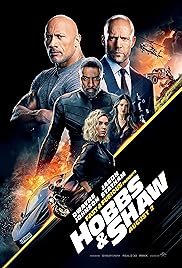
Film Review: FAST & FURIOUS PRESENTS: HOBBS & SHAW (USA 2019)

Fast & Furious Presents: Hobbs & Shaw Poster
Lawman Luke Hobbs and outcast Deckard Shaw form an unlikely alliance when a cyber-genetically enhanced villain threatens the future of humanity.

Director:

David Leitch

Writers:

Chris Morgan (story by), Chris Morgan (screenplay by) |2 more credits »

There is the recent debate in Hollywood whether they now make a product or a film.  From this film’s title, what comes out is clearly a product.  HOBBS & SHAW is a product from the FAST & THE FURIOUS franchise.  And this is not a good thing.

From the makers of THE FAST AND FURIOUS films, HOBBS & SHAW is as much a  film about fast cars than human beings.  Any chance the script gets for an excuse for a vehicle chase, there comes one.  If that is not enough, anytime there is anything to do with skyscrapers (the last FAST & FURIOUS film had an unbelievable stunt where a car drove from then top of one skyscraper to another), there is one.

When the film opens, a crew of MI6 agents attempt to retrieve a virus, Snowflake, which can be programmed to decimate millions of people, from terrorist organization Eteon. Brixton Lore (Idris Elba), an Eteon operative with advanced cybernetic implants that allow him to perform superhuman feats, arrives and kills all agents except for their leader, Hattie Shaw (Vanessa Kirby), who injects Snowflake into herself as a dormant carrier and escapes. Brixton frames Hattie as a traitor who killed her team and stole Snowflake, forcing her to go on the run.

Luke Hobbs (Dwayne Johnson) and Deckard Shaw (Jason Statham) are both informed of the missing virus and are assigned to work together reluctantly to track it down.  The trio locate Professor Andreiko (Eddie Marson) who brings a bit of life into the picture.  The arguing duo save the world in a midst of fast and furious car chases.

The film takes quite a while to get its footing, and when it does, it does not stay focused.  To give the director credit, Leitch (DEADPOOL 2) achieves quite the feat with his action set pieces.  The one with Hobbs and Shaw racing down the skyscraper in pursuit of the kidnappers captures both the humour and excitement of the moment.  The climatic chase and tugging of the helicopter and cars at the edge of the mountains are impressive and almost saves the movie.  The villain Idris Elba is too invincible to excite any suspense in the fight scenes.  The buddy or enmity between Hobbss and Shaw that is supposed to be key in the move is average at best, eliciting a few laughs at most – nothing that is not already done in other buddy cop movies.  

Statham and Johnson deliver average performances – what audiences expect from them.  The film contains quite a few surprise cameos, that will not be disclosed in the review.  These are tactically spread out throughout the film.

The script goes at lengths to bring in more human element to the story.  The introduction of Hobb’s 9-year old daughter does not do much to enhance the film but his extended family with his mother in Samoa, Hawaii stirs up the much needed boost in the story.

HOBBS & SHAW is so forgettable that it is doubtful many would remember who played Shaw and who played Hobbs in the movie.  Apart from the excellent action set-pieces HOBBS & SHAW is a total bore!

Trailer: https://www.youtube.com/watch?v=7W–71iLZ0g

Interview with Festival Director Lisa Diersen (EQUUS Film Festival)

The EQUUS Film Festival is the world’s premier showcase for domestic and international Equestrian Content feature films, documentaries, shorts, music videos, commercials, training and educational materials, art and literature.

Contact

equus 2

Matthew Toffolo: What is your Film Festival succeeding at doing for filmmakers?

Lisa Dierse: The EQUUS Film Festival is the only Equestrian themed film festival that includes equestrian art, literature and music. We also have an On Demand platform for our content that gives filmmakers access to audiences after the festival. We are a touring film festival, after our main fest in December where our WINNIE awards are distributed we spend the following year

2) What would you expect to experience if you attend your upcoming festival?

A wonderful introduction into the world of equestrian films and documentaries.

3) What are the qualifications for the selected films?

Must be horse content.

4) Do you think that some films really don’t get a fair shake from film festivals? And if so, why?

For sure, horse themed film and documentaries get looked over all of the time! That’s why the EQUUS Film Festival was created, to give these filmmakers the respect they deserve.

5) What motivates you and your team to do this festival?

Love of horses and being able to show the world their beauty through film.

6) How has your FilmFreeway submission process been?

Wonderful, it has made my job as festival director a whole lot less stressful!

7) Where do you see the festival by 2023?

We will be expanding our Global reach through more international Tour Stops

8) What film have you seen the most times in your life?

The Black Stallion

9) In one sentence, what makes a great film?

A film that has the ability to bring tears to your eyes one minute and make you laugh out loud the next.

10) How is the film scene in your city?

Great, it’s Chicago!