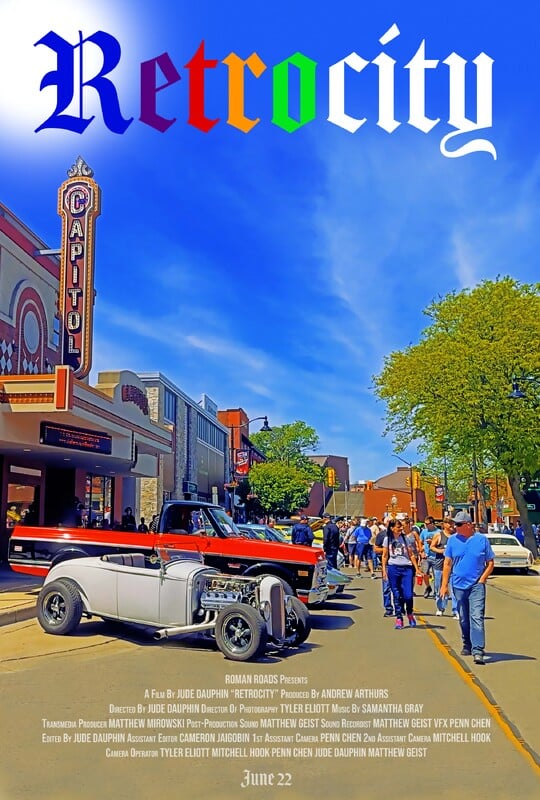
A city lost in the past has to overcome its nostalgia to meet the needs of a modern community.
Retrocity takes you on a journey through the past 80 years of capitalism, consumerism, and individualism, exploring how they have all combined in time to transform our communities from collective, social, human environments, into individualistic, antisocial, car-centric environments.
Centred around Chatham, Ontario, Canada, and the annual retro festival it holds, the documentary takes you into the event to explore the city through the eyes and ears of its residents, showcasing the ironic tragedy of a community so enveloped in nostalgia for its past it has become lost in time.
Review by Victoria Angelique:
The history of Chatham, Ontario is told in a masterful depiction of architecture in RETROCITY. There is no dialogue, yet this is a powerful documentary that showcases the changes in a city through buildings. A sad story that goes from a thriving town to one abandoned throughout time due to society becoming increasingly antisocial.
The score is whimsical. It sets a nostalgic tone as the filmmaker, Jude Dauphin, takes the audience back in time to the beginning of a beautiful town. The captivating cinematography shows the beauty of a thriving town that had gorgeous architecture. The buildings are in contrast to the modernization of Chatham, with popular fast food and grocery store chains lining the outskirts of the magnificent historical buildings.
The editing is seamless as the scene transitions from the black and white past, to the colorful modernization and finally ending on a society beginning to decay. Dauphin showcases the decline in socialization through the lens of what appears to be an abandoned mall that still has the bright decor from decades ago and even payphones hanging from the wall. The footage is almost like an old home movie, reminiscing of the time when people would hang out at this shopping center as they socialized.
The contrast to people only coming together for a retro festival is not lost, as it shows the community still longs for the past before the world became antisocial and individualistic. Chatham, Ontario is a beautiful town that is being lost in time as people move on, leaving history behind them. The hope at the end is that this city can be saved and the people will once again come together as a community.
1. The title of my novel about a girl willing to sacrifice her name and her identity
2. The middle name of Cleo Hart, a scholarship student at a prestigious New England university in the 1950’s
3. A feminized form of “Thessaloniki,” a city in Greece possibly named after Alexander the Great’s half-sister
Get to know the writer:
1. What is your novel about?
A college student masquerades as her male classmate to join an archaeological dig in 1954 Crete. While excavating Minoan ruins, she unwittingly enters a labyrinth of post-war sociopolitical conflict.
2. What genres would you say this story is in?
Upmarket Historical Fiction
3. How would you describe this story in two words?
esoterico, exoterico
4. What movie have you seen the most in your life?
From the age of two to five, I probably watched The Wizard of Oz 300 times.
5. What is your favorite song? (Or, what song have you listened to the most times in your life?)
Choosing favorites of any kind always makes me anxious, for whatever reason. But Mozart’s Piano Concerto No. 23 has been a recurring refrain in my life for at least two decades. Especially the Adagio.
6. Do you have an all-time favorite novel?
Not really? Like I said, I’m not psychologically able to think about the world in terms of absolute favorites. Instead, how about three novels I’ve read (or reread) in the last five years that did something to me: The Blind Assassin by Margaret Atwood, Lonesome Dove by Larry McMurtry, and This Rough Magic by Mary Stewart.
7. What motivated you to write this story?
I wanted to write the kind of book I love to read.
8. If you could have dinner with one person (dead or alive), who would that be?
Now that I’ve got Mozart on the brain, it’d have to be him, the guy who compared his creative process to a cow pissing in a field. He’d order the sturgeon, and I’d make the chef angry by asking for mushroom goulash. We’d drink the most expensive bottle of wine available and charge it all to the Prince Regent of Bavaria’s account. Salieri would send us a complimentary, but poisoned, Sachertorte for dessert.
9. Apart from writing, what else are you passionate about?
Knitting, reading, teaching, swing dancing. I also like zipping around the world.
10. What influenced you to enter your story to get performed?
I’ve had good experiences in the past working with podcasts to adapt my essays. I like collaborating on creative projects and seeing my writing through the eyes of other artists, especially when several different types of expertise are involved.
11. Any advice or tips you’d like to pass on to other writers?
Try to have as much fun as you can with your work. Give yourself space to take risks. Always be learning, but have fun with that too. Maybe make a collage once in a while. Somehow, it always helps me.
Valentine’s Day is etched in Lisa’s memory as a day of betrayal. Four years ago, she embarked on a journey through a relentless snowstorm to surprise her fiancé, Jim, only to stumble upon a scene that shattered her – Jim with another woman.
In the wake of that devastating revelation, Lisa’s friends — Debbie, Mandy, Jenny, and Katie — fashioned Galentine’s Day, a cherished retreat where solidarity among the women reigns supreme. But nothing lasts forever. This is the final Galentine’s Day because the women each have busy lives and romantic partners they’d rather spend Valentine’s Day with. So the women get together for one last hurrah at a secluded lake house in the Ozarks.
Ultimately, Galentine’s Day is about friendship, love, betrayal, and how people slowly grow apart and change, no matter how hard they try to stick together.
2. What genres does your screenplay fall under?
It’s a slasher horror movie.
3. Why should this screenplay be made into a movie?
Galentine’s Day would make an excellent movie because it’s a female-led, action-packed, slasher film full of exciting twists and turns. What starts as a relationship drama, morphs into a buddy comedy, before becoming a murder mystery whodunit, and ending as a full-blooded, thrilling slasher.
The screenplay is a small ensemble full of engaging and distinct characters, each with unique voices and clear character arcs. Galentine’s Day wears its influences on its sleeve. It’s Scream meets Girls’ Trip meets Knives Out.
From a production standpoint, Galentine’s Day could be made on a limited budget. There are only six characters, one main location, and a handful of other smaller locations to consider.
4. How would you describe this script in two words?
Love hurts.
5. What movie have you seen the most times in your life?
Probably the original Star Wars (or as it’s called today Star Wars: Episode IV – A New Hope).
6. How long have you been working on this screenplay?
I wrote a detailed outline and the first draft of Galentine’s Day in about six weeks. Then, I spent about two months revising, rewriting, and polishing it.
7. How many stories have you written?
I’ve written two graphic novels (Pretentious Record Store Guy and Blood on the Tracks, illustrated by Brian Atkins), a collection of comics (SHORTS + LOSSES), a handful of comic books, five screenplays, six pilots, and two spec scripts.
8. What is your favorite song? (Or, what song have you listened to the most times in your life?)
“Bastards of Young” by The Replacements.
9. What obstacles did you face to finish this screenplay?
I wrote Galentine’s Day in a fever pitch after watching a bad horror movie with my wife on Halloween night that started well but quickly dovetailed into unwatchable territory. I thought it was terrible. She said it wasn’t that bad.
I went through the ways I thought the story could have been improved, the various plot turns made not so obvious, and the scares more suspenseful. She said, “Well it sounds like you should write a horror movie.”
So I did. I had the nugget of an idea, so I wrote a 15-page treatment to serve as the outline for the story. After that, the script wrote itself. The biggest obstacle I faced was having it done by my self-imposed deadline of… Valentine’s Day.
10. Apart from writing, what else are you passionate about?
I am a cartoonist who loves making art and telling stories. I’m passionate about movies, art, and design. My office is jam-packed with too many books on painting, design, architecture, screenwriting, and filmmaking.
11. You entered your screenplay via Network ISA. What has been your experiences working with the submission platform site?
Submitting to the contest was very easy, and I enjoyed the experience.
12. What influenced you to enter the festival? What were your feelings on the initial feedback you received?
Horror fans are the most passionate, vocal, and supportive community of movie lovers around. As I was looking for horror-specific contests to submit my screenplay to, the Horror Underground Festival checked all the boxes and felt like the perfect fit.
The initial feedback I got from the contest was not only insightful but was actionable. The feedback came from a fan of the genre and they made a few good recommendations on how best to improve the script within the confines of the horror genre.
Teresa Amadei is a depressed young woman dealing with the sudden death of her mother, Juliana, with whom she has long been at odds since the murder of her father, Peter, when she was little. Her aunt and uncle, Bridget, and Jesse Abbate, send her to be helped by a Byzantine stylite in the Nevada desert, Father Simon. Father Simon trains her in the Way of Fire, a form of meditation that translates into a martial art, into a wandering, ascetic demon hunter and Lamp Bearer.
Teresa is sent on a journey to the city of Alexantine in the midwestern US, where many have started to move to as a refuge against the growing turmoil in the US and the West as a whole. Along the way Teresa fights the Daemoklos, demons who have escaped from their eponymous grimoire, led by their god-king Varazhah. To survive against the outer demons, Teresa must face her inner demons. Key to achieving this, Teresa must at last make peace with Juliana, who continues to speak to her daughter beyond the grave.
2. What genres does your screenplay fall under?
“The Stylite” is Action/Adventure, and can also be classed within “Drama,” “Spiritual,” “Coming of Age,” and “Sci-Fi/Fantasy.”
3. Why should this screenplay be made into a movie?
I believe “The Stylite” provides a unique, or at least not seen in a while, take on the hero’s journey, especially for young characters coming-of-age.
I wanted to write Teresa in a manner different from what has been “conventional” over the past several decades when it comes to female characters, especially in media targeted to younger people, namely in her relationship with her elders, and her “sibling bond” with Matthew. Often media wants to show these type of characters as “antagonistic to social norms” in general; and with regards to male siblings, the relationship is often portrayed in a “lopsided” way where the brother gets “discredited” in some way for some sort of “hypocrisy” that vindicates the sister’s views. Now Teresa has antagonism, particularly with her mother, but in a different way (or at least, a different style) than is often the case in media. The jibing between Teresa and Matthew is one part “normal sibling interaction,” but not at the expense of discrediting Matthew, the “elder brother,” as a character, which would ultimately have hurt his role in the story.
The dialogues and bantering between characters, good guys with good guys, heroes with villains, and even villains to each other, are all meant to express various themes and ideas that reflect many issues in the real world, especially cultural events in the West over the past thirty years. Yet at the same time, I tried to maintain a balancing act in weaving all these things in a way that doesn’t overshadow the story and characters to become a speech, but rather fits each character’s personality and motives.
4. How would you describe this script in two words?
“Overcome yourself.”
5. What movie have you seen the most times in your life?
Nothing comes to mind at the moment. There are many movies and shows I have rewatched over the years, mainly older ones from the 2000s and before. For “historical dramas,” I can say I have watched the 1974 miniseries “Fall of Eagles” (starring such people as Patrick Stewart, John Rhys-Davis, Kenneth Colley, Colin Baker, etc.) several times over the past decade.
6. How long have you been working on this screenplay?
The initial idea for “The Stylite” came back in the summer of 2014, while I was doing a graduate course. I was reading the book “In the Shadow of the Sword: The Birth of Islam and The Rise of the Global Arab Empire” by Tom Holland, which details the history of the Middle East and Mediterranean in Late Antiquity. The book went into detail on the Byzantine Empire, life in Constantinople (modern Istanbul) the stylites/Desert Fathers & Mothers, Christian monks/nuns who lived in seclusion in the dessert, and the Zoroastrianism of Sassanid Persia, namely their fire temples.
Reading all of that both indoors and outdoors in the summertime, one could feel immersed in the hot, dusty environments of that part of the world. From there came the first idea of a superhero-like character based on the stylites and the fire temples of Persia. I first started with designing the armor suits that Teresa Amadei, her older cousin Matthew Abbate, and the Saracen wear. My first draft for the novel was started only in 2019; after taking a year break, it was finished around Eastertime of 2022. The rest of 2022 was spent getting the draft beta-read and creating second and final drafts, and compiling the series bible before finally publishing the script in 2023, and the actual book early in 2024.
7. How many stories have you written?
Since 2008, I have completed a total of eight stories, and am in the process of developing several more. Many of those I used to post on tokusatsu fanboards and other sites; “The Stylite” is the first story I have published in an official manner. Two of the other completed stories will soon be published as well.
8. What is your favorite song? (Or, what song have you listened to the most times in your life?)
I’ve never really had a favorite song, or music genre. I mostly play things by ear: if it sounds good, I listen, and go back to listen again.
9. What obstacles did you face to finish this screenplay?
Dialogue has been the constant issue I’ve had with writing, namely coming up with such that sounds natural yet not too “contemporary” or “slang-y.” I like to use the dialogues from old TV shows and movies from the 1940s through the 2000s, as inspiration for my work. The trick has always been to try to emulate their style and “grandness” while still feeling like something my characters (especially the younger ones) could believably say. It often takes a few rewrites before coming up with something that I think is workable. The ultimate test of whether it worked, is how readers/viewers will respond.
10. Apart from writing, what else are you passionate about?
History and nature (namely, books and shows on historical and natural/biological topics), martial arts (currently a 2nd Dan black belt in taekwondo), and tokusatsu.
11. You entered your screenplay via FilmFreeway. What has been your experiences working with the submission platform site?
FilmFreeway has been a generally good experience. I have noticed that the more I submit my work, the more I get invited by other festivals to submit to them.
12. What influenced you to enter the festival? What were your feelings on the initial feedback you received?
Feedback has been informative and appreciated. What spurs me on to enter festivals is based on the theme of said festival, and whether or not my scripts comply with that theme and their terms (If it’s the right length/format, etc.)
In a large sense, it’s about the end of an era in law enforcement and drug use. Through the lens of a pair of twins who, having been separated at birth, never knew each other. Though one seems better adjusted than the other, neither is happy in their relationship. One is connected to a drug kingpin (not violent), and the other is married to a local deputy sheriff. One is mistaken for the other, and their lives become entangled. We are flirting with two Greek myths: Helen and Clytemnestra, as well as Jason and the Argonauts.
2. What genres does your screenplay fall under?
Comedy / Action / Stoner / LGBTQ+
3. Why should this screenplay be made into a movie?
This subject is being dealt with in the collective even as we speak. There is a back and forth, state by state, as we find our way to a new relationship with drugs.
4. How would you describe this script in two words?
Heartfelt slapstick.
5. What movie have you seen the most times in your life?
Rick: Terminator, because it’s on all the time.
Ray: Monty Python’s The Holy Grail.
6. How long have you been working on this screenplay?
Off and on for four years.
7. How many stories have you written?
Together, we’ve written eight screenplays.
8. What is your favorite song? (Or, what song have you listened to the most times in your life?)
Rick’s Favorite: Get My Bearings by Joan as Police Woman (it’s a great Sagitarean message)
Ray’s Favorite: Brimful of Asha (Norman Cook Original Radio Edit Mix) by Cornershop
9. What obstacles did you face to finish this screenplay?
None. We can handle it.
10. Apart from writing, what else are you passionate about?
11. You entered your screenplay via FilmFreeway. What has been your experiences working with the submission platform site?
Can’t recall.
12. What influenced you to enter the festival? What were your feelings on the initial feedback you received?
We were impressed at the effort put in by our reader, striving to understand the details of the story and the characters. I think she expects to find plot holes in most of the scripts that she reads. In our case, the script does get quite intricate, and there were, in fact, a couple of things that she had missed, but still, the feedback was much appreciated. It’s amazing that when we talked to her during the Zoom conference, she really had the entire script in her head.
HE ONLY HIT ME FOUR TIMES, 25min., USA Directed by Deidra Laquito McEachern An educated woman excuses the domestic violence she experiences, until she is faced with undeniable truth of how tragic the consequences can be..
I am an attorney and over my career I’ve worked on several domestic relations cases, some involving domestic violence. I’ve also see friends, family, and even myself have fallen victim to domestic violence. I wanted to spread the word that DV victims come from all walks of life, are present in all social, economical, and educational spheres. Anyone can be a victim of domestic violence. Even if you are not beaten regularly no DV should be acceptable. If you are a victim you should seek help to get out of the relationship. Period!!!
2. From the idea to the finished product, how long did it take for you to make this film?
It took me approximately 6 months from start to finish.
3. How would you describe your film in two words!?
I would describe this film as enlightening and moving.
4. What was the biggest obstacle you faced in completing this film?
The biggest obstacle I faced in completing this film was obtaining all of the locations. The location I’d planned to use for the urgent care scene became unavailable at the last minute. I was facing a time deadline. Also, I had to make the locations I got versatile enough to double for several scenes.
5. What were your initial reactions when watching the audience talking about your film in the feedback video?
I was very pleasantly surprised when I watched the audience feedback. Then I was grateful and humbled. It was clear that the viewers actually got the message that I was trying to portray.
6. When did you realize that you wanted to make films?
I had written a novel and I heard about a film-making class. I’d written a play and I wanted to turn my novel into a film. That’s how it all began.
7. What film have you seen the most in your life?
I typically don’t watch films more than once. But I have seen Friday, Malcolm X, 12 Angry Men, Shawshank Redemption, Casa Blanca, Love and Basketball, Gone With the Wind, Imitation of Life, The Wizard of Oz, and Forest Gump. Ph and It’s A Wonderful Life more than once. So, I guess I’ve seen a few more than once. It’s hard to say which I’ve seen the most. But if I had to guess I would say It’s a Wonderful Life. (I know, long answer. Lol)
8. What other elements of the festival experience can we and other festivals implement to satisfy you and help you further your filmmaking career?
If there were more information for how filmmakers to get movies seen on a larger scale that would help.
9. You submitted to the festival via FilmFreeway. How has your experiences been working on the festival platform site?
I love the platform. It made showcasing my film to festivals easy. It also, made me aware of film festivals I had not even heard of before.
10. What is your favorite meal?
My favorite meal is steak and lobster.
11. What is next for you? A new film?
Next, I will try to get my film, “He Only Hit Me Four Times” shown via tv steaming or a television network.
OTHERS, 19min., USA Directed by Chris Durr In a midwest suburb, an aging radio enthusiast becomes suspicious that a lonely hispanic teenager is a response to his interstellar transmissions. As misunderstanding and coincidence collide, Mateo perceives Frank as a potential threat, while Frank becomes convinced Mateo is a response to his message that he transmits to the skies. Their misperceptions are flipped over when they are interrupted by a close encounter with an unexpected guest. chrisdurr.dp@gmail.com
The polarization I’ve been experiencing in my country over the past decade has had me pondering what on Earth could drive humanity together…not saying “Others” is the answer, but I wanted to tell a story about two very different people misperceiving one another while experiencing the same isolation or loneliness. The sci fi alien stuff came from an experience I had in 2009 that left me very open minded, so I thought that might be a fun way to get us there in the film.
2. From the idea to the finished product, how long did it take for you to make this film?
15 months! I began to put pencil to paper in March of 2023 and we locked the final audio mix mid June 2024.
3. How would you describe your film in two words!?
Big Misunderstanding
4. What was the biggest obstacle you faced in completing this film?
We didn’t design a simple film to make and with limited resources it becomes very challenging to stay present minded for your department heads and actors, while also staying flexible for the creativity that arises in the moment. Some idiots wrote a movie that takes place mostly at night and running around on a bicycle the whole time. In the end, I’m very proud of how we stayed conscious of what mattered to the end result and navigated a complex puzzle as a team successfully. There were many challenges, but that is one that I really pushed my bandwidth with and still showed up in respect to the story.
5. What were your initial reactions when watching the audience talking about your film in the feedback video?
I thought it was very cool to hear the ideas and themes of the story really garnering a response and being appreciated by the audience members. The audience seemed like they all had very different backgrounds and there was a couple of differences of interpretation too, which I love because it was designed to work between a few different interpretations of the story. I was waiting for a criticism to make it spicy!
6. When did you realize that you wanted to make films?
Long story short, I had a health scare as a young person and decided I wanted to positively impact as many other people as I could – so I cancelled my university plans and went to art school. I didn’t even know film school was a thing, but I found my way onto set anyway.
7. What film have you seen the most in your life?
Big Fish, ET, Wizard of Oz
8. What other elements of the festival experience can we and other festivals implement to satisfy you and help you further your filmmaking career?
Some form of an in person event is always good.
9. You submitted to the festival via FilmFreeway. How has your experiences been working on the festival platform site?
Great!
10. What is your favorite meal?
Kifta, Baba ghanouj, tabouli, fresh pita
11. What is next for you? A new film?
While Others the short was always intended to stand on its own, its a proof of concept for the feature length. We’ve been writing the feature version of Others all along the way. We’re wrapping up the screenplay, putting together a team, and beginning conversations with potential financial partners.
WARRIORS OF THE WORLD, 10min., USA Directed by Gary McMillan Jr. In a war that will decide the galaxy’s future, the greatest warriors from across the globe join forces to take down the dark forces of Death-Is-Fun-Gary and restore peace to the cosmos.
My love for Power Rangers and Mortal Kombat, I also wanted to play a villain.
2. From the idea to the finished product, how long did it take for you to make this film?
I had written the outline of this when I was a teenager, once I got to college I was able to structure and begin the process to film it. I’d say 3 years, I filmed 5 episodes and this was the cold opening that I showed.
3. How would you describe your film in two words!?
Wild adventure
4. What was the biggest obstacle you faced in completing this film?
Scheduling, I started filming during my last year of graduate school. I had access to equipment, the look book and bible was completed, but scheduling was an issues to get everybody together.
5. What were your initial reactions when watching the audience talking about your film in the feedback video?
Genuine shock. I thought it was going to get ripped apart but seeing a wide audience not only enjoy it but understand it shows that we did our job of bringing this to life. Especially with the Power Rangers and Saturday morning cartoon reference.
6. When did you realize that you wanted to make films? When I was 12 and wanted to be on Disney Channel and write for Power Rangers.
7. What film have you seen the most in your life?
Mortal Kombat (1995) and Lion King (1995)
8. What other elements of the festival experience can we and other festivals implement to satisfy you and help you further your filmmaking career?
You have done a great job so far, I could only think of is informing of a list of streaming service who’d be interested in streaming our films.
9. You submitted to the festival via FilmFreeway. How has your experiences been working on the festival platform site? So far it has been a great experience.
10. What is your favorite meal? Tacos and horchata
11. What is next for you? A new film? My next move is to release the full pilot of Warriors of the World and shop it around with the other 4 episodes.
BFFR, 15min,. USA Directed by Erika Apelgren The story unfolds as Angelica and Patricia navigate a night of wine, food, and conversation. Patricia’s detached and cold approach to the interaction becomes evident, but Angelica, desperate for connection, overlooks her flaws.
Get to know the filmmaker:
1. What motivated you to make this film? As this is a proof of concept, we remain in the dark about what BFFR stands for until the very end. The film’s idea originated with the concept of BFFR, exploring what it would be like if you could tailor someone to fit you perfectly. This idea came to me during the explosion of social media platforms like Instagram, which paradoxically made us more connected yet also more disconnected.
2. From the idea to the finished product, how long did it take for you to make this film? I had the idea in 2013, wrote the script, and shared it with Eduardo Whaite, the DP, who loved it. However, we didn’t go into pre-production until years later. When 2021, I got a producer, Steve Deering attached, and we started the process of bringing it to life. We shot the film in 2022 and finally completed it in 2024. It took quite some time.
3. How would you describe your film in two words!? Intriguing and thought-provoking.
4. What was the biggest obstacle you faced in completing this film? The editing process was definitely the most challenging part of this journey. I had several editors work on it, and one after the other fell through, which prolonged the process of getting the footage together.
5. What were your initial reactions when watching the audience talking about your film in the feedback video? It was a joy to hear them discuss the film, share what they enjoyed, and express how they felt about the piece.
6. When did you realize that you wanted to make films? I’ve been writing and telling stories my entire life. I started writing songs at an early age, got my classmates involved in putting together scripts as a pre-teen, and wrote pieces for the stage in high school. Watching “In the Mood for Love,” written, produced, and directed by Wong Kar-wai, was a turning point for me. The visual storytelling of that film is mind-blowing; everything about it is beautiful, from the symbolism to the way he uses the camera, colors, and music. What we see and what we don’t see, what’s said and what’s not—it’s all masterfully done. Watching that movie made me realize this is what I want to do.
7. What film have you seen the most in your life? I think “Zoolander.” I know that script by heart, and quote it daily!
8. What other elements of the festival experience can we and other festivals implement to satisfy you and help you further your filmmaking career? I think what this festival is offering is amazing! To enhance the experience even further, it would be beneficial to include the following: Collaboration Spaces: Providing designated areas for filmmakers to collaborate, brainstorm, and potentially start new projects together during the festival.
Distribution and Marketing Workshops: Offering sessions focused on navigating the distribution landscape and effective marketing strategies to help filmmakers reach wider audiences.
9. You submitted to the festival via FilmFreeway. How has your experiences been working on the festival platform site? Excellent! It’s incredibly user-friendly and lists a vast array of festivals, so I don’t need to submit my film anywhere else.
10. What is your favorite meal? Right now I’m very into poke bowls.
11. What is next for you? A new film? I’m currently juggling several projects. One involves pitching the series BFFR, and another entails creating a video series inspired by Edvard Munch’s ‘Frieze of Life’. A series that aims to capture the raw, unfiltered emotions of women from various historical eras, showcasing their universal struggles and resilience.
COUPLES THERAPY, 101min., Spain Directed by Gaizka Urresti The singer-songwriters Marwan and Rozalén embark on a journey to try to answer the universal question: ‘What is love?’ On this path, five real Aragonese couples undergo therapy for six months to rediscover themselves following the steps of the first international research in Spanish on couples, which scientifically concludes that nurturing love improves mental health.
My wife, Elisa Múgica, the screenwriter and co-producer of the film, told me in 2019 about EFT Couples Therapy (Emotionally Focused Therapy) developed by the Canadian doctor Sue Johnson and the international research in which she was going to participate (the first research in Spanish) with couples and psychologists from Mexico, Argentina, Costa Rica, Guatemala, and Spain. It seemed to me that following the research on couples and romantic love could make for a compelling film. From there, I was invited to document the first meeting between the therapists, researchers, and supervisors of this research in Mexico in February 2020, and the project grew until it became what is now the film.
2. From the idea to the finished product, how long did it take for you to make this film?
As I mentioned, I filmed the first footage in February 2020. The initial idea was to illustrate the therapies with some Latin American couples from the research who agreed to share their sessions, which were being recorded by the researchers, for the film. Then the pandemic hit, and the entire project (both the research and the film) came to a halt. When it resumed, the sessions with the couples were conducted with masks, which was not very cinematic for illustrating work on emotions, where facial expressions and non-verbal language play a fundamental role. Therefore, in the fall of 2021, we held a casting call for couples in Aragón, where we live, among couples willing to undergo real therapy for six months and allow those sessions to be used for the film. We were surprised by the number of people who, through social media, showed a willingness to participate. Many people who have seen the film consider them very brave for sharing their intimacy with the viewers. 150 people signed up in one weekend. From there, we conducted a casting and selected the 5 protagonist couples with the premise that they should be representative in terms of different ages, sexual diversity, and socio-economic background. The filming extended until the summer of 2022 (we also shot some additional scenes with the narrators in the spring of 2023). The first public screening was in late November 2023, and the commercial premiere across Spain was on Valentine’s Day this year, coinciding with the first day of filming four years earlier.
3. How would you describe your film in two words!?
A self-help film that can help improve our relationships.
4. What was the biggest obstacle you faced in completing this film?
The editing was undoubtedly the most complex part. We started in the spring of 2022 and it extended until the summer of 2023. We had over 70 hours of therapy recorded with 3 cameras, and there were such amazing sessions that it seemed impossible to leave anything out. Condensing the evolution of the couples into 100 minutes, including the narrators, the experiments, the research, and the films, has been a long and fruitful journey.
5. What were your initial reactions when watching the audience talking about your film in the feedback video?
I usually test the films with an audience before entering the final stages of post-production and I question the attendees about the films. The first thing that surprised us was how much they laughed during the screening. Elisa Múgica got very nervous because she thought we might have ridiculed or trivialized the couples, but with the feedback, we realized that the audience identified with many elements of the couples. Their laughter was cathartic, a reflection of identification and nerves from seeing themselves on screen. The level of acceptance was very high, at 92%. Forty percent loved the film and 52% liked it. Only 8% felt the film didn’t resonate with them.
6. When did you realize that you wanted to make films?
Since I was very young, around 12 years old, I knew I wanted to make films. I was fascinated by watching movies.
7. What film have you seen the most in your life?
Well, without a doubt, my own films. During the process of editing, post-production, sound mixing, and promotion, I’ve watched some of my movies between 50 and 100 times. You have to really love what you do to not get tired of your own films.
As for other movies, I can’t say for sure. There are many classics that, when you come across them on TV, you get hooked all over again, from “Singin’ in the Rain” to Hitchcock’s films, Woody Allen’s, or Clint Eastwood’s.
8. What other elements of the festival experience can we and other festivals implement to satisfy you and help you further your filmmaking career?
During my early years, festivals were very important for building a résumé as a director and, especially before the 2008 crisis, when festivals would invite you to present your film to the public and meet other directors and producers. Nowadays, everything is more virtual, and I don’t enjoy it as much. There are fewer invitations, and it’s also harder for me to travel.
9. You submitted to the festival via FilmFreeway. How has your experiences been working on the festival platform site?
Streaming platforms for festivals like FilmFreeway have made film promotion at festivals much easier, but they’ve also distanced you significantly from direct contact with the organizers and the audience. You feel a bit like an algorithm, a ledger entry, and you’re never quite sure who is on the other side. For me, cinema is about communication, and that is being lost.
10. What is your favorite meal?
Just like with cinema, I enjoy food so much that I can derive pleasure even from mediocre dishes. Additionally, in Spain, we have a great variety and quality of food, from tortilla de patatas and paella to a good legume stew.
11. What is next for you? A new film?
Well, I’m working on several documentaries at the same time. Two about two very different filmmakers who have already passed away, José María Forqué and Eloy de la Iglesia. Each one, in its own way, aims to be an act of investigation, vindication and love for cinema. Then I’m working on another biographical document about a Jota Aragonesa dancer who, after a 40-year career, is retiring from the stage at the age of 55. I’m accompanying him in this process. And some more, but they’re still in development. I have more projects than time to do them.
 Festival Reviews