A storyboard artist, or story artist, creates storyboards for film productions that are generally for large scope scenes, actions, and/or camera movements. The artist visualizes the story in collaboration with the director and sketches frames of the story on paper.
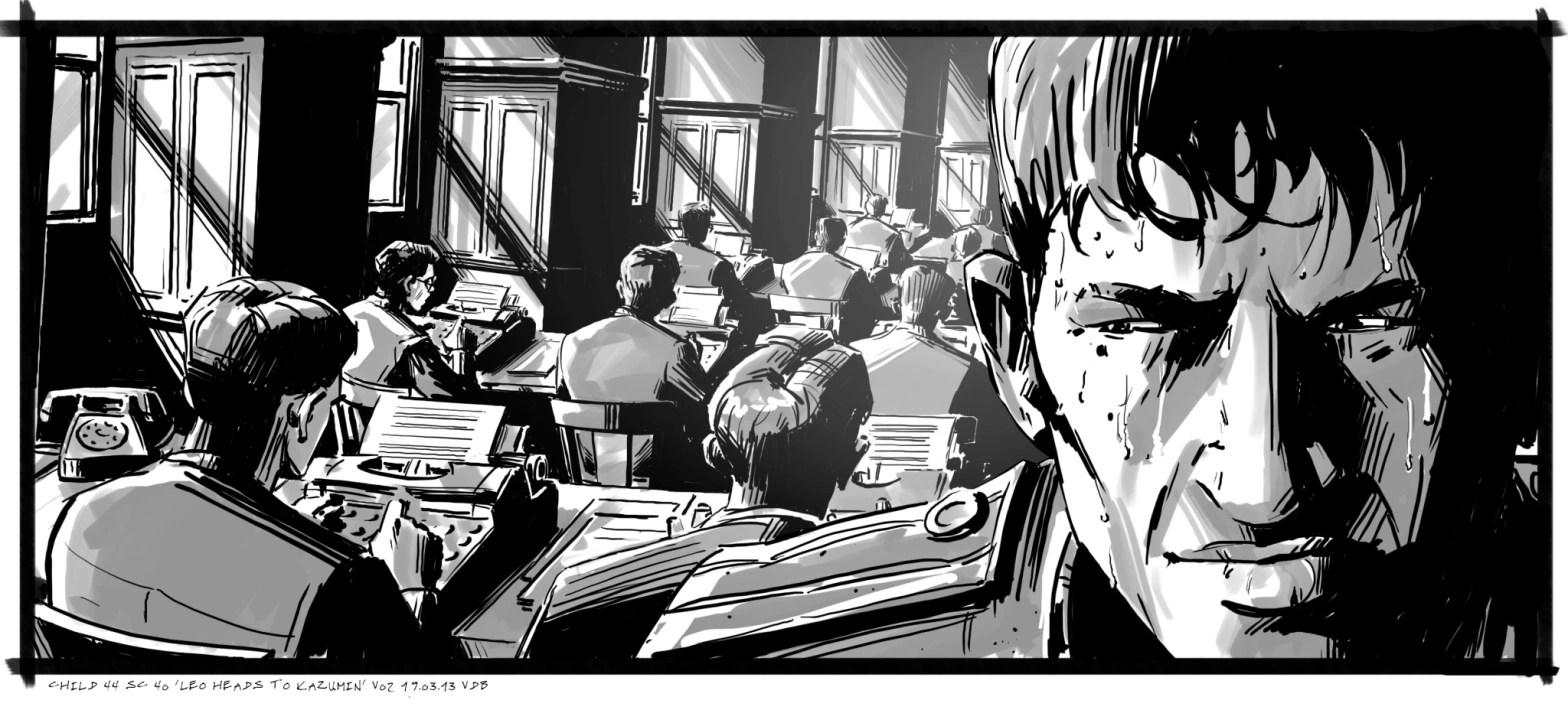
It was an honor to sit down with the brilliant storyboard artist Kurt Van der Basch, who worked on Star Wars: Episode VII. Of course he’s not allowed to talk about it, which is fine because there are so many other questions to ask him.
Please go to his website or follow him on Facebook and view 100s of storyboards from his various credits, including: Assassin’s Creed, Sense8, The Borgias, Chronicles of Narnia, and The Illusionist, to name a few.
www.facebook.com/kurtvanderbaschstoryboards
Matthew Toffolo: I understand that you are not allowed to talk about Star Wars! No problem. Are you allowed to say that you had a creatively inspiring experience?
Kurt Van Der Basch: Yes, I can definitely confirm that it was a creatively inspiring experience and I loved the result as much as everyone else seems to have.
Matthew: Looking at your storyboard examples on your website your storyboards are so visual and amazing to look at. I see the story unfold by just looking at the images. They are like a graphic novel that could be published. Do you have any (or many) graphic novel ideas?
Kurt: Thanks a lot. Sequential illustration is sequential illustration whether it’s in the rougher form of storyboards (usually, at least) or in the ready-for-publication form of a graphic novel. We more or less tell stories the same way in both fields. It’s interesting too that with the growing popularity of graphic novels and the rise of DVD extras that storyboards, interest in storyboard art has grown a lot. Now lots of people know what they are and are keen to see them. As for graphic novel ideas – I have lots of but I don’t consider myself much of a writer. I’m still waiting for ‘the perfect fit’ with a writer who wants to collaborate.
Matthew: What’s the general working relationship and process between a storyboard artist and the director? How early do you meet before production begins?
Kurt: The storyboard artist can often be among the first crew mambers to start. I did a long job this past year where I was one of the first 3 people hired then slowly more and more crew joined the production. Early on, there’s generally a list of the most complicated scenes which the production need storyboarded for budgeting and planning purposes listed from highest priority to least. In these discussions the 1st Assistant Director is a key player and as the production goes on, it’s the 1st A.D. who always knows best what’s most urgent and what the latest developments are.
Usually the storyboard artist has daily storyboard meetings with the director (Often arranged by the 1st AD. As the production grows and the director begins to be yanked in a million directions these meetings may not be so frequent) and they sit down and discuss the scene. Often the director will start by showing some references, video clips or still images that they think could be a good style or tone guide. If there’s already a production designer then he or she may provide location photos or a model (either a white card one or, more commonly these days, a digital sketch-up model) so we have a geography to work with. Then the director will begin to describe shots of the sequence. While the director is describing the shots I draw quick little thumbnail sketches so the director can intercept and say, for instance, ’no, a little bit wider’ or ‘could it be a slightly higher angle?’ etc. until I am drawing what he or she is envisaging. It’s common dirng these meetings to draw a little plan view and indicate on it camera and characters too. Some directors will dictate every shot of each sequence that gets storyboarded, but, especially on huge action movies where it’s nearly impossible for the director to arrive with all the shots of each scene planned out in their head in advance, some directors encourage the storyboard artist to make suggestions or even ask them to have a crack at the whole scene as they see it. Then the director can react to those ideas and say ‘yes that’s interesting, keep that, but here I thought we could….’ etc. This can be a fun and creative way to work. Later in the production these meetings often include the DoP as well. As time permits the little thumbnails drawn during the meeting are taken away and the storyboard artist makes more clear and solid versions of them with directional arrows and shot descriptions added next to the panels, plus proper scene and shot numbering. Sometimes time doesn’t permit and it’s necessary to settle for the rough thumbnail scribbled out in the meeting. Sometimes the director insists on the storyboards being left at the rough stage so the crew won’t take particularities of the drawings too literally.
Matthew: When talking about the cinematic design with the director, is the overall theme and tone of the film always present in each storyboard you create?
Kurt: It can be but isn’t always. Sometime it’s very technical and the most important thing is just to clearly show a certain camera move + character action. If your drawing can convey a bit of the atmosphere in these instances that’s great but not if it takes away the clarity.
Matthew: How is the process different when doing a TV episode assignment in comparison to working on a feature film?
Kurt: TV production usually doesnt have the luxury of pre-production time that film has. From what I’ve seen TV directors tend to behave and are treated much more as regular crew members and in my experience TV directors tend to be extremely focussed and organised knowing how little time they will have to complete their block of episodes (on a series the directors usually trade off in ‘blocks’ of episodes so while one is shooting their 2-3 episodes the other is prepping theirs.) The TV storyboard process can be more intense – longer hours and more frames per day, and often less ‘finished’ in order to get all the necessary sequences boarded before shooting. Also there’s less scope for spontaneous ideas – a sudden brilliant suggestion of a shot from inside the microwave can’t just be thrown in in TV world without serious consideration of the extra time and cost etc. I really enjoy storyboarding for TV.
Storyboard from DEAD SNOW 2 (2014), Director Tommy Wirkola

Matthew: What are you looking for in a director?
Kurt: Well the question is really what are they looking for in me because it’s me who is hoping to get hired. But if they do pick me then I look for patterns in how they describe things so I can get to sense what they probably will want as quickly as possible. For some directors articulating the shots they need isn’t as easy as it is for others and it’s the storyboard artist’s job to help with this. This is where the thumbnailing process can be great. Sometimes seeing my totally wrong scribble can be the very thing that helps a director get across the shot in his or her head. On the other hand I’ve worked with directors who draw beautifully and make perfect thumbnails that are a very clear guide that I then just have to draw up in a more finished way.
Matthew: Do you have a Storyboard mentor?
Kurt: The Engish storyboard and strip cartoon artist Martin Asbury essentially created a whole style and standard in the industry that influenced a whole generation of storyboard artists, at least here in UK/Europe. I’ve been lucky enough to work with him twice and both were great experiences. On top of being a huge talent he’s also a really funny and generous man.
Matthew: You have worked on a lot of Action, Fantasy, and Horror films. How important is the creation of the storyboard to the production team for these genres?
Kurt: In an action movie there’ll be two or three big sequences that the storyboard artist works on and sometimes just these scenes may be revised over and over the entire time on the job.
Storyboarding is more important for these genres than others because of all the VFX and stunts involved. Storyboards are neessary initially for making a budget because it answers questions like: In how many shots do we see the flying ship? How often does the camera tilt up enough to require digital set extension? Do we see the stuntman land or does he just fly off the roof? etc. Often it goes that once boards are made of scenes and compared with the budget then the producers then get out their sharpies and start crossing out shots that the production can’t afford. Then it becomes a discussion of where to use the VFX bdget to best advantage. Of course storyboards are also needed in these genres beyond just technicalities but to give an idea of a scene overall and know if it works in terms of drama and suspense. For this, sometimes the individual storyboard frames are plugged into editing software to make a ‘board-o-matic’ that plays the frames in order with timing and added music and sound effects. This can really give a feeling of the final sequence before it’s actually shot. There are some great examples of this on You Tube from Captain America.
Matthew: The film “Serena”, starring Bradley Cooper and Jennifer Lawrence is almost a lost film. Many film fans don’t even know it exists despite the all-star cast. The film is also a bit of a departure for you as it’s a straight up drama. Can you tell us your experiences working on that film and how working on a drama is different from the action/movement movies you generally work on?
Kurt: It’s the strangest thing isn’t it? I think it’s a good movie yet it took ages to be released and even then it was very limited. I was hired in this case by the production designer Richard Bridgland who I had worked for on Alien vs Predator. I did ink and marker illustrations of all his sets for presentation to the director Susanne Bier and then when my job was done the production asked if I could stay on as a storyboard artist as there were a few scenes where it moved out of the relam of straight-up drama and needed storyboarding. An accident on the cutting slope of a logging camp involving trains and falling trees and later a sort of chase scene and fight.
Storyboard from SERENA (2014), Director Susanne Bier
Matthew: Besides the films you’ve worked on, what movie have you seen the most in your life?
Kurt: Definitely ‘The Exorcist’. But a close second is the annual holiday showing of ‘The Sound of Music’ which is a Canadian tradition since before I can remember. I also know most of ‘Mommy Dearest’ by heart.
Matthew: You have worked on over 40 productions in the last 15 years. Do you have a favorite experience?
Kurt: Working on ‘Cloud Atlas’ was probably the most memorable. It was just such a great group of people over in Berlin and the script is magic to me. So ambitious and crazy but they pulled it off. I also did a sci-fi short called ‘A Living Soul’ with the Swedish director Henry Moore Selder that was really cool. On a short there’s limited money and the storyboards make a huge difference to the production. We did about 400 frames in 2.5 days on that project and the result, I think, is fantastic.
Storyboard from CLOUD ATLAS (2012), Directors Tom Tykwer, Andy & Lany Wachowski

Matthew: What director would you love to work with that you haven’t worked with yet?
Kurt: There’s a few. Maybe when Xavier Dolan makes an action or Sci-fi movie I’ll get to work on it. He’s a genius. And there’s also Ridley Scott!
_____
Interviewer Matthew Toffolo is currently the CEO of the WILDsound FEEDBACK Film & Writing Festival. The festival that showcases 10-20 screenplay and story readings performed by professional actors every month. And the FEEDBACK DAILY Festival held online and in downtown Toronto Thursday’s of every single month. Go to www.wildsound.ca for more information and to submit your work to the festival.








 Festival Reviews