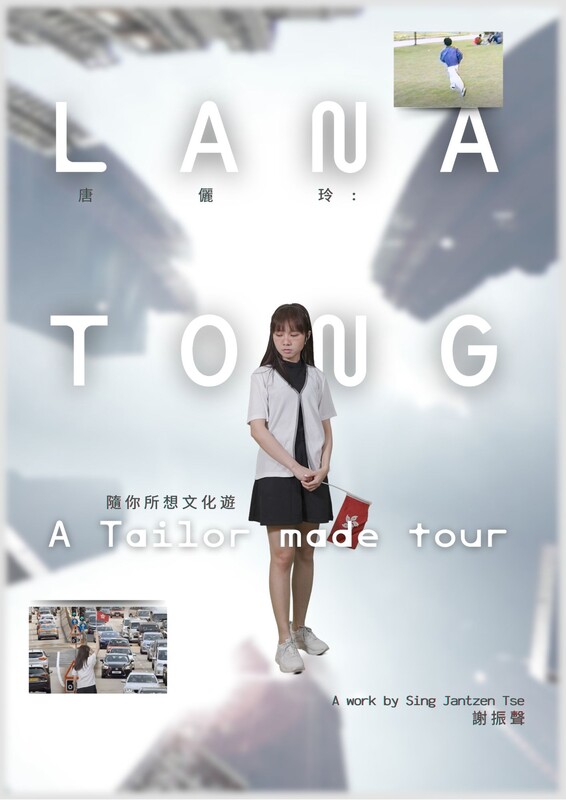
Lana Tong, a tour guide who migrated to Hong Kong less than a decade ago, guides audiences through a post-pandemic Hong Kong undergoing rapid shifts in its political and socio-cultural landscape. Her journey is disrupted by two disembodied voices—native narrators steeped in Hong Kong’s 80s to 00s ethos. Offering corrections rooted in a native perspective and drawing from their upbringing in Hong Kong’s 80s to 00s milieu, they recount the city’s geography and the values of freedom championed by earlier generations, paradoxically steering Lana to rediscover the city through their lens. Amid the tides of time, questions arise: Can a city’s soul survive relentless tides of change? Will its people cling to inherited ideals, flee, or forge new meaning from the fragments?
1. What motivated you to make this film?
This film was born out of a need to hold onto fleeting moments in Hong Kong, moments that felt especially fragile during the severe pandemic and political upheaval of 2021. Homebound with my partner, we found ourselves reminiscing about childhood and quietly mourning how the stories that shaped us seemed to be dissolving, not only through the passage of time, but also because of the shifting political landscape in Hong Kong. In response, I began filming the city’s landscape and eventually created this short film.
2. From the idea to the finished product, how long did it take for you to make this film?
The script and dialogue were written at the very beginning, but the images were filmed gradually over four years—from the lockdown to the reopening of the city. I wandered with a handheld camera and sound recorder, capturing fragments of memory from crowded streets to the city’s border, trying to sketch a map of change through rapidly shifting visuals and evolving soundscapes.
3. How would you describe your film in two words!?
Questioning identity.
4. What was the biggest obstacle you faced in completing this film?
The biggest difficulty lies in the relevance of the content over time. Since the text was written four years ago, some of the topics became outdated during production. I even considered amending or removing those parts. Interestingly, some of these outdated issues have now become cross-generational matters, so I decided to keep the original script.
5. There are 5 stages of the filmmaking process: Development. Pre-Production. Production. Post-Production. Distribution. What is your favorite stage of the filmmaking process?
The most exciting part of the process, I would say, was the ongoing filming during post-production. It felt like sculpting, painting, or even documenting, and the process stretched over several years. I came up with fresh ideas, revisited some places years later, and filmed again to make comparisons. I even incorporated footage that had been shot long before this project began.
6. When did you realize that you wanted to make films?
I worked as a sound artist for years, and I am more familiar with experimental forms and installation building—working with concepts that have a loose structure but rely heavily on intuition. Yet this time, I found myself trying to tell a complete story in sequence, which led me to unfold my exploration through film.
7. What film have you seen the most in your life?
“Made in Hong Kong” (1997) by Fruit chan.
8. What other elements of the festival experience can we and other festivals implement to satisfy you and help you further your filmmaking career?
I would suggest an online platform that brings together creators, potential investors, and film lovers for themed discussions, with the aim of developing cross-regional projects.
9. You submitted to the festival via FilmFreeway. How has your experiences been working on the festival platform site?
There are dozens of festivals I can see on the site, ranging from small independent ones to well-known major events. I have applied to different types of festivals, and this was truly my first attempt. The more I engaged with the platform, the more I realized there would be a dedicated festival that suited my work.
10. What is your favorite meal?
Yangzhou fried rice, which is quite a cheap and quick local dish in Hong Kong.
11. What is next for you? A new film?
I am working on an experimental video that explores the idea of an endless journey. The video is based on poetry written by my wife and is accompanied by sounds and music that I created with a friend.
 Festival Reviews