What motivated you to make this film?
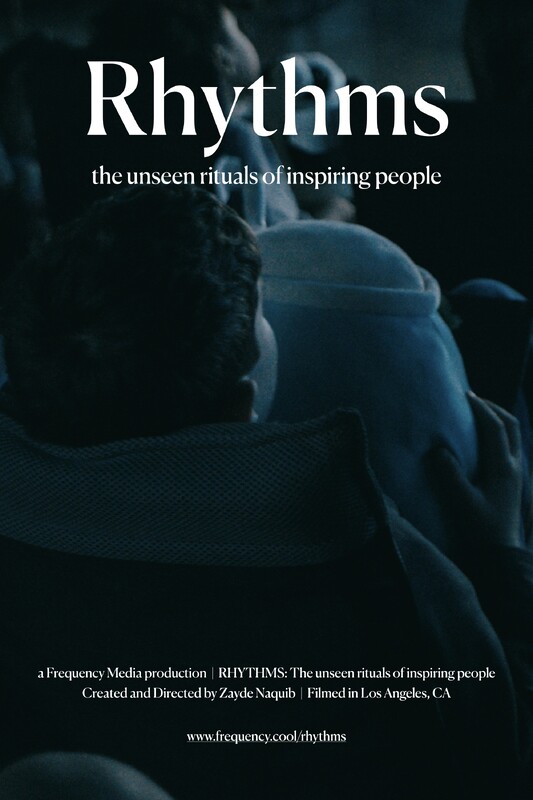
This is the 2nd film in a documentary series I’m directing called Rhythms, which is all about the unseen rituals of inspiring people. I learned about Matthew Biancaniello’s marathon swim to raise money for Indivisible Arts through Robert Wemischner, who’s both a friend and was the subject for the first Rhythms film.
I was immediately intrigued, but then I spoke to Matthew as well as Rafael McMaster, the founder of Indivisible Arts, and I was so inspired. I knew I had to tell this story in some way, and thankfully everyone was excited to have me involved in this capacity. Indivisible Arts is a remarkable organization, teaching creativity and consciousness to kids. The first time I went to their space in Hermosa Beach I was taken aback. These kids are able to explore their own sense of self in a way that’s rare, as well as build vital mindfulness and emotional intelligence skills. Coupling that story with Matthew’s intense swim, 2 years after major back surgery, was something I felt deeply moved by.
2. From the idea to the finished product, how long did it take for you to make this film?
I learned about the September 2025 swim in July. By early September we were confirmed to shoot, with production beginning on September 22. We completed the film and released it online on November 2, so it was about 4 months in total.
3. How would you describe your film in two words!?
Inspiring. Grounding.
4. What was the biggest obstacle you faced in completing this film?
The logistics for the swim itself, as well as the end of the swim, were the biggest practical concerns. Most of the swim took place in the dead of night, and the swim concluded at an alcove that was not accessible to the public, meaning it wasn’t a place I could drive to with a camera and meet him. We were very fortunate that one of Matthew’s kayak support team, Angela Lee, is a documentary filmmaker herself. Angela shot the swim sequence as well as the emotional arrival onshore. Much of the film was shot at 50mm on a Super 35 sensor to feel the intimacy of Matthew’s journey, while the sequence at Indivisible Arts of the kids creating in the moment was shot with a 75. For the swim itself, we switched to a super wide perspective to feel the epic scale of what Matthew was actually accomplishing. It started as a huge obstacle but became an opportunity that deepened the experience of the film.
5. There are 5 stages of the filmmaking process: Development. Pre-Production. Production. Post-Production. Distribution.
What is your favorite stage of the filmmaking process?
It depends on the piece to a large degree. I find shooting to be meditative in a way, so if I had to choose today I’d say Production, but I could easily make an argument for Post. Seeing something take shape is special, and being a musician too the rhythm of editing a piece is its own delight.
6. When did you realize that you wanted to make films?
14. I learned quickly that I love cinema as a form. I took a wonderful cinema class while in high school but also shot all the time on my own, dabbled in photography, and then started taking on freelance gigs while still in high school. It was an amazing way to spend those years.
7. What film have you seen the most times in your life?
It’s a toss up between an unlikely pair, Annie Hall or Star Wars. When I was a freshman in high school I came down with pneumonia and was out of school for a long stretch, which is when I first watched Annie Hall. It became both comfort and inspiration. For the month I had pneumonia I watched it once a day. That led me down paths that led to Fellini, Godard, Bergman, and more. Star Wars, on the other hand, was something I loved as a kid, owning the original trilogy on VHS. Fast forward to a few years ago. I have an African Grey parrot named Prudence, and one day I watched The Empire Strikes Back with her, and she flipped out hearing R2-D2, Yoda, and Chewbacca, all of which she can emulate to an uncanny degree now. She asks to watch Star Wars every day, so it’s on constant rotation in the house!
8. In a perfect world: Who would you like to work with/collaborate with on a film?
I wish I could have met or done anything work-wise with David Lynch. He operated on his own plane of existence in both work and life that will always inspire me. I would have been happy just to make coffee for him on-set!
9. You submitted to the festival via FilmFreeway. How has your experiences been working on the festival platform site?
FilmFreeway makes everything really simple and easy. Being able to upload all the information of your film, track submissions, find festivals that fit your film specifically – all of these are huge.
10. What is your favorite meal?
I love a really early dinner, between 3 and 4. I don’t like to eat much in the mornings, apart from some years when I was baking for work in which I consumed more than my fair share of day-old chocolate chip cookies and olive oil cake.
11. What is next for you? A new film?
Yes! I’m just about to start production on a feature documentary called The Frequency of Jazz, a project I’ve been developing for the last year. At its core, the concept will explore jazz improvisation through the lenses of physics and neuroscience. While being a documentary, the intent is to craft something that visually is an experience unto itself. I’ve been talking to some amazing people in the worlds of music and science, I can’t wait to start shooting!
In addition, Rhythms: An Indivisible Marathon Swim will be screened at Indivisible Arts in the new year and I’m developing more filmed entries in that series, which I’ll be shooting in the new year.
|
 Festival Reviews