The short, The Redemption of Faust, is a glorious, multi-faceted production – – a modern re-telling of the famous tale, Faust. Every frame is a feast for the eyes and ears. It is unrelentingly beautiful. The cinematography moves at a rapid pace, recounting the experience of the central figure, in this case a gifted photographer. Shots quickly flick back and forth from night to day, to city vistas, to extreme close ups of faces, to wide drone shots. Text is masterfully narrated and sung, and sets the structure of the piece.
Sound in the project is equally impressive, with stormy eruptions, stirring choral voices and soft orchestral strains. The atmosphere at the water’s edge is eerie, as whispers are layered with a fervent feminine voice.
There is a strong spiritual essence as the central figure is eventually redeemed, despite a checkered past. It is a clever convention to bring this classic tale of sin and eventual salvation into a more recent era.
What if we could be programmed, our circuitry overwritten, erasing any trace of humanity, or attempts to, and if we stray into uncertainty, a threat to the system, we will be targeted and upgraded to fit nicely back into the societal mode. And if that doesn’t work, lobotomy because the system must remain operational, but you don’t.
2. What genres would you say this story is in? Dystopian
3. How would you describe this story in two words? Alternate Reality
4. What movie have you seen the most in your life? I have seen a multitude of movies, and some I remember, some I don’t. And some will stay with me forever like the movie, The Listener with Tessa Thompson (2022). Do we really remember that we are human, and why does it hurt so damn much? Nobody seems to care about our pain, our suffering, our fears, loss, but someone does. And they are listening, letting us talk, connect, and solitude melts away, even if it is for a few minutes or so. And we remember that yes, we are human, and no, we are not alone.
5. What is your favorite song? (Or, what song have you listened to the most times in your life?) Again, I have found and listened to a multitude of songs, past and present. It takes a certain song to catch my ear, grip me tight, pull me into melody, vocals that drown out the noise, and one song in particular would be Mind over Matter (Acoustic) by PVRIS.
6. Do you have an all-time favorite novel? Charlotte’s Web by E.B. White
7. What motivated you to write this story? It’s routine. Get up. Go to work. Waste your time on mundane things. Go home. Eat dinner. Watch tv, or in my case, Apple TV. Sleep. Repeat. Again and again and again, almost as if I were a real cog in the machine. That doesn’t work for me, but I can’t seem to escape it. It’s almost like I’m programmed to be this way, but what if I want to pull away, tear out the circuitry, and make myself bleed and feel and remember that I am Human.
8. If you could have dinner with one person (dead or alive), who would that be? Seth MacFarlane
9. Apart from writing, what else are you passionate about? Photography – People, Buildings, Dystopian/Abandoned Places
10. What influenced you to enter your story to get performed? I saw that WILDsound was looking for dystopian stories, and this was one of my favorites that I had written. It needed a good home, so I submitted it to them.
11. Any advice or tips you’d like to pass on to other writers? Don’t let the world shut you down. I realized that I have been in a rut myself, barely writing, thinking, waiting for the world to burn down in civil war and World War III, but I’m wasting myself in doing that. I should be doing something, even if it is small, even if it is only known to me, so at least in the end, I can say, I created that.
In the quirky desert town of Grand River, conspiracy theories, old grudges, and government secrets collide in Un-Cognito, a satirical action-comedy with heart.
Glenn Rancher, a straight-laced FBI forensic accountant facing a terminal diagnosis, returns home to reconnect with his estranged daughter Emma, a competitive college archer. His ex-wife Julia, an Air Force general, urges him to make peace while he still can. But reconnecting with family becomes complicated when Glenn stumbles into a chaotic conspiracy led by a ragtag crew of local misfits operating under the viral alias “Un-Cognito.”
Get to know the writer:
1. What is your screenplay about?
Un-Cognito follows a dad trying to make amends with his college aged daughter and ends up in a confusing, chaotic world of misguided militia and conspiracy kooks. It’s about found family, people connecting with people, whether blood ties or common need, we all need to find purpose and fulfilment in our relationships, although some relationship choices may be more flawed than others.
2. What genres does your screenplay fall under?
Action/comedy
3. Why should this screenplay be made into a movie?
I think audiences need to meet these characters. I like to think the right group of actors will bring life and connection to their world. It’s funny, fast paced and gives us a little hope.
4. How would you describe this script in two words?
Charismatically conspiratorial.
5. What movie have you seen the most times in your life?
Not the easiest question to answer, and while I haven’t watched it in a while, probably Repo-Man.
6. How long have you been working on this screenplay?
Entering year three and the umteenth iteration.
7. How many stories have you written?
Twenty or so in various stages and formats. Theater, audio, short film scripts and full length.
8. What motivated you to write this screenplay?
I wanted to take a shot at the action comedy genre and I recently had my own health challenge and can now call myself a cancer survivor. facing uncertainty, going through treatments made me realize that I can’t do everything alone and needed to let people, specifically family in. I love my kids and my wife and this story helped me broach the loner mentality. That coupled with exploring how to conspiracies and ridiculous rumors spread, Today its internet, but before that every kid in the 80s heard that “Bubble Yum had spider eggs” …. no internet but coast to coast we all knew the story. Today, those conspiracies can manifest in things like QAnon and I wanted to poke at that.
9. What obstacles did you face to finish this screenplay?
The biggest obstacle has been of my own making – too many characters, too many story lines, needing to cull the narratives in to an accessible story.
10. Apart from writing, what else are you passionate about?
Collaborative creation! I love working with artists on theater projects, performance art, music and anything to showcase the brilliance inside us all.
11. What influenced you to enter the festival? What were your feelings on the initial feedback you received?
Feedback, learning and reading the responses from other entrants on their experience. You also provided some great ideas on how to market your own work as well as put fresh eyes on the projects.
In a galaxy choked by occupation, reluctant leader Sol hijacks a Galactic Union warship—sparking planetary uprisings and thrusting his fledgling resistance into a brutal war against a colonising force that will burn worlds to stay in control.
What is your screenplay about?
This screenplay is about Sol Muqawam, the burdened leader of a galactic rebellion, who leads a desperate mission to hijack a Union Dreadnought for its resources. What begins as a tactical heist transforms into a profound moral crisis when they discover the ship’s true cargo: hundreds of imprisoned civilians from a conquered world – Zaytoon, which is also Timor’s homeworld. Forced to confront his own traumatic past and the weight of his “savior” legend, Sol must choose between the strategic goals of his rebellion and the immediate, human cost of the war, ultimately reigniting his fight not for victory, but for redemption.
What genres does your screenplay fall under?
Science Fiction: The primary genre, featuring spaceships, railguns, plasma weapons, holograms, and a fully-realized galactic society.
Action: The script is packed with intense space dogfights, explosive boarding actions, and close-quarters combat.
War Drama: At its core, it’s a story about the costs of war, the burden of leadership, and the moral compromises made in a rebellion.
Space Western: Elements like the grizzled, morally-grey crew of a beat-up freighter, the “wanted man” leader, and the frontier-like setting of the asteroid belt give it a distinct Western feel.
3. Why should this screenplay be produced?
With everything that is happening in the world right now, I think my screenplay should be produced because it is a visceral, character-driven sci-fi epic that combines the spectacle of a blockbuster with the heart of a poignant war drama. I have looked at some of the key conflicts that are happening in the world and tried to create an epic that shows a grounded resistance movement against an almost impossible imperial occupation force. It offers:
High-Concept Appeal: A gritty “David vs. Goliath” spaceship hijack is a proven, marketable concept.
Diverse, Compelling Characters: The ensemble cast features distinct, memorable roles that allow multiple actors to shine, from the stoic leader and lethal enforcer to the witty pilot and untrustworthy rogue.
Social Relevance: The themes of resisting oppressive regimes, fighting for freedom, and the moral cost of war are timeless and resonant.
Franchise Potential: The rich universe, deep character backstories, and the open-ended conclusion lay a strong foundation for a potential film series or streaming show.
4. How would you describe the script in two words?
Gritty Opera
5. What movie have you seen the most times in your life?
Star Wars
6. How long have you been working on this screenplay?
About 1 year. I have a full-time job so I have been mainly working on the weekends.
7. How many stories have you written?
3 Scripts and 14 short stories.
8. What motivated you to write this screenplay?
The resistance movements around the world opposing imperial occupation. I wanted to create an allegory based in space where planets represent countries or regions that are being occupied for their land and resources.
9. What obstacles did you face to finish this screenplay?
Time – I have only been writing for just over 1 year on and off. With a full-time day job it’s difficult to find the time and energy to write and complete the script. I have actually created a new version which is 50 pages long and much tighter.
10. Apart from writing, what else are you passionate about?
Freedom
11. What influenced you to enter the festival? What were your feelings on the initial feedback you received?
I had positive feedback from my friends, colleagues and my fellow writers and decided it was time to enter a few competitions. The feedback has been good but would also like to have more!
When an unnamed virus begins to kill off human males, a family takes refuge on a sailboat in hopes they can escape the virus.
Get to know the writer:
1. What is your screenplay about?
This story, like all of the stories I seem to write, is about my daily agony knowing one day I will have to say goodbye to my only Son, and figuring out how to make the most of the little things in life that bond us and my family.
The story itself is about an unnamed, new virus that is causing a mass die-off of human males. A father takes his wife and young daughter to his own father’s sailboat on the Atlantic Ocean to try and evade the virus.
2. What genres does your screenplay fall under?
Drama.
3. Why should this screenplay be made into a movie?
If I can pull this film off, it has the potential to be visually stunning, relying on the simplicity of a sailboat, human drama, moments of levity, grief, and elation. My attached actors, the stellar and criminally underutilized John Conway and a fantastic tiny powerhouse of an actress, Mila Rose, have the ability to push you far into the reaches of emotion. I am looking forward to working with a very intriguing, talented actor, Heidi Danea Crane who is also signed on.
This story will give the audience a heartfelt, intense and beautiful drama that will hopefully generate deep emotional resonance and stronger appreciation for the people closest to them.
4. How would you describe this script in two words?
Contained heartbreak.
5. What movie have you seen the most times in your life?
The Outsiders (of course).
6. How long have you been working on this screenplay?
Completed in about ten days.
7. How many stories have you written?
About 13 features, most with Recommend coverage, many festival placements, several optioned, several in development, several I don’t want anyone ever reading again, plus a short I directed, another short that was produced, and a collaboration on a feature in post production.
8. What motivated you to write this screenplay?
I am constantly on the hunt for just the right 1987 Hunter 23 sailboat. One morning while searching for one I came across a one of a kind, 75 foot, steel hull sailboat in disrepair. I reached out to the owner, asked if I could write a movie that takes place on his boat. He said yes, and that was all I needed.
I was also looking to write something for my favorite actors, wanted to write a project I could direct, and would be low budget.
9. What obstacles did you face to finish this screenplay?
Often times I just can’t type fast enough to roll a script out between the worst moment of every school day (when I drop my son at school) and the best moment of my day (when I pick him up); so the main obstacle always seems to be time.
10. Apart from writing, what else are you passionate about?
Currently I am intensely passionate about my distaste (aka abject fear of) for AI…
11. What influenced you to enter the festival? What were your feelings on the initial feedback you received?
The very first script I wrote, a short called “Throwaways” was a winner at Wildsound. Mathew interviewed me; I loved the experience! Sadly I haven’t made that movie (it will be very complicated), but I love Wildsound and am happy to support it when I feel I have an appropriate project.
The feedback was definitely constructive and gave me food for tnought; I know the reader “got” the story, and offered insight into an audience perspective.
STALKERS, 107min., Canada Directed by Paul Thompson When a former porn star returns to her quaint hometown to raise the now teenage daughter she gave up for adoption, their fragile reunion is shattered by stalkers, secrets, and a string of murders — turning a hopeful second chance into a harrowing fight for survival in a story with a dark twist on a Hallmark story.
STALKERS was an idea I had quite a long time back, in around 2013. It was initially a teaser for Cinecoup film accelerator competition, in which one film would receive $1M in funding. The film has changed a lot from that early teaser, but the core thought behind it was inspired by the ways that many of my favourite genre films stand out as being good films in other regards first – in this case I felt like the story of Kate meeting her daughter Charlotte as a teenager was a movie in itself. Then we twist it a little with our slasher and thriller elements.
2. From the idea to the finished product, how long did it take for you to make this film?
As indicated above, the idea for the film was conceived way back in 2013. Coming out of the pandemic, it became clear that too many things in life are uncertain, and if I were going to see this film made, it would probably take me just going out and making it happen. The process of filming started in early 2022, but even that was beset with challenges, such as some COVID stoppages, and Olivia (Stadler, our lead) having an unfortunate incident with her foot and a kitchen knife at home which stopped filming for months. Principal was finally completed around February 2023, and pickups and flashbacks completed in March of 2024.
3. How would you describe your film in two words!?
Family terror
4. What was the biggest obstacle you faced in completing this film?
Since it was self-funded and produced, the toughest thing was just staying the course throughout the various challenges. Having to cancel a week, or shutting down for months knowing that we still had half a film left to shoot, can be really disheartening. I had to tell myself – not to mention the cast and crew – that we would get to the finish line. And amazingly, even when I was wrestling with doubts, our team really had faith in the film and in me, I guess.
5. There are 5 Stages of Filmmaking: 1) Development. 2) Pre-Production. 3) Production. 4) Post-Production. 5) Distribution. What is your favorite stage of the process and why?
I’m pretty sure there is nothing quite like being on set making something. It’s a physically exhausting, emotionally draining speed run on adrenaline, but for those few minutes a day when the lights are on, the camera is rolling, and the actors are doing their thing supported by the cinematographer and the crew, it’s magical.
6. When did you realize that you wanted to make films?
Sometime in high school. I was not very advanced in my understanding of how it all worked, but I had a friend who was really into shooting things with his video camera, and somehow I got involved and it was pretty quickly all consuming.
7. What film have you seen the most in your life?
There are probably 3 that are in the mix for that title. Star Wars: A New Hope (back when I first saw it in the late 70s as a kid, it was just called Star Wars), The Wizard of Oz, and Halloween.
8. What other elements of the festival experience can we and other festivals implement to satisfy you and help you further your filmmaking career?
Overall my favourite part of festivals is real screenings with real audiences. The best festivals give the filmmakers a chance to watch their film on a proper screen with a live audience, and hopefully take some questions and get feedback after the movie’s over.
9. You submitted to the festival via FilmFreeway. How has your experiences been working on the festival platform site?
Film Freeway has been great. I thing searching and narrowing down festivals could be improved a little, and clarity on whether festivals are real screening festivals or just virtual events or awards only would help.
10. What is your favorite meal?
New York Pizza.
11. What is next for you? A new film?
Still working on some new film ideas. When we started STALKERS I wasn’t sure if this was one and done, but the festival experiences have made me really want to make another film and show it to festival audiences. What that film will be is still up in the air and a couple of years away.
In a near-future world ravaged by the memory-wiping virus X9, brilliant young scientist Andrea Santiago discovers a suppressed cure hidden by the powerful Biotech Pharmaceuticals. Having once been recruited into the system she now seeks to dismantle, Andrea grapples with betrayal, moral compromise, and the overwhelming cost of truth.
1. What is your screenplay about? X9 explores what happens when the boundaries between human emotion and artificial intelligence blur. It’s a sci-fi thriller wrapped around a deeply human question: what defines love, loyalty, and consciousness when technology begins to feel? Beneath the futuristic setting lies a story about redemption, sacrifice, and the fragile line between creator and creation.
2. What genres does your screenplay fall under? It’s primarily a sci-fi thriller with strong psychological and emotional drama elements. Think Ex Machina meets Blade Runner 2049, but with the emotional core of Her.
3. Why should this screenplay be made into a movie? Because X9 reflects where we are right now — standing at the crossroads of ethics, emotion, and evolution. It’s a visual and emotional experience that invites audiences to question their relationship with technology and each other. It’s thrilling, thought-provoking, and cinematic in a way that blends spectacle with soul.
4. How would you describe this script in two words? Hauntingly human.
5. What movie have you seen the most times in your life? Good Will Hunting. Every time I watch it, I’m reminded that truth and vulnerability are the most powerful special effects in storytelling.
6. How long have you been working on this screenplay? The concept first came to me years ago, but I began shaping X9 seriously about two years ago. It’s gone through multiple rewrites — each draft peeling back another layer of its emotional and moral complexity.
7. How many stories have you written? Over 60 screenplays, plus novels, poems, and hundreds of songs. Writing is simply how I process the world. Whether it’s a lyric or a scene, I’m always chasing emotional truth.
8. What motivated you to write this screenplay? As a board-certified plastic surgeon, I’ve spent my life studying both the beauty and imperfection of humanity. Given the recent pandemic, paranoia and the fear about big Pharma and corporate greed, this idea was born from that paradox — how we create, repair, and sometimes destroy in pursuit of perfection. I wanted to explore what happens when our desire to improve humanity leads us to challenge what humanity even means.
9. What obstacles did you face to finish this screenplay? Time. Between music, medicine, and storytelling, every day demands balance. But I’ve learned that creativity isn’t about waiting for the right moment — it’s about making one. The emotional depth of X9 also challenged me; it pushed me to confront parts of myself I didn’t expect to find on the page.
10. Apart from writing, what else are you passionate about? Music is my heartbeat. I’ve released a new song, poem, and chapter every month since 2014. I’m also passionate about empathy — whether through surgery, songwriting, or screenwriting, I try to heal in my own way.
11. What influenced you to enter the festival? What were your feelings on the initial feedback you received? I entered because Fantasy Sci-Fi Thriller Festival celebrates the kind of storytelling that blends imagination with emotion. The feedback was incredible – insightful, validating, and energizing. To have X9 recognized for its depth and cinematic potential means the world to me. It reminds me why I keep creating: to move people, to connect, and to remind us all that even in the future, the heart still matters most.
Film Synopsis: After serving time in prison for a crime that shattered her family, a mother returns to reconnect with her estranged daughter for the first time in fifteen years, only to realize that her daughter is on the verge of moving overseas to start her own family.
It initially started with me, wanting to challenge myself to craft a short film with emotional depth and compelling characters. As a director, I am always interested in exploring relationships on-screen in unconventional settings. I also had almost nothing to show for my work before that other than a short 3-minute scene I directed during COVID, so I was eager to prove myself. After brainstorming, I became interested in exploring the theme of forgiveness and the relationship between a mother and a daughter. As the script developed, I felt a deep connection to the story, and that further pushed me to make the film.
2. From the idea to the finished product, how long did it take for you to make this film?
The screenplay itself took me almost 10 months to write and re-write. The pre-production and production were about 6 months due to so many scheduling conflicts, and post-production for about 6 months. So almost two years!
3. How would you describe your film in two words!?
Relationship Study
4. What was the biggest obstacle you faced in completing this film?
We had to endure a lot of logistical and scheduling issues. We were working within strict budget constraints, and the film wouldn’t work unless we could find the right cast to play the principal roles due to the film being performance-heavy, an affordable location that fits the story, and equipment to shoot the film.
What is your favorite stage of the filmmaking process?
– I love Pre-Production the most because I love the process of discovery… I love talking to each collaborator and exploring character, story, and other aspects of the film. Production comes second because it is stressful, but you get the rewarding feeling of seeing the film come to life.
6. When did you realize that you wanted to make films?
I was in my second year of film school when I watched YouTube videos about film directing and instantly felt that was my calling
7. What film have you seen the most in your life?
It would have to be Denis Villeneuve’s Sicario.
8. What other elements of the festival experience can we and others festivals implemented to satisfy you and help you further your filmmaking career?
More opportunities to get honest feedback from working directors, producers, and filmmakers, and mentorship on how to advance filmmaking career.
9. You submitted to the festival via FilmFreeway. How has your experience been working on the festival platform site?
Pretty good.
10. What is your favorite meal?
It has to be a full English Breakfast
11. What is next for you? A new film?
I am working on a romance short film, a struggling comedian falling in love with a woman funnier than him.
A self-reflection of the filmmakers emotional journey from self-doubt to self-acceptance. There are always moments in life where we feel confident we can complete something, but then encounter an obstacle and feel self-doubt. Eventually, we accept the weaknesses in ourselves, overcome the obstacle and gain confidence again.
While the film Pieces of Me is quite brief at less than two minutes, it covers a wide timeline, acknowledging several transitional periods of an individual’s life. The animation is bold, depicting a series of geometric shapes that suggest humanness, from a tiny round seed to fragmented objects, notably shattered body parts. This imagery is chaperoned by poetic text which describes a seedling finding purpose, to dealing with the inevitable judgments of society, and the self-doubts that this can cause.
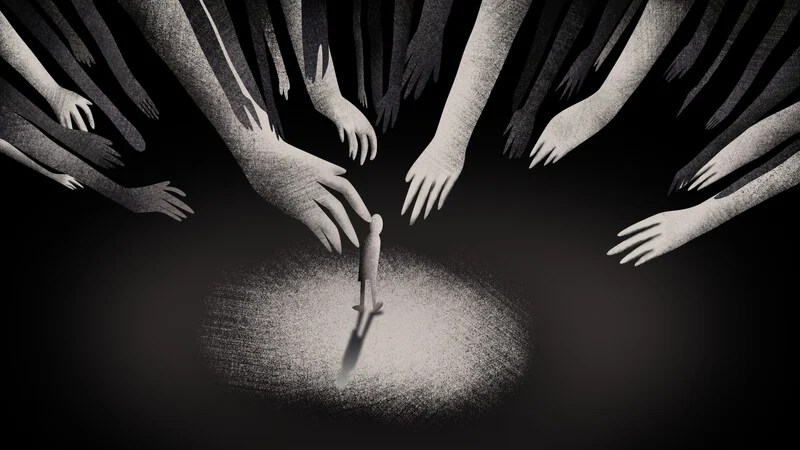
It seems a wise choice to start with black and white shading of items and then to present a colourful kaleidoscope when the central figure is exposed to the outside world. Other striking imagery involves being trapped in a cage, holding back the pressure of walls closing in, and many hands of influence pulling focus. Fortunately, the figure eventually seizes the moment in a brightly illuminated bottle, finds independence, and is now on a self-sufficient journey.
This brief but strikingly dramatic tale is well told by the talented voice artist who possesses a full-bodied, resonant sound. By the end of the piece, confidence is further exuded by the voice artist’s captivating emphasis and increased pace in speech. Pulsing instrumentals are punctuated by the reverberation of the firm piano notes, which rise to a crescendo – – the central figure is now ready to take on the world, after many struggles and transitions.
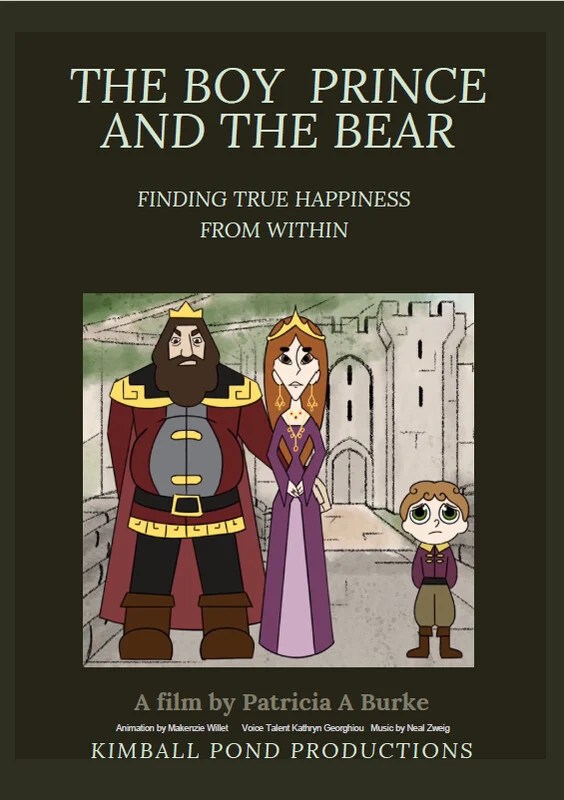
From the award-winning director, Patricia A Burke, comes a captivating parable that explores the journey of a young boy prince and his profound connection to his teddy bear. To find true happiness, William embarks on an inward journey. Guided by a wise shaman, he learns valuable lessons about himself and the world around him. This story delivers a timeless message about the importance of discovering belonging within a community.
Review by Julie C. Sheppard:
The Boy Prince and the Bear is a delightful coming-of-age animated short in the style of a medieval fairy tale, complete with an enchanting castle and costumes. The animation is charming, using defined bright colours for characters in the forefront, and soft, muted watercolours in the background. The plucky acoustic guitar under the narration has a renaissance chamber music feel to it, which works perfectly for this period piece.
Melodic screenplay reading is provided by the talented narrator who has a fitting British accent and the ability for multi-character depiction, much as a parent would when reading a child a bedtime story. Of course, the film begins with the classic opening phrase of “In a distant land…”.
Also, in the style of many a fairy tale, there is a strong character arc. The Boy Prince meets a wise mentor, and gains insight and maturity. By shedding a childhood attachment, he learns how to deal with life’s inevitable challenges on the path to growing up.


 Festival Reviews