FIRE IN MY BELLY, 5min. USA Directed by Steven Speliotis Richard was in his recording studio playing his guitar when he suddenly found himself in a cold sweat lying on the floor.
Get to know the filmmaker;
1. What motivated you to make this film?
When my friend Richard told me his heart stopped for 19 seconds
it took a minute to realize what that experience really meant.
My first question was: How did this experience change your life?
I really wanted to know his answer.
2. From the idea to the finished product, how long did it take for you to make this film?
It took an evening to talk and do a pre-interview and a day to film. and it took a couple weeks of editing and re-editing to get it to where I was happy with the story..
3. How would you describe your film in two words!?
second chance
4. What was the biggest obstacle you faced in completing this film?
Richard has lived a very colorful life and there was so much information to go through in our interview…
The Biggest Obstacle was to keep the story simple and on point with his heart stopping for 19 seconds and why he is recording his songs.
5. What were your initial reactions when watching the audience talking about your film in the feedback video?
I listened very closely to what each person felt and what was their biggest take-away.
And was pleased to know Richard’s story had a positive impact. People who don’t know Richard were impressed with his determination and positive attitude to keep on living after experiencing a near death experience.
6. When did you realize that you wanted to make films?
My “Documentary Filmmaker Antenna” is always up for a good story – So, as soon as Richard told me his heart stopped for 19 seconds I knew this was a story that needed to be told.
7. What film have you seen the most in your life?
“A Wonderful LIFE” – on repeat at Christmas Time… lol
8. What other elements of the festival experience can we and other festivals implement to satisfy you and help you further your filmmaking career?
Getting our films seen by others is great. feedback is wonderful and much appreciated.
Getting the right eyes on our films is even more important. Most filmmakers have a passion to work in the film industry, so learning how to produce and raise money for our next BIG project would be helpful knowledge to have.
9. You submitted to the festival via FilmFreeway. How has your experiences been working on the festival platform site?
FilmFreeway is like striking gold… The website is very organized, easy to navigate and with a little research filmmakers can find the festivals that fit a specific niche …
10. What is next for you? A new film?
My next film is to expand on “Fire In My Belly”.
To capture Richard and his band-mates making the album…
Making his dream come true.
My approach will be part Verite with minimal sit down interviews.
I want to be the fly on the walland capture the recording session as it happens and to get some of the BTS stories that might not otherwise be told.
Heal avec Delphine, 30min., USA Directed by Delphine Breyne Heal avec Delphine is a deeply personal docuseries that follows individuals navigating life after cancer, trauma, alopecia, and other challenges. Each episode invites viewers into a powerful journey of reconnection and renewal—beginning with an intimate look at the person’s world, followed by a transformative beauty restoration at Delphine’s atelier, and ending with a meaningful surprise to mark their new beginning. Through heartfelt storytelling, emotional connection, and light-touch artistry, the series introduces a new era of beauty and healing, where feeling truly seen becomes the start of renewed self-confidence, emotional healing, and personal transformation.
Heal avec Delphine was born from my daily journey with my clients who suffering from missing self confidence and hair loss.
A deep desire to show that beauty is more than appearance — it’s emotional restoration. As a beauty expert, I can tell you each scar, each loss, each mark are telling you a story .
The healing starts when they are seen, listen and restored.
I wanted to give them — and all of us — a voice, a space to heal, and to remind the world that transformation begins within.
2. From the idea to the finished product, how long did it take for you to make this film?
It took about two years from the first idea to the final cut. I receive thousands people from all over the world. I was the only witness of these amazing story. This project brings untold story to the light. I did the casting, auto finance and produce this docuseries.
3. How would you describe your film in two words!?
Emotional Restoration.
4. What was the biggest obstacle you faced in completing this film?
Finding balance — emotionally and logistically. Because the stories are real and deeply personal, I often carried the emotions home. At the same time, producing, directing, and running my beauty business required immense discipline and heart. But I learned that healing others heals you too.
5. What were your initial reactions when watching the audience talking about your film in the feedback video?
It moved me to tears. Hearing people describe how Heal avec Delphine touched their hearts validated every sleepless night. When strangers feel seen, it means the mission worked — that connection through honesty is universal.
6. When did you realize that you wanted to make films?
When I realized beauty and storytelling could merge. I’ve always seen faces as canvases, but film allowed me to capture the emotion behind them — the silent stories behind each pair of eyes. That realization changed everything.
7. What film have you seen the most in your life?
Probably Eat Pray Love — it mirrors the journey of rediscovery, resilience, and the courage to follow intuition. It reminds me that self-love is the starting point of all transformation.
8. What other elements of the festival experience can we and other festivals implement to satisfy you and help you further your filmmaking career?
Creating more mentorship and distribution connections for independent creators would be invaluable — especially spaces where filmmakers can meet producers, streamers, or impact-driven brands that align with their message. That bridge between art and opportunity makes all the difference.
9. You submitted to the festival via FilmFreeway. How has your experience been working on the festival platform site?
FilmFreeway has been smooth and accessible. It’s an amazing platform for independent filmmakers to reach audiences and festivals worldwide. I love how transparent it is and how easy it is to track submissions.
10. What is your favorite meal?
Pasta bolognese
11. What is next for you? A new film?
Yes — Heal avec Delphine is only the beginning. I’m currently developing the next episode and expanding the conversation around emotional healing and beauty worldwide. I’m also looking for a producer and distribution.
REPLICA, 6min., USA Directed by Marta Renzi A house, a replica and its inhabitants, both somewhat removed from reality. Tenderness, delight and quiet companionship. How much is imagined? What does the future hold?
The first inspiration was in choosing the dancers who are decades apart in age, live on different continents, and didn’t know each other! But I knew their verve, their humor, their sensuality, their physicality makes them cousins / twins / anything but lovers!
The last quieter section – to Sylvan Esso music, was a gift to Arthur who had experienced a hard summer, and could use some tenderness. The balloons were a lucky break – a beloved elder in the neighborhood had celebrated her 98th birthday in the performance space the night before.
BAAD! in the Bronx is a wonderful place, Arthur’s home away from home, and completely affordable. https://www.baadbronx.org/
When I decided we should shoot there, I knew the blank back wall would feel too theatrical or empty. So I went poking around for on the Internet Archive for some footage to enliven that wall. And then, since it was near Halloween
2. From the idea to the finished product, how long did it take for you to make this film?
A few months. Selina was arriving from Berlin to NYC for a brief stay. So we had 2 days of rehearsal and 2 days of shooting which ran from about Halloween till Election Day 2025 (that dark day.) Then a few weeks of editing by myself, at home on my computer. For once, music permission was a breeze! Come to think of it, a few months later, I went back in and laid in some more sound effects. Next time a real designer!
3. How would you describe your film in two words!?
Goofy. Sexy.
4. What was the biggest obstacle you faced in completing this film?
Doubt is almost always the biggest obstacle. I guess a nagging doubt that it wasn’t good enough. One friend – who I love, but who is wrong – suggested it wasn’t worth completing!
5. What were your initial reactions when watching the audience talking about your film in the feedback video?
Delight.
6. When did you realize that you wanted to make films?
When the equipment – computer, camera, software – was cheap enough that it was feasible – around 2006?
7. What film have you seen the most in your life?
By now it’s probably Summer 1993, by Spanish director Carla Simon.
8. What other elements of the festival experience can we and other festivals implement to satisfy you and help you further your filmmaking career?
The feedback videos are a gift. For me, trophies are completely beside the point. I’ll let you know if I think of something. Would I be interested in a feedback video that also suggested what DIDN’t work??
9. You submitted to the festival via FilmFreeway. How has your experiences been working on the festival platform site?
Excellent.
10. What is your favorite meal?
The better question is with whom?
11. What is next for you? A new film?
I have a few in mind:
a portrait of a R&B singer in my town who absolutely deserves his own movie
a dance film with two very different Taiwanese dancers who I don’t know personally but who I would “commission” to work together, ideally shot in the parking lot above Port Authority NY with tall buildings all around.
time spent in a run-down horse stable in rural Pennsylvania with an extraordinary woman who is disabled by long chronic illness and is fiercely, poetically determined not to be pitiable.
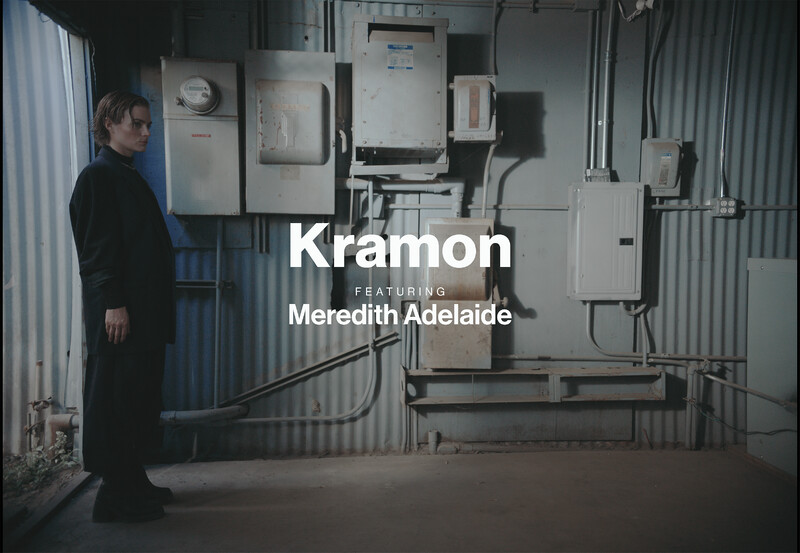
The initial motivation was the fact that the music producer had a marketing budget around his album.
The next inspiration was learning he was invested in the album’s success, and had already hired a team to create content in promotion.
The next inspiration was a jolt of a realization that I have made music videos before, and I could feasibly make one for one of our songs in support of his album and my artistry.
Then the inspiration changed into making sure I was telling the truth.
Then the inspiration was to follow through with this project in the timeline I had, to help prove to myself that in any circumstance, I can create art that aligns with my voice and vision.
From the idea to the finished product, how long did it take for you to make this film?
June 5th I had the initial phone call with Josh Kramon (music producer and exec producer)
June 18th was when I first reached out to my DP Tamara Santos
July 26th was when the video was shot
Gave myself a week to step away for a break, and to go emcee at the Pickathon music festival in Portland, Oregon
August 11th was when the video was finished
How would you describe your film in two words!?
Fractured Unity
Divided Oneness
Unconscious Conscious
Endless Revision
Why Change
What was the biggest obstacle you faced in completing this film?
My emotional experience was the biggest mountain I had to climb about whether I was “worthy” of creating this, asking for money, asking for help, making decisions and feeling like I could trust myself.
The music video’s narrative is a direct reflection of this tumult.
I made a whole collection of blog posts as I was in it that I shared on my Patreon, which can be found here:
There are 5 Stages of Filmmaking: 1) Development. 2) Pre-Production. 3) Production. 4) Post-Production. 5) Distribution.
What is your favorite stage of the process and why?
Hahaha, like the five stages of grief for a terminal illness.
Development / Denial Pre-Production / Anger Production / Bargaining Post-Production / Depression Distribution / Acceptance
My favorite is the process as a whole and how I change from the entire experience, but the most fun I have is during Production, absolutely.
A film set is one of my favorite places to be. The teamwork needed is only paralleled to my 100-person high school choir.
The choices I have to make and not make and the constant shift in responsibility (speaking when I’m both Director AND talent) keeps my brain so occupied and excited that trusting myself and those I’ve brought around me is the only thing I can lean on, and when I do that, I feel invincible.
When did you realize that you wanted to make films?
I used to want to make Pixar films when I was a teenager— I would envision characters and stories flowing along stormwater runoffs. I was obsessed with the shorts they had at the beginning of every film and how they could put me directly in joy and delight.
But it really took shape when I was cast as the lead in a music video for Ash back in 2012, and it was my first ever professional film set. $25,000 budget, 100 crew members. Some water had spilled on set and I tried to grab a napkin to clean it up, but the director interjected and told me there is someone on the crew whose job it is to do that— and I was transported back to my choir days in high school where we each had to work as a team, and sing our parts and listen in order for it to work. So when I saw this set in operation, and everyone had a role, I was like…how can I become part of this?
Then two years of being a Production Assistant while I auditioned for and landed some TV shows and films (Portlandia, Grimm, Leverage), all while creating music…
Now the continued goal is to align my films with my music!
What film have you seen the most in your life?
Oh gosh. Anchorman. HAHAHA.
More niche, but also my favorite film, The American Astronaut.
What other elements of the festival experience can we and other festivals implement to satisfy you and help you further your filmmaking career?
Wanted to first say thank you for giving me the opportunity to show my film… AND this written interview… AND the podcast interview.
Having a platform to share my voice/visions is an incredible feeling.
As for what else could be beneficial… if inspired, sharing my name in rooms I’m not in!
You submitted to the festival via FilmFreeway. How has your experiences been working on the festival platform site?
It has been so easy!
For a first timer doing all this, it has been simple, direct, and expectations are laid out nicely.
What is your favorite meal?
Mashed potatoes with butter, and steak. Plus dessert.
Also any meal anyone cooks me (: I love being fed.
What is next for you? A new film?
I’m currently releasing my debut album, “To Believe I’m the Sun,” and in talks of creating my next video for that (:
If you’d like to support or learn more, you may do so here:
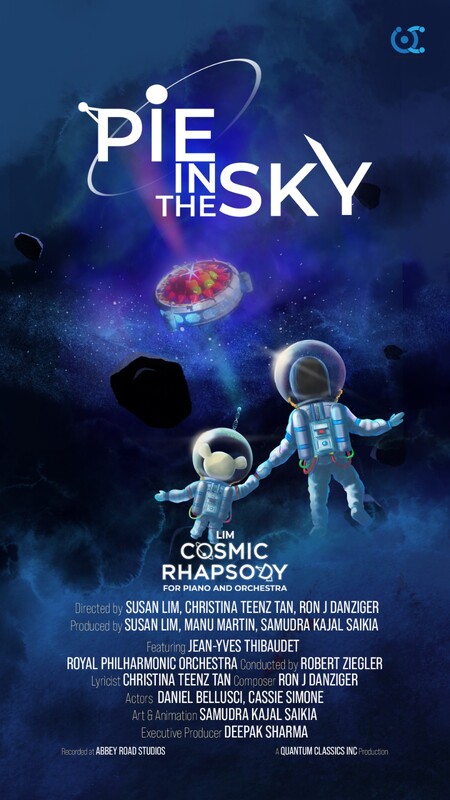
“Pie in the Sky” is an enchanting music video that marries playful animation with the raw power of original recordings at Abbey Road Studio One, and a resplendent orchestral performance at the Barbican Concert Hall, London. The video opens with world-acclaimed pianist Jean-Yves Thibaudet leading the Royal Philharmonic Orchestra conducted by Robert Ziegler, in a captivating orchestral performance, his artistry setting the stage. From this vibrant live spectacle, we’re ushered into a whimsical animated adventure that playfully asks: “What is the ‘pie in the sky’?”
The title of this spirited short Pie in the Sky, which means big dreams that are likely unattainable, contradicts what the fabulous creative team is able to create – – this presentation is not a dream, but a tangible success, professionally, artistically and even romantically.
Frames often offer a bird’s eye view of talented musicians in action, delivering a gorgeous melodic piece. Alternately, we see adorable, animated characters flying through breathtakingly beautiful outer space vistas, and discovering a high-tech utopia. It is a clever filmic decision to intermittently combine this animation with small onscreen boxes of the orchestral musicians playing refrains of the score.
The film does a seamless job juggling shots of the orchestra in fine attire at a formal concert, with them in more relaxed dress at rehearsal in a large, brightly lit studio. Also worthy of mention is the skill of the articulate voice over artists during the animation segments – – so crystal clear and emotive. The absolute highlight of the piece is the culmination of all the hard work of the creators, with a joyful engagement scene – – an actual life experience resulting in an eventual wedding that is not at all “pie in the sky”, but tangible and real.
ALL EYES ON YOU, 23min., UK Directed by Ted Clarke Paranoid couple Adam and Claire move to the peaceful countryside for a fresh start, but quickly become unsettled by a series of sinister interactions with their new neighbours, putting their trust – and relationship – to the test…
Get to know the filmmaker:
1. What motivated you to make this film?
I started out with a determination to make something longer than my previous shorts, wanting room for more plot and character development. But by the time I’d finished a draft and got excited about where the story was going, the runtime was an afterthought and I became much more focused on making this specific project work.
2. From the idea to the finished product, how long did it take for you to make this film?
I wrote my first draft in July of 2024, and started casting in the winter of that year; we shot the whole film in four days during April this year and after spending some months doing post it was finished in July, so it was a year-long process roughly.
3. How would you describe your film in two words!?
Nosy neighbors.
4. What was the biggest obstacle you faced in completing this film?
There was never any one great curveball that threatened the project, however as I began the pre-production I was also starting the final year of my university degree, which took up lots of my time and made it difficult to prioritise the film when I had essays or other projects due in. I managed to schedule production during my Easter break which was very convenient, but the editing process was pretty much simultaneous with my final hand-ins for the degree – on the day of the final deadline, I was staying at my DOP’s house in London to complete the color grading.
5. There are 5 Stages of Filmmaking: 1) Development. 2) Pre-Production. 3) Production. 4) Post-Production. 5) Distribution.
What is your favorite stage of the process and why?
I think the production itself is the most exciting part of the process, being such a rewarding experience for the time spent preparing and getting to see everything come together (fingers crossed), and although it can be stressful, it’s very thrilling. Also, having those moments where the whole cast and crew are gathered in one place all working together is pretty special, and that feeling can’t be replicated by table reads or editing booths.
6. When did you realize that you wanted to make films?
I have always been keen on storytelling, and as a kid my biggest ambition was to be an author, but that was from a perspective where I hadn’t even considered filmmaking as an avenue you could go down. So I think deciding to make films came from a natural progression of wanting to tell stories in the most exciting ways possible, from playing with action figures to filming YouTube videos in my garden. I didn’t truly consider it as a career aspiration until I was probably 14 or 15.
7. What film have you seen the most in your life?
Probably A New Hope. I think there wasn’t a week that went by in my childhood that I didn’t watch at least one Star Wars film. One film that I’ve probably watched as consistently as an adult as I did as a child is Spirited Away, I feel like it can be watched from those two totally different perspectives and enjoyed the same amount – just universally incredible.
8. What other elements of the festival experience can we and other festivals implement to satisfy you and help you further your filmmaking career?
I think that the most important part of the festival experience is being able to interact with viewers and hear people’s thoughts on your work – receiving awards or selections is great, but the rewarding part of the festival circuit should be sharing your films with as many audiences as possible. So festivals that screen films but without any communication or invitation extended to the filmmakers are quite disappointing. As a filmmaker I want to be a part of my film’s success or failures so that I can reap its rewards, or learn how to improve. Being excluded from either is unsatisfying. However I’m happy to report this is far from the case with Thriller/Suspense – one of the most communicative and supportive festivals I have experienced!
9. You submitted to the festival via FilmFreeway. How has your experiences been working on the festival platform site?
FilmFreeway is a very helpful tool for the whole process, it is incredibly easy to seek out the kind of festivals you’re interested in and to research them before submissions. I also like the way they promote films towards festivals too – being approached by festival curators and receiving offers of discount codes etc is very convenient.
10. What is your favorite meal?
A great pizza is hard to top for me.
11. What is next for you? A new film?
I’m currently studying a Master’s degree in Film Production, so throughout I expect to direct at least two/three more shorts, as part of the course as well as independently. Once I’m finished, I plan to start developing a feature!
What’s Locked Behind That Door?, 4min., USA Directed by John Gardner In the visually arresting music video for Lunavox’s “What’s Locked Behind That Door?”, a series of metaphorical doors open onto the full spectrum of human emotion, drawing viewers into a surreal journey through fear, desire, and obsession. These portals also frame the chilling descent of a scientist whose relentless experiments lead him into darkness. Guided by the song’s pulsing rhythm, the two narratives intertwine as human vulnerability and scientific ambition collapse into a single vision of corruption and revelation.
Get to know the filmmaker:
1. What motivated you to make this film?
After two decades of producing brand driven work, where every decision passes through layers of approval, I needed a creative challenge without corporate oversight, something that let me explore my own ideas and push them as far as they could go. I wanted a project that followed instinct instead of consensus.
So I set out to make something that drew on everything I know: music composition, animation, editing, directing, sound design, and post production. As the creator of the post rock project Lunavox, this music video became that outlet. It was a chance to bring all those skills together into one cohesive vision, the kind of challenge I had been missing.
2. From the idea to the finished product, how long did it take for you to make this film?
The project took about eight months from the first concept to the final render. The process involved combining 2D and 3D animation in After Effects and Blender, generating thousands of AI door variations, and compositing, rotoscoping, and match moving them into archival footage. Sourcing and reviewing public domain material was another demanding phase, as finding moments that carried emotional weight and felt cohesive took time and patience. The hardest part, though, was not technical but narrative, shaping a story arc that felt whole. There were many false starts before it finally came together.
3. How would you describe your film in two words!?
Psychologically haunting
4. What was the biggest obstacle you faced in completing this film?
The biggest obstacle was staying accountable to myself, setting clear goals, and following through. Without external deadlines or feedback loops, I had to keep pushing forward even when ideas fell apart. In hindsight, each failed attempt became a way to discover something stronger and more intentional.
5. There are 5 Stages of Filmmaking: 1) Development. 2) Pre-Production. 3) Production. 4) Post-Production. 5) Distribution. What is your favorite stage of the process and why?
Post production! It is the stage where everything comes together – sound design, color grading, and visual effects merging into the final emotional experience. This is also where all the spontaneity happened, as ideas evolved and unexpected moments came to life.
6. When did you realize that you wanted to make films?
Even though I didn’t realize it at the time, it probably started when I was a teenager. One summer, my brother-in-law and I put together a ridiculous home video movie inspired by “The Terminator,” which we called “Tarpinator.” The following summer, it grew into a series of silly films with some close friends, centered around a character called “Little Jimmy,” with fake commercials sprinkled throughout. We were using consumer grade equipment, so we only had one chance to get each take right, and that limitation led to some truly hysterical and absurd moments. I also spent a lot of time making flipbook style animations in my schoolbooks, so in hindsight, all the signs were there pretty early on.
7. What film have you seen the most in your life?
Probably Dr. Strangelove. I have seen it more times than I can count, and each viewing still reveals something new, whether it is a line of dialogue, a visual detail, or a subtle bit of absurd humor.
8. What other elements of the festival experience can we and other festivals implement to satisfy you and help you further your filmmaking career?
The most valuable outcome would be connections leading to collaborative opportunities or commercial work that allows for creative experimentation.
9. You submitted to the festival via FilmFreeway. How has your experiences been working on the festival platform site?
FilmFreeway has been exceptional. The platform is intuitive, easy to navigate, and makes submitting and managing festival entries straightforward and stress free.
10. What is your favorite meal?
Greek-Lebanese is by far my favorite type of meal!
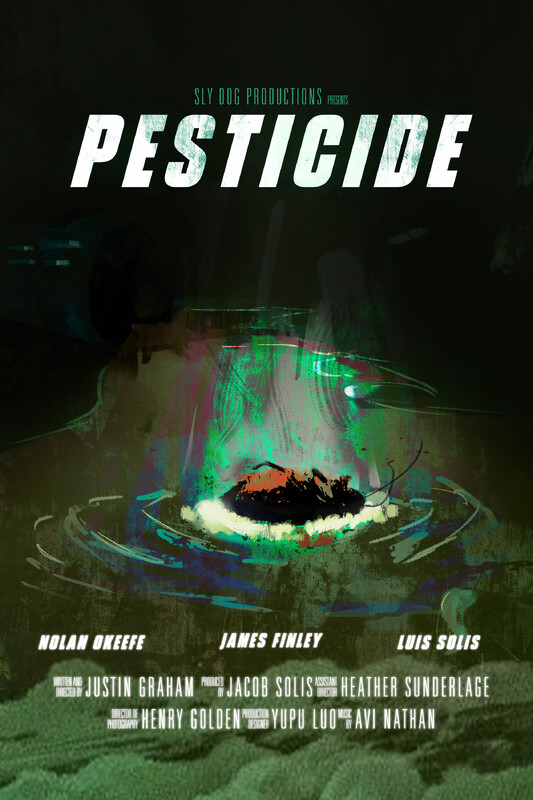
Pesticide, 7min,. USA Directed by Justin Graham An exterminator duels both late night insects and an overbearing car salesman.
Get to know the filmmaker:
1. What motivated you to make this film?
It started as an exercise for my thesis pre-production studio course. The added difficulty of writing our short scripts was that each character could only be allotted 6 lines total. I had already brainstormed the visual of an exterminator at night and wanted to transform that into a comedic/cynical take on workplaces. My producer finding the free location of a car dealership acted as the largest inspiration for planning images that would push this central theme.
2. From the idea to the finished product, how long did it take for you to make this film?
I started brainstorming and creating script drafts during late August-early September 2024, initial production took place in November 2024, and post-production occurred throughout December 2024-August 2025.
3. How would you describe your film in two words!?
Good Drink/Cyclical Cynicism
4. What was the biggest obstacle you faced in completing this film?
The biggest obstacle was needing to completely rearrange our shooting schedule on the day due to mechanics still working in the garage when we arrived. Since we had 10 hours on a singular day to capture everything, my assistant director and crew went into overdrive. Their efficiency and professionalism saved the film. Completing the score additionally turned out to be another lengthy process.
5. What were your initial reactions when watching the audience talking about your film in the feedback video?
My projects have never really been seen and criticized beyond my peers, friends, instructors, and family. Being presented with the thoughts of others outside my close bubble was both very intriguing and helpful. Having more eyes and criticism on any product can only lead to a more refined result, so I genuinely appreciated the different perspectives.
6. When did you realize that you wanted to make films?
During my freshman year of high school, a few friends and I were given an assignment to recreate a scene from A Separate Peace. After that, we kept repeating the process of making our own original short videos. I decided that film school was the right path for me and continue to work on projects there.
7. What film have you seen the most in your life?
Heat
8. What other elements of the festival experience can we and other festivals implement to satisfy you and help you further your filmmaking career?
Having an in-person event is always a plus!
9. You submitted to the festival via FilmFreeway. How has your experiences been working on the festival platform site?
Mostly positive with some small technical hiccups
10. What is your favorite meal?
Jack’s pizza
11. What is next for you? A new film?
I am in the process of completing post-production for my thesis film. I’ll be spending spring in LA for my final semester and hopefully find some sort of career path through that experience.
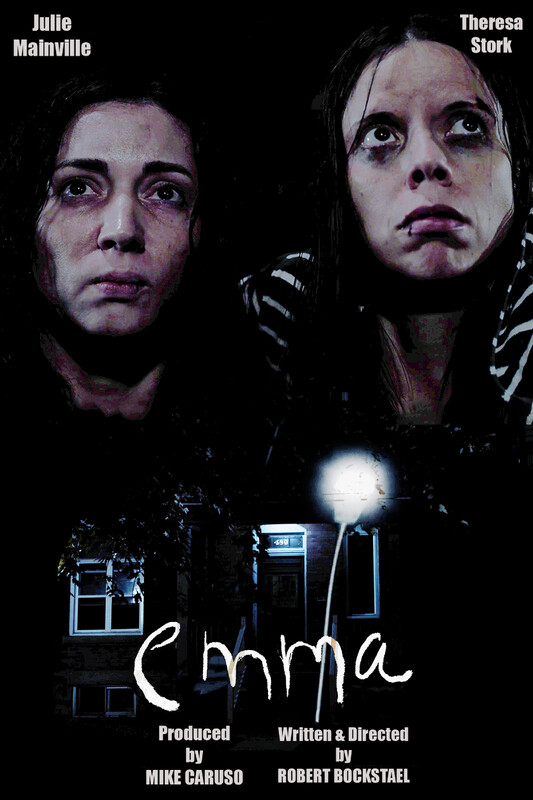
Emma, 11min., Canada Directed by Robert Bockstael Two women, associated through addiction are spiraling downwards. In a rare moment of clarity, nearing the end of their salvageable lives, Emma remembers a long-forgotten ‘secret stash’ of money she and her grandmother kept for an emergency. Embarking on a quest for this treasure – this perceived salvation – they find instead an offer of redemption.
Get to know director Robert Bockstael & producer Mike Caruso:
1. What motivated you to make this film?
Robert Bockstael: Michael contacted me and asked if I’d like to pitch a few script ideas to him as he was interested in producing a short film to submit to a festival in Montreal. He had an idea and would like to flesh it out. I came up with three scenarios based on his idea and pitched them to him. He liked the Emma storyline the best. I fleshed it out into a short script.
Then, he asked if I’d like to direct it! I agreed and he gathered the crew and the location etc. We shot it all in a weekend.
Mike Caruso: I was interested in producing a short film for the ACTRA Montreal Short Film Festival back in July 2023.
I contacted my friend Robert and asked him if he’d like to pitch a few script ideas to me. I had an idea in mind, wanted to see kind of stories he could come up with. Robert sent me 3 scenarios based on my idea. I liked the Emma storyline the best. As soon as I read it, I knew it had to be produced. It had to come to life on screen. This story had to be told. So, I asked him if he would direct. I believe the writer of a script is the best person to direct it, having the experience, since it came from their own vision. Robert agreed and I began to assemble the crew and source the location for the film It was difficult finding the right house to rent… luckily, I found one just in time!
2. From the idea to the finished product, how long did it take for you to make this film?
RB: Shooting in three days. Postproduction – over a year. Michael knows the exact dates, but it was a lengthy process interrupted by lots of life events plus many issues with the initial edits. We were so glad to finally get a great editor on board, the amazing film maker Derek Price, who brought Emma across the finish line at the end of a long marathon!
MC: Jul 2023-Dec 2024 Shooting the film was the quickest part of the process. Post-production took an exceptionally long time, especially the editing. But in the end, we brought a rough cut to an amazing editor named Derek Price, who basically brought the film to it’s full potential
3. How would you describe your film in two words!?
RB: Unforeseen redemption.
MC: Struggle/Hope
4. What was the biggest obstacle you faced in completing this film?
RB: The initial edits were unsatisfactory, and it wasn’t until we acquired a new editor did, we finally see the light at the end of the tunnel. Michael may want to add to this.
MC: Editing… After reviewing the raw footage, I acquired a rough cut from the initial editor, but it unable to bring across the screen all talent and hard work the actors had put into their performances and wasn’t telling the right story. That earlier version was extremely limited, to say the least. It was holding the film way back from what it really had to offer.
5. What were your initial reactions when watching the audience talking about your film in the feedback video?
RB: I was absolutely thrilled by the time and attention they took in analyzing all the various elements of the film – so very much appreciated!!
MC: I could tell they really analyzed the film. The comments about the way actors portrayed the character were spot-on. We appreciate all their time and attention to detail.
6. When did you realize that you wanted to make films?
RB: As a kid. Now, I have been doing it from both sides of the camera for four decades and I still feel as though I’m just getting started. The remarkable thing about it is that the learning process never ends.
MC: I always had a camera in my hands… When I was a kid, I would make stop-motion videos with my action figures. I would essentially create a scene using to-scale backgrounds and place the characters in various positions to capture each of their individual movements, an inch at a time. As I grew up, I’d bring my camcorder with me most of the time and document everyday life. At 18yrs old, I made a short film to submit to The Movie Network (TMN) in LA for a chance to win $1Million to turn it into a full-length feature. I rendered it to VHS and sent it off to LA in the mail. In my 20’s I attended the Toronto Film School and gained more experience.
7. What film have you seen the most in your life?
RB: Chitty Chitty Bang Bang and/or The Princess Bride. Both brilliant, near perfect films.
MC: It’s hard to say which one film I’ve seen the most… there’s too many. I would say I was highly inspired by all the films from the 90’s.
8. What other elements of the festival experience can we and other festivals implement to satisfy you and help you further your filmmaking career?
RB: What you are doing is fantastic! The assistance in publicizing and promoting the film and its creators is priceless and the feedback from the audience is worth its weight in gold! Thank you so very much!
MC: For the winning filmmakers, the festival has met my expectations in terms of its ability to reach a wide array of people through its network and locations, as well as promoting the film even more through its various resources, including the extra options it provides.
9. You submitted to the festival via FilmFreeway. How has your experiences been working on the festival platform site?
RB: Ask Michael this question. I think it is an amazing thing.
MC: It’s an excellent platform for filmmakers to connect with audiences and submit their films to festivals worldwide
10. What is your favorite meal?
RB: Steak frites, au point, in any small bistro in any large city in either France or Spain.
MC: Veal scaloppini and mashed potatoes with vegetables at an authentic Italian restaurant.
11. What is next for you? A new film?
RB: Michael and I have teamed up with a cinematographer here in Ottawa by the name of Sean Weekes. Every shot is a painting. We are a few days away from wrapping a short film, which is a meditation on finding joy in unexpected places when in the deepest throes of grief.
MC: Robert and I have joined forces again on our second film. At this time, we are working as an exceptionally talented cinematographer named Sean Weekes. I love collaborating with fellow artists who aren’t afraid of going the extra mile to get the rightshot. That’s Sean. We’re wrapping a short film right now which again, is emotionally powerful. I love making films that “tackle the issues” and present them through unconventional and unexpected ways
1) What is the theme of your poem?
How the creative process works, and how the different factors – inspiration, tradition, beauty and in particular melody – all work together and relate.
2) What motivated you to write this poem?
I had been reading into prosody and how to create rhythm in poetry at the time. As soon as I came up with the image of each of these different creative factors as Muses, working with Saturn, I started – and wrote it in blank verse. A few months later, I decided an Ode structure would work even better, given I was essentially praising Melody, and so I set to changing it all around, with more of an emphasis on formal polish. It came out to my liking, and I started sending it around for publication.
3) How long have you been writing poetry?
A number of years now – but more seriously this year. It’s a passion of mine.
4) If you could have dinner with one person (dead or alive), who would that be?
Either Shakespeare or William Blake – I think they both knew some pretty esoteric things, and it would be interesting to pick their brains.
5) What influenced you to submit to have your poetry performed by a professional actor?
I thought the poem, with its rhythm, rhyme and cadences, would make for an interesting performance. I wasn’t wrong!
6) Do you write other works? scripts? Short Stories? Etc..?
I’ve been building a meta-poetic system and lecture series called ‘The Ladder of Poetryhttps://essentialpoetry.substack.com/p/introducing-the-ladder-of-poetry’ on my Essential Poetry substack, and work with artists to help them understand their unique creative drive and signature. So lots of my creativity, if it doesn’t flow into poetry, goes in that direction.
7) What is your passion in life?
Poetry and teaching (I’m an English teacher), and – through my Ladder of Poetry framework – teaching poetry! So if anyone reading this is interested in learning more, definitely reach out – I’d love to help you understand your own approach to creativity at a deep level.
—–
Let us sing, Muse, not of your treacled, honeyed lips,
from which the murmurously buzzing poet drinks,
launching a host strong some dozen-dozen ships
only to cry ‘Calypso!’ at the last and in her deep eyes sink;
nor of your distant sister, the pale Lady Memory,
who dwells in the skies above, concealed by her long,
dark and starry robe, who sees all and knows much
of the blind man she loves, the seeming-fathoms of his mysteries.
No, to the youngest of your line and least themed in song
we will bend our humble rhyme with earnest and loving touch.
See how lightly as a cloud she frolics upon and passes
the verdure of Elysium, blown as by a breeze that haunts
the highest mountains and stirs the pleasant grasses,
this our Melody, who with her playful, ever-graceful nature taunts
her sisters and the solemn tunings of their strange, uncanny thoughts
in bursts and fits of happy disruption; sometimes she feigns their manners
(favourite pastime of the youngest child), sometimes she hoards her laurels
to work into their tightened tresses, and with unfurling passion exhorts
them to forget their office, let down their hair, for once unscroll their banners,
and draws from them, if this fails, another bout of sisterly quarrels.
For oft she breaks (such is child-cunning) their sage, impassioned circle
peacocked with fanned arrays and ravishments of girly colours;
they, all-knowing, cease their chantless tracts and open up their oracle,
till she their warm and loving beams accepts with preening flutters,
and imbues them with her native touch, making solemn tresses gay again
which, trinket-trapped, swing now as once they did in the golden youth of childhood;
and softened are their magic tones which treat of her with human and with hearty laugh.
So all, unbeknown to mirthful Melody, approaches her gentle ken,
meeting the errant music of the wild but natural wood
or of such as he who sings, holding steadfast the crooked shepherd’s staff.
By the ancient farmhouse with its incense rich of oak and cedar chips
stands the winter-weathered sovereign of that line, high, oft-consulted Saturn,
in whose dread wave the fired and mutinous city of Atlantis smoking dipped
to learn the icy currents of his rage and the consequence of passion;
ah, but in her presence his aspect is changed and less of terror now,
almost softened are his eyes, as even old ocean must be when the long-labouring sun
pierces the cloudy confusion of night to join in hands with earth,
his patient child, again, and not so deep seem the furrows in his brow;
for awhile Hydra rests with Atlantis, all his troubles are done
and he can joy with his daughter his share of mirth.
So is Saturn and his noble train made mellow
and reminded of their human traces by the playful youth,
and all are linked, one to each and man to his captive fellow,
all in a line with the splendours of radiant truth:
impeccable beauty’s dress, storied tradition
and the purity of rhythm, a comb of honey rich
for the priestly poet to drink deep and gift
to the thirsting masses of his mission,
who cry out nightly for a higher pitch
to harmonise with and curb their errant drift

 Festival Reviews