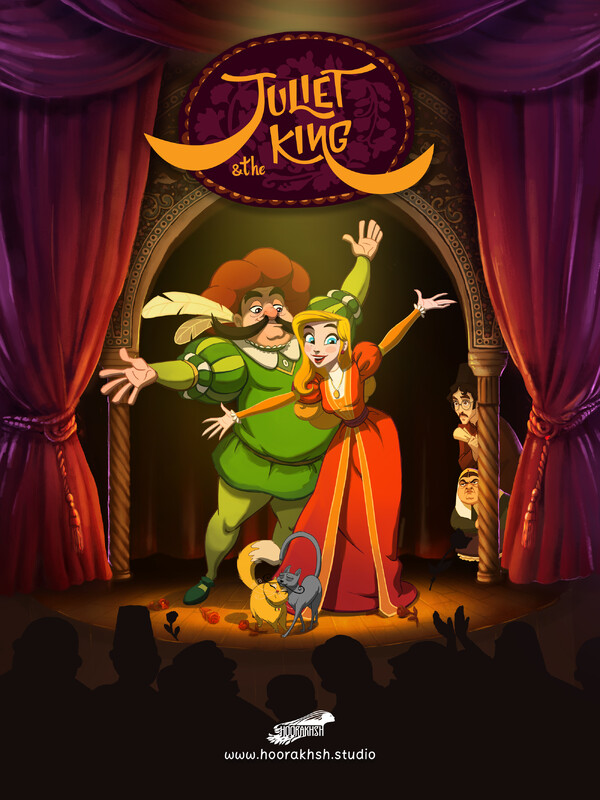
JULIET & THE KING, 92min., Iran
Directed by Ashkan Rahgozar
The Iranian King gets an invitation to visit France. While visiting a “Romeo and Juliet” play in Paris, the actress catches his eye. He falls in love with her so deeply that he asks her to perform the same play in Tehran, so he can impress her and win her heart. Julie, the actress, decides to take this chance with the help of her friend Jamal. But she suddenly finds herself among jealous court ladies.
https://hoorakhsh.studio/works/juliette-and-the-king/
Get to know the filmmaker:
1. What motivated you to make this film?
My motivation for making Juliet goes back to my upbringing. I grew up in a family where history was an inseparable part of everyday life. My father had a large personal library, and I would say that about two-thirds of it consisted of history books, especially books focused on the Qajar period. His own field of study was largely centered on Qajar history.
At the same time, the form of this period—the way Iran began to enter modernity from a traditional structure—was always fascinating to me. Alongside my father’s studies, I was exposed to many of these books; sometimes he would recommend them to us, and we would read them. Gradually, through this process, the historical trajectory of Iran, its cultural interactions with both the West and the East—particularly with the West during the Qajar era—became very interesting to me. These interactions played an important role in shaping Iran’s cultural development and its transformation from tradition toward modernity.
All of this stayed with me, and eventually I felt it would be meaningful to explore these ideas within the framework of a film, and to give them form through a cinematic idea.
2. From the idea to the finished product, how long did it take for you to make this film?
From the initial idea to the completion of the film, it took around seven years. During this period, about a year and a half was spent moving forward at a very slow pace due to financial difficulties. After we were able to resolve these issues, we managed to continue the production with a much better and more consistent speed.
3. How would you describe your film in two words?
Love and Art
4. What was the biggest obstacle you faced in completing this film?
The biggest obstacle we faced during the production was a legal dispute with the project’s investor. Due to the economic conditions in Iran, the significant devaluation of the national currency and the sharp rise in production costs, the project experienced a serious financial shock. Our investor was not willing to accept this situation, which led to a very heavy legal conflict.
This dispute lasted for about a year and a half. During that time, we were under intense financial pressure while also dealing with a prolonged legal process. Eventually, we were able to reach an agreement, and part of the necessary investment was secured, which allowed us to complete the film.
5. There are 5 stages of filmmaking. What is your favorite stage of the process and why?
I really enjoy the development stage. It is the phase where an idea starts from vague mental images and written notes—at first, it exists only as text and unclear images in my mind. These images are usually not very sharp at the beginning, but gradually they take on a concrete form.
During this stage, a very interesting synergy happens between me and the artists who are working on the initial concepts and the early visual development of the project. This process of turning something abstract into something tangible is the part I enjoy the most, and it is also the most exciting stage for me.
6. When did you realize that you wanted to make films?
I realized quite early that I wanted to become an animation filmmaker, probably around the age of 15 or 16. The reason was that I was interested in many different things at the same time—I loved dinosaurs, history, drawing, and music.
I came to the conclusion that if I wanted to pursue all these interests together—developing ideas alongside drawing, music, and many other elements—animation was the best medium for that. From that age, around 15 or 16, I genuinely knew that this would be my profession.
7. What film have you seen the most in your life?
Princess Mononoke is the film I have watched more than any other in my life.
8. What other elements of the festival experience can we and other festivals implement to satisfy you and help you further your filmmaking career?
I think the most important thing that motivates a filmmaker at a festival is how much the film is actually seen. If a festival can attract a larger audience and give the filmmaker more exposure, along with meaningful feedback—sometimes positive, sometimes negative—that can greatly increase the value and impact of the festival.
The more a festival is able to draw audiences and create real engagement with the films, the more attractive and meaningful it becomes for filmmakers.
9. You submitted to the festival via FilmFreeway. How has your experience been working on the festival platform site?
FilmFreeway is probably the best platform for submitting films to festivals. It is very good, highly functional, and fast to use. The main issue, however, is that it can be quite expensive at times. For us, especially when submitting to international festivals from Iran, these costs can become significant.
Beyond the fees themselves, there are also challenges related to payment transfers, as we do not have access to international accounts or full connectivity to the global banking system. This makes the process more difficult for us. That said, in terms of usability and functionality, FilmFreeway itself is a very effective platform.
10. What is your favorite meal?
My favorite meal is Iranian kebab, specifically koobideh kebab.
11. What is next for you? A new film?
I am always engaged in various projects. I work as a co-producer on different projects from around the world, and I also direct several animation projects. Regarding my own film work, I am currently developing a new project that I am very excited about. I hope to complete it and be able to present it within the next two years.
Watch the Audience Feedback Video:
 Festival Reviews