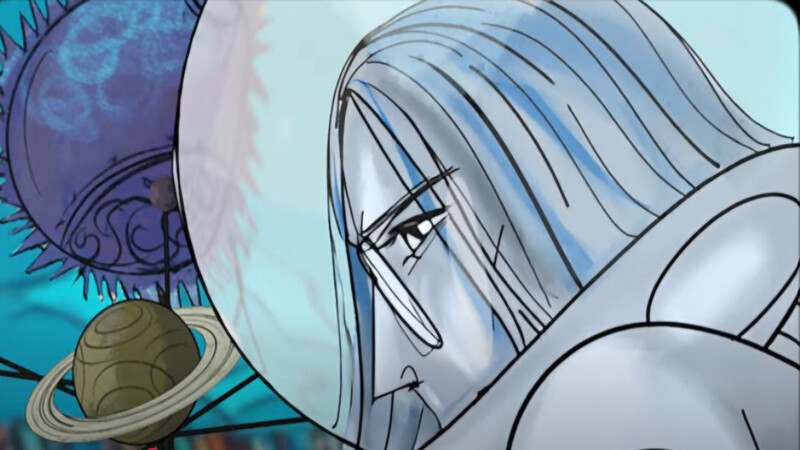
The Planet That Doesn’t Exist, 8min., Israel
Directed by Nadav Embon
Professor Star l’Etoile set at her desk, her notes, were packed into spiral leather bound notebooks, stacked one atop of the other.
Get to know the filmmaker:
1. What motivated you to make this film?
First and foremost, the motivation was to commemorate a young artist whose life was taken in a tragic and violent way. Honoring Navy Bird and preserving her voice felt essential.
As I began working with the material, the connection became deeply personal. As a child, comic books were one of my great passions, and science fiction in particular shaped my imagination. Encountering Navy’s work felt like rediscovering something intimate and formative.
Another strong motivation was the trust Navy Bird’s mother placed in me. The fact that she accepted my creative proposals and vision carried a great responsibility. After meeting her, I felt a clear commitment: to do justice to the work, and to create something she could feel was respectful, thoughtful, and true.
2. From the idea to the finished product, how long did it take you to make this film?
Roughly ten months.
It could have been shorter—perhaps closer to eight—but a significant amount of time was devoted to pre-production. I wanted the storyboard to feel cinematic while remaining deeply connected to the source material. Finding that balance between fidelity to the comic and creating a film language of its own took time, but it was essential.
3. How would you describe your film in two words?
Poetic tragedy.
4. What was the biggest obstacle you faced in completing this film?
Beyond the usual production challenges, the core difficulty was emotional.
The producing and initiating figure of this project was the writer’s mother. This was not a conventional creative collaboration—it was a commemorative work, created within the first year of profound grief after a terrorist attack. Emotions, memories, and visions naturally carried immense weight.
In any creative process there are tensions, but here those tensions were amplified by loss, responsibility, and the sense of mission we carried. Navigating that emotional landscape with sensitivity, honesty, and care was the greatest challenge.
5. What were your initial reactions when watching the audience talk about your film in the feedback video?
It was deeply moving.
Seeing viewers grasp the atmosphere, connect emotionally, and articulate the obsessive drive of the main character was incredibly powerful. The audience understood her tenacity—her relentless pursuit of a personal “holy grail”—and also the inevitability of where that pursuit leads.
Realizing that this emotional journey was successfully conveyed to the audience was profoundly validating.
Watch the Audience Feedback Video:
6. When did you realize that you wanted to make films?
I don’t remember a specific moment—it feels like something that was always there.
As a child, I watched films obsessively, often rewatching the same ones again and again. Animation played a huge role in my upbringing. Even as a teenager, I continued watching cartoons intensely. My mother once asked me if I was trying to hold on to my childhood.
Only when I was accepted into animation school did she say, “Now I understand—you were researching your career.”
Much of my inspiration came from animation, fantasy, and adventure films of the 1980s.
7. What film have you seen the most in your life?
The NeverEnding Story.
Growing up, I watched it on VHS so many times that the tape eventually wore out and stopped working. I probably still know the film by heart to this day—if you want to test me.
8. What other elements of the festival experience can we and other festivals implement to satisfy you and help you further your filmmaking career?
The experience was meaningful and generous, and I appreciate the way the festival created space for conversation and reflection around the film. Continued opportunities for dialogue between filmmakers and audiences are invaluable.
9. You submitted to the festival via FilmFreeway. How has your experience been working with the platform?
FilmFreeway remains a clear and accessible platform that makes the submission process straightforward and transparent, allowing filmmakers to focus on the work itself.
10. What is your favorite meal?
If I had to choose one: asado.
As someone of Argentinian descent, a well-cooked steak shared as part of an asado dinner will always feel like home.
11. What is next for you? A new film?
Yes.
This project sparked the development of another short animated film based on Navy Bird’s larger and more complex graphic novel, Arlequino and Pierrot. I am part of the production team, and we are very excited about its potential.
The project is more ambitious, with many moving parts. It leans toward fantasy with touches of science fiction and carries the symbolic richness that defined Navy Bird’s work. At the moment, we are seeking support and resources, including crowdfunding, to bring it fully to life.
 Festival Reviews