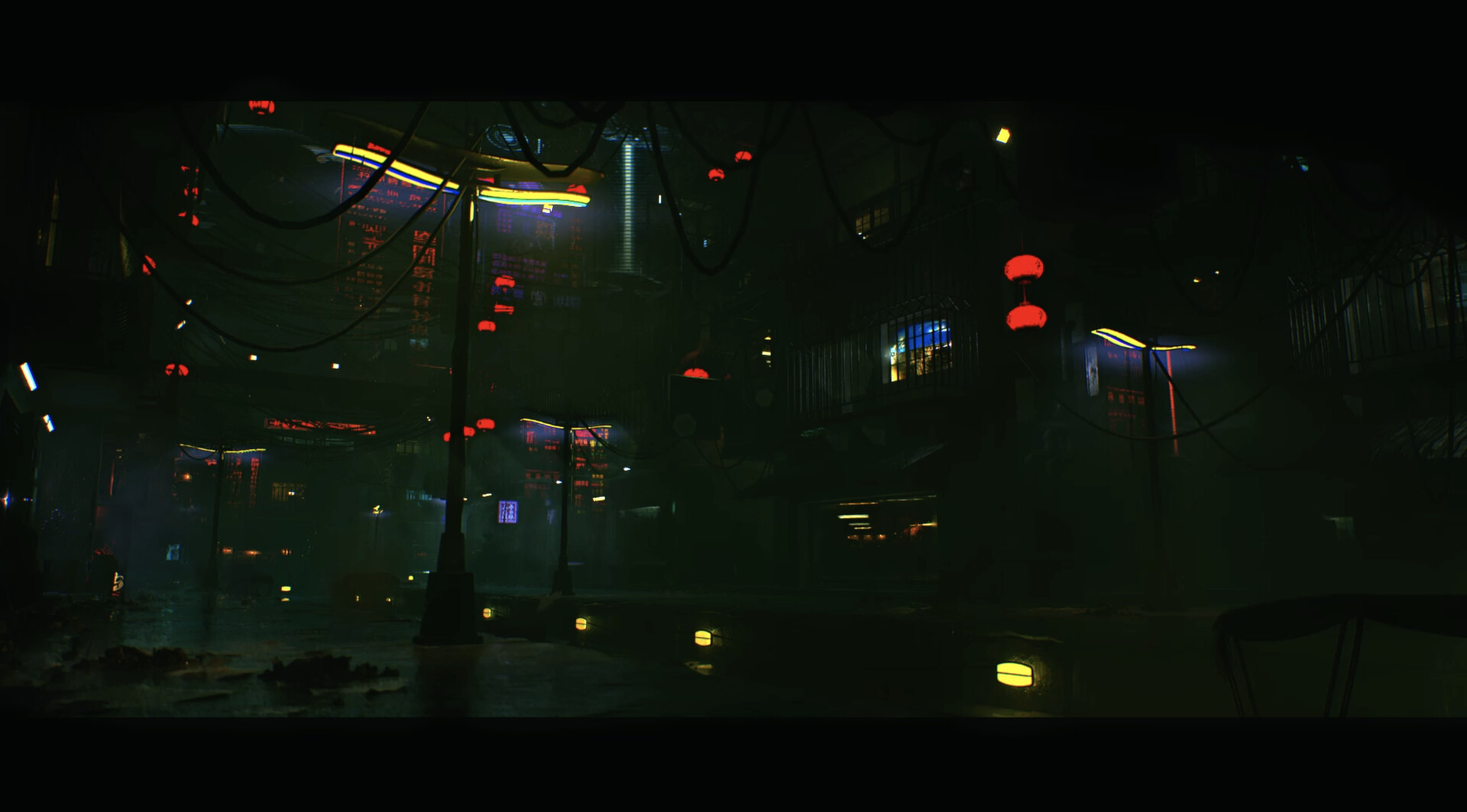
Music Video made entirely in Unreal Engine 5 for the song “BuddhaMachine=HMA” and based off of the short story “Rain Drops”
The plot of the music video pulls and expands upon the short story, whose plot is as follows: a worn out detective in future Beijing attempts to solve a series of bizarre murders that involve a street drug called ‘Rain Drops’, that purports to send people directly to heaven after use.
1. What motivated you to make this film?
After I finished my album, I planned on writing short stories for each of the songs. At the same time my fascination with the workflow and possibilities of Unreal Engine 5 started to grow. I work in film production and have seen people implement it before, but it never crossed my mind that I could do it. So one day the need for a music video crossed with the desire to learn a new skill/program, and I decided to embark on my Unreal Engine journey. I tried to keep it simple at first, use premade assets, touch them up here and there for specific shots. But mostly my goal was to learn the camera and rendering system and see if I could make something compelling and interesting with it.
2. From the idea to the finished product, how long did it take for you to make this film?
It took longer than I hoped! My day job is a sound mixer/designer and composer for film. I think from idea conception to final exports and uploads it took me about 9 months. I could only work on it in my spare time however so it took a while.
3. How would you describe your film in two words!?
Meditative Cyberpunk
4. What was the biggest obstacle you faced in completing this film?
Besides learning a whole new workflow (I’ve never worked with a 3D rendering system or video game engine for that matter), I think the hardest part was understanding and utilizing UE5’s complex rendering engine. It took many many tries in some cases to get it to pump out the shots I needed. Many YouTube tutorials were watched and many a coffee was drunk.
5. There are 5 stages of the filmmaking process: Development. Pre-Production. Production. Post-Production. Distribution.
What is your favorite stage of the filmmaking process?
For me, if this was shooting out in the real world and not in UE5, I would say all of the stages except for production are my favorite. I used to direct music videos when I was younger and the development/pre-production process was always fun and exciting. It’s where the psych was the highest and you came up with all your brilliant and wacky ideas before production time showed up with a wet blanket to tell you what you were actually going to get. I never felt like on any project I directed that I got everything like I hoped it would be. People tell me that’s normal, but I hated the feeling. It was like pulling valuables from a burning building. In post production you can finally go into a dark room with just a few people and finally have some alone time with the pieces you’ve collected. There is when, what you actually made, starts to take shape and you get to be creative again. It can be a cold wet blanket as well, but I’ve always preferred the delicate and exacting lessons post shows you (PUs, color, sound design) to the chaotic and panic-y lessons you learn on set. When you work with UE5 though you get to direct from the comfort of your own home in your pajamas! Nothing better than that!
6. When did you realize that you wanted to make films?
Probably when I was around 8 or 9? I don’t remember exactly when the moment was, but I always was fascinated with cameras and making movies with my action figures in my spare time as a kid.
7. What film have you seen the most times in your life?
Great question! It’s a deep cut, but probably the 2002 cult movie The Mothman Prophecies I’d say. It may not be on anyone’s top 10 lists, but it had a huge impact on me growing up. Especially in my sound design career. The director Mark Pellington used to direct all these weird and surreal spots for MTV back in the day as well as direct some incredible music videos. On the film, they even went so far as to hire the sound designer and composer before the DP so they could make sounds, music, and atmospheres that they could play on set and cut against. This movie really solidified in my mind that films are a marriage of sound and image together, and that cinema’s true power lies in the tango between those two elements. It’s what separates it from all other art forms. Also, if you look back at some of Mark Pellington’s old work you can see that his style certainly had an impact on this video.
8. In a perfect world: Who would you like to work with/collaborate with on a film?
As a sound designer I’d say I’d love (but would also be very nervous) to work with David Fincher, his attention to detail and allowance for his collaborators to dig deeper is something I crave on a lot of the projects I work on. As a film composer I’d love to work with Lynne Ramsay or Zach Cregger. As a director I am not sure! Just people whose work I respect and are great to be around, in this business there is so much chaos that can happen at any step of the process that it’s imperative to have your people around you.
9. You submitted to the festival via FilmFreeway. How has your experiences been working on the festival platform site?
Easy peasy!
10. What is your favorite meal?
At the moment I love a good Poke Bowl
11. What is next for you? A new film?
On top of running my post production business Dragonfly Audio Post with my friend Ben. I am working on two short films and writing a lot! One short film is a UE5 live action hybrid thing and the other is all live action. It is a blessing and a curse sometimes that my brain likes to keep myself this busy. But if I get psyched about something I try to allow myself to embark and follow it wherever it leads! The discovery is part of the fun.
 Festival Reviews