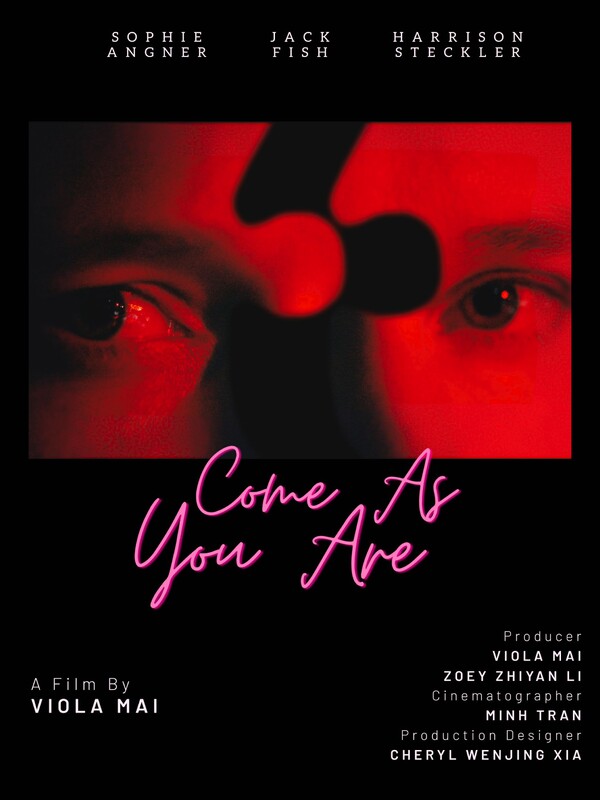
A woman trapped in her husband’s football obsession stumbles into a fleeting connection with a stranger. The city conspires—an elevator ride, a hallway, a spark of possibility. But the outcome she chooses is as funny as it is freeing.
What motivated you to make this film?
I wanted to make a very short film that sits inside the quiet spaces of modern relationships: marriage, friendship, and a woman's relationship with herself within a marriage. I'm drawn to moments that appear ordinary on the surface but carry emotional weight underneath. The film leads the audience toward the suggestion of an impulsive affair, only to gently turn away from it, revealing a more intimate truth and leaving behind a quiet, knowing smile. For me, it was about exploring how expectation, desire, and self-awareness intersect in small, everyday moments.
From the idea to the finished product, how long did it take for you to make this film?
4-5 months.
How would you describe your film in two words!?
Intimate and witty.
What was the biggest obstacle you faced in completing this film?
The driving scene was the most difficult technically and conceptually. We tested different camera rigs, cars, streets, and times of day to find a space that felt alive and honest without becoming unsafe. That balance between control and surrender became a metaphor for the film itself. Our actor, Sophie Angner, approached the scene with incredible calm and precision, which allowed the moment to breathe and gave me the confidence to trust the stillness.
There are 5 stages of the filmmaking process: Development. Pre-Production. Production. Post-Production. Distribution.
What is your favorite stage of the filmmaking process?
I’m deeply drawn to development because it’s the phase where a project holds immense possibility when nothing is fixed yet, and the film can still become many different things. It’s a space of curiosity and sensitivity, where I feel most open to the world around me and can pull inspiration from the smallest details of everyday life. At the same time, production is equally meaningful to me, because it’s the core of filmmaking: collaboration. Working with a great team is such a privilege. I truly believe that the only thing better than making art is making art with your friends, and that was absolutely the case on this project.
Witnessing the ideas that once lived only in my head and on the page slowly transform into something tangible through the creativity, intuition, and generosity of everyone involved still gives me chills. Seeing a treatment turn into lived moments, performances, and images is one of the most rewarding and precious experiences in life, and it’s what keeps me returning to filmmaking again and again.
- When did you realize that you wanted to make films?
I’ve always been deeply moved by films, but I didn’t fully understand filmmaking as a language until I made my first one. That experience showed me that film could hold contradictions, silences, and emotions I couldn’t articulate otherwise. Once I realized that, it felt less like a choice and more like a necessity.
- What film have you seen the most times in your life?
Eat Drink Man Woman by Ang Lee and The 400 Blows by François Truffaut, both films return to the question of family, identity, and growing up in ways that feel endlessly human.
- In a perfect world: Who would you like to work with/collaborate with on a film?
Isabelle Huppert and Benicio del Toro, both fearless and endlessly surprising. I’d also love to collaborate with Phoebe Waller-Bridge, whose work is sharp, funny, and emotionally devastating in the best way, and with cinematographer Claire Mathon, whose images feel so intimate they almost breathe. In a perfect world, that would be a dream team.
- You submitted to the festival via FilmFreeway. How has your experiences been working on the festival platform site?
It’s been very good.
- What is your favorite meal?
Anything Cantonese!
- What is next for you? A new film?
Yes. I recently wrote a new script and am currently submitting it to screenplay competitions and raising funding. It’s titled Being Here Is Everything. It follows an undocumented Asian teenage girl who runs away from home and journeys into the California desert. At its core, it’s a film about displacement, survival, and what it means to exist in a place that both rejects and defines you.
 Festival Reviews