Inspired by true events. Faced with terminal cancer, a beloved acting teacher rallies his favourite students one last time to stage his final play.
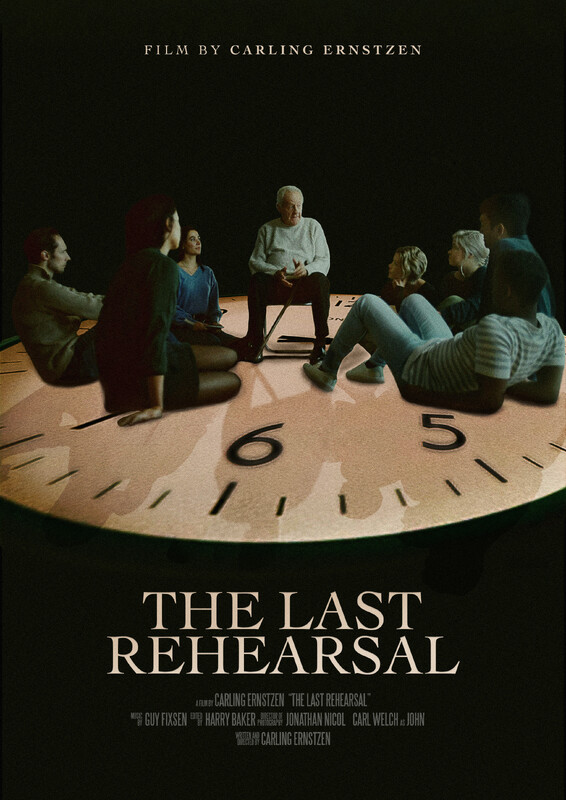
1. What motivated you to make this film?
It began with a group of close acting friends in London who wanted a project to work on together, purely for the joy of acting together again.
The story itself is rooted in the loss of a dear acting teacher and mentor who passed away while we were rehearsing a play he had written for our troupe. At the time, none of us knew it would be his final work. When he died, what I felt most sharply was not only grief, but a creative rupture. He was someone who gave language to us as artists, and suddenly that voice was gone.
I wrote The Last Rehearsal instinctively in response to that absence. It came from a simple question: who carries the work forward when a guiding voice disappears? The film became a meditation on unfinished work, mentorship, and artistic inheritance. It is inspired by true events, but it is not a literal retelling. A small number of my mentor’s words to me appear as voiceover, used sparingly and with intention, not as explanation, but as presence.
2. From the idea to the finished product, how long did it take you to make this film?
The script was written around seven years ago, at the very beginning of my writing journey. At the time, it was deeply personal, so I kept it private.
About two years ago, a group of my acting friends and I were talking about wanting to collaborate again. One of the actors who went on to play the protagonist remembered the script clearly and strongly encouraged me to return to it. He championed it as the project we should make together, and that recognition became the catalyst for bringing The Last Rehearsal back to life.
From there, the process moved very organically.
We shot over five days, wrapping principal photography at the end of November 2023. We went into post-production in January 2024, and the film was completed in March 2025. From shoot to final delivery, the process took roughly a year and a half.
3. How would you describe your film in two words?
Unfinished inheritance.
4. What was the biggest obstacle you faced in completing this film?
Stepping fully into directing.
I come from an acting background, and directing was not something I initially set out to do. It required trusting my instincts while holding the emotional and creative centre of the work. What made it possible was the generosity and trust and skills of the cast and a brilliantly supportive seasoned crew, who approached the material with care, intelligence and belief.
5. What is your favourite stage of the filmmaking process?
Honestly, I have loved every stage of the process. Pre-production, production, and post-production each brought a different kind of discovery, and each was rewarding in its own right.
If I had to choose, it would be the creative thrill of inception. Seeing the characters and the world come to life for the first time in rehearsal was unforgettable. I remember floating home afterwards, in awe of watching a group galvanise around an idea and make something feel suddenly real.
6. When did you realize that you wanted to make films?
I started in music at school piano and singing, and then trained as an actor at a film school in Cape Town called AFDA, with music as a sub-major. Acting always felt instinctive, particularly film acting. I was drawn to subtext, emotional structure, and script analysis more than performance for its own sake.
Writing emerged later, almost accidentally, and directing followed naturally from that. The Last Rehearsal marked a shift for me, from purely acting to writing, and then to directing. I realised I loved shaping the whole, being a creative architect, and working closely with collaborators to build something cohesive and meaningful.
7. What film have you seen the most times in your life?
This is difficult, because I tend to return to a small handful of films rather than a single favourite.
Taxi Driver and Rebel Without a Cause were formative early on. Dead Poets Society and Billy Elliot deeply shaped how I think about mentorship and creative encouragement. I have returned many times to Steven Soderbergh’s King of the Hill and Fame (1983).
French cinema was also formative for me, particularly Amélie for its emotional lyricism, and La Haine for its urgency and clarity.
More recently, the work of Joachim Trier feels closest to my creative DNA.
8. In a perfect world, who would you like to collaborate with on a film?
Paul Thomas Anderson, Greta Gerwig, and Damien Chazelle.
I am drawn to filmmakers who balance emotional intimacy with cinematic ambition, and whose work feels deeply human while remaining formally precise.
9. You submitted to the festival via FilmFreeway. How has your experience been working with the festival platform?
Wildsound has been incredibly meaningful. I love the emphasis on audience feedback and conversation. That exchange is why we make films. Being genuinely seen and engaged with as a filmmaker is rare, and Wildsound creates that space.
10. What is your favourite meal?
More than a specific dish, it is about context and community we have back home in South Africa a braai which is akin to a barbecue.
Growing up in Cape Town, food was always communal. Long meals shared over conversation, music, and debate. That sense of togetherness stays with me. I do also have a sweet tooth, and I love food that feels celebratory and of the moment.
11. What is next for you? A new film?
Yes. The Last Rehearsal feels very much like a calling card. It was the one I wanted to make first and reveals the most about me as a writer and director.
I have written multiple short films of around fifteen minutes each as well as dark comedy TV pilot. I now have several scripts actively in development. I am excited to expand my creative team and collaborate with producers, agents, and partners who are aligned with this kind of intimate, human-centred storytelling. My next 2 scripts are larger in scope and daunting in the best possible way as I tackle very heavy subject matters but always with a thorough line of hope and aspiration.
Lastly I would be remiss if I didn’t mention my collaborators;
This film was shaped by extraordinary collaborators.
Jonathan Nicol , Director of Photography, whose work captured the delicacy and restraint of the story.
Guy Fixsen, sound recordist and sound designer, who built the sonic world and held the voiceover with precision and meaning.
Harry Baker, editor, who shaped the film with clarity, dignity, and emotional intelligence.
Tony Osborne, colourist, who finished the film to the highest level, making it feel lived in and true.
Above all, my cast, largely an acting troupe I have worked with for many years, who brought truth above all else.
Thank you
 Festival Reviews