Night has fallen, but the vineyard does not sleep.
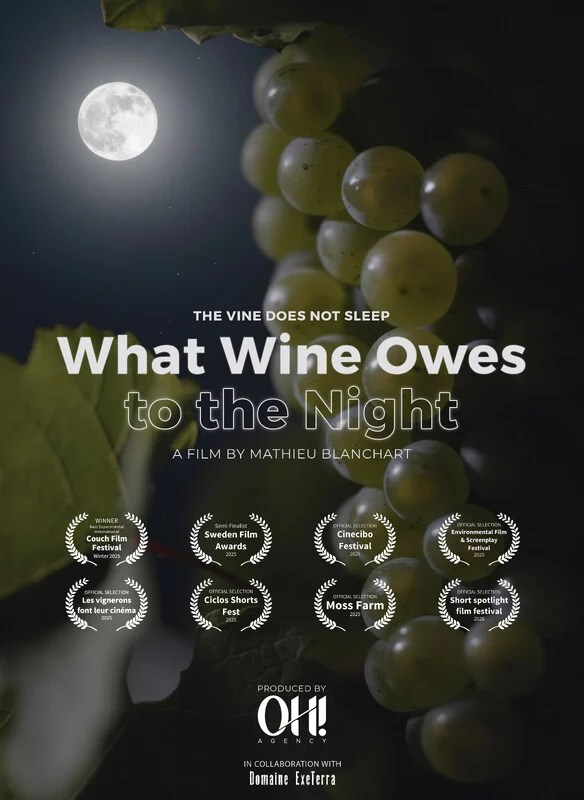
In the silent darkness, the vines whisper, the leaves quiver, and the earth still breathes. What the Wine Owes the Night is a visual and sensory poem, an intimate dive into the nocturnal life of a vineyard. With little or no dialogue, the film captures breaths, fleeting lights, and unseen presences that watch over the land as humans withdraw.
1. What motivated you to make this film?
The film grew out of a visit to the Exettera vineyard in Alsace (France). While walking through the vines, I spent time talking with the winemaker about his biodynamic approach and his relationship with the living world. At one point, I asked him what happens in the vineyard once night falls. He led me to another plot, almost untouched by light pollution. In that quiet darkness, the vineyard felt alive in a different way, and I was immediately drawn to it. The project was born there, without a clear intention or outcome in mind. It was an experience first, an attempt to listen, to observe, and to let the night reveal its own presence. I never imagined it would eventually travel to festivals around the world.
2. From the idea to the finished product, how long did it take for you to make this film?
I first visited the location in April 2025, and the film was shot in August 2025. The edit was completed a few weeks later. What truly took time was not the production itself, but waiting for the right conditions. I wanted to film under a full moon, at the moment when the vineyard reaches its peak just before the harvest, and only if the sky remained clear. In that sense, the film followed a natural rhythm, shaped by the moon, the season, and a bit of patience.
3. How would you describe your film in two words!?
Quietly alive
4. What was the biggest obstacle you faced in completing this film?
The biggest obstacle was the lack of margin for error. Everything had been carefully scripted and planned in advance, but once on location, I had to confront the reality of the environment and adapt in real time. I was filming in lighting conditions I had never experienced before, with only one chance to get it right. It required focus, flexibility, and trust in the moment.
5. There are 5 stages of the filmmaking process: Development. Pre-Production. Production. Post-Production. Distribution.
What is your favorite stage of the filmmaking process?
For this project, definitely production. It was a truly magical night, accompanying the vineyard from sunset to sunrise. Being present as the landscape slowly transformed in the darkness was a unique experience. Ending the shoot sitting on a bench, quietly contemplating the place while drinking the glass of wine seen in the film, felt like a natural and meaningful conclusion to the night.
6. When did you realize that you wanted to make films?
My desire to make films comes from an endless curiosity about the world around me and a need to share that curiosity with others. It wasn’t a career I initially planned. It gradually became evident around the age of 19 or 20, as filmmaking felt like the most natural way to combine observation and expression.
7. What film have you seen the most times in your life?
Probably Good Will Hunting by Gus Van Sant.
8. In a perfect world: Who would you like to work with/collaborate with on a film?
Too many possibilities and desires, but Gus Van Sant could be so rewarding.
9. You submitted to the festival via FilmFreeway. How has your experiences been working on the festival platform site?
Very smooth and straightforward. It’s an efficient platform that makes submitting and tracking films easy for filmmakers.
10. What is your favorite meal?
Anything that comes with good company and wine
11. What is next for you? A new film?
There’s no fixed project yet. For now, the focus is on staying curious, exploring the world around me, and letting the next story reveal itself naturally.
 Festival Reviews