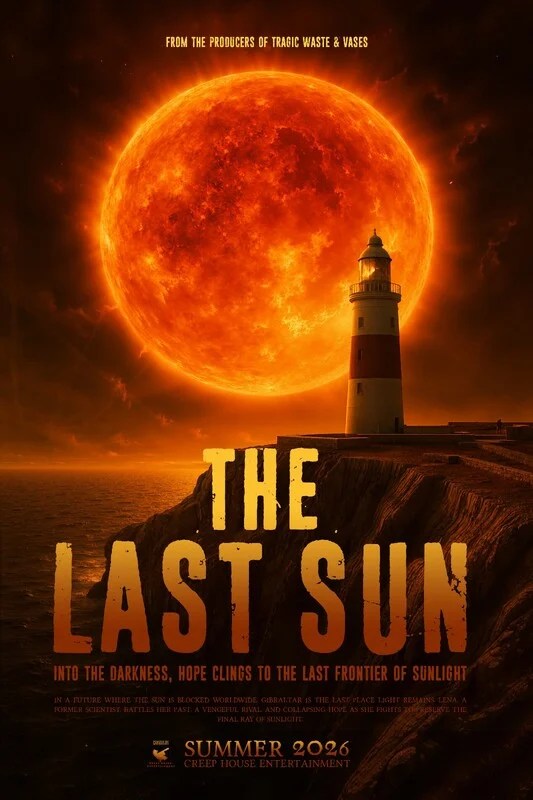
In a future where the sun is blocked and humanity is forced underground, Gibraltar holds the last light. Lena, a former scientist, strives to bring back the sun. One day, a stranger arrives with ancient knowledge and new hope.
Project Links
Review by Parker Jesse Chase:
In the not-so-distant future where the sun has been labeled a threat The Last Sun builds a quiet dystopia rooted in fear. Governments, led by the towering Luma Corporation, push a single message: sunlight is going to be deadly. The solution, they insist, is exile underground. Humanity obeys.
The film opens in sirens of panic portrayed by the media. Families are fleeing the city. A scientist wearing bold red stands against the tide, urging calm in the sense of great alarm. She calls it what it is, propaganda. Other scientists have confirmed the sun poses no harm. She asks her husband and daughter to stay three days, just three, to see the sky does not strike them down. By morning, they had disappeared.
Eight years later, Lena lives alone in a lighthouse along Gibraltar’s coast, one of the last places where natural light still breaks through. The lighthouse becomes both refuge and relic, a monument to her former life. She studies the sky through a telescope, tracking sunlight as if it were an endangered species. Drones sweep overhead, reminders that even in isolation, power watches.
Nature persists. Flowers bloom between stones. Birds glide across the horizon. Their presence feels intentional. Scientists often look to bird populations as a sign of environmental health, and here they act as silent witnesses, proof that life resists extinction even when systems collapse. Flashbacks drift through the lighthouse like ghosts. It once held laughter, conversation, and community. Now it holds equations and unanswered questions. Lena’s research suggests a terrifying possibility: the sun may not return at all.
Then a stranger washes ashore.
He is injured, overwhelmed not by pain but by light. When the sun touches his face, he weeps in gratitude. Lena approaches with caution, slingshot raised. He claims to be a former slave, held for years within slave ships. Of four captives, he alone survived.
Their dynamic is careful at first. He carries a spiritual weight, speaking like a shaman guided by forces beyond data. She is all numbers and proof, a geophysicist who once believed she could restore the sun through science. She calls her work a lost cause now. Her husband abducted their daughter to join the colony. Hope, for her, has been expensive.
Yet her equation is incomplete. Something small is missing.
The film’s production design grounds its world with subtle precision. Newspaper clippings, salvaged tech, handmade devices pieced together in a dystopian landscape. Nothing feels overstated. It is simple enough to believe.
Lena’s contraption can coax the sun back for ten seconds. No more. And by her calculations, after tomorrow, not even that.
The stranger offers what she cannot calculate. He warns her that the path he walks would poison her, even if it’s an ally to him. Still, he studies her work, eats the berry to go on his spiritual journey, and etches the missing variable into her formula. She hesitates. He does not. What are you waiting for?
They test it.
Thunder cracks the sky. The air clears. Light floods the coast. Lena smiles, a flicker of triumph breaking through years of solitude. For a moment, it works.
Then the world darkens again.
The final sequence is restrained and human. They sit by the ocean as the sun fades, grief settling in without melodrama. In the distance, the lighthouse sparks to life, hinting at change, or perhaps just the illusion of it. Lena remains by the water while the shaman walks back toward the tower. Leaving the discovery open ended for us all.
At its core, The Last Sun wrestles with control. How fear can be manufactured to reshape society. How propaganda can turn a life-giving force into a weapon. It asks what happens when institutions rewrite reality, and how easily people comply when safety is promised.
This film studies something softer. The tension between science and faith. Between fighting for answers and accepting limits. Between fixing the world and simply sitting with it.
In the end, the film suggests that the moments we chase, the light we believe will save us, might already exist in smaller forms. In the warmth on your face. In birds crossing a sky no one was meant to fear. Sitting by the water as day fades, even if tomorrow promises darkness.
 Festival Reviews