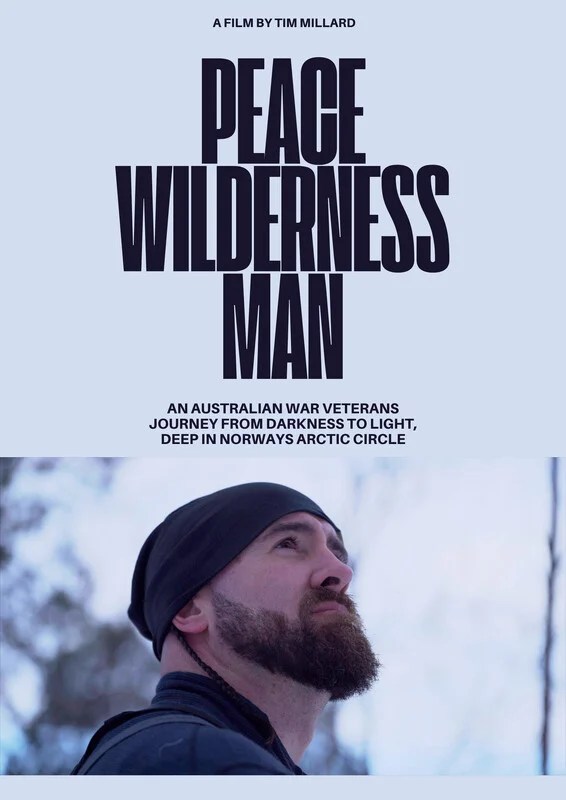
An Australian war veterans journey from trauma to inner peace in Norways remote Arctic Circle.
Review by Parker Jesse Chase:
Set deep inside the Arctic Circle of Norway, Peace Wilderness Man follows Australian war veteran Lex Reilly as he searches for calm after years of trauma. The film moves between stillness and confrontation, asking what it means to rebuild a life after violence, grief, and regret. The documentary opens with breath. Inhale. Exhale. Before we see anything clearly, we hear the rhythm of breathing over quiet shots of snow and flowing water. The landscape feels almost sacred. Snow settles across the ground while the river moves slowly beneath it. From the first moments, the film places us in a state of calm.
Then that calm breaks.
A man stands waist deep in freezing water, meditating. Cold water immersion becomes a confrontation. He shouts into the open air, releasing something raw. From above, the camera pulls back and we see how small he is against the white expanse. A single figure inside an enormous wilderness.
The title appears after this moment, leaving the audience with two emotional anchors, stillness and anger.
Lex Reilly was raised in Australia in a home shaped by alcoholism and instability. The film does not soften this history. He speaks openly about growing up without safety, about sexual assault, and about the absence of support when he needed it most. His path toward the military begins here. For him, the army offered strength, structure, and a place where aggression had a purpose.
Reilly served in the war in Afghanistan during the conflict involving the Taliban. Combat brought another layer of trauma. He describes losing friends and witnessing violence that never fully leaves his mind. When he returned home, the war remained inside him. Something as small as a toy dropping on the floor could send his body into panic.
The film does not turn away from the darkest parts of his story. Reilly admits he became violent toward his family. He speaks about abusing his children and the damage it caused. The documentary allows him to sit with that truth without trying to redeem it too quickly. There is a yellow-lit interview space where these confessions take place, a color that feels tense and exposed, as if the room itself is warning the viewer.
Eventually his life collapsed under the weight of that trauma. Divorce followed. He lost custody of his children, something he says was justified. His military command dismissed his struggles rather than helping him. Discharged and isolated, he spiraled into suicidal thoughts. Yet the film never frames recovery as a single turning point. Instead it shows a slow, uneven process. Reilly sells nearly everything he owns and moves into the remote wilderness of northern Norway. Nature becomes both refuge and discipline.
The cinematography here is remarkable. Vast white landscapes stretch across the screen until sky and snow blur into the same color. These wide shots feel almost spiritual. The wilderness dwarfs the human body, but it also offers space to breathe again.
In many films, snow functions as a visual metaphor, a blank surface where emotion can be written clearly. Here it becomes a form of rebirth. When the film cuts away from painful memories, it often returns to pure white landscapes, as if the environment itself is absorbing the weight of the past.
Reilly begins to rebuild through routine and responsibility. He speaks about taking long morning walks, watching birds move across frozen water, and learning to live in silence. At one point he recounts rescuing a drowning boy during his time at a surf club, a small act that helped him believe he could still contribute something good to the world.
The documentary also raises a quiet critique of modern life. Reilly reflects on how people have drifted away from the natural world. Technology fills our time while our relationship with the environment fades. In his view, reconnecting with nature is not a luxury but a necessity. That philosophy shapes the structure of the film. Conversations about trauma unfold while the camera rests on mountains, rivers, and snowfields. The setting stays peaceful even while the words remain heavy. This contrast gives the film its emotional strength.
Reilly is not presented as a hero. He is flawed, responsible for deep harm, and aware of it. What the film offers instead is a portrait of accountability and effort. Healing is shown as work that never fully ends.
By the closing moments, the wilderness no longer feels like escape. It feels like a place where a man sits with himself long enough to change.
Peace Wilderness Man is a quiet but confronting documentary. It asks the viewer to hold two truths at once, the damage people can cause and the possibility that they can still try to live differently afterward.
 Festival Reviews