After her cell phone is stolen, Laura, a pregnant dentist, commits a desperate act: she attacks a stranger, convinced he’s the thief. But what seemed like a passing impulse opens a rift in her perception of reality. The cell phone reappears. The messages don’t stop. The images show impossible things.
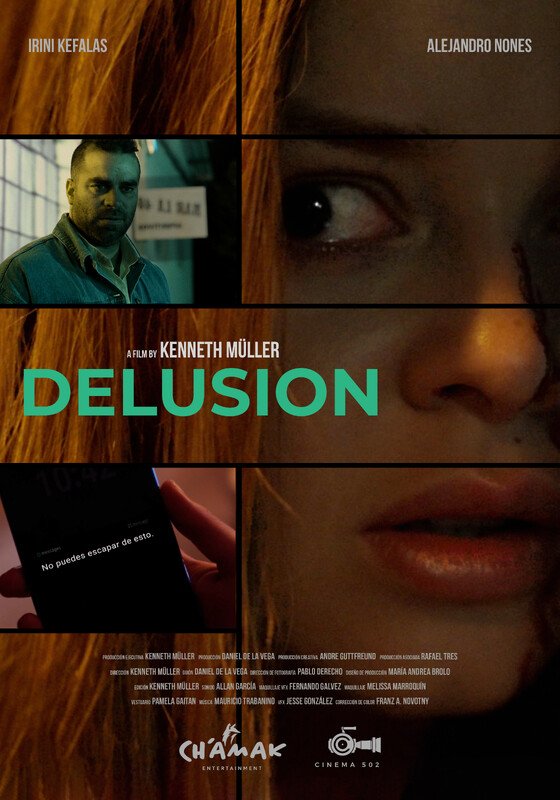
Review by Parker Jesse Chase:
Delusion opens with the sound of a lighter flicking open and closed. No context is given, but anxiety builds. This directorial choice sets the tone before any visual or narrative is shared. When we finally see Mauricio, lit by a harsh red glow, it frames him in ambiguity. Is he a threat, or just a man caught in the wrong moment? The film never gives us a clean answer, and this uncertainty fuels everything that follows.
As the film continues to follow Laura, a pregnant woman whose phone is stolen on a dark roadside. What should be a moment of inconvenience turns into something far more dangerous. She locks onto a stranger, Mauricio, and decides he is the one who took it. That decision becomes the film’s core fracture point. From there, reality begins to slip.
Lighting plays a major role in the psychological shifts at play. The early warm tones of the gas station give way to sickly greens, reds, and yellows by the time we reach outside the bar. The world starts to feel contaminated, like reality itself is turning against Laura. It’s not just a visual queue, it mirrors her internal state.
This is a story about perception under pressure. About how fear, isolation, and vulnerability can lead to abrupt decision making. Laura’s pregnancy adds weight to every choice she makes. Her body is not just her own, and that amplifies the urgency, the protectiveness, the paranoia. When she says, “I’m not going to let them take anything else,” it lands as both maternal instinct and a
warning sign. Protection turns into projection.
Sound design carries much of the emotional weight. The escalating notifications, the persistent ringing, the layering of a heartbeat tied to her pregnancy, all build a sense of pressure that never releases.
Delusion is defined by its refusal to bend, even when confronted with its very truth. Laura embodies this. There is no real evidence that leads to Mauricio taking her phone in the first place, yet she builds a case in her mind and acts on it. The stabbing is not just violence, this is conviction made physical. Once Laura crosses this line, the film refuses to let her step back. The phone returns to her hand. Messages flood in. Images appear that should not exist. It becomes less of an object and more of a force. Something invasive. Something that cannot be discarded.
The phone reads like a stand-in for our relationship with constant connection. It doesn’t just demand attention, it traps it. Laura tries to throw it away, destroy it, escape it, but it always returns to her hand. That loop mirrors the way we engage with our own devices. The need to check, respond, stay plugged in. Even when it harms us.
Then the film sharpens its edge. Laura receives a video of herself committing the crime. She is being watched. Not just observed, but consumed. A message comes through: she is being live-streamed. People are watching her unravel in real time.
That’s where the film lands its most unsettling idea. Suffering turned into entertainment. We scroll through pain every day. We watch breakdowns, violence, and public shame. There is a distance that makes it easy. Delusion collapses this distance. It puts Laura inside that loop, turning her fear into content. The audience within the film becomes a reflection of us outside it. The performances ground the film. Laura’s unraveling feels physical. Her hands shaking, her breath tightening, the way panic lives in her body. Mauricio, in contrast, is quiet and human, which makes the violence against him hit harder. He feels like someone who could have walked away from the story entirely, if not for her belief.
The final image, a wide pullback revealing her bloodied and alone, lands with a kind of cold distance. It echoes the earlier surveillance shots. We are no longer close to her. We are watching, just like everyone else.

 Festival Reviews