Waiting For Nia, 16min., USA Directed by Maurice Simmons Nia Kim, a 16-year-old girl, is rushed to Brookshire Hospital after a severe car accident. Her divorced parents, Justin and Tanya Kim, anxiously await news of her condition. As they confront their past issues and fears, they find moments of revolution, connection and understanding.
Get to know the filmamker:
1. What motivated you to make this film? The story is a tapestry of personal memories that stayed with me for years. I finally felt compelled to weave them together after seeing the Oscar-nominated short A-lien last year; it served as the creative spark I needed to finally bring these lived experiences to the screen.
2. From the idea to the finished product, how long did it take for you to make this film? It moved relatively quickly once the momentum started. I wrote the script in February 2025, moved into production in June, and we wrapped the final edit by September 2025.
3. How would you describe your film in two words? Family Drama.
4. What was the biggest obstacle you faced in completing this film? My biggest challenge was in the writing—specifically, ensuring each character possessed a distinct, individual voice. I wanted to provide the actors with enough subtext in the dialogue to keep the audience leaning in, avoiding anything that felt repetitive or predictable.
5. What were your initial reactions when watching the audience talking about your film in the feedback video? It was incredibly validating. I felt the comments were deeply honest, and it was a relief to see that the audience truly “got” the picture I was trying to paint.
6. When did you realize that you wanted to make films? The spark was there from a very young age. While life circumstances forced me to take a detour and start later than some, the delay hasn’t diminished the passion. Finally doing this now is immensely satisfying.
7. What film have you seen the most in your life? The original The Magnificent Seven. It was the first movie I ever watched in a theater alone. To this day, if it’s on TV, I’ll stop everything to watch it. It’s the quintessential “good vs. evil” story.
8. What other elements of the festival experience can we and other festivals implement to satisfy you and help you further your filmmaking career? As a filmmaker, I value any opportunity for direct networking and distribution resources. At this stage, however, I’m simply enjoying the platform provided to share this story.
9. You submitted to the festival via FilmFreeway. How has your experience been working on the festival platform site? It’s an invaluable tool. Without FilmFreeway, I wouldn’t know where to begin in terms of contacting global festivals or tracking my submissions. It streamlines the business side of filmmaking so I can focus on the creative side.
10. What is your favorite meal? A great Pasta dish.
11. What is next for you? A new film? I’m currently in development for a courtroom drama. It’s a compelling project, and I’m currently looking for the right partners and support to help bring it to life.
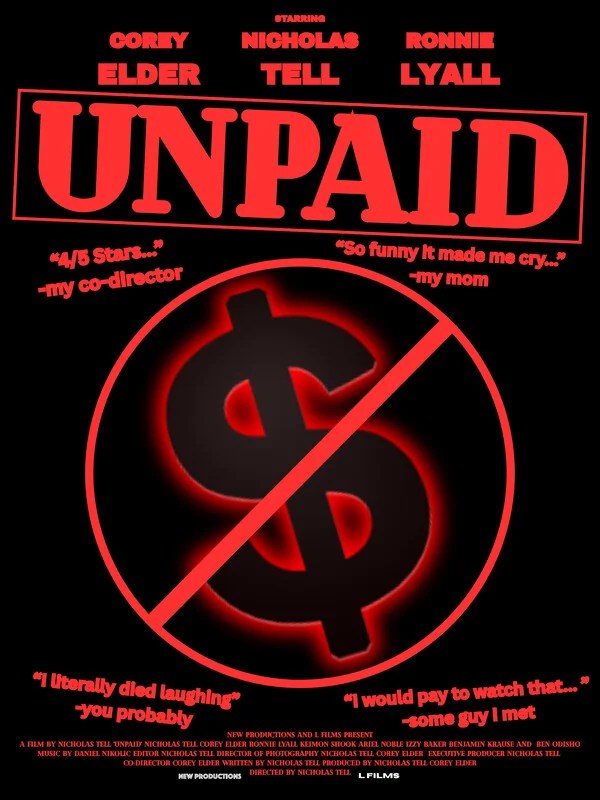
James (Nicholas Tell) had the unpaid internship of a lifetime, “employed” by one of the biggest film studios on the planet. However, the 2 year job is about to come to a close and all of the interns, including his mortal enemy Darren (Corey Elder), will have to interview for the one spot that can give them a permanent job. If that’s not enough, James has been staying on the couch of his friend Mark (Ronnie Lyall) for the entirety of his internship and Mark is fed up with his freeloading. James has no other choice than to get the job or become homeless. Come along as James and Darren butt heads in a hilarious interview war where the winner proves that they are the biggest fan of movies and the loser never works in entertainment again.
This lighthearted comedy gives an inside look into being an intern in Hollywood. It’s part underdog story and part tongue-in-cheek comedy with a gentle tug on your heartstrings. Nicholas Tell wrote, directed, produced, acted, edited, handled cinematography and lighting and probably handled krafty for the crew. He did almost everything and that is a sure sign of a labor of love. Nicholas did have help, Corey Elder was co-director, co-cinematographer, co-lighting guru and he also acted in the film. What is really cool is that you can see these two have a close friendship but in the film they are “mortal enemies”.
Nicholas and Corey did a great job with how it was lit and directed, plus the story is really sound. The music score from Daniel Nikolic was wonderful and fit the vibe of this film beautifully. I wish the sound was as stellar in the office as it was in the apartment sequences but you definitely got a feel of all the different relationships from each intern during their interviews. It was ending that warmed your heart and gave you a sense of hope that dreams can come true.
In a future where fertility is rare and tightly controlled, an eighteen-year-old girl is publicly selected as a Miracle Maker after failing to comply with a mandatory wellness check. As she is celebrated and subjected to months of ritualized spectacle broadcast to the world, she comes to believe her pregnancy is a blessing meant for her alone. Only after the birth does she awaken to the truth: the celebration was a trial, the child was never hers to keep, and she has been absorbed into a system that forces fertile women to endlessly repopulate society.
Get to know the writer:
1. What is your screenplay about? Miracle Maker is set in a future where fertility has become rare and tightly controlled. An eighteen-year-old girl is publicly selected as a Miracle Maker after failing to comply with a mandatory wellness check. For months she is celebrated, watched, and ritualized, broadcast to the world as a symbol of hope. She comes to believe her pregnancy is a blessing meant for her alone. Only after giving birth does she awaken to the truth: the celebration was a trial, the child was never hers to keep, and she has been absorbed into a system designed to force fertile women into endless cycles of reproduction. It is a story about identity, bodily autonomy, and the violence hidden inside spectacle.
2. What genres does your screenplay fall under? Dystopian sci-fi and speculative drama, with elements of psychological thriller. Think The Handmaid’s Tale meets Never Let Me Go.
3. Why should this screenplay be made into a movie? Because the story doesn’t feel like the future, it feels like right now. It asks urgent questions about who controls women’s bodies, how systems manufacture consent through celebration, and what it costs to wake up too late. Audiences are ready for this conversation, and cinema is exactly the right place to have it.
4. How would you describe this script in two words? Gilded cage.
5. What movie have you seen the most times in your life? Honestly, it’s a tie between The Count of Monte Cristo and Zoolander, which tells you everything and nothing about me at the same time. Very different films, very different from what I write. But I like what I like.
6. How long have you been working on this screenplay? About five months total, roughly a month writing and four months in the notes and revision cycle.
7. How many stories have you written? Several, across different formats. On the feature side, I’ve written Domefall, a sci-fi screenplay about an astrophysicist who deciphers an alien signal with her AI, and Brooklyn’s Uber Hero, based on the true story of an Uber driver who rescued people from a burning building in Brooklyn and still got his passenger to the airport in time for her flight. I also wrote an adaptation of H.G. Wells’ The Country of the Blind. On the TV side, I have Sidebar, an animated dark comedy set aboard a U.S. Navy ship, and I’m currently developing a sci-fi TV pilot. I came to screenwriting after 22 years in the Navy, and that background, command structures, high-stakes decisions, systems with real consequences, runs through everything I write.
8. What motivated you to write this screenplay? It started personal. My sister struggled with infertility, multiple rounds of IVF, and eventually, they stopped. Then my best friend experienced the same thing. When I started looking into it, the numbers were striking: estimates suggest up to 1 in 7 couples face difficulties conceiving, and roughly 10 to 11% of women in the U.S. have trouble getting or staying pregnant. The trend is moving in one direction. So, my mind went where it always goes, forward. What does a future look like where only a small percentage of the population can conceive? Who controls that? The answer is always either the government or a corporation. And I don’t think the women who are lucky enough to be fertile would have any say in what happens to their bodies or how many times they go through it. That’s the world of Miracle Maker. It’s speculative, but it doesn’t feel far off.
9. What obstacles did you face to finish this screenplay? Writing while actively transitioning out of a 22-year military career, finishing a degree, and leading roles on two film festivals simultaneously. The obstacle wasn’t what to write; it was time. Protecting the hours to write is always the fight.
10. Apart from writing, what else are you passionate about? Ocean exploration, hiking, and paddleboarding. I live in Hawaii, so the water is never far. I’m also developing a children’s book series rooted in Dominican and Latin American identity, and I care deeply about representation in storytelling across all age groups.
11. What influenced you to enter the festival? What were your feelings on the initial feedback you received? What drew me in was that this festival performs the work. Script coverage is valuable, I’ve used it, but there’s something completely different about hearing your scene read aloud in someone else’s voice. That’s when you find out if the story actually does what you think it does. Hearing Liz, Porter, and the Narrator bring the scene to life confirmed that the emotional core landed. I really appreciated hearing it.
A biomythography of a childhood experience: a difficult, traumatic memory, and a healing that took many years. I describe the experience of growing up with a mother who had mental health disorders, raising five children on her own.
*2. What genres would you say this story is in? *
My story is a biomythography. Biomythography is a genre created by Black lesbian author and poet Audrey Lorde in her 1982 book, *Zami: A New Spelling of My Name. *She wrote that this genre enables us to use our experiences to compose what identity means to us, and that we can use emotions, along with imagery and perception, to express our truths.
*Biomythography – weaving together myth, history, and biography in epic narrative form, a style of composition that represents all the ways in which we perceive the truth. Biomythography is a writing down of our meanings of identity… with the materials of our lives. We are the culmination of it all; experiences are painted with imagery, perception, and, mostly, emotion. Details that become true in the telling.*
*3. How would you describe this story in two words? *
Tragic, hopeful
*4. What movie have you seen the most in your life? *
Honestly, I don’t have an answer.
*5. What is your favorite song? (Or, what song have you listened to the most times in your life?) *
*Cats in the Cradle* by Harry Chapin comes to mind.
*6. Do you have an all-time favorite novel? *
*Aunt Sookie and Me* by Michael Scott Garvin comes to mind.
*7. What motivated you to write this story? *
The need to heal, the need to remove the deep pain within me, and give it another place to exist. To put the pain somewhere else to live instead of within me.
*8. If you could have dinner with one person (dead or alive), who would that be?*
Oprah Winfrey, I have so many questions for her.
*9. Apart from writing, what else are you passionate about? *
The love of my life and the life we created together.
*10. What influenced you to enter your story to get performed? *
I needed to know whether it was worth sharing, whether others could relate to and benefit from my experience. To let others know that there is hope. And if my story got picked up for performance, that would answer my question.
*11. Any advice or tips you’d like to pass on to other writers?*
Write what you feel. Write what’s deep inside you. Write what is most uncomfortable. Let it live in writing. “Your body is not a coffin for pain to be buried in.” (Ehime Ora). Write biomythographically.
While Joe waits a dear friend he lost touch with to show up at their 50th high school reunion, he flashes back to how they met and the secret she asked him to keep.
Performed by Val Cole
Get to know the writer:
1. What is your short story about?
This story is about a man who reminisces about childhood as he looks forward to reconnecting with a former, female classmate.
>> 2. What genres would you say this story is in? It’s a romance.
>> 3. How would you describe this story in two words? Hopeful reconnection.
>> 4. What movie have you seen the most in your life? The Princewss Bride
>> 5. What is your favorite song? (Or, what song have you listened to the most times in your life?) Hallelujah by Leonard Cohen
>> 6. Do you have an all-time favorite novel? Small Great Things by Jodi Picoult, but there are many others I consider favorites.
>> 7. What motivated you to write this story? I recently reconnected with someone from high school, and that inspired me to write the story.
If you could have dinner with one person (dead or alive), who would that be? Michelle Obama
>> 9. Apart from writing, what else are you passionate about? I’m passionate about creating mixed media art.
>> 10. What influenced you to enter your story to get performed? I don’t usually write romance, butI ended up admiring this sweet story and wanted to see where it could go.
>> 11. Any advice or tips you’d like to pass on to other writers? Put your whole self in. Don’t just observe the work. Feel it. Be actively involved in it.
1) What is the theme of your poem? Sticks and Stones explores memory, guilt, and the way childhood experiences shape how we understand ourselves. It’s also about how coping is varied and deeply individual — how different minds, different bodies, and different people survive difficult moments in very different ways. At its heart, the poem is about perception, responsibility, and quiet forms of compassion.
2) What motivated you to write this poem? Much of my poetry grows from moments and people that linger long after they’ve passed. This poem, in particular, comes from revisiting a childhood memory and memorializing the people who mattered most to me when I was young. Poetry, for me, is often an act of preservation.
3) How long have you been writing poetry? I’ve always been a writer. I was fortunate to win awards for writing as early as elementary school and continued through law school. I write poetry because I have to — it’s less a choice and more a necessity.
4) If you could have dinner with one person (dead or alive), who would that be? Alive.
5) What influenced you to submit to have your poetry performed by a professional actor? Poetry changes when it moves from the page into someone else’s voice. Other people give the work a shape, a rhythm, and an emotional texture it could never have if it only came from me. I’m fascinated by that transformation.
6) Do you write other works? Scripts? Short stories? Etc.? I’ve written personal essays and short stories, but in my heart of hearts, I am a poet.
7) What is your passion in life? Subtly shifting the people I encounter into being a little more compassionate, a little kinder.
A man with stricken anxiety is forced to move his family to a remote area of the Appalachians where they make a shocking discovery lurking in the mountains when their dog captures a baby monkey.
Feral Mountains addresses the issue of the inability of controlling a situation due to a condition. I created a world around a person who has developed a crippling anxiety disorder. The affected person does not have the capability to control his behavior and think in a normal, expected way. I wanted to expand on this situation and integrate it with another most unlikely situation; that is, introducing a disparate world of monkeys subjected to unethical but legal experiments for the benefit of humans, with anxiety being one of those benefits. The situations and conditions are beyond the control of the innocent and defenseless victims. In order to illustrate the similarities of both worlds, I needed to the worlds to confront each other. Consequently, to illustrate the similarities, I needed to write the script as a thriller with a conscience.
2. What genres does your screenplay fall under?
The screenplay is considered a thriller with a dysfunctional family setting; however, it also includes the action and horror genres.
3. Why should this screenplay be made into a movie?
The screenplay is different from other thriller-type films. Blood is shed only when it is necessary and makes sense. The dysfunctional family bonding gives the story depth and structure. The seemingly unethical but legal experiments performed on Rhesus monkeys are based on fact. There is nothing supernatural in the script. To a certain degree the story shows the monkeys as well as the family are victims.
4. How would you describe this script in two words?
Overcoming injustices
5. What movie have you seen the most times in your life?
Casablanca, Once Upon a Time in the West, The Day the Earth Stood Still, Apocalypse Now… many others.
6. How long have you been working on this screenplay?
Over one year. I finished the first final draft in about three months, then constantly revised it. My last major revision was about two weeks ago.
7. How many stories have you written?
I have finished eleven screenplays – six features and five shorts. I have three other outlines for feature screenplays to be written when time permits.
8. What motivated you to write this screenplay?
I originally planned to write a simple thriller about creatures, possibly one based on folklore, terrorize a man with crippling anxiety and his family who are forced to live in a remote area. However, I could not do it. I wanted it to mean more. I read a few articles in the national news about facilities that experiment on Rhesus Monkeys and decided the monkeys would be the creatures. However, I did not want to show them in a disparaging light. I wanted them to have personalities, characters, so I took the liberty of slightly anthropomorphizing them. I did not want it to be black or white, I wanted it to be more complex. So I started from that idea and created the other characters and story around them.
9. What obstacles did you face to finish this screenplay?
I was still recovering from divorce, alcoholism and liver cancer, which exhausted me. The hours I dedicated into writing the screenplay was greatly curtailed.
10. Apart from writing, what else are you passionate about?
My passion revolves around movies. I enjoy older classic films and dissect them from the viewpoint of a writer. I love traveling; that is, exploring different places and meeting new people in all cultures. I’m also a voracious reader, whether it’s in book form or on my computer or phone, which allows me to keep up with current events or check into anything of interest.
11. What influenced you to enter the festival? What were your feelings on the initial feedback you received?
The festival appealed to me because it emphasized screenplays that focus on action, fantasy, sci-fi and thriller genres. The feedback is exceptional. It’s spot on.
I feel the evaluator has valid and fair points positive and negative. The evaluator also gives actionable examples to enhance some issues on my story. If an evaluator expresses a criticism, it is well explained and offers useful suggestions.
Agents Bryan and Lee investigate the disappearance of a young girl, Jasmine. With the help of James, they gain access to her home but find themselves trapped with an alien creature which absorbs James. However, they are aided by Thacker, Jasmine’s father, who has held the alien captive to lead him to his daughter. But when a saucer arrives, the trio are beamed aboard where they discover Jasmine and other members of the family being harvested to cure an alien disease. Rescuing her, they attempt escape, but only Jasmine and Lee make it home. Unknown to Lee, Jasmine is carrying a mutagen which infects humans, paving the way for an alien invasion.
Get to know the writer:
1. What is your screenplay about?
Absent is about two regular Joes working at a charter school. They help at risk students stay in school and progress toward graduation(my actual job). While training the new guy on home visits, they investigate the chronic absences of one particular student. Everything goes awry when they accidentally discover that the student was abducted by aliens, and the Father has an alien in his basement. Bait, to be used in an even trade. His daughter for the alien captive. During the trade, they all end up getting sucked into a spacecraft where they have to fight to make it back home where it’s safe, or so they think.
2. What genres does your screenplay fall under?
Horror/Sci Fi
3. Why should this screenplay be made into a movie?
This should be made into a movie because of its originality and right now alien stories are prevalent. This movie would do well. It has a wide target audience as well.
4. How would you describe this script in two words?
Fun Horror
5. What movie have you seen the most times in your life?
Night of the living dead (1990)
6. How long have you been working on this screenplay?
I worked on this script most of 2025.
7. How many stories have you written?
I’ve written 5 complete screenplays. A few scripts that are nearly done, but I took a break for one reason or another.
8. What motivated you to write this screenplay?
My current job in Education motivated most of this script. We’ve done plenty of home visits for chronically absent students, and I always thought we could run into some horrific scenarios. I love anything alien, so it came naturally.
9. What obstacles did you face to finish this screenplay?
I think my obstacles are that of the everyday American. I have two daughters. One in high school. One is 2 years old. So, there is plenty to do with very little time. I work 40 hours a week in education and I do security over night for another 35 hours a week. I sleep on average 4 hours a night. My spare time, I write and sleep.
10. Apart from writing, what else are you passionate about?
I love watching movies with my family. Spending time with my daughters. I played football for 10 years and have always been passionate about it. Music is a huge part of my family’s lives as well. We listen to all types and have many musicians in the family.
11. What influenced you to enter the festival? What were your feelings on the initial feedback you received?
Horror Underground sounded like a very cool festival and I hadn’t entered one that would table read my work, so I thought it would be a cool prize. I am very happy with the feedback as it was 100% positive. The scene was done so well. I was so impressed. I absolutely loved it.
The theme is about ICE detentions specifically those that transpired in Minneapolis.
2) What motivated you to write this poem?
I was motivated to write this poem to shed light on the gross injustice done to immigrants in this country.
3) How long have you been writing poetry?
I am a South African-born poet living in New York City and I have been writing poetry for 16 years.
4) If you could have dinner with one person (dead or alive), who would that be?
I would like to have dinner with Nelson Mandela.
5) What influenced you to submit to have your poetry performed by a professional actor?
I am not a voice actor or even an actor for that matter, but I know how to write poetry. So having a professional voice actor read my work is priceless and truly accelerates the message in a powerful way.
6) Do you write other works? scripts? Short Stories? Etc..?
I have several poetry collections that include my experience as an immigrant in America. I write short stories also and have multiple competed novels.
7) What is your passion in life?
My passion in life is to use my words to communicate with the world in a way that moves people. Whether it be about immigration and social justice, or just a lovely little poem about my observations in life, poetry allows me to speak where my physical voice falls short.
——
Neutralize
They arrive faceless, as if shame were standard issue.
Vans idle. A neighborhood becomes a diagram.
The public word is enforcement. The private one is containment.
In the desert, tents flower— soft-sided, seventy-two to a bloom. Toilets flood rice with sewage. Water tastes metallic, instructional.
A mother at an airport learns the grammar of absence: no food, no water, no sky.
Her daughter folds inward like a closing book.
They call it civil. They call it procedure.
History calls it rehearsal.
At Fort Bliss— where the enemy once had a face— a boy turns off a light and wakes in an ambulance. A body becomes leverage: fingers tightening where refusal lives.
Thirty-two dead in a year. Four more before January settles. One ruled homicide in solitary confinement— as if loneliness were not already lethal.
“Poisoning the blood,” the phrase travels cleanly. What do we do with poison? We neutralize it.
Neutralize: to render inert. To make lifeless. To subtract breath from belonging.
There are those who imagine a gentle subtraction of millions.
But mass removal has a sound.
It is a child crying into government bedding. It is a fist correcting a refusal to disappear. It is a country rehearsing how to forget its own reflection.
Inside the tents people whisper their names like contraband.
I am not poison. I am not blood to be purified. I am a body with a sky in it.
An overwhelmed professional flees her rigid routine for the sanctuary of a park, only to be drawn into a surreal, time-bending world where she must confront her subconscious to reclaim her authentic voice
Performed by Val Cole
—–
Get to know the writer:
1. What is your short story about? The story explores the profound routine and loneliness experienced by the majority of the population due to a societal obsession with ‘hard work’ and material values. It challenges readers to ask themselves: to what extent are we living full, authentic lives? Through the protagonist’s journey, the story reveals a future that awaits us if we continue to function as ‘robots’ dedicated to numbers and financial gain—values that are, ultimately, hollow.
2. What genres would you say this story is in? Magical Realism and Speculative Fiction, with a strong philosophical and psychological undertone.
3. How would you describe this story in two words? Existential Awakening
4. What movie have you seen the most in your life? It’s a rich mix of psychological depth and core human values. I find myself returning to ‘Under the Tuscan Sun’ for its profound exploration of the transition from loneliness to authentic happiness. Recently, I’ve been deeply influenced by the series ‘Severance’, which brilliantly captures the duality of modern existence and the ‘robotic’ nature of corporate life. I also appreciate the ‘Fast & Furious’ franchise; despite the action, it consistently emphasizes essential values like family and loyalty, which I find very grounding.
5. What is your favorite song? (Or, what song have you listened to the most times in your life?) My musical taste is a journey through different energies. I have a long-standing passion for Classic Russian Rock, which carries a lot of poetic and raw power. On the other hand, I deeply appreciate the structure and timelessness of Classical Music. However, as reflected in my story, I find a unique sense of peace in the laid-back, soulful blues of artists like J.J. Cale. His music represents that moment of slowing down and finding rhythm in a world that is often too loud and fast.
6. Do you have an all-time favorite novel? It is a dialogue between two very different worlds that both explore the human condition. On one hand, I am deeply moved by Dostoevsky’s ‘Crime and Punishment’ for its unparalleled psychological depth and its exploration of morality, guilt, and the price of one’s soul. On the other hand, I hold the ‘Harry Potter’ series close to my heart; beyond the magic, it is a masterclass in addressing social stigma, the courage to face deep-seated fears, and the power of choices over circumstances. Both, in their own way, deal with the weight of our decisions.
7. What motivated you to write this story? I actually wrote this story over a decade ago, during a time when I felt suffocated by my own reality. As a lecturer and business consultant, I was constantly surrounded by people, praise, and success. But the more I was celebrated, the lonelier I felt. Everyone saw the ‘persona,’ but no one saw the real me. I was playing a role every day because that’s what was expected, while my true self remained hidden. I poured that stifling loneliness and pain onto the paper. I decided to bring it out of the drawer now because I finally felt strong enough to share this truth, and because I believe the message is more urgent than ever. With the current global instability and the growing emotional distance caused by technology, I felt it was time to tell people: ‘Wake up. Stop just surviving. Stop being robots to your roles and material values. Pause and choose what truly matters before the countdown ends.'”
8. If you could have dinner with one person (dead or alive), who would that be? Without a doubt, my grandmother. She was a survivor of World War II whose life was incredibly complex and challenging, yet she remained the most graceful and joyful person I’ve ever known. She taught me to truly see the world—to find joy in every small flower. Her philosophy was simple yet profound: if you don’t like something, change it or walk away; if you can’t, find something within it to love. She taught me to treat every crisis as a lesson and to be grateful to the universe for that growth. She was a pillar of support for everyone around her until her very last day. It would make me truly happy if I could sit across from her once again and learn more about her boundless resilience and love for life
9. Apart from writing, what else are you passionate about? I am deeply passionate about finding the bridge between the business world and mental health. I believe this intersection is key to creating a balance between true human values and the practical means required for living. This passion has led me to develop a comprehensive theory based on the love of the soul, which I call ‘Filopsycha’. Beyond my professional and academic work, I find my greatest joy in simple, authentic moments: traveling with my husband and our dog, engaging in deep conversations with my children, and spending quality time with my friends and extended family. These connections are what keep me grounded and inspired.
10. What influenced you to enter your story to get performed? After keeping this story in a drawer for over a decade, I felt a sudden urgency to see if its message still resonated. I wanted to see if the ‘rhythm’ of the internal struggle I wrote about back then could touch someone else when performed out loud. WILDsound offered the perfect stage to transform my private thoughts into a shared, living experience.
11. Any advice or tips you’d like to pass on to other writers? My advice is a balance of patience and courage. On one hand, embrace your silence and let your story mature until you feel strong enough to stand behind it. But on the other hand, when you realize that your message is truly important—dare to put it out there. Sharing your truth is a powerful tool; it can be the very thing that helps someone else feel less alone in their own struggle. Don’t just write to express yourself; write to build a bridge for others who might be trapped in the same situation you once were.”