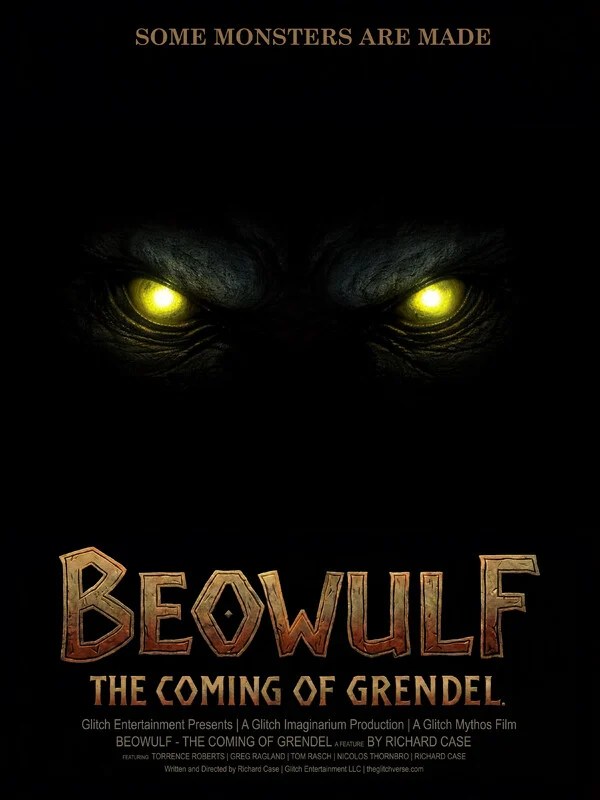
In the mead-hall of Heorot, the warrior Beowulf answers King Hrothgar’s desperate call as the monstrous Grendel terrorizes the kingdom. A dark epic retelling of the ancient legend — Act One of a planned trilogy.
Revenge is sweet in the animated short, Beowulf: The coming of Grendel. The Old English epic poem Beowulf as its source, this AI-generated film does a superb job creating the atmosphere of the period piece: scenes of rocky terrain by the sea, rough behaviour of raucous men feasting and drinking in front of a roaring fire in the middle of the sturdy wooden hall, and the presence of the old king in elegant robes and crown, and suitably-lined face. Grendel is terrifyingly depicted with a massive body and hideous eyes and teeth. Of course, we are not disappointed by the visuals of the handsome, muscled conquering hero.
This short makes use of impressive sound effects and music, from guttural utterances, surging orchestrals and booming percussion during combat, to wistful refrains of a medieval-style pipe as the king deliberates. Voice artists also deserve a nod here, convincingly able to portray their roles, from noble to brave to beastly. This project provides an excellent introduction to those fascinated by the epic poem Beowulf, a satisfying tale in which both revenge and justice are served.
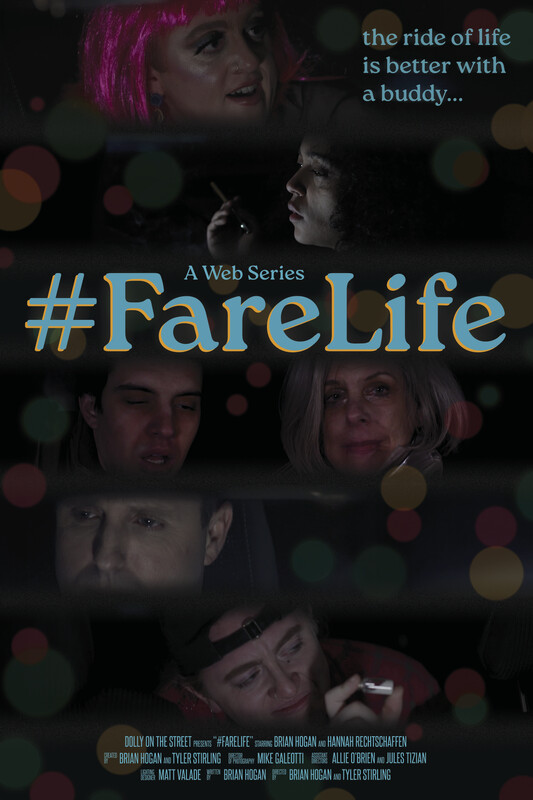
#FareLife gives us a peak inside the lives of Connecticut strangers from all walks of life as they ride from place to place with everyone’s favorite FareRide driver, affectionately called “buddy”. From drag queens to estranged parents to drunk strangers, follow “buddy’s” adventures as he navigates the streets and the pitfalls of living, in this zany, touching and often times irreverent ride of a lifetime.
Life can be unexpected, especially for a ride-share driver like Buddy in #FARELIFE. The story starts out like a typical narrative, Buddy is unhappy with his life and is living in his sister’s basement and decides he needs to make a change to improve his circumstances. His sister wants to help, though she has a vastly different idea of what her brother needs. Buddy wants a job to earn his own way out of her home, she wants him to find a romantic partner so that he can find someone to spend his life with to be happy.
The solution comes with the ride-share job that Buddy’s sister teases him for taking as she sets up his dating profile before clients. She seems like she is well intentioned, though her brother isn’t so sure about the prospects he will find on an online dating platform for gay men in his area. He is old fashioned and would rather meet someone the traditional way, in person, to form a connection.
The unexpected happens through his first night driving clients when he meets a drag queen named Hannah. The conversation is awkward as Buddy learns the first rule of driving in this new job, learning the importance of body language. The attempt to break the ice causes Hannah to snap, resulting in a few moments of silence before she offers an apology to Buddy. The rest of the night ends up establishing rules for individuals that want to join ride-share jobs as the story goes from funny to somber. It picks back up at the end as Buddy picks up his final ride, Hannah.
Buddy’s sister might have wanted him to try online dating, but he proved that his way is what worked best for him. He met someone on the job she teased him about, a person that put a spark into his head about moving cities where even if they don’t work out, there would still be more romantic options that wouldn’t involve online dating. The film depicts that there are times that people feel like they are stuck, but in reality the door sometimes opens and a person can come in that will change someone’s life by a few simple words.
It is a tale of redemption and what it might take to push the worst villain in the Orion Colonies to seek it. The answer is a psychic tie to a native Orion alien who plays the memories and experiences of all of her victims through Charlie’s head. Some of whom have also been Charlie’s victims.
We first meet Charlie hiding in a monastery on a small planetoid. He wants redemption, but is afraid to try to face the world he once terrorized to seek it. The Abbott knows Charlie will not find redemption in the monastery, so he pushes him to help a small crew of misfits and his mute sponsor hunt down the cause of everyone’s communications going down.
When they find the cause is a plot by a delusional megalomaniac to rule the Orion Colonies as a king, they have to band together to stop him. When the wannabe king kills the Abbott as a warning to others, Charlie’s path to redemption must compete with his path for revenge.
As he gets to know the ships Captain and her crew his path finally becomes clear to him. And, with the help of the alien queen and her cult of followers, he turns from revenge, stops the king and finds redemption.
2. What genres does your screenplay fall under?
It is a sci-fi adventure with humor infused throughout.
3. Why should this screenplay be made into a movie?
Well, anything I say is obviously self-serving, so I’ll quote feedback I’ve gotten from seven different competitions.
The ISA said it, “skillfully combines space adventure, personal redemption, and interstellar intrigue… offering a balanced mix of action and character development” and “features rich world-building and strategic plot dynamics.”
Barnstorm said it, “was a blast to read! We loved spending time with the crew! It’s a great premise and you know how to build character. It’s an interesting and imaginative script.”
Creative Screenwriting said, “The Orion Queen is an action-packed and epic sci-fi tale with a crew of compelling characters that drive the story.”
Pre-Pro Script Development said, “We like this one – cool concept and compelling characters. Everyone has a unique voice, which keeps the dynamics engaging throughout.”
Screencraft said, “Action-set pieces are exciting and should please the target audience. Its science fiction setting features some imaginative vistas. It builds logically to an exciting climax, inspired by its source material but neatly transmogrified into a space opera.
On The Brink said, “this is an exciting space adventure. The characters are likable, have solid goals, and their odyssey is fun and wild. So, it could make up for a very entertaining movie in the veins of Guardians of the Galaxy or Treasure Planet.”
And I’ll wrap it up with your festival’s feedback, “We feel that your script is already one of the best specs out there.”
Probably more than what you wanted, but you can pick and choose what to include.
4. How would you describe this script in two words?
Epic redemption
5. What movie have you seen the most times in your life?
If we cut out the annuals (holiday movies), I would probably say Jaws. If it were a franchise, then it would definitely be Star Trek.
6. How long have you been working on this screenplay?
I started kicking the tires in 2020, but actually sitting down to work out the story and then write started in 2023. It made the Barnstorm short list that year. Then I took a hiatus from writing for a little over a year and revisited it in 2025. The revised script made the short list again and then was named a Barnstorm finalist. And, of course, a winner in the WildSound Sc-Fi / Fantasy Festival.
7. How many stories have you written?
Not including half hour direct-to-video work, I have eight feature length screenplays. Five of which were from before or during getting my masters degree in screenwriting and all need a massive overhaul to get them to the level of the three I am putting into the world right now.
So, how many do I have to show right now? Three.
8. What motivated you to write this screenplay?
Oddly enough it all started with a viewing of “The African Queen” with Humphrey Bogart and Katherine Hepburn. I really liked the dynamic of their two characters, Charlie and Rose, and the quest that brings them together. Rose and her brother are missionaries in Africa. Charlie has a small boat that deliveries supplies to them. The Nazis attack the mission and kill Rose’s brother. Rose then basically commandeers Charlie’s vessel to fight the Nazis and destroy the main ship that is helping their campaign in Africa, “The Louisa.”
My Charlie and Rose’s story is far off from theirs. I flipped the roles and worked it out with more of a larger crew in the vein of stories I like – Star Trek, Firefly, Guardians of the Galaxy – but you can still see the inspiration in the names I kept and the troubles they face as they go.
9. What obstacles did you face to finish this screenplay?
I have a full-time job as a graphic artist at a small print shop and have been raising two boys with my wife while trying to rehab the mobile home we bought in the mountains, so finding time to give to my passion is always a struggle. Once I had my first draft in 2023 and it was well-received, I still had a lot of polishing to do. My weakness is always “too much” and “too long”, so most of my rewriting is cutting back and streamlining.
But, as I said, I took over a year off. We found out my wife had cancer so I stepped away to concentrate more on family. Then I was smack dab in the middle of the Hurricane Helene attack on the mountains of North Carolina. Four trees wound up on our home and we had to live in hotels for months. My wife lost her battle with cancer during that time.
Then, once we got back in our home, I’ve been trying to put my home and life back together. It’s an ongoing effort. Part of that effort was finally getting back to writing. I started that by getting my feet wet with submitting my two scripts and doing rewrites. Then I eventually jumped into a new script. I recently finished it and have been getting good feedback on it as well.
10. Apart from writing, what else are you passionate about?
My family has always been my priority. I left a promising career with Disney Feature Animation when my wife got pregnant with our second son because I just could not afford a decent home for my family in California. So we moved back east and began building a life in the Carolinas. All art has always been in my soul. Shortly after I married I got an associates degree in commercial art and became a graphic artist. Then I got a bachelors degree in computer animation and did that for several years. When we moved back east and I worked at a small animation studio in Charlotte I got a masters degree in Screenwriting. When the studio closed we bought property in the mountains of western North Carolina and I found work as a graphic artist again, illustrated a kids chapter book and started pursuing screenwriting. Through all of it, writing – the very spark of creation – has always been where my sights were.
11. What influenced you to enter the festival? What were your feelings on the initial feedback you received?
The idea of having my script read by professional actors was very exciting and made the festival stand out to me.
The initial feedback made me go back and review different aspects of the script to make sure certain elements were clear to the audience.
“Friend” follows the heading-for-divorce parents of a precocious nine-year-old who befriends an older, intellectually disabled man. Friend is in a great place—well written and with a strong premise.
Get to know the writer:
1. What is your screenplay about?
A precocious tween befriends a lonely, mentally childlike giant of a man. While trick-or-treating, she’s abducted by the “friend” right in front her distracted and dysfunctional parents. Frantically searching for their daughter in the dark, eerie environment of the friend’s home, the make a discovery more terrifying than their child’s abduction.
2. What genres do your screenplay fall under?
Horror/Thriller
3. Why should this screenplay be made into a movie?
Well, I am a little biased, but I like to think it offers something fresh, with a twist.
4. How would you describe this script in two words?
Emotional punch.
5. What movie have you seen the most times in your life?
Peter Weir’s Fearless.
6. How long have you been working on this screenplay?
Because it’s short (23 pp), I wrote it in about a month.
7. How many stories have you written?
I’ve written and self-published three novels and currently have five screenplays – three features; two shorts – completed and making the rounds at various competitions. And there’s more coming. You can view my portfolio at www.gordongravley.com.
8. What motivated you to write this screenplay?
Like a lot of my ideas, Friend was inadvertently inspired by my son. My wife and I were out with him one Halloween and my mind was wandering. I pondered, “What would happen if…?”
9. What obstacles did you face to finish this screenplay?
The same obstacle I’ve encountered with most of my writing – having to work a full-time job to pay the bills. I’ve recently retired, though and now I’m much more productive.
10. Apart from writing, what else are you passionate about?
Music. Although, you wouldn’t know if you ever heard me play or sing.
11. What influenced you to enter the festival? What were your feelings on the initial feedback you received?
Posted on the ISA website, the Horror Underground Festival seemed like a great venue for getting eyes on my writing. The feedback was concise and actionable. I made the recommended changes right away for future submissions.
A grieving tourism commissioner and a physicist on probation rescue a relic of the Manhattan Project from the world’s largest landfill.
Get to know the writer:
What is your screenplay about?
The Demon Core of Fresh Kills is the story of a grieving tourism commissioner and a physicist on probation, who discover the reason for their failures and frustrations in life are tied to a supernatural relic of the Manhattan Project, which they have to rescue from Fresh Kills Landfill in Staten Island.
What genres does your screenplay fall under?
It’s science fiction, in the form of an alternate history of the borough of Staten Island in New York City. It’s told as a mockumentary.
Why are you making this movie? And why should someone cut you a healthy check to help you make it?
I’m making The Demon Core of Fresh Kills for two main reasons. The first is to make sense of history. This sounds abstract, but it’s not. We were all born on a moving train. Is the train running well? Some say it’s running as well as could be expected. Others say the train needs maintenance. Others say the train has to stop and let everyone off. No one listens to that last group. And this train we’re on, is it going too fast? Too slow? Is it headed for a crash?
This is what I mean by making sense of history. This is hard to do, because people have very strong opinions, and they spend as much energy trying to recruit you to their side as they do trying to understand what happened. One way to start to make sense of history is to take a step back into the fantastical. It may not answer every question. But it may help. That seems as worthy of investment as a timeshare or Papa John’s franchise.
I’m also making the film to enrich the mythology that underpins the often-disheartening visible world. A lot of the world, even New York, really doesn’t look like much. But the story behind and underneath a place is a source of majesty, pride and inspiration for the people who live in it. I don’t have the money to build something beautiful. But I can spin a yarn. Staten Island has a history jam-packed with incredible stories, I’m trying to weave them into something of cosmic significance. That has to help property values.
What movie have you seen the most times in your life?
It doesn’t burnish my credentials as an auteur, but probably The Empire Strikes Back. I have kids. My son loves the scene where the guts come spilling out of the snow-kangaroo. And he’s fascinated by the scene where Darth Vader tells Luke that he’s his dad. And I can’t stand the high voices in kids’ shows, so it’s our go-to. We watched it tonight while I was cooking.
How long have you been working on this screenplay?
It was ten months from first written notes to the final draft. But the first glimmers, about the Manhattan Project, started more than twenty years ago. And about twelve years ago, I swore to myself I would do something about Fresh Kills someday. In terms of ideas, there were a lot of players on the sideline all suited up just waiting to have their numbers called.
How many stories have you written?
I’ve been at this for a while, so I don’t know how many stories. But I’ve written eleven novels, four feature screenplays, and two short films.
What motivated you to write this screenplay?
The Fresh Kills Landfill, which sits at the center of the mystery the film unfolds, is the largest man-made object on earth. It sits inside of one of the richest, largest cities on earth. But it’s rarely spoken of. It’s hard to talk about. And one day, I found a narrative path into the landfill. It came out of left field. But it worked. Not long after, I found characters who could not only blaze that trail, but take the whole world with them.
What obstacles did you face to finish this screenplay?
Time was an issue. I was working a full-time job at a financial leviathan, with two young kids at home. It was a lot of notes jotted into a notebook, and snatches of dialogue tapped into my phone.
One draft stalled out at 51 pages – too long to be a short and too short to be a feature. I had to think about the ending. I had to go back and do some more research. I had to ask some questions about who these characters are.
Apart from writing, what else are you passionate about?
I have a family – two young kids. That, the writing and the filmmaking doesn’t leave much passion for much else.
What influenced you to enter the festival? What were your feelings on the initial feedback you received?
The Demon Core of Fresh Kills starts with a pretty far-out concept. And the treatment is unconventional. My main concern was that it wouldn’t make sense. So I knew I wanted a science-fiction audience, who could roll with the more fantastical elements. And so this recognition is extremely meaningful. The notes were good, and illuminated some possibilities I hadn’t considered.
After the death of her father and the loss of her racing partner, a veteran off-road driver enters an all-women desert rally with an unlikely teammate.
Get to know the writer:
1. What is your screenplay about?
DESERT BELLES is about a mature woman pushing herself to win an off-road desert auto race to save the family business and in doing so rediscovering her passion for the sport.
2. What genres does your screenplay fall under?
Action adventure.
3. Why should this screenplay be made into a movie?
DESERT BELLES is based on a real women-only off road competition, The Rebelle Rally. The world is exciting, dangerous, physically and mentally challenging and shows that women are strong and resourceful competitors. We’ve had 100 plus years of men in movies having grand adventures. Now it’s time for women, and women of an age, to be the lead.
4. How would you describe this script in two words?
Exhilirating competition.
5. What movie have you seen the most times in your life?
The Princess Bride
6. How long have you been working on this screenplay?
Active writing was about 2 years.
7. How many stories have you written?
Five screenplays completed, seven more in various stages of development, including one award-winner that I’ve gone back for one more rewrite that is nearly complete.
8. What motivated you to write this screenplay?
I stumbled across The Rebelle Rally while researching women offroaders and was captivated.
9. What obstacles did you face to finish this screenplay?
I don’t feel like I faced any obstacles beyond the reality that it takes many rewrites to get a screenplay to a solid place. Instead a new obstacle has arisen recently with Jeep dropping their electric vehicle line potentially requiring me to rewrite the film with a different manufacturer.
10. Apart from writing, what else are you passionate about?
I am passionate about tennis and play on multiple United States Tennis Association adult teams.
11. What influenced you to enter the festival? What were your feelings on the initial feedback you received?
I wanted to hear my character’s words performed by actors and was drawn to a contest with a female focus.
This gritty thriller follows Boston Detectives David Carr and Ryan Fowler as they hunt the infamous Block Killer, a brutal murderer who targets the quiet neighborhoods surrounding Boston, leaving each block with nothing but silence and bloodshed. After Carr seemingly killed the Block Killer a year earlier, he returns and embarks on a new rampage across the city. The case becomes personal when he abducts Carr’s family and secretes from the past come to light.
Get to know the writer:
1. What is your screenplay about?
This gritty slasher thriller follows a worked-consumed Boston Detective, David Carr, who is haunted by the disappearance of the “Block Killer”-a serial murderer he shot, but whose body vanished in a mansion fire a year ago. When the killer resurfaces, he embarks on a new mission: targeting tranquil neighborhoods throughout the city and leaving each block of houses with nothing but silence and bloodshed. The case becomes personal when the Block Killer taunts Carr with footage of him stalking the detective’s young daughter. As a media frenzy erupts, Carr and his partner, Ryan Fowler, race to stop the carnage. The investigation takes a devastating turn when they discover the killer is Fowler’s estranged father, Allen, who snapped after his wife’s death. Driven by pure rage, he marks each September as a twisted anniversary of his loss by slaughtering entire families. The story culminates in a brutal basement showdown where Fowler must confront his father’s madness and Carr must risk everything to protect his family.
2. What genres does your screenplay fall under?
Thriller, Slasher, Horror.
3. Why should this screenplay be made into a movie?
My antagonist, the BLOCK KILLER, is someone new and exciting, yet an absolutely terrifying figure to be reckoned with. He’s not a superhuman like Michael Myers. He’s not a monster like Jason or Freddy, just a man so consumed with rage, he becomes an unstoppable force.
4. How would you describe this script in two words?
Terrifying, brutal.
5. What movie have you seen the most times in your life?
Scream.
6. How long have you been working on this screenplay?
Two years.
7. How many stories have you written?
Four.
8. What motivated you to write this screenplay?
I wanted to see something different. So, I created my own story and a brand new villain to be brought into the slasher world.
9. What obstacles did you face to finish this screenplay?
I found myself over writing certain action scenes as well as some dialogue. These areas I have worked on to tighten them up and make them more punchier.
10. Apart from writing, what else are you passionate about?
I love 90’s and early 2000’s alternative rock and play drums.
11. What influenced you to enter the festival?
What were your feelings on the initial feedback you received? Just like any other field, you have to start somewhere. What better place to start than to enter festival’s to try and rank or get a good position to help show the “Bigs” that your work is being noticed. I liked the feedback and actually took it all into consideration to make some updates and corrections.
Due to his actions during a daring rescue, young Deputy Sheriff McGee follows in his late father’s footsteps by being selected to receive the department’s Medal of Valor.
Get to know the writer:
1. What is your screenplay about?
Viral is about a young sheriff’s deputy who performs an act of great bravery, only to reveal a deep-set fear in a very public way shortly thereafter.
2. What genres does your screenplay fall under?
The genre is drama (although the scene is from a feature script I’m working on that is a horror/comedy).
3. Why should this screenplay be made into a movie?
I think the story, brief as it is, concerns an important topic – social media shaming – and would provoke thought and discussion.
4. How would you describe this script in two words?
Highs / Lows
5. What movie have you seen the most times in your life?
I have probably seen Blade Runner in its various iterations more times than any other movie.
6. How long have you been working on this screenplay?
I started working on the feature script which forms the basis of this short script about three months ago. After writing this scene, I thought it would be interesting to turn it into a short script.
7. How many stories have you written?
I’ve written dozens of short stories, two novels, five feature scripts, three tv pilot scripts, and several short scripts.
8. What motivated you to write this screenplay?
I was asked to officiate my niece’s wedding last summer, and a friend said that sounds like an idea for a movie. Somehow, that led to this short script:)
9. What obstacles did you face to finish this screenplay?
I think the main obstacle to finishing this script was my hesitation to declare the script finished and enter it in a festival/contest
10. Apart from writing, what else are you passionate about?
In addition to writing, I am passionate about music, literature, languages, and trying to be a positive part of my community.
11. What influenced you to enter the festival? What were your feelings on the initial feedback you received?
I had read good things about the festival and decided to enter Viral in it for that reason.
Linked is a surreal dark comedy about Jordan, a man slowly losing his identity to the performative chaos of LinkedIn. Comment wars turn passive-aggressive, emojis become weapons, and the platform bleeds into reality.
Get to know the writer:
1. What is your screenplay about?
At its core, Linked is about how we shape our identities in a world that is constantly watching us. It looks at the pressure to be seen, liked, validated, and how that slowly starts to change who we are. It is funny on the surface, but underneath it is really about insecurity and control.
2. What genres does your screenplay fall under?
I would say comedy first, but it definitely has satirical and psychological elements. I like using humor as a way in, and then letting the deeper themes sneak up on you.
3. Why should this screenplay be made into a movie?
Because it feels timely. We are all living inside this constant loop of connection and performance. I think audiences would recognize themselves in it pretty quickly. It has humor, but it also has that uncomfortable feeling of truth, which is usually where the best conversations start. It’s also the one social media platform that hasn’t been leaned into for storytelling.
4. How would you describe this script in two words?
Uncomfortably honest. OR Performative leadership.
5. What movie have you seen the most times in your life?
Good Will Hunting. It’s the one movie that I saw growing up that made me feel multiple emotions. I also loved seeing two young men write such an incredible first screenplay at the time.
6. How long have you been working on this screenplay?
The idea had been sitting with me for a while. Once I locked into the concept, the first draft came together fairly quickly. The real work was refining the tone and making sure it did not become too heavy handed.
7. How many stories have you written?
Quite a few at this point. I have written features, pilots, and shorts across different genres. Storytelling has always been part of my professional life as well through advertising, so understanding and writing longerform scripts feels like a natural extension of that.
8. What motivated you to write this screenplay?
I’ve been working in advertising for 20 years and that was my introduction to these types of professional social platforms and the types of messages I’ve seen. I always found it facinating to see how the community would post and engage. I was thinking a lot about how much of our lives are curated now. We present versions of ourselves constantly. I wanted to explore what happens when that version starts to feel more real than the person underneath it.
9. What obstacles did you face to finish this screenplay?
Tone was the biggest one. Satire can easily go too broad, and psychological stories can get too internal. Finding that balance where it is entertaining but still grounded took some rewriting. Also, at some points while I wrote the script I was worried it might be too niche and not everyone would understand it
10. Apart from writing, what else are you passionate about?
I am passionate about creativity in general. Building brands, building ideas, understanding culture. I am especially interested in how technology and AI are reshaping how we tell stories and create things.
11. What influenced you to enter the festival? What were your feelings on the initial feedback you received?
While I currently live in Miami, I grew up in Toronto and was motivated to see a comedy festival for a historically funny city. I liked the idea of hearing the script performed. When actors read your words, you learn very quickly what works and what does not. The feedback was encouraging. It is always reassuring when the themes you care about actually resonate with other people.
 Festival Reviews