Facing death due to different illnesses, three patients find themselves playing a made up game called The Mortality Game to experience life one last time risking it all.
What is your screenplay about? It’s about 116 pages! Sorry, I just had to get one “Dad Joke” in, even though I’m NOT a Dad (that I know of). “The Mortality Game’ is in essence a story of life as seen through the lens of impending death. It’s about how we as humans face the “final act” of the stage play of our lives. In the case of my three headed lead: Schubert, Halada and Tugger face it in their own differing, yet quirky ways. Ultimately deciding to take a final road trip across the country while playing a game where they do dangerous things to challenge and defy death, since they have nothing to lose.
What genres does your screenplay fall under? Character Driven Dramedy for the most part, as it has elements of Comedy and Drama, with a bit of Coming of Age mixed in for good measure.
Why should this screenplay be made into a movie? Because the characters are as diverse in age and attitude as they are strong in development and memorability. Because the story, about how we face death is an important one to tell, since that is a situation that none of us can avoid. Because it explores letting go as well as fighting back, finding the joy in the dreaded, and allowing yourself to feel what you feel facing the end, whether it’s understandable or not, expected or not, appropriate or not.
Since 2016, the FEEDBACK Film Festival has been showcasing the best of COMEDY directors, producers, writers, and actors at the festival in Toronto.
In-person and hybrid multiple screenings.
The Toronto Comedy Festival occurs every single month.
Various options to submit to the festival. A hybrid model.
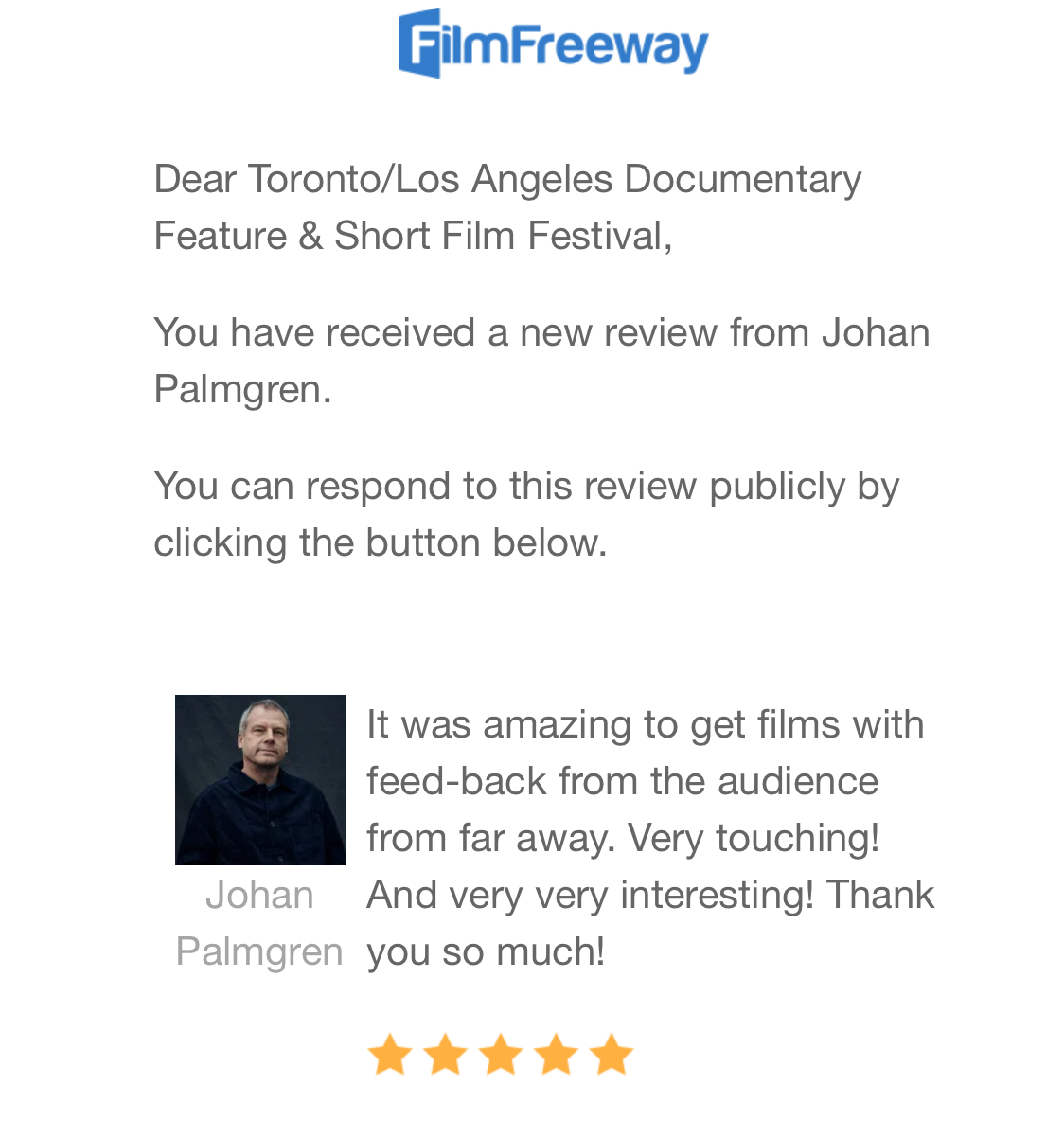
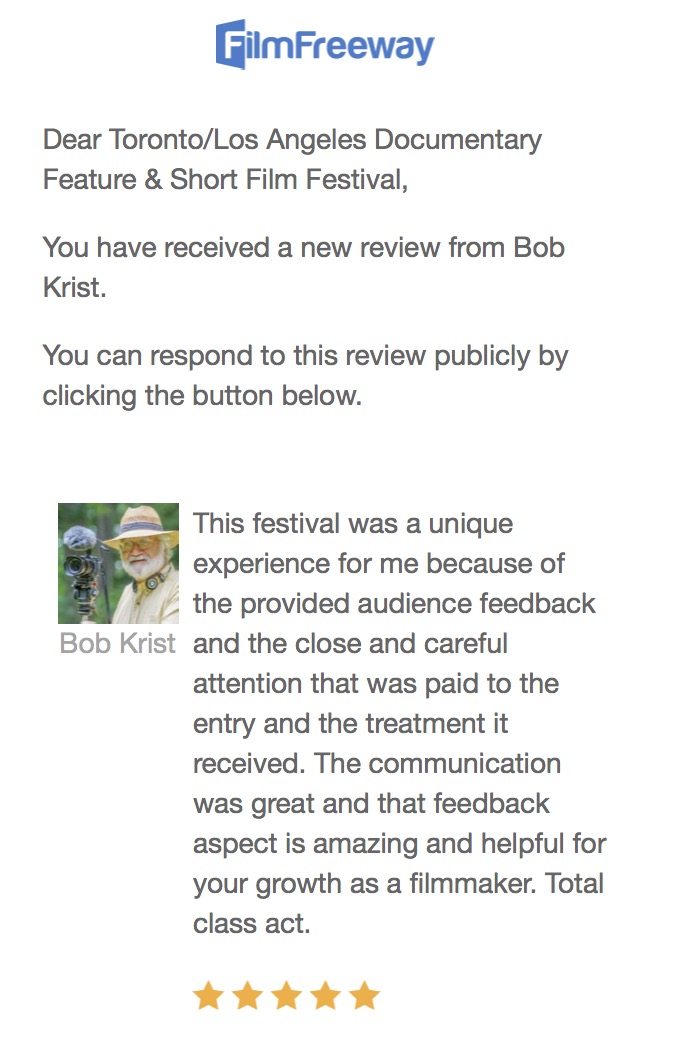
– Cinema screenings for audience feedback video.
– Blog and podcast interviews. And a bonus virtual screening (optional!) geared to create community over distance, PLUS, get your film seen by the right people.
– Also option for live screening in Toronto (always sold out!) where you can attend for Q&A and audience reactions.
For FILMS:
Submit your short or feature film. – NEW OPTION for guaranteed submission.
For SCREENPLAYS:
Submit your screenplay (feature, TV, short) and get full feedback no matter what from the industry. Winners get their script performed by professional actors.
– Also option to submit a 1-page script (guaranteed winner).
Another option is to submit your screenplay for a 10 day or less turnaround for your feedback.
Get your short film showcased at the FEEDBACK Film Festival and get an audience video.
Offers filmmakers to get their works showcased at the FEEDBACK Film Festival. Then the filmmaker will receive an audience reaction video for their film.
Get your script and story performed by professional actors at the Comedy Festival. – 0ffers screenwriters, novelists, and storytellers at all levels the fantastic opportunity to hear their stories read aloud using TOP PROFESSIONAL ACTORS.
Hypnagogia, 4min., UK Directed by Ysabelle Taylor Hypnagogia is the transitional state of consciousness between wakefulness and sleep. A sensation of semi-consciousness or trance where images float sometimes randomly, sometimes sequentially through our minds.
Mx., 5min., UK Directed by WWenen Lusa “Mx.” is a title used as a gender-neutral alternative to Mr. or Ms., reflecting inclusivity in gender identity. This film delves into the tension between gender identity and societal expectations, highlighting the quest for selfhood amidst oppression. Through the lens of diverse, non-binary lesbians, it showcases their struggles with physical acceptance, cultural pressures, and homophobia. The narrative emphasizes the symbolic power of costumes and dance as tools for inner awakening and liberation, illustrating the beauty and strength found in diverse identities. By following the journeys of these individuals, “Mx.” challenges societal norms and questions how the fashion industry can lead the way in accepting varied gender expressions, ultimately portraying the ongoing fight for identity acceptance and understanding.
Seeking Tranquility, 4min., UK Directed by Ysabelle Taylor An improvised dance film in collaboration with dancer Aleth Berenice and composer Alberte Erantis. Filmed at Acosta Dance Centre, located in a historic building of the Woolwich Royal Arsenal in London.
Mx., 5min., UK Directed by WWenen Lusa “Mx.” is a title used as a gender-neutral alternative to Mr. or Ms., reflecting inclusivity in gender identity. This film delves into the tension between gender identity and societal expectations, highlighting the quest for selfhood amidst oppression. Through the lens of diverse, non-binary lesbians, it showcases their struggles with physical acceptance, cultural pressures, and homophobia. The narrative emphasizes the symbolic power of costumes and dance as tools for inner awakening and liberation, illustrating the beauty and strength found in diverse identities. By following the journeys of these individuals, “Mx.” challenges societal norms and questions how the fashion industry can lead the way in accepting varied gender expressions, ultimately portraying the ongoing fight for identity acceptance and understanding.
BLAKE AND CATHIE, 8min., Argentina Directed by Ileana Gómez SHORT FICTION FILM ABOUT WILLIAM BLAKE, ENGLIH WRITER AND PAINTER.
Hypnagogia, 4min., UK Directed by Ysabelle Taylor Hypnagogia is the transitional state of consciousness between wakefulness and sleep. A sensation of semi-consciousness or trance where images float sometimes randomly, sometimes sequentially through our minds.
Seeking Tranquility, 4min., UK Directed by Ysabelle Taylor An improvised dance film in collaboration with dancer Aleth Berenice and composer Alberte Erantis. Filmed at Acosta Dance Centre, located in a historic building of the Woolwich Royal Arsenal in London.
Last Love, 18min., Russia Directed by Dmitri Frolov The musical and poetic composition “O my prophetic soul” on the verses of Fedor Ivanovich Tyutchev for the Reader, Pianist and String Orchestra of the composer Sergei Aleksandrovich Oskolkov served as a sound basis for the philosophical parable about the Love of the human and divine, about the cycle of life, about the decline of civilization, That the latter will be the first. The film is shot as a dream, and the use of the aesthetic series of experimental cinema only emphasizes this state. The universal sound gives him the poetry of Fedor Tyutchev (1803-1873), deeply played by Leonid Mozgovoy behind the scenes. The young actors Natalya Surkova and Vladimir Zolotar, who existed in the frame, had a difficult task to show the first people not burdened with the intellectual work of subsequent generations. It was necessary to abandon today’s problems and try to imagine themselves as original people, and then immediately move to the very end of time. The plot begins with them and ends with humanity. This author wanted to show continuity: the first love and the supposed last is an indivisible whole of one eternal Love.
Tomasz Kwiecien – Professional skating instructor, 6min., USA Directed by Dominika Machel Tomasz Kwiecień is on a mission — to get as many people involved in blading as possible, not just kids but adults too. His passion for skating knows no limits — he even set a Guinness World Record by completing a full marathon… skating backwards! Blading in schools?
Nakielsky, 1min., Poland Directed by Dominika Machel This isn’t a story – it’s a collision of senses. Movement, sound, image – equal, sharp as glass, precise as a blade. Nothing leads, nothing follows. They coexist in tension, in a rhythm that doesn’t obey rules but rises from the clash of motion, sound, and visuals. Each sense holds its ground – sight never overshadows hearing, sound never silences the body. But everything penetrates everything else – without that, there’s no meaning. The layers merge, not in harmony, but in friction – and that friction sparks reaction.
We’re Nothing, 4min, USA Directed by Kelly Hughes Music video collaboration between director Kelly Hughes and Italian Post-Metal band Postvorta. Hughes filmed most of the footage in Kitsap County in WA State (Port Orchard, Gorst, Sunnyslope, Bremerton, Suquamish) with a mostly local cast.
Ice Cream Sidewalk. 5min., USA Directed by Randy Zuniga
Pvt. Ravel’s Bolero, 28min., USA Directed by JZ Murdock Pvt. Ravel’s Bolero is a unique anti-war film blending historical documentary, visual poetry, and the haunting music of Maurice Ravel. Based on the poem by JZ Murdock, the film delves into Ravel’s time as a truck driver in World War I, reflecting on the profound impact of his music and the devastating effects of war.
THE VEGETABLE GARDEN – a tale from the Barbagia region in Sardinia, 3min., Italy Directed by Samantha Comizzoli In a Sardinian’s village of Barbagia, a mother writes to her son in prison beacuse. She is to old to work the land, so she can’t makes the vegetable garden. The son finds an ingenious solution.
Matthew Toffolo: Tell us about your experiences working on “Brooklyn”? How many months do you work on editing the film? How does it feel to be the editor of an Oscar Nominated film?
Jake Roberts: ‘Brooklyn’ was a great experience. There was a really positive energy throughout the shoot and it felt like we might be working on something quite special. It was personal to a lot of the people involved and that seemed to come through in the material and that makes you want to raise your game, especially when you’re watching a performance like Saoirse’s unfold you feel a huge pressure to do it justice. Once John and I were back in London we cut for about 3 months and obviously there was plenty of back and forth but at the same time it was quite a calm and controlled process. We had a very strong first assembly and we never deviated too far from it or went down too many experimental cul-de-sacs. This is largely a testament to Nick’s script which only needed the subtlest of refinements so essentially it was about distillation, making it as tight as possible and all the while carefully calibrating the emotional journey through the performances. As for the Oscars it is all a surreal bonus, like I say you hope as you work on something that it is special and obviously a nomination suggests you did something right but the most thrilling thing is that a wide audience gets to see it and thankfully it seems we managed to strike a chord with a lot of them.
PHOTO: Still shot from BROOKLN:
Matthew: You have worked on many documentaries. Is this something you like to continue to do?
Jake: In theory yes as documentary is so much of an editor’s medium but having fought for so long to get into features it’s difficult to turn your back on them. Certainly as a viewer I’d rather watch a great documentary than a fictional film so if the right one came along it’d be hard to say no.
Matthew: What is the key difference between working on a narrative film in comparison to a documentary?
Jake: In documentary you are creating the narrative as you go, effectively writing the script in the edit, but at the same time you are obviously constrained by your material so you have to know both how to tell the story but also how best to illustrate that within the limitations of the footage you have available. Someone once said that it’s like being given a bag of sentences and being asked to write a novel. The fact that in narrative film you get to follow a script that has been very carefully written and developed means that all that heavy lifting has been done for you and your role is just tell that story as effectively as possible.
Advertisement
PHOTO: Documentary film LONG WAY AROUND, starring Ewan McGregor:
Matthew: How did you transition from working on short films to features?
Jake: The very first short film I ever cut was for the director David Mackenzie after which we made a low budget feature together, I was 23 at the time, but then David went on to make a bigger film with actual film stars and the producers insisted on a more experienced editor so I lost that relationship. I then spent years cutting every kind of project that came my way, documentaries, commercials, music videos, shorts, television drama, you name it. Basically I honed my craft and just tried to become the best editor I could always hoping I could return to features one day. Many years later David was preparing his sixth feature film and his regular editor was unavailable so we reconnected and fortunately I had gained enough experience to be given a chance by the financiers. We have now made 5 features together.
Matthew: In the last 16 years you’ve worked as an editor on over 20 productions. What film has been your favorite working experience so far?
Jake: Films are like children and like any parent you can’t really pick favourites but each has their own unique qualities. Being involved in ‘Long Way Round’ Ewan McGregor’s round the world motorbike trip was a great communal experience, working out of a garage in Shepherd’s Bush in the months before they set off we were cutting upstairs as they prepped the bikes downstairs. Everyone involved stayed up all night helping pack up the equipment the night before they left and then months later we were flown to New York to be there when they arrived. We shot ‘Tonight You’re Mine’ in 4 days at a music festival working 22 hour days which was a very intense and disorientating but bonding process. ‘Starred Up’ was shot over four weeks in Belfast but was similarly intense as David was insisting that we have all the scenes fully cut within hours of them being filmed. We were shooting completely sequentially and he wanted to have as clear an idea as possible about the shape of the film up to the scene he would be filming the next day so we basically made the film as we went. We eventually screened the entire movie at the wrap party and locked the picture 3 weeks later so it was ultimately very short and sweet. Just recently I was cutting in a log cabin in New Mexico and every Sunday we would have a barbecue and screen assemblies for the entire cast and crew, Jeff Bridges would bring his guitar. That was a lot of fun.
Advertisement
Matthew: What is an editor looking for in their director?
Jake: Work. No seriously I think a coherent vision that hopefully translates into the dailies and then a sense of collaboration in the cutting room. It’s definitely a conversation and I think I would struggle to work with someone who insisted on doing all the talking.
Matthew: What is a director looking for in their editor?
Jake: You’d have to ask them but I would imagine someone who brings ideas and solutions to the table but doesn’t force their agenda, merely offers it. Ultimately someone who makes them look good, which we usually do.
Matthew: What film, besides the ones you’ve worked on, have you seen the most times in your life?
Jake: Probably Jaws or This Is Spinal Tap.
Matthew: What type of film would you love to edit that you haven’t worked on yet?
Jake: I’d love to do a kids film so that my children might be allowed to see what I do for a living.
Matthew: What suggestions would you have for people in high school and university who would like to get into the industry as an editor?
Jake: Start early. I can only speak from my own experience but if you’re clear about what you want to do then I wouldn’t waste time getting a media studies degree, you’re going to have to work for nothing to get started anyway so better to do it at 18 than 22. Get any practical experience you can, firstly to make sure this is really something you want to do, it’s going to take a lot of work and sacrifice so make sure you’re suited to it. Approach established professionals directly and tell them you want to do what they do, most will try and help in some way even if it’s just a cup of coffee and some advice, I always do. Try to edit rather than assist. Personally I think you’d learn more cutting a zero budget music video than you would assisting on a big budget feature. Even if you’re at the bottom of the ladder doing very basic tasks do them as well as humanly possible, listen to any instructions very carefully and never think of anything as beneath you or not worth trying over. Care. I once had to edit 9 hours of obese women discussing their bras in a focus group but I treated it like I was making art. You never know where the contacts who can ultimately give you a break might come from. It might be the guy directing the corporate video you’re working on? He might be making a feature in a few years so do an incredible job and he might remember you. If you are always creative, reliable, conscientious and good company doors will eventually open I promise.
____
Interviewer Matthew Toffolo is currently the CEO of the WILDsound FEEDBACK Film & Writing Festival. The festival that showcases 10-20 screenplay and story readings performed by professional actors every month. And the FEEDBACK DAILY Fesival held online and in downtown Toronto on the last Thursday of every single month. Go to www.wildsound.ca for more information and to submit your work to the festival.
Submit your YOUNG ADULT Short Story to the Festival here and we will automatically have it performed by a professional actor and turned into a promotional video for yourself.
This festival has a guaranteed 4-tier set up for each accepted script. (No matter what, all screenplays submitted receive FULL FEEDBACK on their work.) 1) Full Feedback on your script 2) Actors performance video reading of your script 3) Blog interview promotion. 4) Podcast interview on the Film Festival ITunes show