TRUE ROMANCE (1992): The forgotten Tarantino film (written by). How it influences writing today.

Award winning screenwriter Amy Kolquist (BEASTIES) chats about the movie “Shes watch the most times in her life”, TRUE ROMANCE, and how it’s influenced her writing style.


LISTEN to the full interview: https://youtu.be/xI8XkJPP1D0

Watch the best scene reading: https://www.youtube.com/watch?v=ORLXdXShdAk

Desperate to escape her abusive, Christian Nationalist family, a teenage girl finds an unlikely ally when a female werewolf from a pack dead set on killing her family lands in her home, and the attraction they develop for each other forces them into a fight for their very survival.

Get to know the writer:

What is your screenplay about?

Beasties is a coming of age, horror story, about Mara, a late teen girl living on a remote ranch in Montana with her abusive, Christian nationalist family with dreams, but no means, of escaping. Her life changes when Lilly, the daughter of an equally toxic werewolf clan traveling through Montana, ends up saving Mara’s life and consequently lands in Mara’s family’s home during an extreme winter storm. As Lilly’s family descends on the farm to retrieve Lilly, Mara’s family realizes that Lilly and Mara have formed a romantic connection, going against the very roots of their family moral system. With Lilly’s family hell bent on destroying Mara’s, and Mara’s family hell bent on destroying Mara and Lilly, the two girls find themselves in a desperate battle for survival that forces them to each question their own moral compass if they are to win.

What genres does your screenplay fall under?

Horror and coming of age

Why should this screenplay be made into a movie?

This movie works with current and relevant themes that are being questioned in our current political climate. The idea of “beasts” is examined in the film superficially as the werewolves, but more authentically of how we have characterized people as beasts within our society based on our morale beliefs. While Mara’s mom tries to initially save Lilly because it is the Christian thing to do, once she realizes that Mara and Lilly have connected romantically, she moves to kill not just Lilly, but also Mara, as her religious beliefs are so compromised by the thought of her daughter being a lesbian. The script also explores the hypocrisy of using our beliefs to defend our actions. In spite of his strong religious beliefs, Mara’s father kills Lilly’s father early in the script because he feels that Lilly’s father is morally beneath him. The script also explores themes of toxic masculinity and the difference in the rules in our society depending on gender. It’s also a fun horror movie set in a remote, barren setting, that has some good old fashioned fun horror scenes.

Subscribe to the podcast:
https://www.instagram.com/wildsoundpod/

https://www.facebook.com/wildsoundpod

Development of an Animation Film: Creating Storyboards & Starting the Music Score in pre-production

Conversation with the film team from the “DigiPen Institute of Technology” on the making of their short film MARIPOSA. It’s all about the pre-production. Creating storyboards and working on the tone and music before the drawing for the film begins.


LISTEN to the full interview: https://youtu.be/X8LYSjbMG1A

Mariposa, 5min,. USA
Directed by Brook Vitovsky

Mariposa’s world begins to unravel around her when she finds a mysterious butterfly.

Conversation with director: Brook Vitovsky. producer: Cambria Cheney. composer: Chase Miller. artist/writer: EmmaLeigh Fleck. artist: Kiera Vermeal

Get to know the filmmaker:

What motivated you to make this film?

Growing up, I, Brook Vitovsky, watched my great-grandmother struggle with dementia. From the time I was a toddler until I was thirteen, I saw how the disease slowly affected her mind and spirit. Witnessing that experience firsthand made me realize how deeply dementia impacts not only those who live with it but also their families. My motivation for making this film comes from a desire to honor that experience — to reach people’s hearts and create a sense of shared understanding and connection.

How would you describe your film in two words!?

Heartfelt and bittersweet

What was the biggest obstacle you faced in completing this film?

The biggest challenge we faced was definitely the layout. Matching the perspective from the storyboards to the 3D model in Maya proved difficult, especially when it came to controlling the camera.

Subscribe to the podcast:

https://www.instagram.com/wildsoundpod/

https://www.facebook.com/wildsoundpod

DRONE SHOT to establish your film: Brandon Katcher’s “Resonance in the Castle”

Conversation with filmmaker Brandon Katcher, as he was travelling in the Swiss Mountains before starting his “castle” film Italy. He happened upon an amazing area to do a drone shot that would fit into the themes of his film. Good thing he had his equipment (always have your photography equipment with you) so he could do the shot.


LISTEN to the full podcast: https://youtu.be/l0UEdzmS9LE

Resonance in the Castle, 17min., USA
Directed by Brandon Katcher
A mysterious castle breathes with light and color, drawing all who enter into its shifting embrace. Stained glass spills vivid hues across ancient stone, golden reflections dance over strange artifacts, and ethereal performances flare up like living paintings. Surreal, electric, and unbound by space or time. Musicians, dancers, and performance artists bring their visions to life, each performance casting a ripple, before fading into the ether. A place of mystery and spectacle, this living museum exists only in the moment it is seen, leaving behind only echoes. Here, the castle is not a place but a state of mind, a dream in motion, inviting us to lose ourselves within its walls.

https://www.lostsummitfilms.com/

Get to know the filmmaker:

What motivated you to make this film?

The opportunity to make Resonance in the Castle came at a key moment in my life, when I felt directionless and depleted. I had just wrapped a grueling, two-year documentary production, and like so many filmmakers, I found myself in that fog of burnout and uncertainty. What’s next? And then, pure coincidence gave me the opportunity to join an artist residency in a century-old castle in Italy. I traveled there with only a few basic ideas, the glimmer of a story. But through collaboration with musicians, dancers, sculptors, and actors from around the world, a film was born through the freedom of creating without expectation.

From the idea to the finished product, how long did it take for you to make this film?

Not knowing what to expect from the location or the artists involved, I arrived in Italy with only basic ideas and visuals in my head. Once I was able to see the castle in person and meet the artists, those ideas became collaborations, and the scenes took shape. Each artist had a plan for their live performance, which we adapted for each room and scene. The actual filming took place over two days and became an improvisation as I learned to “dance” with each performer. During the week in the castle, we also performed live in front of an audience and filmed a documentary of the event. Once I returned home, the editing process took about two months.

Subscribe to the podcast:

https://www.instagram.com/wildsoundpod/

https://www.facebook.com/wildsoundpod

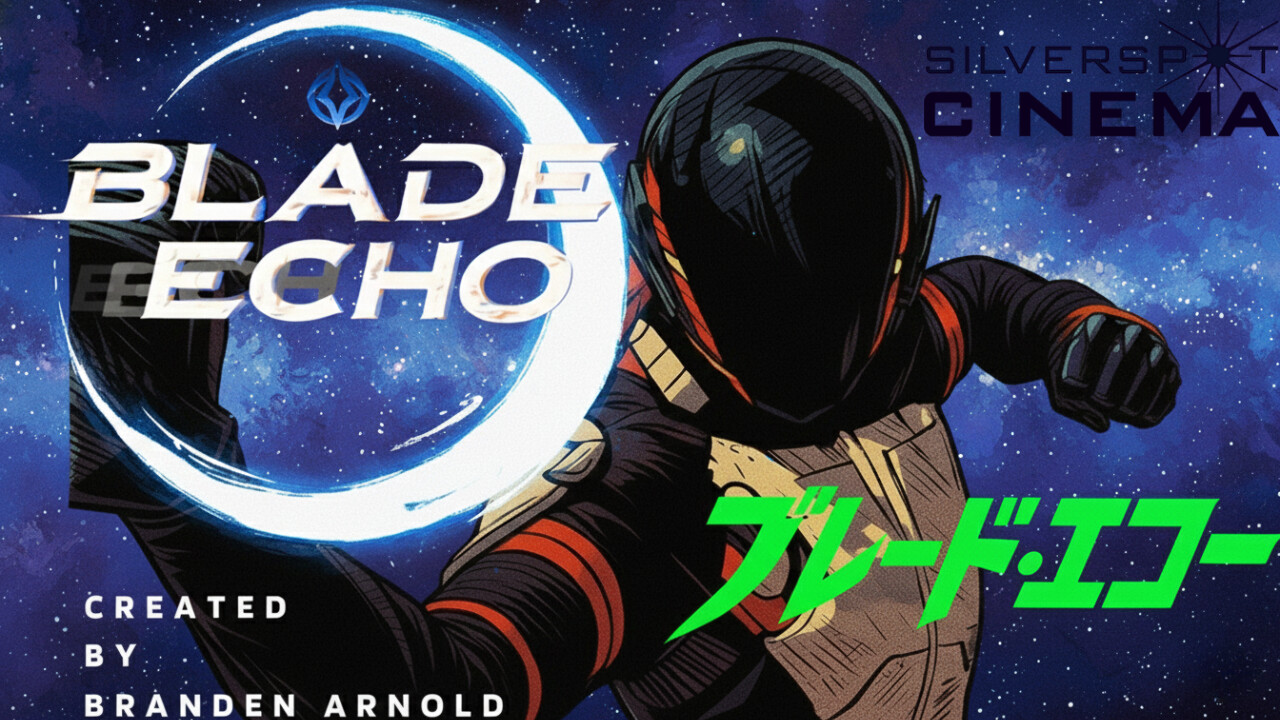
Short Film Review: BLADE ECHO. Directed by Branden Arnold

Blade Echo is a gritty, tactical tokusatsu-inspired episodic series following Derek Castle, a wrongfully convicted underdog recruited to become an Echo—a government-deployed warrior equipped with an adaptive combat suit and a personal AI partner.

Review by Andie Kay:

Exciting, fast paced and with a killer soundtrack, this action/sci-fi short film delivers a great edge
of your seat experience. The filmmakers open by succinctly explaining what these Echoes are
and that sets the tone for the entire film. At an undisclosed time in the future, the government is
recruiting convicts to help fight off a sinister alien invasion. They are called “echoes”. Derek
Castle is a wrongly convicted man who finds himself with no choice but to become an Echo.

Visual Effects, CGI and costuming were all done amazingly well. As was cinematography, it
gave you this feel of a gritty, futuristic world. Stunt work was incredibly well done and the actors
portraying Derek Castle and our government handler were believable and had a great rapport.
The storyline was engaging and keeps your attention from start to finish, with a twist at the end
that you don’t see coming. I loved the attention to detail the film makers did in using a muffled
sound effect when our lead was speaking with his helmet on. The only downside was it was a
little hard to hear the dialogue.


There was a lot of hard work that went into this film and I wish there was an end credit roll to
commend the individuals who were responsible. All I can say is this was highly enjoyable and I
look forward to more of the story of Blade Echo.

Is Tom Hanks still America’s Dad?

Conversation with Evan Neill, who wrote the award winning screenplay. “Tom Hanks Must Die”., and how once upon a time everyone loved him.

But with today’s political climate, is that still true?

LISTEN to the full podcast: https://youtu.be/xPrdi31g3nc

—–

Watch the best scene reading: https://www.youtube.com/watch?v=Ttk712qLnB0

When a bitter nobody becomes convinced that Tom Hanks is the cosmic reason his life sucks, he drags a new friend on a chaotic cross-country mission to confront destiny-and maybe punch America’s dad in the face.

Conversation with Evan Neill on screenwriting, and the art of storytelling.

——-

Subscribe to the podcast:

https://www.instagram.com/wildsoundpod

https://www.facebook.com/wildsoundpod

Hong Kong’s Post-Pandemic Reality: A Filmmaker’s Perspective

Conversation with filmmaker Tse Jantzen on the Hong Kong experience post-Covid and how things have changed.

—–

LISTEN to the full interview here: https://youtu.be/gc3dLv_EpRQ

Lana Tong, a tour guide who migrated to Hong Kong less than a decade ago, guides audiences through a post-pandemic Hong Kong undergoing rapid shifts in its political and socio-cultural landscape. Her journey is disrupted by two disembodied voices—native narrators steeped in Hong Kong’s 80s to 00s ethos. Offering corrections rooted in a native perspective and drawing from their upbringing in Hong Kong’s 80s to 00s milieu, they recount the city’s geography and the values of freedom championed by earlier generations, paradoxically steering Lana to rediscover the city through their lens. Amid the tides of time, questions arise: Can a city’s soul survive relentless tides of change? Will its people cling to inherited ideals, flee, or forge new meaning from the fragments?

What motivated you to make this film?

This film was born out of a need to hold onto fleeting moments in Hong Kong, moments that felt especially fragile during the severe pandemic and political upheaval of 2021. Homebound with my partner, we found ourselves reminiscing about childhood and quietly mourning how the stories that shaped us seemed to be dissolving, not only through the passage of time, but also because of the shifting political landscape in Hong Kong. In response, I began filming the city’s landscape and eventually created this short film.

From the idea to the finished product, how long did it take for you to make this film?

The script and dialogue were written at the very beginning, but the images were filmed gradually over four years—from the lockdown to the reopening of the city. I wandered with a handheld camera and sound recorder, capturing fragments of memory from crowded streets to the city’s border, trying to sketch a map of change through rapidly shifting visuals and evolving soundscapes.

How would you describe your film in two words!?

Questioning identity.

What was the biggest obstacle you faced in completing this film?

The biggest difficulty lies in the relevance of the content over time. Since the text was written four years ago, some of the topics became outdated during production. I even considered amending or removing those parts. Interestingly, some of these outdated issues have now become cross-generational matters, so I decided to keep the original script.

—-

Subscribe to the podcast:

https://www.instagram.com/wildsoundpod

https://www.facebook.com/wildsoundpod

Inspired by the Masters: How Classic Directors Influence Experimental Film

Conversation with Experimental filmmaker Sary Andre El Asmar, from Lebanon on being influenced by classic Hollywood directors to make his films.

—–

Turmoil – Chapter One, 6min., Lebanon
Directed by Sary Andre El Asmar

A young woman lives between two worlds: Europe, where she’s built a life, and Lebanon, the home she can’t stop longing for. Torn between memory and desire, she drifts back and forth, riding the emotional rollercoaster of exile, identity, and belonging.

Get to know the filmmaker:

What motivated you to make this film?

What motivated me to make this film was the complex feeling of belonging and displacement that many Lebanese expats carry. I started filming randomly with no clear plan.When my friend, who lives in Germany, came back to Lebanon we spent many days together, and after that i began to sense the constant push and pull, the urge to return to her home but at the same time the desire to leave again. For me home is where your roots are, but it’s also where safety feels uncertain. The film became a reflection of living between two places, two lives, and two versions of what “home” means.

From the idea to the finished product, how long did it take for you to make this film?

Well actually, I have been shooting randomly for about 1 year and a half. I am a sea lover and mountain lover. So I used to shoot randomly every time I went out. But the idea of putting those shots into the final product took me like 3 months.

How would you describe your film in two words!?Wandering Roots

What was the biggest obstacle you faced in completing this film?Emotional breakdowns

There are 5 Stages of Filmmaking: 1) Development. 2) Pre-Production. 3) Production. 4) Post-Production. 5) Distribution.What is your favorite stage of the process and why?4) Post-Production because this process is where the real story telling happens , where I can put all my emotions and meanings to start to take shape.

—-

Subscribe to the podcast:

https://www.instagram.com/wildsoundpod

https://www.facebook.com/wildsoundpod

“You Can’t Go From Cock to Donkey”: Unpacking a Quirky Movie Line and the Art of Doc Filmmaking

What does the phrase: “You Can’t Go From Cock to Donkey” mean?

Unpacking the art of making a great documentary film in today’s era.

Conversation with Swiss filmmaker Herve Marcotte (ALONG THE THREAD OF THE OTHER) on making his documentary film and getting “reality” from his subject.

——
LISTEN to the full podcast here: https://youtu.be/nwlx4zuSG4Y

Herve Marcotte is back on the podcast chatting about his next experimental feature documentary. Without getting TOO flaky, Herve and Matthew take a deep dive into the meaning of life and the human psyche.

Along the Threat of the Other synopsis:

After my first long documentary, “Encounter with remarkable souls”, with focus on the meaning of life, I am exploring the concept of self-realization with two 25 years old young adults. The film is a quest for an unknown treasure that cannot be found alone. Like the red thread of a fulfilled life !

A tightrope walker, a physiotherapist, a sculptress, a researcher and several adults take turns talking about the inner life… and their relationship with others. Throughout the film, fictional scenes resonate with their words. The film is constructed in the manner of an adventure.

Director Statement

In my films, there’s a symbiosis between the “actors” (not in the traditional sense) and the director, creating an authentic truth that would otherwise remain undiscovered by them.

I enjoy incorporating elements such as animation, improvisation, experiments, games, self-thoughts. For examples, in “Encounter with Remarkable Souls,” I incorporate scenes inspired by the emperor Marcus Aurelius, in “Fraternity is Contagious !” improvisational segments, in “Along the Thread of the OTHER” fictional scenes shot in black & white. Philosophical says constellate my films. I am meticulous in ensuring these elements resonate harmoniously with the documentary’s themes, which originate from my thoughts but are never told during filming.

My films, directly or indirectly, revolve around universal love, portrayed by young characters (either in age or spirit), who offer viewers another perspective. I plan to give even more space to the Divine in my future works.

I film alone.

All my documentaries, under small budgets, are of cinematic quality, edited with the assistance of a professional team, including professional editing, music composition, sound design, and mixing.Last but not least, all my films are films of faith.

——-

Subscribe to the podcast:

https://www.instagram.com/wildsoundpod

https://www.facebook.com/wildsoundpod

The Art of Noah Baumbach: All of his films work no matter what era. Will Barbie work in 20 years (co-wrote script)?

Composer/Filmmaker Daron Hagen name-drops his friend Noah Baumbach in the WILDsound Podcast and admires how he is changing the landscape of cinema. And how Daron wants to do the same with the Opera.

Discussion on the art of the “Barbie” film and how he compares it to Fellini’s 8 1/2 film.


LISTEN to the full podcast here: https://youtu.be/BJU45dOa4WQ

The conventions of documentary, musical theater, and magical realism are combined and subverted to address issues of personal, national, and artistic identity through the eyes of a composer desperate to pull off one final backer’s audition whilst hounded by a disdainful documentarian named Charon.

Feature Film: Musical, Meta-modernist, Documentary, Meta-fiction, Bardo, Opera, Musical Theater

https://instagram.com/americasinging

https://www.americasinging.art/

Director Statement

This film is the final installment of a project called “The Bardo Trilogy,” which begins with “Orson Rehearsed,” and continues with “9/10: Love Before the Fall.” In the trilogy of features I explore, from the stance of an auteur composer-director-screenwriter-editor, the concept of “operafilm” — a fusing of the procedures and tropes of lyric theater and cinema in a comprehensively correlative fashion in order to achieve a new form of “gesamtkunstwerk.,

Subscribe to the podcast:

https://www.instagram.com/wildsoundpod

https://www.facebook.com/wildsoundpod

The Secret to Self-Taught Screenwriting: Read Scripts and Get Feedback

Military veteran and award-winning screenwriter Hannah Augenstine (PRIORITY ONE) chats about how she taught herself to write scripts while on a US military base in Italy.

LISTEN to the full interview here: https://youtu.be/anulab1E4xw

Watch the best scene reading of PRIORITY ONE: https://youtu.be/anulab1E4xw

Three interconnected teams – firefighters, police officers, and 911 dispatchers – face relentless emergenies in Indianapolis, balancing personal struggles with the split-second decisions that determine life or death.

——

Subscribe to the podcast:

https://www.instagram.com/wildsoundpod

https://www.facebook.com/wildsoundpod