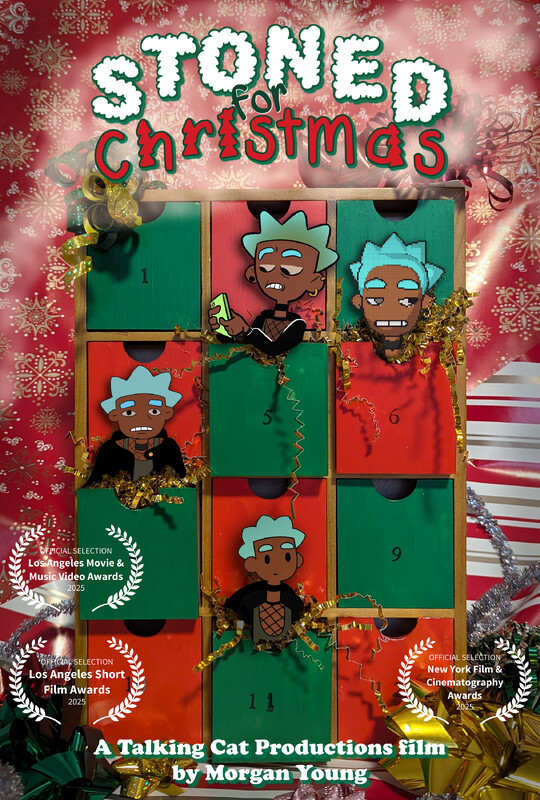
“Stoned for Christmas” is a multimedia whirlwind and a love letter to weed. This short film follows the adventures of one cannabis courier delivering at Christmastime.
The short Stoned for Christmas is bursting with creative input — the story of a drug courier working on Christmas Day is a true celebration of multiple artists. It moves seamlessly from one style to another, sometimes using classic animation lines, and other times claymation, ink, paint, pencil and live action objects and performances.
The viewer can sense the courier’s desire to deliver the goods, but also the need for reprieve to celebrate the holiday. The film shrewdly touches on a wide variety of social issues such as misgendering, a loneliness epidemic in a big city, and the human need for relaxation and connection.
The film makes use of a wide variety of musical styles, notably upbeat rap and wacky refrains of Christmas music. This project is full of cheeky humour, such as the reduced number of fingers once the lead is a video game character, and when the old lady gives the courier many extra tasks around the house, beyond the basic delivery.
This memorable short entertains from beginning to end — the clever screenplay, the hip and talented voice artists, and the numerous storyboard and animation styles, takes this edgy, festive film far beyond the “bonus level”.
How is the world affected by a catastrophic event? Everyday people live through a government mandated quarantine during a global pandemic while desperate scientists race to find a cure before it’s too late.
Staycation is not your typical fast-paced, blood-splattered zombie flick. Instead, it roots itself in a world we’ve all just come out of — one marked by a global pandemic, isolation, media saturation, and the ever present tension between hope and paranoia. This film doesn’t imagine a future dystopia; it reflects the one we’ve already survived, making its slow-burn horror hit all the more deeply.
We’re first introduced to a seemingly ordinary Zoom call between a couple — familiar, casual, and deceptively mundane, but the tone shifts quickly. Before the story even begins to unfold, we receive a chilling message from the woman on the call: she’s been selected for experimental testing in a race towards a cure. Right before our eyes, and her boyfriend’s, she turns. It’s subtle, heartbreaking, and terrifying.
From there, the film pivots. The narrative reveals its true central characters — two young women navigating this strange, evolving world. Our supposed final girl receives an invitation to return home to her family, but the film resists this path, instead exploring the way society itself has morphed to accommodate this new strain of infection. In this version of reality, infected individuals can remain in their homes with the proper licenses and regulations — essentially treated as pets or human vegetables. The satire here is razor-sharp, filtering this absurd premise through news broadcasts, government permits, and media sensationalism.
Staycation leans into the social commentary with vignettes mirroring the pandemic experience: endless work Zoom calls, awkward online dating, political divides, and the growing influence of livestreams and podcasts. These glimpses build a complex emotional landscape reflecting the waves we all felt during lockdown, from eerie calm to deep fear, connection to collapse. Russ Emanuel directs with a careful eye toward satire, layering in commentary on political extremism, conspiracy theories, and the terrifying normalcy of a world falling apart in a sort of slow motion. As humanity inches toward a cure, suspicion and chaos swell. The film explores the idea the virus may have been released intentionally, a man made tool of control. This suspicion bleeds into interpersonal relationships and fuels a growing storm of rage and desperation.
Staycation imagines a new world order, not one born from explosive zombie warfare, but through the slow, creeping collapse of what we once considered to be normal. The horror lies in our familiarity with it. The tension isn’t in the transformation from human to zombie, but in watching the slow unraveling of trust, stability, and oneself.
It’s unsettling, darkly funny, and honest in ways most apocalyptic horror films aren’t.
Submit your Literary Fiction Short Story to the Festival here and we will automatically have it performed by a professional actor and turned into a promotional video for yourself.
“Graphic Novel” isa format, not a genre. Graphic novels can be fiction, non-fiction, history, fantasy, or anything in-between. Graphic novels are similar to comic books because they use sequential art to tell a story. Unlike comic books, graphic novels are generally stand-alone stories with more complex plots.
This festival has a guaranteed 4-tier set up for each accepted script. (No matter what, all screenplays submitted receive FULL FEEDBACK on their work.) 1) Full Feedback on your script 2) Actors performance video reading of your script 3) Blog interview promotion. 4) Podcast interview on the Film Festival ITunes show
Great experience! Perfect festival for our micro-short “Bug Eye” I loved getting a video with feedback from the audience. Highly recommend!
FEEDBACK Under 5 Minute Film Festival is a great opportunity for filmmakers. The communication is excellent, and receiving audience feedback on your short film is always insightful and constructive!
Wowser. It feels so fulfilling to hear people commenting about and analyzing our documentary THE TRENT SAUCER, which won for Best Short Film. This is why we create films – to share with the wider world. Thank you for building this festival!
Because I as a filmmaker am so close to the film, It’s truly helpful to get fresh eyes & feedback on a film to know what and how others are receiving the film… what stood out for them and what could be improved upon…The people who gave feedback were positive and very helpful…
Congratulations! A great festival and grateful to have been selected as best Director!
The idea to hear what the public thinks about our work is excellent and a great way to connect with the audience from a very organic style of reviews. Thank you for the feedback on our micro-short “A Taco” and the exposure you give us as filmmakers!
I became pregnant with my son a month after Roe Vs Wade was overturned, and it gave me a lot of room for thought about women’s rights and the immensity of the choice of motherhood. To me it is a private decision that I wanted to examine in the microcosm of an expiring relationship.
In 2021, I had written a full-length play about a decade-long relationship which starts at their last meeting and works its way back to their first date. I always felt this two-hander of mine could have cinematic potential, so I adapted the first scene of the second act to the screen, where she is pregnant and struggles to break the news to her partner.
What were your initial reactions when watching the audience talking about your film in the feedback video?
I was so excited to hear their thoughts. Such gratitude to resonate with and move people with my storytelling. I felt deeply seen and appreciated.
Go to the Daily Film Festival Platform http://www.wildsound.ca and sign up for the free 3 day trial to watch a new and original festival every single day.
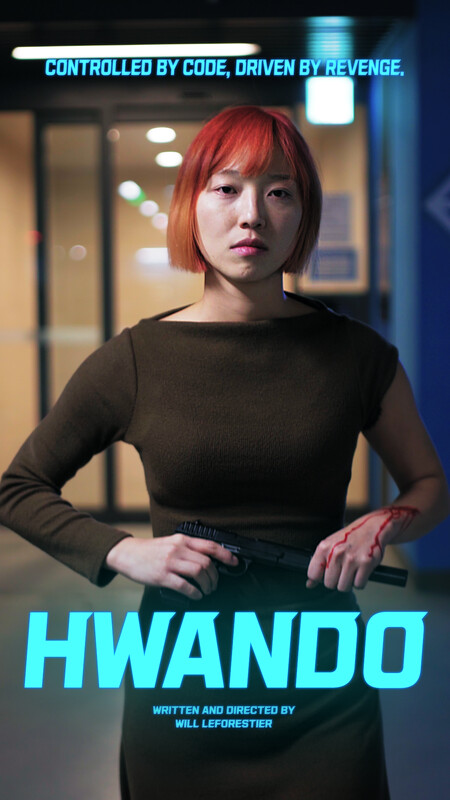
HWANDO, 25min., South Korea Directed by Will LeForestier An assassin enhanced with a brain-to-computer interface an controlled by a dark organization, must turn against her creators to protect her family and destroy the AI-driven system that enslaves her.
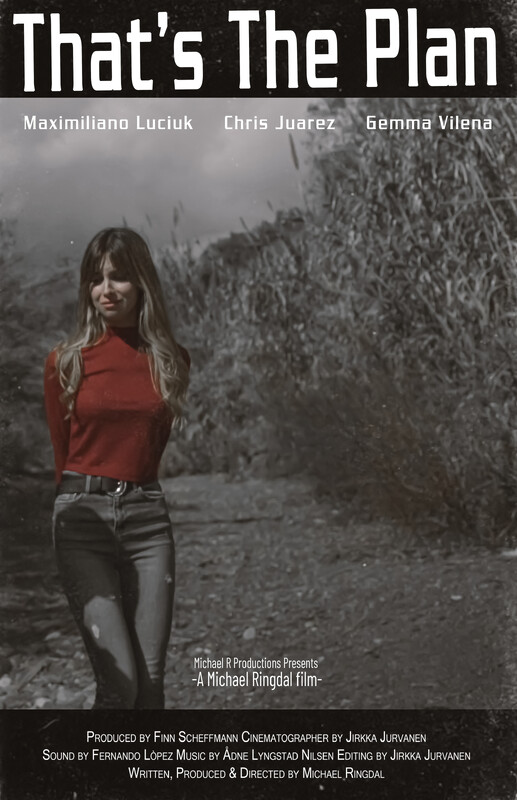
That’s The Plan, 8min,. Spain Directed by Michael Ringdal When you feel that you have nothing more to live for. It’s good to have a true friend to help you out.
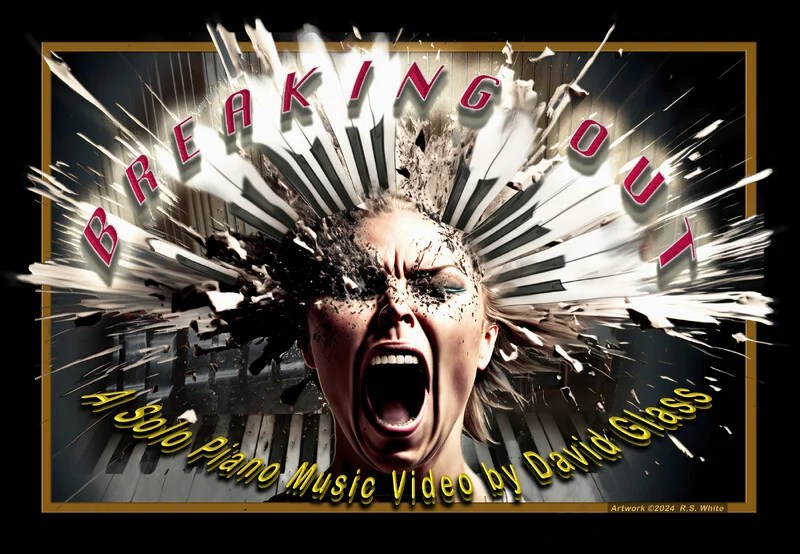
Breaking Out, 6min., USA Directed by David Glass “Breaking Out” is a visually and emotionally intense short film set to a turbulent piano improvisation, blending raw emotion, nature’s forces, and synchronized imagery in a mesmerizing psychological journey.
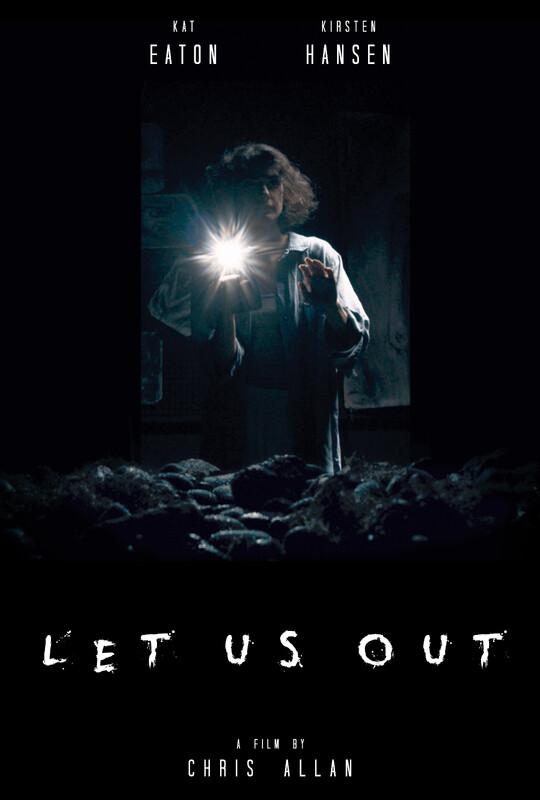
Let Us Out, 10min., USA Directed by Chris Allan A struggling painter begins to question her own sanity when her latest nightmarish creation inexplicably escapes its canvas.
Somebody Else’s Life intertwines the personal histories of a convicted cold war spy, an East German intelligence officer who sets her up for entrapment, and the son of Holocaust survivors who takes her in following her release from prison. Themes of place and betrayal weave through the narrative, which involves echoes of the Spanish Civil War, the Shoah, the founding of the Village of Goose, spiritual cults, drug running cartels, and The World Trade Center on 9/11.
2. What genres would you say this story is in?
Somebody Else’s Life sits at the intersection between literary fiction and a book-club beach read.
3. How would you describe this story in two words?
History Rhymes.
4. What movie have you seen the most in your life?
The Big Lebowski
5. What is your favorite song? (Or, what song have you listened to the most times in your life?)
Hashkvieinu, the lullaby that’s part of the Sabbath liturgy on Friday nights.
6. Do you have an all-time favorite novel?
American Pastoral, Philip Roth
7. What motivated you to write this story?
It needed to get out.
8. If you could have dinner with one person (dead or alive), who would that be?
Chaim Rumkowski
9. Apart from writing, what else are you passionate about?
U.S. History, the Spanish Civil War, worker rights
10. What influenced you to enter your story to get performed?
Curious as to how it sounds in somebody else’s voice..
11. Any advice or tips you’d like to pass on to other writers?
Two strangers meet and sparks fly, but when he accidentally discovers forged paintings at her house, he leaves abruptly. That would be the end of their story except for the fact that he’s reported her to the FBI, and their children are marrying one another on Christmas day.
It’s about two successful fifty-somethings who have had good lives but have avoided relationships because of the pain they experienced when they were younger. Because they are forced to spend time together, due to their children marrying one another, they eventually have to come to terms with the fact that they are flawed humans who care for one another.
2. What genres does your screenplay fall under?
The Art of the Matter is a romantic comedy and a holiday adventure.
3. Why should this screenplay be made into a movie?
Because it is an original take on the holiday movie, blending a Christmas romance with road trip adventure with heartfelt family drama.
4. How would you describe this script in two words?
Unconventionally conventional
5. How long have you been working on this screenplay?
I’ve been working on it for almost a year. I did a zoom script reading with you some months ago, and the feedback I got from the actors inspired me. It seemed to mean a lot of them, but listening to it, it was clear I still had work to do on it, and you mentioned a few things that made me think I still had a bunch to think about and rework. I’ve revised it multiple times since the reading. It may be getting close considering that the script won at this festival.
6. How many stories have you written?
I’ve written six features and 10 shorts.
7. What motivated you to write this screenplay?
I wanted to write a holiday movie; I wanted to write a love story with older characters; I wanted to write a script with funny Indigenous characters, and I wanted it set in the southwest. I also wanted to incorporate Las Vegas in a way that is not usually considered—no debauchery, just a nice place to get married and gather people. Sort of crazy that I was able to bring all of these desires together in this script.
8. What obstacles did you face to finish this screenplay?
I don’t really think this script is finished yet, but I am working on it. I didn’t really have too many obstacles working on it, but I did have a weird conversation with a producer who told me that she couldn’t help me with it because she wasn’t “an east coast elite” and “fortunately did not grow up wealthy” so she didn’t see what the big deal about forged paintings was and no one would want to watch this movie. Our conversation did not last too long.
9. Apart from writing, what else are you passionate about?
Horses and mules. I have loved horses as long as I have loved writing. Basically, my passions are the same as when I was 10 years old.
10. What influenced you to enter the festival? What were your feelings on the initial feedback you received?
I have gotten braver about feedback. It’s never easy for me, really, but I wanted more feedback for this script, and I knew the relationship-focus of this festival was appropriate for my script. The feedback was clear and easy for me to incorporate. I’ve already made the changes.
A few years back, I entered a script into this festival and the feedback I got was pretty brutal. The most scathing I’ve ever received. The fact that I was brave enough to enter a script into this festival again and that it won, makes me feel like I’m making progress.
11. What movie have you watched the most times in your life?
Summary: Martin’s mother passes away after a two year battle with cancer and his long lost best friend Abe finally shows up after seven years. They have to catch up and fill each other in on what they have missed out on -only to realise that they might have missed out on being more than best friends.
Get to know the writer:
1. What is your screenplay about?
The logline for my script is about as basic of a summary as I could muster: “A reunion at a funeral between two friends who haven’t seen each other in seven years leads to conversations regarding loss, relationships, career, and family trauma.” Beyond that barebones description, within the span of the day these two guys will spend together, they realize how deeply impactful the other one was on their lives when they were younger.
2. What genres does your screenplay fall under?
The screenplay straddles back and forth between drama and comedy throughout.
3. Why should this screenplay be made into a movie?
Man, that’s a tough question, and I’m not sure I can come up with an answer that isn’t self-congratulatory on some level – haha! But, I think one of the things I like so much about these characters is that, throughout the script, they have the chance to work through issues that I would hope are universal for so many people, regardless of how one identifies.
4. How would you describe this script in two words?
Thoughtful conversation
5. How long have you been working on this screenplay?
“Lost & Found” is a sequel to another script that I wrote, also last year, called “Missing Persons” and, like the “Before” trilogy, or films like “The Decline of the American Empire” (1986) and its sequel “The Barbarian Invasions” (2003), we catch up with characters several years later and find out what’s been happening to them in the interim.
In one form or another, I’ve sat with these two characters – Martin and Abraham – for the better portion of two and a half decades in my head. I’ve long thought that the original script for “Missing Persons” needed to be about one thing but I would only write half a page here, half a page there and never really go anywhere with it.
Through a series of family events that have taken place over the last few years, I finally realized why that initial script was taking so long and, it was because it also needed to be about what happened with those events and how they were inextricably linked to what I had originally planned for “Missing Persons”. Once that all played itself out, these scripts that I had been toying with for the better portion of 25 years, all came flooding out in a total of about a month to a month and a half per script. And, the great part is that my original themes and ideas for “Missing Persons” are alive and well in the script as it stands.
While I guess you could say that I technically finished “Missing Persons” first, “Lost & Found” was also written in tandem and they do truly feel like companion pieces. Before anything else was ever written for the script, I knew what I wanted the ending of “Missing Persons” to be. Everything was essentially backwards planned from there. And, as I started writing “Missing Persons”, I realized that I wasn’t done with these guys and I had to see where they might land next, hence, the birth of “Lost & Found”.
6. How many stories have you written?
Just these two.
I have another script I’m in the middle of writing now and hoping to have that one finished (at least in first draft form) within the next month or so. I also have two other scripts that I have finished the final outlines for, but am waiting to start writing until I finish the one I’m in the middle of now. I also have a list of about 7 or 8 other script ideas that I keep in my phone as a general one-sentence plot summary comes to mind that I don’t want to forget for later, including an idea for a potential third go round with Martin and Abraham.
7. What motivated you to write this screenplay?
That’s a loaded question, and I’ve kind of already touched upon their connections to my family and the profoundly dysfunctional house I grew up in.
But, as I think about these two characters and what they mean to me, I realize that the scripts are essentially love letters to my three best friends from high school who saved my life, even if they didn’t know they were doing it at the time.
8. What obstacles did you face to finish this screenplay?
Some of the obstacles I’ve already talked about (i.e. in terms of the time it took to finally realize what I knew they needed to be about). But, I think I’d say one of the biggest challenges I had was just getting used to the formatting. I’d never written a script before these two. I’d never taken any classes on screenwriting. And, I’d read very few of them on paper even though my life has essentially revolved around film for as long as I can remember.
Another huge obstacle was getting that voice in the back of my head – the one that wanted me to doubt myself as a writer or as a person who might have a story to tell – to shut up.
There was another obstacle that I think is worth mentioning, but I’ll speak to it in a couple of questions from now.
9. Apart from writing, what else are you passionate about?
Film, in general. I’m nuts about the medium. I’ve kept a record of every movie I’ve ever seen since I was a kid. I’ve studied it passionately since I was about 14 years old and my first Bachelor’s is in film studies.
On top of that, my husband, our daughter, and our two dogs and two cats are pretty much the focal points of my life outside of work and film.
10. What influenced you to enter the festival? What were your feelings on the initial feedback you received?
What influenced me to enter the festival was the idea that I could submit two screenplays for the price of one. I’d entered “Missing Persons” into a few other competitions before this one, but I had never entered “Lost & Found” because I’d always seen it as a sequel and didn’t know whether or not it could stand on its own without the first one.
When “Lost & Found” won the competition, I was blown away, because I never expected it to win in the first place (which was a lovely surprise), and I’ve never really been able to separate the two stories in my head even though they are distinctly different on paper.
Strangely enough, I received feedback on “Lost & Found” prior to receiving feedback about “Missing Persons” and, what that helped me to do was to go back and to make minor tweaks and edits to the story so that it truly could stand alone as its own piece should somehow something come of it and not from the first one.
I guess harkening back to the question about obstacles, one of the challenges I faced once I received feedback about “Lost & Found” was how to go back and do just enough reworking so that it could stand alone on its own. I wanted to ensure that I wasn’t leaving anything out in terms of information that the first film would have filled in if the second was to play by itself while simultaneously making sure that I didn’t repeat the same information that I’d shared about the characters in the first one, should both films ever eventually see the light of day.
And, the last reason I entered the competition was, for me, the most important one: I’d not entered either of the scripts into a competition focused solely around LGBTQ+ stories yet. While I’d wanted the characters’ feelings, and emotions, and longings, and dreams, and anxieties, and fears to be (hopefully) universal on some level, I think there’s something to be said about entering the scripts into a competition that is focused on raising the voices of LGBTQ+ writers and stories that feature LGBTQ+ characters.
11. What movie have you watched the most times in your life?
I’ve been glued to movies ever since I can remember. In another lifetime (my 20’s) I worked in a video store and I would put the same movies on over and over again. These were movies I used to watch on repeat when I was a kid, as well, so, I’d probably say: Indiana Jones and the Temple of Doom (1984) (which, additionally, was the first movie my parents ever took me to the theater to see), Pee Wee’s Big Adventure (1985), Back to the Beach (1987), Beetlejuice (1988), and/or Troop Beverly Hills (1989).
1. What is your screenplay about? It’s a re-imagining of Mary Shelley’s Frankenstein with an AI-enhanced tree. And of course the monster is the hero.
2. What genres does your screenplay fall under? Horror/thriller.
3. Why should this screenplay be made into a movie? It’s entertaining. And it speaks to two of the most important issues of the day: climate change and AI.
4. How would you describe this script in two words? Environmental revenge.
5. What movie have you seen the most times in your life? (Combined) Apocalypse Now
6. How long have you been working on this screenplay? Two years.
7. How many stories have you written? Between the two of us, 20.
8. What motivated you to write this screenplay? We are a father and son; we were walking in the park appreciating the trees and talking.
9. What obstacles did you face to finish this screenplay? Day jobs and depression.
10. Apart from writing, what else are you passionate about? Reading, movies, RPG.
11. What influenced you to enter the festival? What were your feelings on the initial feedback you received? We were looking for an environmental screenplay competition: there you were. The initial feedback seemed like it was written by a very smart and thoughtful person who asked some good questions (some already answered in the treequel), but we wished there had been more feedback.
12. What movie have you watched the most times in your life? (Combined) Apocalypse Now