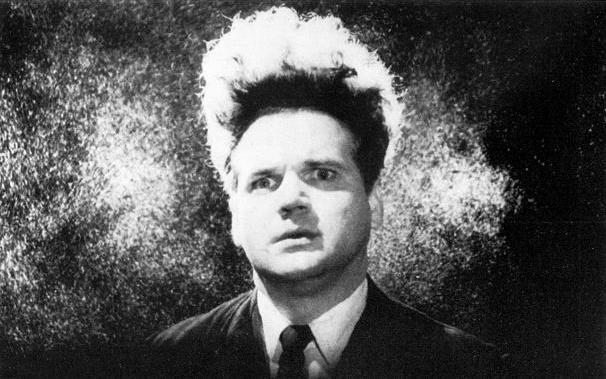
1977 Movie Review: ERASERHEAD, 1977

  MOVIE POSTERERASERHEAD, 1977 
Movie Reviews

Director: David Lynch

Stars: Jack Nance, Charlotte Stewart and Judith Anna Roberts

Review by Russell Hill

SYNOPSIS:

A deranged man is forced to look after his strange-looking baby and struggles to cope with his own demons.

REVIEW:

David Lynch has always been an odd director. Turning narratives on their head, Lynch makes regular storylines seem unreal and not like anything which is based on reality. Take Blue Velvet for example – it’s a love story at first but weird and fantastical individuals appear throughout. Eraserhead is no different, especially as its imagery and storyline is more akin to Salvador Dali’s Un Chien Andalou.

Harry Spencer (Nance) lives in squalor. With an untidy apartment, Spencer leads a twisted existence. His strange girlfriend Mary (Stewart) informs him that she has given birth to a grotesque-looking child. Spencer and Mary struggle to cope looking after a deformed child and she leaves them both. Spencer tries to juggle his romantic feelings for the girl who lives opposite him with caring for his child. Will Spencer give into his rage and kill his child?

Eraserhead is certainly not for family viewing. Its use of strange imagery is similar to what might be in the psyche of a demented maniac. However, for adult viewers, it’s a fascinating film. As any new father learns, their baby can be terrifying. Although Eraserhead takes the metaphor to a completely different level, especially as the child doesn’t look human, one can sympathise with Spencer.

Lynch’s direction is sublime. Eraserhead was his first feature-length film and shows a truly great director in his infancy. The film touches on a subject which was very important to Lynch, especially as his own child had recently been born with clubbed feet. Although basing a character on his own personal life and turning it into an alien-like creature might be a step too far, the similarities are certainly evident.

Although it is an odd movie, Eraserhead is one of the best surreal films to have been made in the past fifty years. It isn’t surprising that it has been likened to the work of Luis Bunuel and Last Year at Marienbad because it takes several viewings to fully appreciate.

eraserhead.jpg

1977 Movie Review: CLOSE ENCOUNTERS OF THE THIRD KIND, 1977

CLOSE ENCOUNTERS OF THE THIRD KIND, 1977
Movie Reviews

Directed by Steven Spielberg
Starring: Richard Dreyfuss, François Truffaut, Teri Garr, Melinda Dillon, Bob Balaban, Lance Henriksen
Review by Steven Loeb

SYNOPSIS:

Cableman Roy Neary is one of several people who experience a close encounter of the first kind, witnessing UFOs flying through the night sky. He is subsequently haunted by a mountainlike image in his head and becomes obsessed with discovering what it represents, putting severe strain on his marriage. Meanwhile, government agents around the world have a close encounter of the second kind, discovering physical evidence of otherworldly visitors in the form of military vehicles that went missing decades ago suddenly appearing in the middle of nowhere. Roy and the agents both follow the clues they have been given to reach a site where they will have a close encounter of the third kind: contact.

REVIEW:

In the early days of science fiction movies, beings from other planets were often used as a symbol of fear and destruction. During the Red Scare of the 1950s, aliens were often used as a representation for the invasion of Communism. They came, they saw and they destroyed everything in their path. By the late 1970s, though the Cold War was still going strong, the Red Scare was long over, and the Strategic Arms Limitation Talks (SALT) had improved relations between the United States and Russia, leading to a reduction in the number of missiles that each country would be allowed to keep in their arsenals. It seemed that the two super-powers might be coming toward some kind of resolution to their decades-long war; of course this would not actually happen until more than ten years later. Nevertheless, if there is one film that shows a prevailing optimism in the direction that the Cold War, and the world in general, was taking at the time, it was Close Encounters of the Third Kind (1977), the third film directed by Steven Spielberg.

Close Encounters of the Third Kind is the story of a small town electrician named Roy, played by Richard Dreyfuss, who experiences a seemingly random encounter with a UFO. After the experience, Roy becomes obsessed with aliens and UFOs. His behavior becomes extremely strange and erratic, including drawing the same mountain over and over. When he is unable to explain his behavior to his wife, she leaves him, and only then does he realize that he is drawing Devils Tower in Wyoming, the site where the UFOs are about to make contact with humans. As he races to get there, the government, having made a list of people who will be allowed to visit the aliens, apprehends him. After being questioned, Roy is added to the list, the aliens return the numerous people who had been abducted over the years, Roy and the others on the list enter the spaceship and are taken away to make contact with the friendly aliens.

Close Encounters was a film that Steven Spielberg had been working on for almost a decade by the time it was finally released. After shopping the film around, Spielberg was finally able to sell the script, and get creative control of the project, following the massive success of Jaws (1975). Based on a story he had written as a teenager, it is one of the few scripts for which Spielberg gets full writing credit, even though the script went through numerous changes and numerous other writers worked on different drafts of the story. Despite the contributions of other writers, in many ways, this is the first real Spielberg film, as this is where he began to incorporate themes that he would use in many of his later films, some of which reflect his own life and would come to define him as a director. This is the first of Spielberg’s films to depict an unhappy marriage; Spielberg’s own parents had divorced when he was a child and he often incorporates broken families, or single parent homes, in his films. Roy and his wife have a tempestuous relationship to begin with, and they see their marriage become even more strained as a result of Roy’s obsessions, ultimately leading to the collapse of their relationship. Spielberg would use this theme most famously in E.T. the Extra Terrestrial (1982), a film about a lonely boy who finds friendship with a lost alien. Spielberg’s films also often incorporate the themes of wonder and child-like innocence, seen here as Roy enters the spaceship at the end of the film. Though he is unsure of what is going to happen, he is excited and awed instead of afraid. This motif was used again in the Indiana Jones movies and, perhaps most successfully, in Jurassic Park (1993).

Close Encounters was the second collaboration between Steven Spielberg and Richard Dreyfuss, the first being Jaws two years earlier. Dreyfuss, who had first gained fame for his role in American Graffiti (1973), became a major movie star after Jaws. In 1978, he became the youngest actor ever to win the Best Actor Oscar for his role in The Goodbye Girl (1977), though this honor has since been surpassed by Adrian Brody.

Unfortunately for Dreyfuss, at the peak of his success, he developed a serious drug habit and, after crashing his car and being arrested for cocaine possession in 1982, he was forced to enter rehab. He was eventually able to resuscitate his career, going on to receive a nomination for Best Actor for Mr. Holland’s Opus (1995). After Close Encounters, Dreyfuss and Spielberg would work together one more time in Always (1989), a film that is widely considered to be one of Spielberg’s worst movies.

Close Encounters of the Third Kind was a huge success, both critically and at the box office. It was nominated for nine Academy Awards, including a Supporting Actress nomination for Melina Dillion, playing the mother of an abducted child, and Spielberg’s first for Best Director; the film would walk away with two Oscars, for cinematography and sound editing.

close encounters.jpg

1977 Movie Review: ANNIE HALL, 1977

ANNIE HALL MOVIE POSTER
ANNIE HALL, 1977
Movie Reviews

Directed by Woody Allen
Starring: Woody Allen, Diane Keaton
Review by Eli Manning

SYNOPSIS:

Neurotic New York comedian Alvy Singer falls in love with the interesting Annie Hall.

REVIEW:

First lines of film:
Alvy Singer: [addressing the camera] There’s an old joke – um… two elderly women are at a Catskill mountain resort, and one of ’em says, “Boy, the food at this place is really terrible.” The other one says, “Yeah, I know; and such small portions.” Well, that’s essentially how I feel about life – full of loneliness, and misery, and suffering, and unhappiness, and it’s all over much too quickly.</br

That is the overall theme of this movie and Woody Allen tells us about it straight up.

There’s been a lot written about this film and many of the film’s core ideas are in other people’s films because this is just one of those films! It triggered a great emotion in the world and is considered the Classic Comedy film of all-time.

Woody Allen is a master of the art of laughter and sadness. When he is in his own films he always plays a man who loves himself and hates himself at the same time. His self-love and confidence puts himself in great spots and situations until his self-hatred brings him down and out of those good situations. And that is the grammar of Woody Allen. These are the films he makes: then, now and in the future.

Allen plays moderately successful comedian Alvy Singer. He’s been married before and is seasoned in the world of relationships. Seasoned but really a failure in it. He falls for the woman Annie Hall, a young idealist with different core values than himself – played brilliantly by Diane Keaton (who picked up an Oscar for Best Actress). Annie Hall likes Alvy because he’s the type of guy that she can learn a lot from and has been in situations where she wants to be.

Right from the start it becomes a mentor/protege relationship and the madness of this situation is that Alvy can learn a whole lot more from Annie than vice/versa. But Alvy is too much into Alvy and his own love/hate of himself. It’s just too hard for him to really see or understand this.

Of course this is a comedy and it’s a very funny film. So funny in fact that I believe that someone who watches this film 100 years from now will laugh just as much as we do now and when they did in 1977 when it opened. It has universal appeal as we all want to find love but the trick is that you need to love yourself first in order to love someone else.

Emotionally most of us attach ourselves to Annie Hall because she carries this genuine kindness for herself and humanity. And we want her to get far away from Alvy because he’s a selfish jerk, even though we can’t help but like him. Avly (and Woody Allen) has charm and charm seems to go a long way in life.

A film everyone needs to watch and see. Some will hate it I understand because it’s just a film that hits too close to home for some people to really laugh at. Or they just hate quirky comedies. In my opinion it’s the best comedy of all-time.

annie hall.jpg

1977 Movie Review: AIRPORT 77, 1977

AIRPORT 77 POSTERAIRPORT 77, 1977
Movie Reviews

Directed by Jerry Jameson

Cast: Jack Lemmon, Brenda Vaccaro, Lee Grant, Joseph Cotton, Olivia De Havilland, Darren McGavin, Christopher Lee, Robert Foxworth, Robert Hooks, Monte Markham, Kathleen Quinlan, James Stewart, George Kennedy, James Booth.
Review by Jason Day 

SYNOPSIS:

A luxury Jumbo Jet, kitted out as a swish, flying convention centre, sets off on it’s maiden voyage carrying a passenger list of the rich and redoubtable and owner Stewart’s priceless artwork collection. Some of the crew are bent on carrying off this loot for themselves so they takeover the plane and fly it into the bermuda triangle to avoid detection. Hitting an off-shore oil rig, they plunge into the sea, ditching the air-liner on the sea-bed. Harrassed captain Lemmon has to try and save everyone as the air runs out and the water starts seeping in.

REVIEW:

Universal’s third entry in their increasingly tired series of airborne disaster dramas features perhaps the oddest casting for this type of venture, perfectly in keeping with the daft plot in what has become something of a guiltily enjoyable late-night viewing pleasure.

Comedy film legend Lemmon slums it in the lead role and is off-key and clearly embarrassed, despite being surrounded by some hard working and classy support actors, the best of which are Grant who is on top-form as a bitchy, boozy passenger making best friends with the drinks cabinet and the requisite relics of Hollywood’s Golden Age de Havilland and Cotton as two old flames reigniting their romance beneath the waves.

Stewart, Lee, Vaccaro, McGavin, a young Quinlan et al are completely wallflowered by the dismal and sodden script. These are actors who had shown themselves to be capable of much more but are ultimately defeated by thinly drawn, cardboard characterisations and a distinct lack of dialogue. Though for some of them, this may have been a blessing in disguise when looking back on their CV (pity poor McGavin who gets the award for the worst line as he sagely intones: “And oxygen. That could be a very important factor”).

Jameson, a former movie editor, still knows how to make a winner and is smart enough to completely side-step the loopy plot and focus his and our attention firmly on the well-orchestrated rescue operation. Here, the US Navy came in handy, as the liner is painstakingly raised from the sea and water rushes into the cabin area in the film’s most impressive moment.

Despite being hampered by special effects that wouldn’t allow for a decent crash into the sea (see it to believe it – a kid’s toy chucked into a bath and a bin hitting someone on the head would never make this stand up against Titanic), Jameson still jumps on any moments of action to ensure the excitement is pushed to the limit.

A film like this was never going to win any major film awards (or even the minor ones), but thanks to a decent budget the good looking production managed to garner itself Oscar nominations for production design and Edith Head’s costumes.

AIRPORT 77.jpg

Film Review: ATOMIC BLONDE (USA 2017) ***

Deadlines to Submit your Screenplay, Novel, Story, or Poem to the festival: http://www.wildsound.ca

atomic blonde.jpgAn undercover MI6 agent is sent to Berlin during the Cold War to investigate the murder of a fellow agent and recover a missing list of double agents.

Director: David Leitch
Writers: Kurt Johnstad (screenplay), Antony Johnston (based on the Oni Press graphic novel series “The Coldest City” written by)
Stars: Charlize Theron, James McAvoy, John Goodman

Review by Gilbert Seah

 Advertised as a female James Bond film with Charlize Theron as a top ass-kicking M16 spy, ATOMIC BLONDE tries its best to assume a British setting though Theron and most of the cast speak with an unchanged American accent. Who really cares, as the film delivers senseless action with dazzling visual and choreographed fight scenes courtesy of director David Leitch in his first solo directorial debut, himself a stunt coordinator and stuntman for stars like Brad Pitt and Matt Damon.

The film is written by Kurt Johnstad, based on Antony Johnston and Sam Hart’s 2012 graphic novel The Coldest City, published by Oni Press. The film opens with a commentary of how the cold war has ended in 1989 flowing the collapse of the Berlin Wall and then goes on to say that the film is not about this subject. The film is about the cold war revolving the good guys, the British M16 and the Americans in this case trying to retrieve a list of double agents that if fallen into the wrong hands would…..It does not really matter as Master of Suspense Alfred Hitchcock says. The point is that top level female spy, Lorraine Broughton (Theron) has been assigned to aid fellow spy and wild card David Percival (James McAvoy) with this mission. As it turns out Percival has supposedly got the list from Spyglass, a Starsi agent (Eddie Marsan) and he is to be escorted out of Berlin. Not so easy, as every Russian and German spy is also out to get the list.

With the film setting in the 80’s, one can expect a solid 80’s soundtrack. And the film has a great one at that, and not surprising as the music is by Tyler Bates who has put together similar memorable soundtracks for films like GUARDIANS OF THE GALAXY 1 and 2 and the two John Wick Films. The song are also appropriately chosen to fit the plot for example with Depeche Mode’s ‘Behind the Wheel’ during the defection segment and Queen’s ‘Under Pressure’ at the film’s climax.

The film’s excellent cast includes McAvoy (SPLIT), always good in portraying crazies. Eddie Marsan who plays Spyglass steals the show with a dead serious performance amidst the over-the-top action. German veteran actress Barbara Sukowa has a cameo as the coroner who delivers a key line: “In Germany, we do not make little mistakes.”

The film’s best action sequence lasts a full 10 minutes as Lorraine fights off multiple attackers in ultra-violent hand-to-hand combat on a staircase while protecting Spyglass. If this is not enough, an exciting car chase follows right after where villains in cars appear out of nowhere to chse the two. Director Leitch dishes sexiness to the limit with same sex scenes between Lorraine and a French spy (Sofia Boutella).

The plot of ATOMIC BLONDE is quite difficult to follow and there is no use trying as the plot is pointless. The story’s twist in the end of who is the double agent makes little sense either. But cold war spy films in the 70’s were often difficult to follow. ATOMIC BLONDE delivers dazzling senseless action, that is the point of the film and that it succeeds.

Trailer: https://www.youtube.com/watch?v=nI7HVnZlleo

Also, Free logline submissions. The Writing Festival network averages over 95,000 unique visitors a day.
Great way to get your story out: http://www.wildsound.ca/logline.html

Deadlines to Submit your Screenplay, Novel, Story, or Poem to the festival:http://www.wildsound.ca

Watch recent Writing Festival Videos. At least 15 winning videos a month:http://www.wildsoundfestival.com

1967 Movie Review: YOU ONLY LIVE TWICE, 1967

YOU ONLY LIVE TWICE,  MOVIE POSTERYOU ONLY LIVE TWICE, 1967
Movie Reviews

Directed by Lewis Gilbert
Starring Sean Connery, Akiko Wakabayashi, Mie Hama, Tetsuro Tanba, Donald Pleasence and Bernard Lee.
Review by Jesse Ryder Hughes

SYNOPSIS:

In the midst of the cold war still going on, someone is stealing Russian and American spaceships right out of space. Bond fakes his death to go undercover in Japan, to find a chemical company supplying and hiding illegal rocket fuel. A mysterious island catches Bond’s eye after a young girl is found dead. On the island Bond searches a volcano that is not what it seems. Can Bond stop world War 3 and stop whoever is stealing the spaceships? I have a feeling a good predictable ending ensues.

REVIEW:

Roald Dahl wrote the imaginative script for You Only Live Twice and it is the most imaginative script so far of the series. Abandoning Fleming’s novel almost completely Dahl and the film makers make an epic Bond film dealing with the space race and the cold war. Someone is stealing ships right out of space using their own spaceship. Russia is blaming the U.S. and vice versa. Bond under the foes impression that he is now dead travels to Japan and finds that the Osato corporation is behind the crime. The themes in You Only Live Twice are great, especially for the time, before the first man hit the moon the Russians and Americans were fighting for the glory, so why not excite audiences who were all excited about the prospects of space at the time. Also this is the first film that deals with a corrupt corporation funding the money for big crime.

The first hour, You Only Live Twice is exciting and well told with great mystery woven around Japanese customs. Supposedly at the time men were put first in Japan before the women. They even say it in the movie with Bond saying I have to retire here, which doesn’t help the controversy of Bond being the worlds biggest womanizer, but he is. Bond slowly figures things out and it leads him to a volcano which is in fact a secret launching pad and station for none other than SPECTRE head No.1, Ernst Stavro Blofeld petting his white cat ready to kill anyone who fails ONCE. He is ready to start World War 3 for some money.

 This is the film that is truly spoofed by the Austin Powers films. Blofeld’s volcano station is just crazy. Bond films were never the same grounded films after You Only Live Twice, with the exception of a couple. It pushes Bond in a direction completely away from Fleming’s novels into what the studios wanted. More action, more stunts, more gadgets overriding the stories being told. And I’m not saying I don’t like it. I still do, because it’s fun, emotionally it becomes lost, but this is the direction the franchise takes.

There is a certain amount of convenience in most Bond films. You just have to accept as an audience member and suspend disbelief. The Americans and Russians almost seem to jump to conclusions about each other too soon for the convenience of the film. Bond gets the chance to use each one of his gadgets at a perfect time in the movie. That is the fun of these movies though. As I am watching the film I can’t wait for Bond to get a chance to use a cigarette that is actually a gun.

As haywire as You only Live Twice is and fans of the novels may be disappointed. It still has its great moments, locales, action, girls and mystery to keep audiences excited. It feels like all the previous Bond films rolled into one, trying to revolutionize the genre into what it did become when Roger Moore took over.

CLICK and WATCH MOVIES ONLINE!


YOU ONLY LIVE TWICE

1967 Movie Review: WHO’S THAT KNOCKING AT MY DOOR, 1967

WHOS THAT KNOCKING AT MY DOOR MOVIEWHO’S THAT KNOCKING AT MY DOOR, 1967
Movie Reviews

Directed by Martin Scorsese

Cast: Harvey Keitel, Zina Bethune, Anne Collette, Harry Northup, Lennard Kuras, Michael Scala, Robert Uricola
Review by Vinny Borocci

SYNOPSIS:

Three young men living on the New York City streets engage in trivial violence and unproductive activities. They enjoy hanging out at bars, watching movies, having parties, etc. Suddenly, one of the men, J.R., meets a girl and begins to have a relationship with her. The other men are skeptical not only because of J.R.’s unusual changes in his behavior, but the amount of time spent with her as opposed to hanging out with them. J.R. feels the pressure from both his friends and the girl. In the process, the strains become too much for J.R. to handle, where hostility and a sense of aggression result, along with making some very poor judgments. As a raised devout catholic, J.R. feels the only one to turn to is God.

CLICK HERE and watch TV SHOWS FOR FREE!

Take a look at what’s new today!

REVIEW:

During the 1960’s, Americans spent much time engaging in street protests, focusing on topics such as feminism and gay rights, events such as various political assassinations and anti-war messages, along with numerous public outbursts against racial and sexual intolerance. In other words, the Vietnam War came knocking on everyone’s doorstep. Fittingly, during this time, director Martin Scorsese provided the audience with his first feature film, Who’s That Knocking at My Door, which remarkably took almost 6 years to complete. During this public outcry and chaos, we see in this film Scorsese provide many delicate and subtle references which not only reveal his own views on the war, but specifically reflects the attitudes of the “student movement” taking place.

Even though the film has a look of a student film – the opening sequence is of a simple match-action sequence of a mother baking bread for children – we can clearly see his first utilizations with the camera to capture various shots in a very original and unique method. We can see his influence from the French New Wave as he includes various jump-cut shots and freeze frames, while also displaying his childhood love for Italian Neorealism films through the morality of his images, capturing closeup shots of assorted Christ-like images and statues, emphasizing the blood, scrapes, and cuts on the figures to reinforce the violence and suffering of the human condition. Despite his “European” visual style, Scorsese incorporates American rock music throughout the film, serving as a function to link the youth movement of the 1960’s.

‘Who’s That Knocking’ follows a trio of young men: J.R., Joey, and Sally “Ga-Ga.” The three spend time hanging out on the rugged streets of New York, getting into fights, lounging in bars, picking up girls, fooling around at each other’s apartments. While we see these men engage in their everyday pleasures, we also see J.R. begin to have a relationship with a woman. Scorsese was not shy about exposing his own unique direction and style, moving away from the traditional Hollywood Studio system. For instance, in the beginning of the film, we see J.R. hanging out at a bar with the other men juxtaposed with his first encounter with the woman. This contrast in scenes, showing men sitting around doing nothing productive, with images of beautiful women can serve as a representation of the attitude of young men who were on the verge of leaving for Vietnam.

As we see J.R. slip into deep thought, we see Scorsese blend a parallel of scenes involving the interactions between J.R. and the girl and J.R. sitting at a bar with his friends, cleverly suggesting that while J.R. is hanging out with his friends, he still cannot get this woman out of his mind. When Joey tries to get J.R.’s attention, we see a point of view shot from J.R. looking not at Joey’s face, but of his lower body, indicating that J.R. still has something else on his mind. Continuing his European style, Scorsese utilizes a similar element of the French New Wave as he expresses his youthful love for Hollywood, making specific references and even including images (through freeze frames and snap shots) of John Wayne films.

Clearly, these three men do not have jobs, and have no intentions in pursuing anything work-related. We see J.R. get upset with the woman when she continues to ask what he does. After he replies, “I’m in between jobs right now,” she does not seem to get the message and obliviously continues to ask, “Well, what do you do now?” Scorsese presents these men as highly uneducated with a lack of understanding for human and personal relationships and interactions. As J.R. and the woman continue to see each other, the only conversations taking place is about John Wayne movies (or actually going to see a John Wayne movie). Additionally, we can see J.R. and the woman hold different religious values. In the scene at the apartment of J.R.’s mother, as we see closeup images of the Catholic images of Christ and Holy Candles spread out on dressers, the two lie in bed making love. While the woman, who does not appear to hold any religious concerns, wanting to go further, does not understand when J.R. suddenly stops. Asking, “What’s wrong?” the woman thinks there is something wrong in how J.R. thinks of her, instead of understanding how J.R. was raised as a devout Catholic.

WHO'S THAT KNOCKING AT MY DOOR.jpg

1967 Movie Review: WAIT UNTIL DARK, 1967

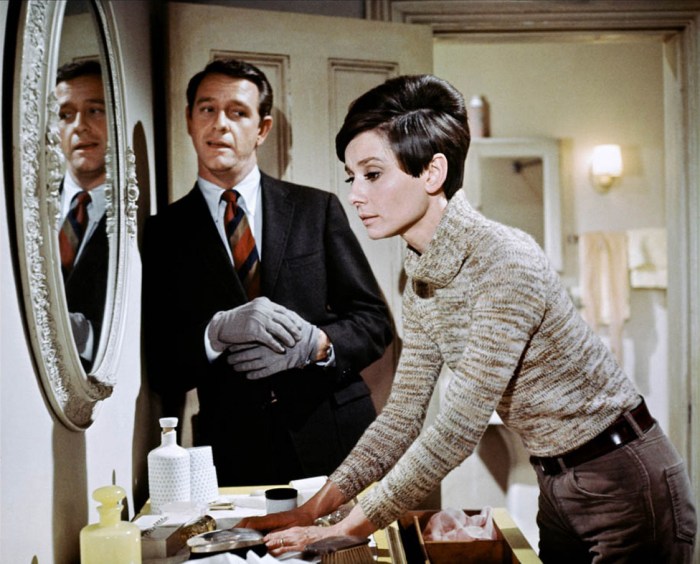
WAIT UNTIL DARK,  MOVIE POSTERWAIT UNTIL DARK, 1967
Movie Reviews

Directed by: Terence Young
Cast: Audrey Hepburn, Alan Arkin, Richard Crenna, Julia Herrod, Efrem Zimbalist Jr.
Review by Jarred Thomas

SYNOPSIS:

A recently blinded woman is terrorized by a trio of thugs while they search for a heroin stuffed doll they believe is in her apartment.


REVIEW:

A highly entertaining and suspenseful thriller that follows a tormented blind woman terrorized by three men, with one being considered by many critics as one of the scariest villains of all time played to perfection by Alan Arkin. Susy (Hepburn) suffered a terrible accident recently has been left blind. Her only aid comes from an unreliable younger neighbor, Gloria (Herrod), in which the two have a mother daughter relationship. Susy’s disability has been challenging, however, her greatest challenge comes in the form of three criminals.

The ruthless gang in led by the psychotic Roat (Arkin) who believes that Susy’s husband, Sam, has a doll with heroin inside after it was given to him on a plane by a woman trying to hide the doll from custom officials. Unknowingly, Sam brought the doll to the couple’s apartment and unfortunately Roat is determined to gain the doll despite Susy’s innocence.

The tension builds as Roat tries to manipulate the situation through cunning plans including pretending to be a police officer and using Sam’s friends to gain the trust of Susy, gaining access to the apartment. Roat is a freat villain. There are layers to the characters that unfold over the course of the film. He appears calm, collected and calculated. But as his desperation and Susy’s resistance continues, his raw emotions get the better of him and he begins to unravel.

The suspense is captivating, particularly during the final confrontation between Audrey and Alan. The cinematography is helps to create a dark and haunting atmosphere that heightens the tension and suspense. Susy realizes that the men want access to her apartment, so, knowing the place better than they do, she darkens the room by taking out the lights, leaving the men blind.

The confrontation in the kitchen is the most memorable scene in the film and help to start a trend in which the villain, thought dead, turns out to be alive and appears out of nowhere for one last kill. Other films, most notably Friday the 13th and Nightmare on Elm Street uses this trend in every one of their films. Unfortunately, those moments pale in comparison to how it was effectively done in Terence Young’s film.

Audrey was nominated for her fifth and last Oscar for her excellent performance as the vulnerable blind woman with enough resourcefulness to outsmart her pursuers. Alan created a monster that was listed in Bravo Channel’s 100 Scariest Movie of All Time coming in at number 10. Along with their great performances, Young succeeds in providing thrills and scares with the building tension and effectively taking a rather simple premise and turning it into a unique and compelling thriller.

Wait Until Dark is a remarkable and superb film that keeps you captivated throughout and never lets up. The strong performances and excellent directing with great editing provide for some entertaining and engaging moments, as well as a sterling story. If you’re a fan of Audrey Hepburn, or great thrillers, Wait Until Dark is certainly worth your time. Enjoy.

Audrey Hepburn, Wait until dark (1967) starring Alan Arkin and Richard Crenna

1967 Movie Review: THOROUGHLY MODERN MILLIE, 1967

THOROUGHLY MODERN MILLIE, MOVIE POSTERTHOROUGHLY MODERN MILLIE, 1967
Movie Reviews

Directed by George Roy Hill
Starring: Julie Andrews, James Fox, Mary Tyler Moore, Carol Channing, John Gavin, Jack Soo, Pat Morita
Review by Jayvibha Vaidya

SYNOPSIS:

Small-town girl Millie Dillmount arrives in New York City intent on finding a husband. But first she must become a modern city girl, befriend naïve Miss Dorothy, seduce her boss, stop a white slavery ring and decide between love and money when she meets smitten paper-clip salesman, Jimmy Smith.

WON an OSCAR – Best Music – Original Score.


REVIEW:

“I’m a modern!”

Opening with a suspenseful kidnapping which cuts to the wide-eyed Millie arriving in the big city, Thoroughly Modern Millie weaves together an evil plot to exploit young women with an amusing tale of a woman’s search for love and friendship. Spoofing the Roaring Twenties, Millie (Julie Andrews) transforms into a flapper or ‘modern’ in order to blend in and find herself a suitable husband. At the women’s hotel where she stays, Millie befriends Miss Dorothy (Mary Tyler Moore) as owner Mrs. Meers (Beatrice Lillie) sets her eye on Miss Dorothy for her next kidnapping victim.

See, Mrs. Meers is making some extra cash by selling young women with no family ties to the underground Chinese slavery business. In dark shadows lurk her two ‘oriental’ henchmen with their laundry basket of drugged bodies to smuggle into their lair. It’s a silly plot which turns Mrs. Meers into a caricature villainess, complete with poisonous apple and tranquilizer darts. But this plot is played for comedy and is thankfully balanced out with young Millie’s search for the perfect husband.

At a dance Millie meets Jimmy Smith (James Fox), a paper-clip salesman. After an energetic and well choreographed dance, she informs him that her intention is to find a handsome, single boss and become his stenographer. And eventually, his wife. Even after Jimmy proclaims his affections for her, she turns him down, intent on marrying her boss Mr. Graydon (John Gavin) who has no romantic feelings for her at all. Graydon only has eyes for Miss Dorothy who returns his affections but gets kidnapped before they can even have a first date. And to complicate it further, Millie sees Miss Dorothy running into Jimmy’s bedroom, causing her to believe they are having a torrid affair. Millie’s complications are eased when she meets eccentric Muzzy Van Hossmere (Carol Channing) who advises Millie to “Follow your heart, no raspberries!”

As all the players gather to save Miss Dorothy, a chase through Chinatown ends in an acrobatic showdown. The bad guys are defeated and Mrs. Meers sits drenched in a pool, her evil plan completely foiled. A twist at the end of the film reveal the secret identities of Millie’s friends as Muzzy clears away all confusion leaving two happy couples at the end of the film. Millie, despite becoming a modern finally finds love, exclaiming, “I don’t want to be your equal any more – I want to be a woman!” Well then! It appears that thoroughly modern Millie isn’t so modern after all.

Hilariously cutting to ‘20s-style title cards to represent Millie’s reactions to the city and people, the film contains many moments of humour expertly executed by Julie Andrews. Her looks at the camera display perfect comedic timing and a natural sweetness in her performance. She’s utterly adorable and her voice is exquisite, especially in “Trinkt le Chaim,” the Jewish wedding song. Mary Tyler Moore is sweet and naïve; especially charming in the scene when she calls snobby socialite Judith Tremaine a “bitch!” Andrews and Moore’s sensational tap number in a moving elevator is a real highlight, showcasing their chemistry and dancing skills.

The choreography and dance numbers are thoroughly entertaining, from the Tapioca Dance to the Jewish wedding. Carol Channing is wonderful in a bizarre and exhilarating acrobatic number. She’s fearless and steals scenes with her humour and personality. John Gavin as Mr. Graydon is in on the joke playing part playboy, part airhead, hilariously checking out of scenes due to a tranquilizer dart.

Winning an Oscar for original score, the film successfully maintains its comedic energy because of the music that runs through each of the scenes. The jaunty ‘Thoroughly Modern Millie’ tune plays repeatedly during the film, reminding Millie and the audience of her goals in the big city.

Although the last half of the film becomes cheesy and wraps up in a most bizarre fashion, Thoroughly Modern Millie is laugh-out-loud funny and entirely entertaining. The cast is delightful and the songs are fun, raised to a higher level by the talent of Julie Andrews. Finding love and friendship in New York City isn’t easy, but Millie gets a taste for what life is like for the ‘modern’ girl, taking the audience along on an exciting adventure.

THOROUGHLY MODERN MILLIE

1967 Movie Review: QUATERMASS AND THE PIT, 1967


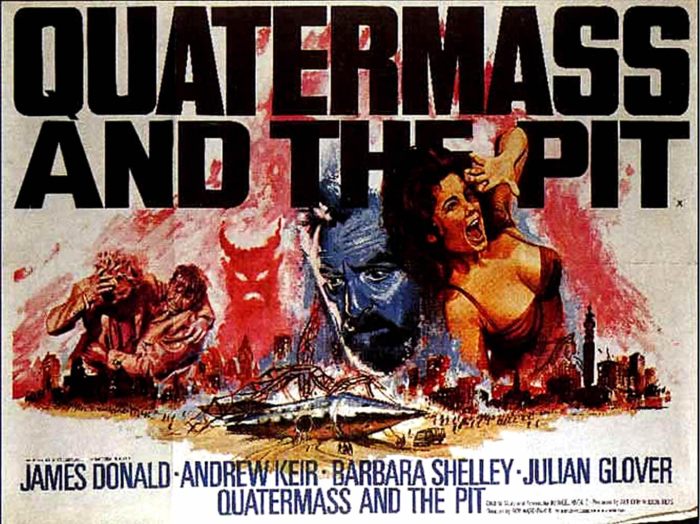
QUATERMASS AND THE PIT, 1967
Movie Reviews

Directed by Roy Ward Baker
Starring: James Donald, Andrew Keir
Review by Ace Masters 

SYNOPSIS:

While digging a new subway line in London, a construction crew discovers first: a skeleton, then what they think is an old World War II German missle. Upon closer examination the “missle” appears to be not of this earth! This movie examines the age old question of how we came to be on this planet.

CLICK HERE and watch 2009 MOVIES FOR FREE!

REVIEW:

Hammer Films made great movies. They didn’t rely on special effects, blood and gore, but on mood, setting, acting and writing. After all they were a British film company and for all their accolades British film and TV have never been know for special effects – until recently.

And, when watching it, keep in mind this is a British film, it will make it easier to swallow the plot of Martians actually being giant, intelligent Locust.

Five Million Years to Earth is the American release name (and the more original, eye-catching name of the two) of the Hammer film Quatermass and the Pit, starring Andrew Keir as Professor Bernard Quatermass. Itself a film adaption of the original 1950’s BBC television serial Quatermass and the Pit.

When skeletal remains of potential human ancestors are found during a re-development dig at Hobb’s Lane, London the re-development is postponed for an archeological dig. Professor Quatermass and military weapons expert Colonel Breen become involved when a large object is found that is initially believed to be an unexploded Nazi bomb from World War II.

Quatermass soon discovers the truth. The object is not a bomb, but a Martian spaceship. Five Million Years ago Mars was dying; its population – a race of advanced, intelligent Locust – was in the midst of extinction. They turned to Earth for their salvation.

With the object disturbed and the military and government refusing to believe Quatermass, the human race is put into jeopardy, as the plans the Locusts had for colonizing Earth than, threaten us now.

Andrew Keir plays Quatermass perfectly with the right amount of intelligence, awe and anti-authority. He is at once part of the government buts disdain the government as well. He is a brilliant man in his field and in general, but doesn’t know everything and doesn’t act like he does. Like any good scientist, he researches, theorizes and wants to learn the truth, even if the truth may destroy him.

Like almost all Hammer films this one is beautifully filmed, with excellent settings and a mood that fits perfectly into its sci-fi story. The only thing that lacks is the physical remains of the locusts, which are obviously fake – but done as well as they could with their budget and the limitations of the day.Beyond Andrew Keir’s performance and the look of the film, the writing is the shinning gem. Characters are handled deftly and for the most part are three-dimensional. Even Colonel Breene shows a multitude of dimensions until he becomes convinced he is right and Quatermass is wrong, then he becomes one-dimensional and single minded.

The plot is not original – Aliens wanting to take over the Earth – but the twist is. The takeover, or “colonization,” was attempted Five Million Years ago and the left over artifact is threatening us now.

The best part of the film is the act of discovery. The film never reveals too much information to the viewer, nor does it talk down to them. We discover things and learn what is going on as the characters do. This sense of discovery integrates us more into the story, unlike films where we know what is going on and are waiting for the characters to play catch-up.

If you like Hammer Films or old sci-fi films in general, than Five Million Years to Earth (aka Quatermass and the Pit) should be right up your alley. It is the second of three Quatermass films from Hammer Films, all three adaptations of early BBC serials. After viewing this one, you’ll surely want to see the others.It is a shame that a full fledge revival of Quatermass has never truly taken place.

QUATERMASS AND THE PIT.jpg