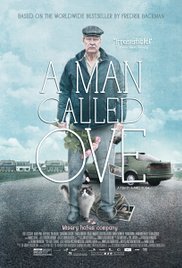
Film Review: A MAN CALLED OVE (Sweden 2015) ****

a_man_called_ove.jpgDirector: Hannes Holm

Writers: Hannes Holm (screenplay), Fredrik Backman (novel)

Stars: Rolf Lassgård, Bahar Pars, Filip Berg

Review by Gilbert Seah

Nominated for two Academy Awards for Best Foreign Film and Make-up & Hairstyling, A MAN CALLED OVE stands to compete with the big guys like the favourites THE SALESMAN, TONI ERDMANN and THE LAND OF MINE but the film has already been a hit in the U.S. when it opened last September as well as in its native country Sweden. The film is a dark horse but it might just be the winner as the Academy is made up of older voters and this film about an old retied widower is just the type of film that suits the voters.

Based on Fredrik Backman’s beloved novel (a 3.8 million bestseller), A MAN CALLED OVE tells the story of Ove (Rolf Lassgård from Downsizing, The Hunters, After the Wedding), a retired widower and a curmudgeon who keeps a critical eye on his neighbours and their goings on. He is all but given up on the world, until Parvaneh (Bahar Pars) and her family moves in across the street and an unexpected friendship emerges.

When the film opens, Ove is shown as an old grump. Films about old codgers have always been a favourite subject for filmmakers with films like GRUMPY OLD MEN (Walter Matthau and Jack Lemmon) and the recent Scandinavian entry by Dome Karukoski called THE GRUMP. Like the grump in THE GRUMP, Ove is angry at all around him, but director Holm (Adam & Eva, Behind Blue Skies) ensures that he is a likeable character.

Ove (young Ove played by Filip Berg) is shown pining over his late wife (Ida Engyoll). He smells her clothes and visits her grave at least once a day bringing flowers. Who cannot like such a devoted husband? But Ove wants to end it all, as he sees no purpose in living. So, he attempts various ways of doing himself in including hanging himself in the middle of the living room, often with no success. During the time, when he is in ‘limbo’, his brain races to recall past memories. Director Holm uses this time to flashback and reveal to the audience the early life of Ove – from the loss of both parents to finding the love of his life. The film also plays as a romance. The dinner date scene and the marriage proposal scenes are both very romantic. Though more than half he film is in flashback, the transition from current to flashback is carried out very smoothly.

Holm’s film is not one with special effects or stunning cinematography. The cinematography by Göran Hallberg is still impressive with him giving the film a hazy romantic atmosphere. It is a film about human beings. It is good that Holm trusts the source material and the charm of the book rubs off the film nicely.

The film is immediately likeable for it will make the audience both laugh and cry at Ove’s undertakings. One can also relate with the main character – whether it him being a loner, a romantic or a senior or a misunderstood man.

Trailer: https://www.youtube.com/watch?v=IMZuic0dG1w
 

SUBMIT your TV PILOT or TV SPEC Script
Voted #1 TV Contest in North America.
FILM CONTESTSUBMIT your SHORT Film
Get it showcased at the FEEDBACK Festival
writing CONTEST1st CHAPTER or FULL NOVEL CONTEST
Get full feedback! Winners get their novel made into a video!
SCREENPLAY CONTESTSUBMIT your FEATURE Script
FULL FEEDBACK on all entries. Get your script performed

Film Review: 2BR02B: TO BE OR NAUGHT TO BE (2017)

Played at the January 2017 Sci-Fi/Fantasy Film Festival

  MOVIE POSTER2BR02B: TO BE OR NAUGHT TO BE, 18min, Canada, Sci-Fi/Fan Fiction
Directed by Marco Checa Garcia

Based on the short story “2 B R 0 2 B” by Kurt Vonnegut. Set in a dystopian future where population is strictly controlled, a Father waits for his children to be born. In a deserted hospital waiting room, one man must ask himself exactly what he is willing to do, to give his children a chance at life, any life at all.

Review by Kierston Drier

 A short story by Kurt Vonnegut turned short film by director Marco Checa Garcia, 2BRO2B: To Be Or Naught To Be is a beautifully balanced, heart wrenching and well composed piece of cinema. To open, anyone who has read the original by Vonnegut will be delighted by the amount of literary detail that the filmmaker attempts to keep in the cinematic adaptation.
Set in the dystopian future, where death is rare and birth strictly controlled with rigid population regulations, a young man must choose which one of his three new triplets will live just after their birth. To add extra tension, the birth of this new child will be accompanied by the requirement to take his own grandfather to an early grave. Distraught and emotionally unwell, our hero must dissect the cause of this turmoil by unraveling its’ necessity with one of his society’s founders. This seemingly perfect world so strictly controlled is thrown into chaos when our hero attempts to kill the antagonist- making one more space available for another one his children to be able to live. With elements similar to Children of Men, and The Giver, this is film that does not allow you to watch it passively. It demands to be engaged with.

2BRO2B: To Be Or Naught To Be is one of those rare gems of short cinema that will set your philosophical mind in motion, make you question the nature of choice, freedom and safety, spellbind you with its’ cinematic beauty, all while bringing you to your emotional knees. There is true craftsmanship in this piece. There is a level of polish and richness that any lover of science fiction and literature will appreciate and admire. Bravo Marco Checa Garcia, Bravo.

SUBMIT your TV PILOT or TV SPEC Script
Voted #1 TV Contest in North America.
FILM CONTESTSUBMIT your SHORT Film
Get it showcased at the FEEDBACK Festival
writing CONTEST1st CHAPTER or FULL NOVEL CONTEST
Get full feedback! Winners get their novel made into a video!
SCREENPLAY CONTESTSUBMIT your FEATURE Script
FULL FEEDBACK on all entries. Get your script performed

Film Review: ARKHAM’S JOURNAL (2017)

Played at the January 2017 Sci-Fi/Fantasy Film Festival

  MOVIE POSTERARKHAM’S JOURNAL, 7min, Canada, Fan Fiction/Mystery
Directed by Matthew P.H Rea

Based on “Batman” DC Comics. Filmed in and around Toronto, this short proof-of-concept film provides a small insight into the untold stories of Gotham’s darkest hour. With the timeline loosely based around the batman comic, “Knightfall”, Arkham’s Journal is told through the words of Dr. Arkham’s Journal, detailing the lives of all the Arkham Asylum patients.

Review by Kierston Drier

Director Matthew P.H Rea uses ARKHAM’S JOURNAL to explore the the question “where does evil come from?” in the DC Batman Comics. Told through doctors’ notes, this piece walks through the lives and backgrounds of those residing in the Arkham Asylum.

This vibrant short doesn’t give us the whole story, and this may be one of its’ stronger points. Instead of spelling out the complete and total backstory of each villain, it shows just enough to spike our emotional centres- our fear, our intrigue, our disgust and our sympathy.

Evocative and beautiful, with strong gothic visuals and the dramatic density that rings true to the series tone and makes the franchise proud, ARKHAM’S JOURNAL brings us right to the brink of wanting to know what comes next. A strong, engaging and visually riveting piece, that stands alone while still fitting within a rich and elaborate world.
 
Watch the Audience Feedback Video of the Short Film:

SUBMIT your TV PILOT or TV SPEC Script
Voted #1 TV Contest in North America.
FILM CONTESTSUBMIT your SHORT Film
Get it showcased at the FEEDBACK Festival
writing CONTEST1st CHAPTER or FULL NOVEL CONTEST
Get full feedback! Winners get their novel made into a video!
SCREENPLAY CONTESTSUBMIT your FEATURE Script
FULL FEEDBACK on all entries. Get your script performed

Film Review: MARIA FERNANDA IN TIME (2017)

Played at the January 2017 Sci-Fi/Fantasy Film Festival

MARIA FERNANDA IN TIME, 9min, Spain, Sci-Fi/Comedy
Directed by Xavier Pijuan

An overprotective mother produces an accident with terrible consequences in the space-time continuum in the scientific laboratory where his son works.

Review by Kierston Drier

A mixture of slapstick, bawdy, comic timing and recapitulation humor make MARIA FERNANDA IN TIME a hilariously enjoyable piece. Coming to us from Xavier Pijuan, this film explores the classic comic relationship between a loving but overbearing mother and her struggling-for-independence adult son. This classic comic duo is overlaid with the sci-fi twist of time travel, when our hero tells his mother not to touch the time-loop machine, and of course, she does.

Playing off the comedy found in the technology generation-gap lends itself well to this type of tale, as our hero realizes the only way to save himself, his colleagues and the world, is to get his mother to fix whatever she has done to mess up the machine. Thus our plot is complicated by both escalating tension and steaks, and our characters’ being doomed to repeat all the misfortunes of the last few moments.

What delightful about this piece, is that it’s plot is complication, but its’ humor is effectively simple. You love every character, despite their conflicts, you root for everyone regardless of their tragic flaws. You understand each character’s motives, and the humor is palpable, strong and engaging. A wonderful, short, brilliant piece of comedy that goes out with bang.

Watch the Audience FEEDBACK of the Short Film:

SUBMIT your TV PILOT or TV SPEC Script
Voted #1 TV Contest in North America.
FILM CONTESTSUBMIT your SHORT Film
Get it showcased at the FEEDBACK Festival
writing CONTEST1st CHAPTER or FULL NOVEL CONTEST
Get full feedback! Winners get their novel made into a video!
SCREENPLAY CONTESTSUBMIT your FEATURE Script
FULL FEEDBACK on all entries. Get your script performed

Film Review: IM PERFEKT (2017)

Played at the January 2017 Sci-Fi/Fantasy Film Festival

IM PERFEKT, 7min, Hungray, Sci-Fi/Fantasy
Directed by Zsuzsanna Koszti

The short film aims to show a date in 2046. How the technology can shape our lives in an everyday situation. What if someone else controls your senses.

Review by Kierston Drier

What happens when we can no longer create distinction between where we end and technology begins? How does create us? Define us? Reshape our views of the world and of each other? IM PERFEKT coming to us via director Zsuzsananna Koszti explores the world in the-not-too-distant future, when humanity can seamlessly move between the human/techno gap, and what joys and concerns come from that.

Our two young heroes have met for coffee after meeting digitally. Each of them has a perfectly designed prosthetic hand. Sexual and romantic tension runs overtly between them and the casual seductive flirtations create an instantly engaging dynamic between our characters. Yet, when the female’s hand loses power, her date suggests they switch hands to charge. Once they do however, they can still experience the physical sensations of their own hand, even while it’s in the power of the other. It’s titillating, although somewhat invasive, when our male protagonists puts the fingers of his counterparts’ hand in his own mouth, and rubs her hand up his own leg. And the flirtatious mood turns somewhat embarrassed and awkward, when she tells him to stop. A date turned busy by jumping in too fast might be a theme that rings as current no matter how far in the future it is. A refreshingly modern take on the online dating hookup scene, with the comic twist that hooking up might just as easily mean plugging into power. Despite the clearly inappropriately liberal use our male hero takes with his female counterparts’ hand, we still feel empathic towards him, that his flirtations went one step too far and ruined an otherwise lovely coffee. Which is why you have to smile when the twist comes. Technology gets a bad rap in this day and age for dividing us all, but in IM PERFEKT we get to see it bring us closer together and unite us all, despite our differences. With the slight moral of remembering to ask permission before you take your dates’ hand.

Watch the Audience FEEDBACK of the Short Film:

SUBMIT your TV PILOT or TV SPEC Script
Voted #1 TV Contest in North America.
FILM CONTESTSUBMIT your SHORT Film
Get it showcased at the FEEDBACK Festival
writing CONTEST1st CHAPTER or FULL NOVEL CONTEST
Get full feedback! Winners get their novel made into a video!
SCREENPLAY CONTESTSUBMIT your FEATURE Script
FULL FEEDBACK on all entries. Get your script performed

Film Review: INTO THE DARK (2017)

Played at the January 2017 Sci-Fi/Fantasy Film Festival

  MOVIE POSTERINTO THE DARK, 14min, USA, Sci-Fi/Fantasy
Directed by Lukas Hassel

Sometime in the future, two men strapped in back to back, on a journey from Moon to Earth. Real Justice. Just Reality.

Review by Kierston Drier

 Director and main actor Lukas Hassel, brings to us the intense drama that is Into The Dark. A film that starts with no easy explanation, we open on our hero in a two person ship jetting through space. He is strapped in a pod, which is pressed back to back with his traveling partner, a slightly more optimistic fellow, we never see, but do hear. The discourse the two share is a fascinating breakdown of two people with completely different goals. Our hero’s counterpart seems to want to make a friend during this journey, and yet our hero seems bent on controlling what little he can, including the conversation. What is uncovered is that both our characters are in the process of paying the ultimate price for wrong doings we never learn about. The twist? It’s being live broadcast from space to the general public for entertainment and as a guard against other potential wrongdoers.

Fascinating as the concept alone is, Into The Dark has much to unpack for its short fourteen minutes. A prediction on the future of reality television? Maybe. A commentary on justice and the nature of punishment? Possibly. But what really hits this piece out of the park, as a piece of cinematic entertainment, is the acting. Hassel is our main character, and due to the nature of the film, nearly the entire piece is a close up on him, almost completely unmoving, in a tiny space. This is a dangerous and daring choice in filmmaking. It runs the risk of creating visual stagnation. Yet every moment in this piece is riveting. This is testament to intense and dramatic filmmaking, that is utterly simple, and that indicates incredible story telling.

A classic science-fiction in its form and function, Into The Dark nevertheless fails to entertain with dramatic and exceptionally engaging characters, story and twist.

 
Watch the Audience Feedback Video of the Short Film:


SUBMIT your TV PILOT or TV SPEC Script
Voted #1 TV Contest in North America.
FILM CONTESTSUBMIT your SHORT Film
Get it showcased at the FEEDBACK Festival
writing CONTEST1st CHAPTER or FULL NOVEL CONTEST
Get full feedback! Winners get their novel made into a video!
SCREENPLAY CONTESTSUBMIT your FEATURE Script
FULL FEEDBACK on all entries. Get your script performed

Film Review: A CURE FOR WELLNESS (USA 2017) ***1/2

a_cure_for_wellness.jpgGore Verbinski
Writers: Justin Haythe (screenplay), Justin Haythe (story by) |
Stars: Jason Isaacs, Dane DeHaan, Mia Goth

Review by Gilbert Seah

The director of THE PIRATES OF THE CARIBBEAN films turns serious with a new psychological thriller written by Justin Haythe (THE LONE RANGER and REVOLUTIONARY ROAD). Like the PIRATES OF THE CARIBBEAN films, A CURE ROR WELLNESS is over-long and can be shortened, but it is still a surprisingly entertaining suspensor, keeping the audience on the edge of their seats from start to finish.

An ambitious young executive, Lockhart (Dane DeHaan, his most memorable role being in CHRONICLE) is sent to retrieve his company’s CEO from an idyllic but mysterious “wellness center” at a remote location in the Swiss Alps. He soon suspects that the spa’s miraculous treatments are not what they seem. When he begins to unravel its terrifying secrets (Do NOT drink the water!), his sanity is tested, as he finds himself diagnosed with the same curious illness that keeps all the guests there longing for the cure. He is being watched and confined by Volmer (Jason Isaacs) who has darker designs for Lockhart. Lockhart, in the meantime falls in love with Hannah (Mia Goth) another patient at the facility. The question is whether Lockhart can escape or end up committed forever. The film might have been inspired by the classic THE CABINET OF DR. CALIGARI.

The film is realistically shot in English and part German as the mountainous parts of Switzerland is mainly German. The film was filmed largely at The Babelsberg Film Studio, located in Potsdam-Babelsberg outside Berlin, Germany, the oldest large-scale film studio in the world. (METROPOLIS was shot there.) The film is a handsome production, with special effects and stunning shots by cinematography Bojan Bazelli.

Relative newcomer Dane DeHaan makes a believable naive young executive falling prey to a dark evil that challenges his sanity. Equally good, if not better, is young Mia Goth who plays a waif who is as innocently creepy as Sissy Spacek in CARRIE. There is a nice cameo by English actress Celia Imrie (THE BEST EXOTIC MARIGOLD HOTEL) who plays a small but important role as a Baroness.

The film is a tad too long at 146 minutes with many repetitive scenes. How many times has Lockhart been warned by Volmer for roaming around and getting lost in the facility? How many times must Lockhart see the toilet handle shaking. And how many times must Lockhart wake up from a nightmare in cold sweat for the purpose of director verbinski scaring the audience with a false alarm?

To be fair to Verbinski, he has staged some very creepy scenes, the one in the village pub being one of he creepiest I have seen in a while , In this scene, Hannah puts on a song from the jukebox, that turns out to be the creepiest, haunting music I have ever heard. She dances in her skimpy dress with the heads of onlookers turning around to watch this strange creature dancing, only to have her felt up by the local village thug who yields a curved blade when later rescued by Lockhart. Lockhart is at the telephone making a long distance call at the point Hannah is being molested, the timing adding to the suspense, in the film’s best scene.

The film has not had that much publicity so far, but it comes with my high recommendation as a taut suspenseful thriller with super eerie European atmosphere. Creepy and scary, the film will keep one absorbed in suspense from start to end. The film also delivers, subtly, the message that wellness comes from oneself, through self-discovery.

Trailer: https://www.youtube.com/watch?v=4mcVodJmBlU


SUBMIT your TV PILOT or TV SPEC Script
Voted #1 TV Contest in North America.
FILM CONTESTSUBMIT your SHORT Film
Get it showcased at the FEEDBACK Festival
writing CONTEST1st CHAPTER or FULL NOVEL CONTEST
Get full feedback! Winners get their novel made into a video!
SCREENPLAY CONTESTSUBMIT your FEATURE Script
FULL FEEDBACK on all entries. Get your script performed

Film Review: BEFORE THE STREETS (AVANT LES RUES) (Canada 2016)***1/2

before_the_streets.jpgDirector: Chloé Leriche

Writer: Chloé Leriche

Stars: Rykko Bellemare, Kwena Bellemare-Boivin, Jacques Newashish

Review by Gilbert Seah

Things have not gone right, are still not going right and are going to get worse for a young adult Atikamekw man in the First Nations reserve of Manawan in Quebec. When the film opens, his girlfriend has left him, with him trying to win her back, unsuccessfully. Shawnouk (Rykko Bellemare) smokes up daily, is jobless and leaves a meaningless life with with his sister, mother and mother’s boyfriend, who happens to be an indigenous cop. Things get worse, when he accidentally kills his crime partner after a botched burglary.

When things have gone this badly, it can only get better. But this story of Shawnouk’s redemption shows that redemption does not come easy. It comes with humility, diligence and a self-discovery experience. All these issues make a heated subject for a super indigenous movie And writer/director Chloe Lerich does her subject justice. Lerich also produced, wrote and edited her film besides performing the directing duties.

BEFORE THE STREETS is an original and admirable first feature from director Chlore Leich. It is a moody piece that effectively capture the monotony of life with few opportunities on the reservation. The film also questions the rights deserved of these people – who have essentially got they land stolen from them. Now they have to suck up to the Whites. “Here come the shiflies”, says the indigenous cop, humorously about the Quebec police, at one point in the film.

There is a segment in the film where Shawnouk works in the canine department putting down stray dogs that are sick, or have bitten people. The metaphor is clear. Shawnouk finds it unbearable to work in such an environment.

One problem of the film has is Lerich’s fondness of closeups. As a result, only the closest object can be in focus and others in the frame appear blurred. The result is often many blurred images, especially at the very start of he film. There is also Atikamekw chanting at the start and end of the film – with the Atikamekw character screeching at a very irritating high pitch tone. It is a necessary piece, but hard on the eardrums.
Credit should be given to two excellent performances. The first is the actor Rykko Bellemare who plays the lead like an Atikamekw James Dean. He is able to capture both the audience’s sympathy and admiration for his downs and ups. The second is Jacques Newashish as the mother’s cop boyfriend, who is torn between the right and lawful thing to do.

For a debut feature Lerich’s film is an emotionally satisfying tale of redemption. The only question here is the credibility of the spiritual cleansing depicted. But it works through the personal change of Shwnouk, which is more important and effective than any jail term dished out by a Justice system. As in films like this, the ultimate question asked is: “Can there be any justice on stolen land?”

The film is shot mainly in he Cree language with a bit of French.


SUBMIT your TV PILOT or TV SPEC Script
Voted #1 TV Contest in North America.
FILM CONTESTSUBMIT your SHORT Film
Get it showcased at the FEEDBACK Festival
writing CONTEST1st CHAPTER or FULL NOVEL CONTEST
Get full feedback! Winners get their novel made into a video!
SCREENPLAY CONTESTSUBMIT your FEATURE Script
FULL FEEDBACK on all entries. Get your script performed

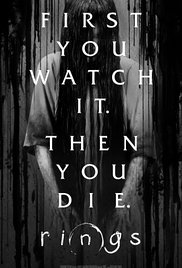
Film Review: RINGS (2017)

rings.jpgDirector: F. Javier Gutiérrez
Writers: David Loucka (screenplay), Jacob Estes (screenplay)
Stars: Matilda Anna Ingrid Lutz, Alex Roe, Johnny Galecki

Review by Gilbert Seah

 Directed by F. Javier Gutiérrez (BEFORE THE FALLS) and written by David Loucka, Jacob Aaron Estes and Akiva Goldsman, RINGS, the third film in the RINGS horror franchise (after THE RING and THE RING 2) attempts to blend in American psychological horror to the Japanese ‘watch the video – then you die’ scenario. It does not work.

When one goes to see an American remake of a cheap Japanese horror franchise, one had better keeps ones hopes low. The question is how low to keep ones hopes at to still NOT be disappointed. The film’s first 10 minutes set up the audience for these low expectations. A cute guy is seated, and sweating on an economy flight. When the girl next to him asks what is wrong, he explains that he has seen a video and is to die within 7 days and that he has 5 more minutes to survive. So, stupidly enough, he has to leave for the washroom when the seat belt sign is on. Black stuff flows on the floor, he is pulled on the floor by an unseen force and the plane crashes. All this makes absolutely no sense at all. And neither do much of the rest of the film. The odd thing is that the film gets really boring within the next 10 minutes.

The film’s main characters are two teens, who are very much in love. Holt (Alex Roe) leaves for University while Julia (Matilda Lutz) stays home pining for him. When Holt does the ‘watch the video and then die in 7 days’ gig, Julia drives up to save him. All these problems are caused by Holt’s Professor Gabriel (The Big Bang Theory’s Johnny Galecki). Somehow, the smart one seems to be Julia who has all the answers. Julia figures out that she has to free some girl in order to remove the curse which she is now caught with – which proves that she is not that smart after all. The villain of the piece turns out to be a blind fat priest called Burke (Vincent D’Onofrio – he played the recruit that shot himself in Stanley Kubrick’s FULL METAL JACKET) who might end up unforgettable in this role for all the wrong reasons.

The story turns into the horror story of a town that had a missing talented girl. The talented girl was kidnapped for almost a year, and put in chains in a basement by the priest, Burke. The attempt to Americanize RINGS with the video horror and this kidnapping story is a weak excuse of a plot that is just too flimsy to work. The tactic is not fooling anyone either.
The only thing going for the film are the scary images – most duplicated from the Japanese franchise.

For a horror flick, RINGS cost a massive $25 million to make. This will add to the estimated $500 million loss Paramount is is writing down from its film division this year. Watch the film, then sell your stock within 7 days.

Trailer: https://www.youtube.com/watch?v=NFB4eZSVgBE


SUBMIT your TV PILOT or TV SPEC Script
Voted #1 TV Contest in North America.
FILM CONTESTSUBMIT your SHORT Film
Get it showcased at the FEEDBACK Festival
writing CONTEST1st CHAPTER or FULL NOVEL CONTEST
Get full feedback! Winners get their novel made into a video!
SCREENPLAY CONTESTSUBMIT your FEATURE Script
FULL FEEDBACK on all entries. Get your script performed

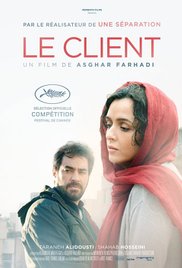
THE SALESMAN (Iran/France 2016) ****

the_salesman_poster.jpgDirector: Asghar Farhadi
Writer: Asghar Farhadi
Stars: Taraneh Alidoosti, Shahab Hosseini, Babak Karimi

Review by Gilbert Seah

Winner of the Best Script and Best Actor (Shahab Hosseini) prizes at 2016 Cannes,THE SALESMAN, the third film from the Iranian director of UNE SEPARATION and LE PASSE once again deals with domestic problems of a husband and wife in a suspense whodunit Hitchcockian setting.
Rana (Tararne Alidoosti) and her high-school teacher husband Emad (Hosseini) have moved quickly into their new apartment after an earthquake deemed their last place too dangerous to live. At the new place, just before going into the shower, Rana buzzes someone up thinking the person to be her husband. A stranger turns up in the bedroom. Rana ends up in hospital with bruises. The husband seeks revenge. In whodunit style, he traces keys and cellphone to the person responsible. The last 20 minutes has Emad confronting the perpetuator with unexpected results.

THE SALESMAN of the film title refers to the Pulitzer Wining 1949 Arthur Miller play, DEATH OF A SALESMAN. Emad is in a current production of the play with him playing the main character of the salesman, Willy with Rana playing the wife. There are of course parallels between the play and Emad’s real life. Both Willy and Emad seek the perfect life (as Willy in Miller’s play searches the American Dream), but fate hands out a different deck of cards. When Emad faces the man who committed the crime, a hidden crisis in his marriage relationship resurfaces – and he has to deal with it.

Unlike Farhadi’s other two films, THE SALESMAN moves at a slower pace and has more hidden agenda. Things are not what they seem. For one, the wife is a bundle of contradictions. She wants her husband to spend more time at home, but she wants personal solitude. When the husband finds the culprit, she wants the husband to let him go.

Farhadi also deals out slices of Iranian life in his film. The audience gets to see how the people live in Tehran where the story is set. The evacuation at the film’s start show how Iranians live. They take care of their disabled family members. The perpetuator’s family that show up at the end of the film depict the strong bond of Iranian family culture. One segment in Emad’s classroom reflects what the school system is like – and humorously. In one funny scene, a fat student quizzes Emad how possible it is in a literature text for a man to turn into a cow, only to be commented by a fellow pupil if he had recently looked into the mirror.

What is also immediately noticeable about Farhadi’s filming is his camera placement. At the film’s start, the stationary camera captures effectively the mayhem of the building evacuation. From the camera behind a window, a bulldozer can be seen. The climax of the film has the camera placed so that the characters move into the frame where the entire action then takes place.

At the end of the film,when the audience sits back to consider the consequences of the incidents that have unfolded on screen, one realizes that the impact is on the individual. The culprit is not sent to jail and the husband has not punished the wife’s attacker. The film leaves an open ending on how the revelation of events affect each character in the story. And his is what makes Farhadi’s film stand out.

THE SALESMAN has been nominated for the Academy award for Best Foreign Language Film. Director Farhadi has announced that he will not attend the ceremonies because of President’s Trump controversial travel ban.

Trailer: https://www.youtube.com/watch?v=_VcfinMasfw

SUBMIT your TV PILOT or TV SPEC Script
Voted #1 TV Contest in North America.
FILM CONTESTSUBMIT your SHORT Film
Get it showcased at the FEEDBACK Festival
writing CONTEST1st CHAPTER or FULL NOVEL CONTEST
Get full feedback! Winners get their novel made into a video!
SCREENPLAY CONTESTSUBMIT your FEATURE Script
FULL FEEDBACK on all entries. Get your script performed