Film Review: PETERLOO (UK 2018) ***** Top 10

Peterloo Poster
Trailer

The story of the 1819 Peterloo Massacre where British forces attacked a peaceful pro-democracy rally in Manchester.

Director:

Mike Leigh

Writer:

Mike Leigh

Mike Leigh’s PETERLOO (named after the Battle of Waterloo as this other massacre took place at Peter’s Field) is described in the press notes as a historical drama that portrays the epic events surrounding the infamous 1819 Peterloo Massacre, where a peaceful pro-democracy rally at St Peter’s Field in Manchester turned bloody.  British government forces charged into a crowd of over 60,000 that had gathered to demand political reform and protest against rising poverty.  Many protestors were killed and hundreds more injured, sparking a nationwide outcry.

The outcry was made known by the Guardian newspaper thus re-defining a moment in British democracy.

It is a 150 minute film which builds up to the last 30 minutes when the bloodshed begins.  The audience is aware of what will happen, but it is a climax of the film the audience dreads.  The build up is nothing short of brilliant, resulting in an expected brilliant from an equally brilliant writer/director who has delivered great films in the past – both of historical epics (MR. TURNER) and personal dramas (VERA DRAKE, HAPPY-GO-LUCKY, SECRTS AND LIES).

  The film is bookended with the presence of a young, handsome soldier dressed in red coat, who at the start of the film is seen surviving from the Battle of Waterloo.  This is Joseph (David Moorst) who returns to his loving but poor family in Manchester.  In contrast, the Duke of Wellington, the victor of Waterloo, is rewarded with a staggering £750,000 from Parliament.  Joseph cannot find a job, his mother trades pies for eggs, and the rest of his family works in the cotton mill for pittance.  With no voting privileges, bad harvests and a restriction on corn imports, the labouring classes of Northern England are in a bad way.

Finally the poor and oppressed decide to make their say and plot out a plan for change.

They enlist an initially reluctant but charismatic orator Henry Hunt (Rory Kinnear) from
London to speak at a big rally in St. Peter’s Field.  Dressed in their Sunday best, thousands of men, women and children come to hear what Hunt has to say.  Joseph and his family are among them. 

There many reasons to see this historical epic.  The most important one is to listen (and hence appreciate) the well written and spoken oratorical dialogue delivered by the actors in glorious English that is seldom heard in films.  Hearing the speeches reminds one of the oratorical debates that used to take place in ones schools.

PETERLOO encompasses both the historical epic with the tragedies of personal drama.  The film is full of scenes wth crowds of the poor, with dingy clothes and bad teeth, often dirty and unwashed but then putting other Sunday best for the St Peter’s gathering.

  Cinematography is by Dick Pope (10 Leigh films), who creates a film resembling an Old Master painting.  The film is written and directed by Mike Leigh, who grew up in Greater Manchester, just a short walk from St. Peter’s Field. 

Trailer: https://www.youtube.com/watch?v=mhSv5-frnxk

Film Review: TOLKIEN (USA 2019)

Tolkien Poster
Trailer

Tolkien explores the formative years of the orphaned author as he finds friendship, love and artistic inspiration among a group of fellow outcasts at school.

Director:

Dome Karukoski

J. R. R. Tolkien (pronounced tol-keen, as Tolkien’s professor’s pronunciation is corrected), the LORD OF THE RINGS / HOBBIT famous author whose books have been made even more famous by the Peter Jackson films is the subject of the new bio-pic of the same name.  The film traces the story of the author’s life and includes the influences on the books.  Those familiar with the books will find the film more fascinating than others, who might treat the exercise as another period piece bio-pic.  TOKIEN is a handsomely mounted period piece production though be it a dull one at that, the film often trudging through the narrative just Tolkien the soldier makes through the mud of the trenches on the western front during World War I.

The film’s core has Tolkien (Nicholas Hoult) sick with trench fever fighting in World War I at the Battle the Somme.  Tolkien holds the rank of lieutenant.  With the aid of a faithful soldier, a diminutive Sam (Craig Roberts) who helps him search for a friend of his TCBS (Tea Club and Barrovian Society)  club fellowship.  The film cuts to Tolkien’s life from childhood, living and playing the lush green English countryside (in the Midlands) to his schooling and friendship with four others fellow artists that they swear ‘to change the world through art’ together. Tolkien also falls in love with Edith Brett (Lily Collins), but is prevented from seeing her by his Guardian, Father Francis Morgan (Colm Meaney).  It is a choice of education over romance that the Father decides for Tolkien but the couple’s bond of romance remains strong.

While Tolkein’s life unfolds, director Karukowski constantly reminds the audiences of the influences on his writing.  These includes his war experiences, his brotherhood (hence ‘The Brotherhood of the Rings’), Sam, Tolkien’s friend in the trenches is like Grodo’s best buddy in the books and the beauty of the countryside akin to the beauty of the shire where the Hobbits live.  But the film is a slow march, the film often lingering at the landscape, scenery and sets tab on the emotions of the characters.  The film’s war segments which transforms into fire as breathed out from the mouth of dragons s in the Lord of the Rings stories look a desperate attempt at connecting the author’s experiences to his writing.  Tolkien’s aptness at the creation of his own unique language takes enables him to complete his Oxford studies under Professor Wright (Derek Jacobi) is yet another influence,

Finnish director Dome Karukowski, one of the most famous directors of his country has been chosen to do this bio, as he has done bios before, most notably TOM OF FINLAND his previous film that was Finland’s entry for the Best Foreign Film Academy Award though it did not make the short list.  It was not a very good film, short of passion and inspiration which the director has ensured does not happen again in TOLKIEN.  Still, Karukoski fails to engage his audience, due primary from the uncomfortable intercutting of the world War scenes with the rest of his story.  Just when the audience is drawn into the story, the film shifts to the trenches.

Irish actor Colm Meaney (who usually plays comedy) delivers a solid and serious portrayal of Father Francis Morgan who restricts Tolkien’s freedom.  His character is reminiscent of one of directors Karukowski’s previous character in THE GRUMP, one of his other films that made North American distribution.

The film is ultimately properly concluded with titles that summarize what director Karukoski had been attempted to do with his film.  Too bad all that all these should have been made clear without the titles.

Trailer: https://www.youtube.com/watch?v=wZ1vn85iQRE

Film Review: TIFF CINEMATHEQUE Presents – Files from Iceland

TIFF CINEMATHEQUE Presents – Files from Iceland

The title of this new series on Icelandic films is Wayward Heroes: A Survey of Modern Icelandic Cinema because that is calling the series what it is.  Those who are fortunate to have traveled to Iceland (myself included) will reminisce of the amazing natural beauty of the island as they watch these films, many of which celebrate the landscape and beauty of the country,

The total of 10 films showcase the diversity of genres explored by Icelandic filmmakers, from Baltasar Kormákur’s Nordic noir Jar City to Ágúst Gudmundsson’s deadpan comedy Golden Sands, Gudný Halldórsdóttir’s absurdist Under the Glacier to Baldvin Z’s post–financial crisis drama Life in a Fishbowl.

The series will also feature introductions by three of the directors included in the retrospective: Fridrik Thór Fridriksson, who is considered to be the modern godfather of Icelandic film; Kristín Jóhannesdóttir, known for her masterful use of magical realism; and Róbert I. Douglas, whose satirical looks at Icelandic society premiered to substantial domestic box-office success in the early ’00s. 

For a complete program, ticket pricing and descriptions of each film in the series check the TIFF website at: 

tiff.net

Capsule Reviews of Selected Films:

CHILDREN OF NATURE  (Iceland 1991  ) **** 

Directed by  Fridrik Thór Fridriksson

The only Icelandic film ever nominated for the Best Foreign Language Film Oscar, Fridrik Thór Fridriksson’s CHILDREN OF NATURE is the story of two seniors who escape their old age home because they’ve nature.  The film begins sadly with Thorgeir (Gísli Halldórsson) biding a silent farewell to the farm he has devoted his life to as he hoots his dog and prepares to move in with his grown married daughter in Reykjavík.  He is eventually put into a retirement home, where he is unexpectedly reunited with an old flame, Stella (Sigrídur Hagalín).  Stella’s words to the retirement home’s attendants: “You have no right to decide for me,” is indeed very sad and moving and has the audience rooting for her.  They flee the home, stealing a jeep to travel back to their country home while the baffled police gather the clues.  Extremely well put together and one of the most effective dramas about old age I have ever seen.  The film also celebrates the countryside beauty of Iceland.

JAR CITY (Myrin) (Iceland/Denmark/Germany 2006) ***1/2

Directed by Baltasar Kormákur

As Detective Erlendur (Ingvar E. Sigurdsson) investigates what he calls a messy and pointless murder where the culprit does not even bother to hide the evidence, he uncovers a three decade long crime involving a rape and some genetic dis-order.  Erlender is one tough cop and unafraid to go all out to solve the murder.  Director Kormákur (he made the Hollywood film ADRIFT and is now remaking Hollywood version of JAR CITY) ups the angst in this gruesome mystery by making the atmosphere so foul (Erlendur is shown eating  sheep’s head; he uncovers a rat infested wrapped body among the pipes) that one can almost smell the stench and rot. At the same time, another story of pathologist Örn (Atli Rafn Sigurdsson) embarking on a parallel odyssey searching for the cause of his little daughter’s incurable hereditary disease is intercut with the murder mystery.  The two stories are neatly tied together in one of the most satisfying and grossest mystery thrillers seen in a while.  The film also makes extensive use of the Icelandic landscape which makes this film a must in the Icelandic Films series.

UNDER THE GLACIER (to be reviewed and posted Saturday)

WHEN THE RAVEN FLIES (Iceland 1984) **

Directed by Hrafn Gunnlaugsson

WHERE THE RAVEN FLIES is the first of Gunnlaugsson’s epic Viking trilogy.  The story unfolds in a straight forward fashion, opening as a young Irish boy witnessing the slaughter of his parents and the kidnapping of his older sister by marauding Icelandic warriors.  The film quickly moves years later, the now grown boy (Jakob Thór Einarsson) now arriving in Iceland with vengeance on his mind.  He systematically sows discord among the Viking clan that killed his family, secretly murdering some and playing off their suspicions of one another as he works his way towards their leader.  The film takes its time to establish any interest as the start of the film looks cheesy and cheap due to the music and badly staged set-ups.  The film eventually picks up with a bit of violence and Icelandic flare.  The film has promise but could have been better.

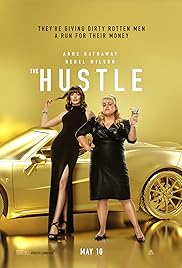
Film Review: THE HUSTLE (USA 2019)

The Hustle Poster
Trailer

Anne Hathaway and Rebel Wilson star as female scam artists, one low rent and the other high class, who team up to take down the men who have wronged them.

Director:

Chris Addison

Writers:

Stanley Shapiro (screenplay by), Paul Henning (screenplay by) | 5 more credits »

THE HUSTLE (original title NASTY WOMEN)is a remake of DIRTY ROTTEN SCOUNDRELS (Michale Caine and Steve martin) which is a remake of  the sophisticated comedy, BEDTIME STORY (Marlon Brando and David Niven)  One can see the casting of Anne Hathaway who looks posh and refined playing the suave con-artist in opposition to the Rebel Wilson’s con-artist.

The film is set in one of the smaller Riviera towns in the south of France.  The town is not big enough for two con artists.  The posh one, Josephine (Hathaway) plans to get the crass one, Lonnie (Wilson who also produced the film) out of the town so she can do all the cons herself.  But Amy, crass as she is still succeeds in her crooked endeavours.

Though the film can hardly be described as good, one must give credit to both Hathaway and Wilson for trying hard.  Wilson tries the hardest, putting her figure often to ridicule to get a few extra laughs while Hathaway uses her posh exterior to inject any class into the movie.  If Wilson is the sort of comedienne that annoys you, best stay away from THE HUSTLE as they are lots and lots of her comedy.  

The basic premise of the original films is kept in THE HUSTLE while a few updating touches are made.  The target is also tech savvy and has acquired his wealth from owning a lot of stock from his own company.  The enmity between the two con-artists is still present as the wager of a sum of money that will be won based who gets to bed the prized catch.  The lead con-artists have been switched from male to female for the main reason as to update political correctness with more female oriented films.  The reason given in the film is that females make better con artists than their male counterparts is that females are smarter and can prey on man’s weakness for the opposite sex.  As such the male prize in the story looks rather unattractive as a male specimen, looking nerdish and immature.  In real fact, the two female con artists do not do anything really smart either.  The main plot takes a while before settling in, allowing Wilson (this is clearly her vehicle) to do her own thing and her own comedy. 

Whether based on the two previous films or not, the story comes off as entirely predictable, right up to the very end.  When the credits finally roll – what a relief, what transpires is yet another tired and unnecessary make of the the 2 films that could be re-watched instead of this blatant and dull affair.  The only ones that turn up hustled are the audience that pay good money to see what has been advertised as a comedy.

Trailer: https://www.youtube.com/watch?v=_j5hwooOHVE

Film Review: SHADOW (China 2018) ***

Shadow Poster
Trailer

Life and intrigue in an ancient Chinese court.

Director:

Yimou Zhang

Writers:

Wei Li (screenplay), Yimou Zhang (screenplay)

Chinese director Zhang Yimou has made beautiful period films like RAISE THE RED LANTERN and JU DO, my two personal favourites.  But often the beauty of the films take over the narrative resulting in pretty empty pieces like his foray into martial art epics.  Martial art epics should be excited with fast and furious executed action segments, not moving in slow motion showing the choreography of the moves.  Films like HOUSE OF THE FLYING DAGGERS end up like empty pretty vessels.  Yimou’s SHADOW again is a beautifully shot period pieces set in ancient China, but thankfully has a stronger plot with little martial arts.

The story concerns a king and his commander, the commander’s wife and the king’s sister.  It is a four-handler set in a period epic.  In an empire ruled by thus wild and dangerous young king (Zheng Kai), the court is a hive of politicking and treachery.   The monarch’s brave military commander (Deng Chao) has cultivated a secret weapon to aid his survival: a “shadow,” (and hence the film title) a lookalike who can fool both his enemies and the king himself as the commander prepares for a dangerous final assault against the forces of a rival kingdom.   There is no real villain in the film.  The Yangs of the rival Kingdom could also be the good guys and the Pei Kingdom the bad guys – interchangeable.

One wonders about the soundtrack and score.  If at first to denote tension, the soundtrack works.  Overuse of the same in repetition in this case in the film renders the soundtrack really annoying after a while.

Most of the actors are unrecognizable in North America but are all quite the good lookers, both male and female.  The production sets particularly the Pei Palace and the costumes are also a feast for the eyes.  The young actors are not very good, overacting or looking as if they are trying too hard half the time.  What the film is lacks is an effective dramatic content that connects the audience with the plot.

The film is quite male oriented that might defend the other gender.  The sister mistreated as second class, offered as a concubine.  The commander’s wife has little say in things and has to suppress her romantic emotions.

For a fight film, the action sequences do not make up the majority of the film nor are they particularly exciting.  Do not expect an action packed film from this director.  A few action sequences though not that many, are still executed in slow motion. But the fight segments that include special effects, especially fo the steel umbrellas and their blades are impressive.

Yimou had been the Chinese director to watch when he first came on the scene with his muse Gong Li.  His newer works including SHADOW have never reached the heights of films like JU DOU, RED SORGHUM, RAISE THE RED LANTERN or even the lesser THE STORY OF QIU JU. 

The film has a limited run at the TIFF Bell Lightbox and should be seen onto big screen.

Trailer: https://www.youtube.com/watch?v=ubrquR6i0WQ

Film Review: THE WHITE CROW (UK 2018) ****

The White Crow Poster
Trailer

The story of Rudolf Nureyev‘s defection to the West.

Director:

Ralph Fiennes

Writers:

David Hare (screenplay), Julie Kavanagh (Inspired by her book: “Rudolf Nureyev: The Life”)

The term white crow refers to a person who is both extraordinary and an outsider, a term that clearly applies to the famous Russian ballet dancer defector Rudolph Nureyev.  Ralph Fiennes directs from a screenplay by theatre playwright and director (who has also directed a few films) David Hare from the biography Rudolph Nureyev: The life by Julie Kavanagh.  It is the first part of his life, apparently the less volatile portion of it.  This begs for a sequel to this first look at Nureyev’s younger days.

The film begins with the dancer with his Russian troupe arriving in Paris for a performance for the first time.  The year is 1961.  As the route steps on to the bus that takes them around the streets of Paris, it is clear that the amount of logistics that have gone into this period piece.  The troupe are decked in the 60’s wardrobe with 60’s make-up and hair.  The steps on the bus are made of aluminium as they were often made in those days.  And the street is filled with 60’s vintage cars.  The Parisienne period atmosphere created is stunning as it is and well worth the price of the admission ticket regardless of how Fiennes’ film turns out.  His attention to detail, including his speaking of Russian, playing  Nureyev’s ballet teacher is to be commended.

The film flashbacks to the year 1938 on a train in the Soviet Union.  A woman is in delivery, which the audience assume (correctly) that it is Nureyev being born.  The audience sees that the ballet protege was born in poverty but rises to the top not only by talent and hard work but by sheer will of determination, often getting his way by awkward means.

As a biopic, Nureyev’s life story contains sufficient events to make it extremely absorbing if not entertaining.  Nureyev is told at the very beginning by a Russian official.   Ballet is all about rules and obedience.  Nureyev is a rebel.  Nureyev is brilliantly portrayed by Ukrainian dancer Oleg Ivenko who displays great dance performances as well as a model body to die for.  He has sex with both sexes, but the audience is spared the sex scenes.

The film’s shooting locations include the Hermitage in St. Petersburg (formerly Leningrad) and the Louvre in Paris.  The important painting ‘the raft’ is shown, displaying how beauty can emerge from ugliness.

For a two hour plus film, director Fiennes paces his film well, with hardly a dull moment.  He ends the film with an extremely suspenseful segment that turns out very satisfying for two reason.  Firstly, it is a truly well executed nail biter, with shades of TORN CURTAIN, that even Hitchcock would be proud of.   Fiennes also takes the risk (that pays of), of intercutting the segment with Nureyev’s mother offering him the crucial words “You do this alone,” while he makes the crucial important decision of whether to defect or go back to Russia.  The conclusion is also the termination of Nureyev’s dream for freedom to do the things he wishes, without restriction.  

I was in London a month ago when two opening films were hogging the news.  THE WHITE CROW (the other film was US) was one of them.

Trailer: https://www.youtube.com/watch?v=IUYPHIG8os8

Film Review: THE SKIN OF THE TEETH (USA 2018)

The Skin of the Teeth Poster
After his date takes a shocking turn, a man is plunged into a surreal interrogation of just who and what he is.

Director:

Matthew Wollin

THE SKIN OF THE TEETH is an ambitious LGBT psychological drama written and directed by Matthew Wollin that plays in select North American cities come May the 10th.  It held its world premiere at the Twin Cities Film Festival and went on to have a healthy festival life, including the prestigious Newfest and Outfest.  It has been described as a cross between GRINDR and GET OUT.

For non gay audiences unfamiliar with they hook up scene, GRINDR is a gay hookup app that many a gay people use to get no-strings attached sex.  A profile is created and once on, one can see all gay people with their profiles in the near vicinity.   Hook ups are so simple.  The film has a meet up between a white and black man in which identities are questioned.

THE SKIN OF THE TEETH is a two act film.  The first act is the meet up.  The second is the detective’s questioning of the black man, which is taken a step further.  The first act is the more interesting one, which results in a let down by the film’s end.

When Josef King (Pascal Arquimedes) arrives at John Burstner’s (Donal Brophy) apartment for a date, their prickly energy slowly gives way to an unusual and genuine chemistry. But after Josef takes a pill with unclear effects, the night takes a shocking turn, and he is plunged into a surreal interrogation of just who and what he is.  The interrogation is headed by Detective Locarno (Tom Rizzuto) and Detective Matthews (Chuja Seo) who are as weird as they come.

The first act is the more interesting as writer/director Wollin plays with the two characters introduced to the audience who are never sure who the weird one is.  Is John the one going to turn on Josef or the other way around?  Wollin creates an amazing build-up, so intriguing that the aftermath is a let-down.  It turns out that Josef turns weird but only because he consumed some unknown drug he found in John’s bedroom.

This is where the film goes down hill.  For one, who in their right mind would pop down a pill one is unsure of.  Josef ends up behaving really strangely.  As no mdma (‘Molly’) or ecstasy pill or other recreational drug gives the effects experienced by Josef (but maybe LSD), the drug is described by John as an experimental drug.  Josef ends up killing John, ending up being interrogated by the detectives.  Or is all this a hallucination?

The trouble is that Wollin fails to connect the audience his characters.  It is difficult to feel sympathetic and to care to what happens to a care-free sex crazed gay couple who take drugs.  And when everything could be a dream – one would care even less as to what happens.  The interrogating detectives are too weird to anchor the second act.

We get it.  Reality is ambiguous and we have to decide if what occurs on screen in real or a hallucination.

Despite an excellent build up and a few good moments, THE SKIN OF THE TEETH though well made on a limited budget disappoints leading nowhere.

Trailer: https://www.youtube.com/watch?v=YnR5NzvRv8w

Full Review: JT LEROY (USA/UK/Canada 2018)

JT LeRoy Poster
Trailer

A young woman named Savannah Knoop spends six years pretending to be the celebrated author JT LeRoy, the made-up literary persona of her sister-in-law.

Director:

Justin Kelly

Writers:

Justin KellySavannah Knoop (memoir) | 1 more credit »

The film opens with Savannah (Kristen Stewart) being fetched from the airport by her brother-in-law.  Slowly but surely the film introduces its characters including Laura Albert.

Laura Albert (Laura Dern) writes tough, insightful fiction under a pseudonym, JT LeRoy.  The full name of the pseudonym is Jeremy Terminator Leroy, which incidentally is also the original title of the film that served as the Closing Night Gala last last year’s Toronto International Film Festival.

JT is not just a pen name but a whole persona, a teenage boy from West Virginia living a dangerous life as a truck stop sex worker.  Laura was born in Brooklyn a generation earlier, and grew up in New York’s punk scene.  Writing books such as The Heart is Deceitful Above All Things as JT gives her complete freedom to explore the darker regions of human experience. Readers and the media apparently love it so much that they begin to demand JT in person.  

As journalists press for interviews with JT, turmoil mounts with Laura’s husband Geoffrey (Jim Sturgess) and sister-in-law Savannah (Kristen Stewart).  Partly from desperation, partly for kicks, they conspire to have Savannah don a wig and sunglasses, adjust her voice, and become the teenage boy author.   

This is supposed to be inspired by a true story that is satin San Francisco in 2001.  Despite everything being based on a true story, Kelly’s film is extremely dull.  He makes no attempt to make the events authentic or to make Savannah believable as JT.   Whenever she appears as JT, she mumbles all along and the media and everyone takes it in from Cannes to Paris to the U.S.  

Laura Dern (daughter of Bruce Dern) has proved herself an excellent actress in films like BLUE VELVET and CITIZEN RUTH.   She appears in this film as a free spirited bohemian author filling everyone and forcing her sister and husband to do what she wants.  Her character (and therefore her) is extremely annoying.  The last straw is when Laura pretends to be an obnoxious Brit, complete with outrageous British accent.  As expected, all these things lead nowhere.  Stewart, spotting short hair looking like a lesbian that she really is in life goes through the film mumbling and trying to look cool.  Jim Sturges is wasted as Laura’s husband.

Worst of all is the pretentious bit at the film’s end where Laura preaches to the audience that everyone has to be the person he or she is.

There is nothing really wrong with the film JT LEROY.  But if you would not mind spending 2 hours in a theatre watching annoying characters doing annoying things trying to be cool when in fact they are not, then this film might be for you.

Trailer: https://www.youtube.com/watch?v=DC-6gwt822M&feature=youtu.be

Film Review: UGLYDOLLS (China/Canada/USA 2019) ***

UglyDolls Poster
Trailer

An animated adventure in which the free-spirited UglyDolls confront what it means to be different, struggle with a desire to be loved, and ultimately discover who you truly are is what matters most.

Director:

Kelly Asbury

Writers:

Alison Peck (screenplay by), Sun-min Kim (based on characters by) |1 more credit »

UGLYDOLLS (one word) is an animated adventure in which the free-spirited UglyDolls confront what it means to be different, struggling with a desire to be loved, and ultimately discovering who they truly are and what matters most.  It is not a new concept.  Beauty is from the within and not in eternal appearances.  Films like I FEEL PRETTY, TROLLS and  now UGLY DOLLS stress the importance of internal beauty and to celebrate the idea of being different.

The film begins with a scene from the insides of a doll manufacturing facility.  The rejected dolls, damaged, for example with one eye, are picked out.  These UglyDolls live in a city called Uglyville while the perfect dolls live in their perfect world.  The protagonist is Moxy (Kelly Clarkson) an ugly female doll.  Her dream is to be adopted by a human child in the big world.

In animated features, the aim of the story is often to save the world or the world the characters are living in.  In UGLYDOLLS, the aim is Moxy’s dream come true.  And it does not take an intelligent child to guess the outcome of the film.

Though the film starts off rather oddly with all the Chinese banners as the film is a Chinese co-production, ULGYDOLLS is the love child of both Kelly Clarkson and Pitbull who have reported put in quiet a lot into the film.  Both have contributed their music and with Clarkson a few of the original songs.  The film clearly contains one too many songs, which often sound identical.  The best musical number is performed by Lou (voiced and sung by Nick Jonas), the super good looking perfect doll in Perfectland) with super cool animated dance moves that demand to be imitated by the youngsters.  Unfortunately Lou is a nasty dictator hiding behind the blond hair and good looks.

The Moxy character is surrounded by her assortment of friends, the most notable voiced by comedienne Wanda Sykes and singer Pitbull.  Like Moxy, these are all cardboard characters that are not given much to do but crack the occasional side joke.  The only interesting and different character in the movie is Mamdy, one of the perfect dolls who is not really that perfect as she has imperfect eyes that are hidden behind huge classes.  She shows that pretty dolls need not be mean dolls.  She becomes Moxy’s friend.  They end up helping each other out.  The characters in ULGLYDOLLS are silly rather than goofy.  Silly means toned down and less funny than goofy.

UGYDOLLS is not truly original.  The film follows other animated successes like TROLLS (also featuring ugly characters), TOY STORY and even the LEGO MOVIE (with a song paralleling ‘Everything is Awesome’ sung by Moxy when she gets up in the morning that runs a positive fresh outlook for the day.

UGLYDOLLS is not that bad a film, though obviously catered to younger children who will laugh at anything, even unfunny stuff on screen.

Trailer: https://www.youtube.com/watch?v=qqlEGYo0xCA

Film Review: THE INTRUDER (USA 2019)

The Intruder Poster
Trailer

A young married couple buy a beautiful house on several acres of land only to find out that the man they bought it from refuses to let go of the property.

Director:

Deon Taylor

THE INTRUDER is a slasher flick advertised as a psychological thriller featuring no real surprises, about a couple having to survive an intruder to their new home.  As far as intruder movies go, it is a well-worn genre done in one form or other.  The best ones are the two FUNNY GAMES, both directed by Michale Haneke, the Austrian and Hollywood versions.

THE INTRUDER sees a handsome looking black couple, Scott Howard (Michael Ealy) and the missus, Annie (Meagan Good) purchasing their dream home in the wine Napa Valley.  They leave city life for the wine region.  But they do not get what they dream of.   Instead of a funny and entertaining GREEN ACRES, the scenario turns out to be a campy horror INTRUDER in which director Taylor accomplishes a few good turns but ends up churning out a run-of-the-mill boring slasher film.

There are two kind of black films.  One shows the hardship of the African Americans like IF BEALE STREET COULD TALK, MOONLIGHT or 7 YEARS A SLAVE.  The others are these unrealistic fairy tales, especially the romantic comedies and this one that show the blacks as rich, wealthy and beautiful people.  They often work in advertising agencies or some executive position with white people as their lackeys.

The married couple move into a gorgeous mansion that has been carefully kept for generations by its owner Charlie Peck (Dennis Quaid).  After selling the house Peck keeps showing up unannounced, much to the chagrin of Scott, though the wife does not mind the extra help Peck offers.  Peck is supposed to leave to live with his daughter but that date never realizes.       

It soon becomes apparent that Peck has the hots for Annie.  When Scott gets aggressive with Peck, Peck runs him off the road while jogging.

The careless script is glaringly full of loopholes.  When Scott is in hospital, he asks his world buddy and colleague, Mike (Joseph Sikora) to run a background on Peck.  That very night, Mike has got all the back information on Peck, way too soon and way to convenient before Peck starts terrorizing Annie.

The only interesting character in the film is Mike, the white friend of the couple, who the audience is sure of will come to a grisly and violent death.  Mike is conveniently freaked out by a domineering Peck, making up the film’s queaziest scene.

The otherwise unimpressive film film benefits from Wilson’s occasional inspired direction and Quaid’s campiness.  One such example is the scene that suddenly lights up that reveals Quaid crouched up and ready to pounce on the unsuspecting victim.  A few other good camera angles achieve a few surprise jolts as well.  Dennis Quaid, a handsome bulked up actor now shows signs of his age though still possessing a body to be envious for.  Quaid hams it up, giving the film some camp and wicked humour needed to lift the film out of the doldrums.  One scene has her licking his victim’s body using his tongue to file her while she is passed out.

The audience at the promo screening appear to be enjoying the movie, though laughing too much for a horror film.

Trailer: https://www.youtube.com/watch?v=1K7y0zsuPic