Film Review: WILDLIFE (USA 2018) *** Directed by Paul Dano

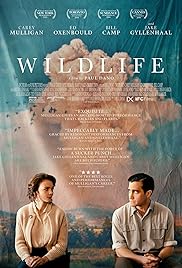
Wildlife Poster
Trailer

A teenage boy must deal with his mother’s complicated response after his father temporarily abandons them to take a menial and dangerous job.

Director:

Paul Dano

Writers:

Paul Dano (screenplay by), Zoe Kazan (screenplay by) | 1 more credit »

Paul Dano, in his early 30’s  is an excellent actor who has been seen in a diverse range of films from COWBOYS AND ALIENS to 12 YEARS A SLAVE.  He has delivered outstanding performances in his films, the best of which is with Daniel Day Lewis, holding his own with the multiple Oscar Winner in P.T. Anderson’s THERE WILL BE BLOOD in which a troubled teen learns of life.

Having proven his active chops, Dano has now taken on directorial reins in a new film again centring on a troubled teen.  Dano also co-wrote the script with his partner Zoe Kazan, this giving the film a female point of view.  It is familiarity that Dano has dealt with and it is of no surprise that the actor he has chosen to play the 14-year old protagonist, Joe looks somewhat like a younger version of himself.

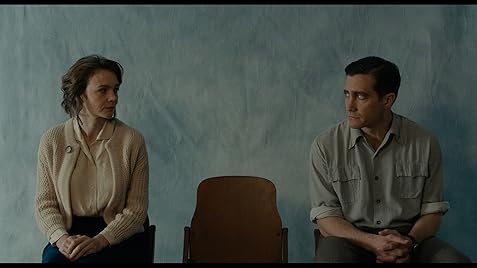
The film is set in 1960, Montana.  Jeannette (Carey Mulligan) and Jerry Brinson (Jake Gyllenhaal) have recently moved to Great Falls, Montana with their teenage son Joe (Ed Oxenbould).  Tensions build after Jerry is fired from a low esteemed job as a golf pro at a country club.  He is offered his old job back but refuses out of pride, and instead of looking for work, he sleeps in his car and watches the local firefighting efforts against a forest fire raging in nearby mountains.  To support the family as Jerry looks for a job, Jeannette takes a job as a swimming instructor, while Joe works at a local photography studio.  One day, Jerry decides to take a low-paying job fighting the forest fire, which upsets Jeannette and worries Joe.  Jeannette speaks openly about her strained marriage with Jerry to Joe, and the stress of the situation takes a minor toll on Joe’s school life.  

While Jerry is away, Jeannette becomes romantically involved with one of her students, Warren Miller (Bill Camp), a rich older man who owns an automobile dealership.  Fireworks begin when Jerry returns and Jeannette announces that she is moving out – all this inferno of and to Joe’s dismay.

WILDLIFE s a simply told family drama but one told with conviction.  The mountains and icy landscape look stunning in  the background, reflecting the loneliness of people in  the vast surroundings.  Dana connects the audience with both points of view, that of the mother and the father but it is the story of the young son.   “I surprised myself and had a good time.  Did you?”  asks the mother to Joe and one point int he film, illustrating how the film looks from the woman’s point of view and then when there is no answer from the son, switches perspective back to the son.

The desperation of the mother is what propels the family woes.  She tells Joe after Joe catches her making out with Miller.  “He wants to make it better.  Maybe you got a better plan.  I wish I was dead.”

It is a common story of father leaving home to get a decent job while mother becomes restless.  There is really nothing Joe can do.  He wants to keep the family together, but all he can do is to say how each misses the other.

Dana keeps his film on track as Joe’s coming-of-age passage as he is forced to navigate the complex dynamics of adult relationships and figure out what to make of the woman who used to be just Mom.   A well paced family drama with real characters from Paul Dana. 

Trailer: https://www.youtube.com/watch?v=q77YXl_ujBM

Film Review: ASH IS THE PUREST WHITE (China 2018) ****

Ash Is Purest White Poster
A story of violent love within a time frame spanning from 2001 to 2017.

Director:

Zhangke Jia

Writer:

Zhangke Jia

The first 15 minutes of ASH IS THE PUREST WHITE shows the difference between China and the western world.  Everyone is smoking in the train that gos into the city.  Smoking is still allowed everywhere in 2001, China.   When Qiao arrives at a mah-jong parlour. she hits several men who tease her hard on the back.  Hitting is tolerated.  A debt argument in the parlour results in a firearm pulled out and pointed at the debtor.  This is clearly a China or country one is unfamiliar with, which would make a good intriguing story for a film.  The first half of the film is set in 2001 and the second half in 2006 after Qiao has served a 5-year jail sentence for firing an illegal gun.  She did it to protect her gangster boyfriend, who leaves her when she gets out of jail.

The story follows Qiao, a strong willed woman who survives the changing environment of cultural progress and her relationship changes.  Qiao never break down.  The film begins in Shanxi, a dying coal town, where Qiao, a modern, feisty local beauty spends her time with her boyfriend, Guo Bin, a local gang boss.  Qiao takes care of her father, who insists on fighting for the coal workers’ rights, although in an embarrassing fashion.  Qiao is not Bin’s woman, as she carries herself as an equal among gangsters. When a group of young thugs starts making noise in the town, the clash with Bin’s gang is inevitable, and in the film’s most violent scene, Qiao ends up saving her boyfriend by shooting a gun, in a series of events that lead her to prison.

Five years later, and during the fourth phase in the evacuation of the Three Gorges Dam Project area, Qiao is released and tries to reconnect with Bin, who is is avoiding her.

ASH is a female dominated picture.  The protagonist, Qiao is a survivor.   When she is robbed, she pursues and cares her thief and retrieves the stolen I.D. and money.  When sex affronted by a motorcyclist, she steals his bike.  The film is told from Qiao’s point of view.

Jia’s sprawling film can hardly be classified as a particular type of genre.  It is a character study while the protagonist undergoes changes in her life as society progresses as well.  New cities have sprung up and adapting is difficult.  Jia’s shows that one cannot always control destiny.  Qiao and Bin begins as a  decent couple, not overtly loving but not in an abusive relationship either.  Bin’s gangster connections lead him to trouble. One can see and pity Qiao.  She loves him and sacrifices 5 years of her life for the man she loves, spending it in prison and still helping him along when Bin loses everything while becoming a cripple.  One can see Bin’s bitterness.  Bin also cheats on Qiao with another woman.  “I don’t hate you.  I do not have any feelings for you,” Qiao tells Bin at the end.

The film’s message is revealed during early in the film.  Bin tells Qiao, “Enjoy the moment.”

Jia’s film is never short of surprises.  The surprises propel the narrative and are not without reason.  One of these involves Qiao on a train where she meets, by chance a loud man trying to recruit others for his UFO-tourism company.  “Yes, I have seen one.” Qiao quips.

ASH IS THE PUREST WHITE  is a moving story, one so deep in emotional content that it should keep audiences fully glued to the characters and the story.

Trailer: https://www.youtube.com/watch?v=SOCpXuHQAZQ

Film Review: LE GRANDE NOIRCEUR (THE GREAT DARKENED DAYS) (Canada 2018) ***

While a world war rages, Philippe, a draft-dodger from Quebec, takes refuge in the American West, surviving by competing in Charlie Chaplin impersonation contests. As Philippe makes his … See full summary »

Director:

Maxime Giroux

Writers:

Simon Beaulieu (co-writer), Maxime Giroux (co-writer) | 1 more credit »

If there is a weird Canadian film of 2018, LE GRANDE NOIRCEUR must surely be the one.  Writer/director Maxine Giroux’s last film was Félix et Meira — which won the Best Canadian Feature at TIFF in 2014, but the two films are worlds apart.   LE GRANDE NOIRCEUR makes no sense at all, in setting, theme, structure, but it is this weirdness that makes Giroux’s film so fascinating.  And frustrating.  The film feels like a Kafka horror movie.

The setting could be the dystopian future, or during the World War II or even World War 1.  The film hints of the Trump-era  where things are about or already gone to shit.   Still there is the General Patton’s famous speech heard on the radio at one point in the film.  “No bastard ever won the war by dying for his country  He won the war by making the other poor dumb bastard die for his country.”  There is the unseen fascistic leader eerily conjuring the idea of “the other” currently playing out in the real world.

The film’s protagonist is Philippe (Martin Dubreuil), a would-be Québécois actor.  When the film opens, the audience see him dressed as Charlie Chaplin amidst a sea of other Chaplin impersonators.  Apparently, Philippe wins this contest and the money.  It is also revealed that Philippe has dogged the draft and escaped from Montreal to an unnamed southwestern American state.  He is robbed, stuck there and forced to deal with crushing poverty, a collapsing moral order, and persecution, all sparked by an ongoing, vaguely outlined war and the odious ethics of an unseen leader whose rants over the radio touting success at all costs.  Yet all around him, Philippe only sees abject squalor and a fearsome propaganda machine recalling 1930s-era Germany.

This is Philippe’s horror road trip.  Philippe meets an aloof, proud woman (Sarah Gadon) who lives in a cave/abandoned basement.  She introduces another girl as her dog.  Philippe also meets a nasty ringmaster (played by French actor Romain Duris) who tortures the weak to force them to become informants.  Already an outsider because of his  (French/Quebecois) accent, Philippe jumps from the frying pan into the fire.

Giroux’s film is filled with surprises or rather shocks.  His film gets really nasty at times.  The girl dog gets her tongue cut out by her mistress at one point.  Philippe is covered in mud shoulder down and tortured with his face dunked in the mud.  These are not pretty sights and hard for audiences to stomach.  One also wonders of the purpose of all this surrealistic horror.  At times, nothing makes any sense.

Near the end, Philippe wakes up from all the hour and finds himself in the midst of a desert.  He meets a Lucky Strike cigarette salesman with his briefcase full of Lucky Strike packages.  The encounter is weird and occasionally homo-erotic,

See THE GREAT DARKENED DAYS if you dare!  The film guarantees a really dark experience!

Trailer: https://www.youtube.com/watch?time_continue=9&v=seUDYmbbn0s

Film Review: WHAT IS DEMOCRACY? (Canada 2018) ***1/2

What Is Democracy? Poster

The National Film Board of Canada (NFB)’s WHAT IS DEMOCRACY? just nominated for Best Canadian Documentary by the Vancouver Film Critics Circle is the kind of educational film made for students to watch in schools where lots of information is provided on the subject as if coming directly from a textbook on democracy.  The origin of the word is also explained in the film, to illustrate the amount of detail going into its research.

The film questions what it means to want to live in democracy.  Therefore the question asked is what the word even means.  WHAT IS DEMOCRACY? is an idiosyncratic, philosophical journey spanning millennia and continents: from ancient Athens’ groundbreaking experiment in self-government to capitalism’s roots in medieval Italy; from modern-day Greece grappling with financial collapse and a mounting refugee crisis to the United States reckoning with its racist past and the growing gap between rich and poor.

Celebrated theorists Silvia Federici, Cornel West, Wendy Brown, and Angela Davis are joined by trauma surgeons, activists, factory workers, asylum seekers, former prime ministers and others, in a film speaking to the camera or interviewed by Taylor, that connects past and present, the emotional and the intellectual, the personal and the political, to provoke critical dialogue about our future.

Though not really a feminist film, it should be noted (not a bad thing) that most of the interviewees and those involved in the making of the film including the director (who doubles her function as interviewer) are women.

  Trump is given screen time. Surprisingly Trump is not dismissed as a bad President but given due respect as well as reasons he got elected.  An identical situation can be applied to Brexit.  The masses are fed up with the elected who have forgotten the people. The Democrats have forgotten the people, says one American.  So when Trump goes down to the people at their level, he won their confidence.

An eye-opener is also revealed on how Americans are cheated on democracy in voting, especially the poorer and black parts of the United States.

Also interesting is the segment on Greece.  Greece has been in financial crisis and has to be bailed out by the other European Union countries that claim that Greece have lived beyond their means and now they have to pay. The film reveals another side that does not reflect well on the banks and the authorities.

There are lots in the film that will titillate the mind.  After all, it is the philosophers who had a big deal to do with the concept of democracy, as the film implies.  The film’s best segment has young students talking about democracy.  They talk about the results of their complaints in school, one in articular that resulted in the school taking away the vending machines.  They claim that the teachers say that they get paid regardless what they do and that the students need to go to college to success and be happy.  Yet they do not set the example.  It is a very moving and realistic situation that touches the heart.

The film summarizes democracy simply as justice – the right to self rule.  The film also demonstrates selective democracy and that real democracy is practically unattainable.  

The film will be back in the city on January 26 at Ryerson University at the DemocracyXChange Summit—a new annual event co-founded by the Open Democracy Project and the Ryerson Leadership Lab—where Taylor will deliver a keynote address, followed by an evening screening of her film.

Trailer: https://vimeo.com/266692157

Film Review: OUT ON STAGE (USA 2018) ***

Out On Stage (Movie Version) Poster

Something different for the New Year?  The stand-up comedy “OUT on Stage: The Series” hosted by Zach Noe Towers, releases Jan. 17th on the usual streaming platforms.  Produced by Comedy Dynamics and Dekkoo, “OUT on Stage: The Series” features an eclectic lineup of renowned LGBTQ stand-up comedians.  

It is so rare that a grouping, let alone a series of all queer stand-up comics even exists.  The host is Zach Noe Towers, an LA-based comedian, actor, and writer who was recently named one of Time Out Magazine’s “2018 Comedians to Watch.”

OUT ON STAGE is comprised of 6 episodes, each episode with 3 gay stand-up comics, all introduced by Towers.  Towers gets to do his routine in Episode 2.  Needless to say, not all episodes are of the same standard.  A few are funnier, just as a few others are better than others.

Host Towers can get a bit annoying with his infectious laughter, but one has to give him credit for trying.   He does even give the worst jokes (the trans-ginger joke and the corny ‘all the comedians here suck’) a go.

All the comics share a few things in common.  They all make fun of themselves being gay.  The jokes also get dirty and the language occasionally foul, though one may argue there is no need to be.  As with all comics, timing is of the essence.  As all the comics come on stage one after the other, one would automatically make a list of the favourite ones and the ones who really suck, and not in the sexual way.

Here are the episodes:

Episode 1:

The first episode is quite hilarious, setting the tone for the other 5 to be watched.  The first is Jared Goldstein who demonstrates expert timing in the delivery of the material.  The second one, Ranier Pollard is the best of the three.  He is black, muscular and comes on stage with super-tight pants.  These muscles are just for show, he quips, they are for my ‘instagram’ followers.

Episode 2:  This, to me is one of the most mediocre of the episodes.  The host Towers is the first comic in this episode.

Episode 3:  The first comic Gloria Bigelow is the best of the lot, generating the most laughs of the episodes.  She, the first one one, makes fun of being gay, black and a woman while tackling topics like hairy bears.  The third comic is a butch lesbian, A.B. Cassidy, who could have been funnier.

Episode 4: The first comic in this episode cracks jokes mostly on drugs, completely omitting gay humour.  He could very well be a straight comic for all that matters.  The drug jokes come out awkward and are not really funny.  Funny however is the second comic, Chris Bryant, whose infectious good nature helps the audience love him.  He demonstrates expect comic timing.  He is the one who cracks the dirtiest of all the jokes and gets a good laugh from it.  Joe Dosch, the third comic does more jokes on South Dakota where he is from than gay jokes, but the South Dakota jokes are funny.

Episode 5:  Julian Michaels, the second comic proves again the black comics are the funniest.  The majority of his jokes are ‘coloured’ ones.

Episode 6:  The final episode leaves one wanting for more.  The last 2 comics are quite funny, particularly Eric Hahn who makes fun that he is now middle-aged and no longer looks gay.  The last one in contrast is a flaming queen making his delivery all the more flamboyant!

Trailer: https://vimeo.com/304184058 

Film Review: NANCY (USA 2017) ***1/2

Nancy Poster
Trailer

Nancy becomes increasingly convinced she was kidnapped as a child. When she meets a couple whose daughter went missing thirty years ago, reasonable doubts give way to willful belief.

Director:

Christina Choe

NANCY opens with the title character, Nancy (Andrea Riseborough) looking after her ill-tempered mother, Betty (Ann Dowd, last seen in HEREDITARY).  The mother is ungrateful, nasty, impatient and rude making Nancy wonder the reason she is that way, as she has always been pleasant towards her mother.  The two watch OLIVER TWIST on  television, the Charles Dicken’s story of an orphan.

When the mother dies, 15 minutes into the film, Nancy watches on television the news of a mother who has had lost her daughter about 30 years ago.  Nancy thinks she might be the missing daughter and contacts Ellen (J, Smith-Cameron) and her husband (Steve Buschemi).  Nancy heads out to meet them, the meeting being the rest of he film.  Revealing more of the plot would definitely spoil the film’s effectiveness.  All that needs be said is that writer/director Choe has made an effective psychological mystery drama.

The film is set in winter in the country where Ellen and her husband live.  The falling snow and snow covered woods are beautifully shot by cinematography her Zoe White, who went on to shoot THE HANDSMAID TALE after being noticed for her work in this film.

NANCY speaks to a lot of Americans for reason of the main character’s demise.  

NANCY gives voice to and represents the many disappointed, disconnected twenty-

first-century millennials making up the first-world.   These are adults struggling to grow up, yet

unable to identify where boredom ends and untreated mental health issues begin.   Nancy is a confused grown-up kid, unable to really function socially, unable to afford to fly the coop, their 

youth saturated by inflation, aware of the dream that capitalism promises, yet living on the 

outskirts of its failings. 

Longing for physical connection, and attempting to find it through online self-

misrepresentation, Nancy has a short meeting with a well-meaning Jeb played by John Leguizamo.  Nancy wrestles with unemployment, only able to obtain a temporary job with insufficient hours.  The character also, when the film opens, has returned from a visit to Korea – not South but North Korea, to the surprise of the person Nancy was speaking to.  Nancy claims that it was easy to go there.  The choice of North Korea depicts the kind of vacation Nancy would be interested with – going to a country with dispirited and oppressed people. Director Choe herself has visited North Korea.

The film’s message comes across loud and clear as voiced by Ellen (J. Smith-Cameron, who delivers the film’s best performance): “We have to appreciate what we have now.  It is the only thing that matters.”

NANCY belongs to the category of low budget films that often struggle at the box-office but is worth a look for effort and result.  The film has already received accolades having been nominated for the following two categories of ‘Best First Screenplay’ and ‘Best Supporting Female’ for the 2019 Film Independent Spirit Awards.  In addition, the film won the ‘Waldo Salt Screenwriting Award’ at Sundance this year.

Trailer: https://www.youtube.com/watch?v=KDXSp8kfBGw

Film Review: THE RESISTANCE BANKER (Bankier van het Verzet) (Netherlands/Belgium 2018) ***1/2

The Resistance Banker Poster
Trailer

In Nazi-occupied Amsterdam, banker brothers Walraven and Gijs van Hall face their greatest challenge yet when they decide to help fund the Dutch resistance.

Director:

Joram Lürsen

THE RESISTANCE BANKER is a Netflix original film and perhaps the first one from the Netherlands.

THE RESISTANCE BANKER is World War II banker Walraven van Hall, the hero who financed the Dutch Resistance against the German war machine.  Not many outside the Netherlands might have heard of him.  Therefore it is a story that needs be told, which translates into a film that needs to be seen.  It is of no surprise that the country has proudly submitted the film for the 91st Academy Awards for the Best Foreign Film Oscar.  Unfortunately, the film did not make the December Best Foreign Film Nominee short list.  But the film did become the most visited Dutch film of 2018 and was nominated for eleven Golden Calves, the first time a film received so many nominations for the award.  It went on to win four Golden Calves, among them the prize for Best Film and Best Actor.

THE RESISTANCE BANKER is the true story of the Dutch banker Walraven van Hall (Barry Atsma), a man who, witnessing the holocaust together with the Nazi occupation of his homeland, decided to finance the Dutch resistance with the creation of a shadow bank.  Walraven van Hall used the guise of a charitable fund to help Dutch sailors stranded abroad by the war to launder money into his shadow bank.  As the war continued, the needs of the resistance increased. Nazi leaders grew closer to catching van Hall.  At great risk, Van Hall decided to forge war bonds, secretly exchanging them for the real bonds at a major bank, and then redeeming them for cash at this same bank.

The film is not a bad one, being full of good intentions,  But it is not perfect with a lot of choppy parts.  For example, characters appear from nowhere like the girl on a bicycle carrying anti-German papers, then later explained in the story who she is.  Incidents are also inserted into the story before some crisis following it occurs.  A torture scene (and quite a nasty one at that) appears out of nowhere and a following scene shows van Hall sitting in a train that has German around checking for suspicious characters.

The film does play it safe in its storytelling.  The first third, which is quite slow moving, establishes the characters of van Hall.  He is shown to be a man who loves his wife, who sticks to his beliefs despite the danger he puts himself into.  He loves his children, even sacrificing his life for doing what is right.

The film spends quite a bit of time going through the mechanics of forging the Treasury Bills. Though some might find these sequences boring, they are necessary to show the difficulty of forging especially during war times when materials like ink and special paper are almost impossible to obtain.  At its best, the film contains a few genuinely suspenseful moments, though the one played at the bank is cliched-ridden.

THE RESISTANCE BANKER is currently playing on Netflix.  It is the story of a different kind of hero, but one outstanding one who knows sacrifice of family and love ones is necessary to do what is right.

Trailer: https://www.youtube.com/watch?v=GXUkyudJoVg

Film Review: INVENTING TOMORROW (USA 2018) ***

Inventing Tomorrow Poster
Trailer

Meet passionate teenage innovators from around the globe who are creating cutting-edge solutions to confront the world’s environmental threats – found right in their own backyards – while … See full summary »

Director: Laura Nix

INVENTING TOMORROW follows 6 youth groups that enter their science projects for ISEF (the International Science and Engineering Fair)n- right up tot he winning announcement.  The robe with docs like this is that the director choses her groups.  It would be fortunate that the group the director choses wins, but often than not, it is hit and miss and intros one.  Not all the 6 group come off as winners.  A few do of course.  But audience might learn a thing or tow about competitive – fair or unfair the process.

The 6 young groups of scientists hail from Indonesia, Hawaii, India and Mexico as they tackle some of the most complex environmental issues facing humanity today – right in their own backyards.  Each student is preparing original scientific research that he or she will defend at ISEF.  Framed against the backdrop of the severe environmental threats humans  now face,the audience is immersed in a global view of the planetary crisis, through the eyes of the generation that will be affected by it most.

Considered the Olympics of high school science fairs, ISEF is the largest gathering of high school scientists in the world, attracting approximately 1,800 finalists from over 75 countries, regions and territories.  All the finalists want to do a good job, but the heart of the story isn’t about whether they go home with an award.  As they take water samples from contaminated lakes (Hawaii), dig up the dirt in public parks (Hawaii), board illegal pirate mining ships (Indonesia), and test their experiments in a lab, we see each student display a tenacious curiosity, and a determination to build a better future.  Motivated by the desire to protect their homes, these young people are asking questions about the issues they observe in their communities, and proposing innovative solutions to fix them.

The students spend close to 600 hours each on their projects, guided in their scientific quest by dedicated university mentors.   At home with their parents, grandparents, and siblings, they compare the world their elders knew with the stark reality of the one they’re inheriting.

Director Nix brings the personal issues into the equation.  The audience sees, in an emotional moment the proud tears of a grandmother as her grandson wins the prize.

One must admire the young contestants for their diligence and brilliance.   Most of the terms they use are newt many.  The film should spend more time explaining each project to the audience so that the audience can connect more with the characters.  At bets, these projects appear difficult to understand.

The judges judge hard too.  The Mexicans likely did not win as they have difficulties explaining their project to the judges.  The Indian also has difficulty having the audience understand her project, as she speaks a little too fast.

The film shows that it is not the winning that counts.  It is the beauty of competition and meeting other contemporaries in the field.  The film soars when the camera shows young strangers from different countries making friends, hugging each other for the purpose of saving the environment.

Trailer: https://www.youtube.com/watch?v=E7bdRgf1BAY

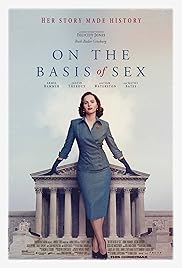
Film Review: ON THE BASIS OF SEX (USA 2018) ***

On the Basis of Sex Poster
Trailer

The story of Ruth Bader Ginsburg, her struggles for equal rights, and what she had to overcome in order to become a U.S. Supreme Court Justice.

Director:

Mimi Leder

Mimi Leder (director of the little seen PAY IT FORWARD and made-for-TV, THICK AS THIEVES) tackles a female issue film, ON THE BASIS OF SEX,  an American biographical legal drama film based on the life of Supreme Court Justice Ruth Bader Ginsburg.  The film is written by Daniel Stiepleman, with an impressive cat that includes Felicity Jones as Ginsburg, with Armie Hammer, Justin Theroux, Jack Reynor, Cailee Spaeny, Sam Waterston, and Kathy Bates in supporting roles.

If when watching the film, everything looks familiar, perhaps you might have seen a documentary released early this year called RBG, the letters stand for Ruth Bader Ginsburg – the subject of ON THE BASIS OF SEX.  The doc concentrates more on her career and what she has done to promote progressive change in the legal America system.  Leder ON THE BASIS OF SEX, opening during Christmas plays like feel-good stand up and cheer move while trying to keep to the spirit and truth of RBG, a legend in our times.  (One can imagine director Leder herself trying hard o get work as a female director as one notices her dry spell of films after PAY IT FORWARD.)  

The film covers the full life of Ruth Ginsburg.  The first third shows her struggle in an almost all-male (she was one of only 10 females) Harvard Law School.  The film is quick to emphasize that Ruth had more on her plate than her fellow undergraduates.  She was not only married with a kid, but her husband (Armie Hammer) suffered from cancer with hospitalization.  Ruth looked after him, their kid while attending his classes and her own the same time.  She came up top of her class.  The second part shows her at her job after graduation.  She teaches while inspiring her students to change the world.  Her subject was “Sex discrimination and the Law”.

Leder’s film reveals important truths.  The success of a woman depends on the support of her husband.  Clearly Ruth’s husband was always behind her, giving in and urging her to strive on.  The same can be likely said for husband of Prime Ministers Margaret Thatcher and Teresa May. However, Ruth and her husband’s relationship appears too perfect.  “You are ready for this.  You have been ready for this your whole life.  Go in there and let the judges see the real Ruth Ginsburg I know,” is the husband’s best advice, obviously spiced up int he script for artistic purposes.  Despite the husband’s support, it must be certain that they must have had huge arguments that would have rocked their marriage.  No major disagreements are on display except for one minor argument which involves their daughter, now grown up.

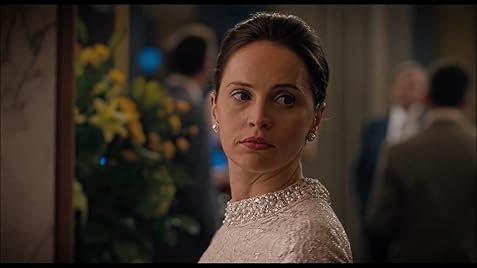
English actress Felicity Jones is winning as Ruth Ginsburg.  Armie Hammer, also delivers a remarkable performance in a little written role.  But the best performance comes from little known Charles Milky who plays Charles Moritz, Ruth’s caregiver client denied his tax benefits for looking after his ailing mother based on his gender.

It is clear that more cane learnt about Ruth Ginsburg by watching the doc RBG than this Hollywood dramatization.  Audiences have seen similar films before, like MADE IN DAGENHAM and even the lighter and more hilarious LEGALLY BLONDE.   What is clear is that Ruth Ginsburg is still recognized as a major force in changing sex discrimination in America.  Her story needs be told in one form or another.

So the ultimate question is whether Ruth Ginsburg’s achievement in life can be trivialized into a 2-hour feel good movie?  Surprisingly, the answer is yes, judging that the real Ruth Ginsburg appeared the end of the film implying her endorsement of the film which was written by her nephew, Daniel Stiepleman.  At least the words at the start of the film declared the film ‘inspired’ rather than ‘based’ on a true story.  But as far as feel-good movies go, Leder’s film is a textbook example of how to achieve the task

Trailer: https://www.youtube.com/watch?v=28dHbIR_NB4

Film Review: PRIVATE LIFE (USA 2018) ***

An author (Hahn) is undergoing multiple fertility therapies to get pregnant, putting her relationship with her husband (Giamatti) on edge.

Director:

Tamara Jenkins

PRIVATE LIFE is a Netflix original movie which normally means that the main studios will not touch the film.  The likely reason is the ‘difficult’ theme of the film, about the trauma a couple goes through in order to have a child of their own.  So desperate they are, that they try two options simultaneously – adoption and getting an egg donor.

Written and directed by Tamara Jenkins, her film begins as a comedy and a very sly and deadpan one at that.  As the film progresses and fertilization attempts fail, drama sets in and the comedy slowly gives way to a more serious film.

Richard (Paul Giamatti) and Rachel (Kathryn Hahn) are a childless middle-aged couple desperately trying to have a child.  After multiple failed attempts at artificial insemination they attempt in vitro fertilization where they learn that Richard has a blockage that is not letting him produce sperm forcing him to choose a quick surgery and go $10,000 dollars in debt to his brother Charlie (John Carroll Lynch) and Charlie’s wife Cynthia (Molly Shannon).  At the same time they are also attempting to adopt a child after having previously being matched with a pregnant teenager from Little Rock who was looking to give up her child and then stopped contacting them.

The drama continues as the plot thickens.  While still  maintaining a it of humour, the funny bits slowly fade away.  The IVF fails.  Their doctor, Dr. Dordick (Denis O’Hare who can be quite hilarious as well)  floats the idea of using a donor egg to inseminate Rachel which would raise their chances of success from 4 to 65 percent.  Rachel is initially vehemently against the idea, but slowly begins to contemplate it with Richard’s encouragement.

Into the picture arrives Cynthia’s 25 year old daughter, Sadie (beautifully played by Kayli Carter), who meanwhile decides to leave her college writing program to finish in absentia.  Sadie goes to live with Richard and Rachel, with whom she is already very close.  Rachel, who struggled with the idea of an unknown egg donor, decides that she wants to ask Sadie for her eggs. To their surprise Sadie quickly agrees, both because she loves Richard and Rachel and because she thinks the egg donation will bring meaning to her life.

Giamatti and Hahn are two actors that are comfortable with both comedy and drama.  Their transition to drama is therefore credible.  Comedienne Molly Shannon ditches her funny personality playing a dislikable opinionated mother,  Teen actress Kayli Carter who seems to be doing Saoirse Ronan is not half bad either.

Jenkins’ film at the end, the film clocking a full 120 minutes, is quite different from what is expected at the start.  In the same way, her characters change as well, i.e. there is quite a bit of character development.  Many of the characters develop for the better, which makes for one of the film’s greater pleasures.

Jenkins loves to poke fun at males.  Richard has one testicle.  Richard has a sperm blockage.  Still PRIVATE LIFE is an intelligent though more female oriented drama.

Trailer: https://www.youtube.com/watch?v=yLuaXTPZdt8