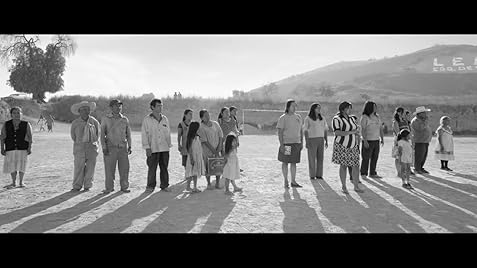
Full Review: ROMA (Mexico/USA 2018) Top 10 *****

Roma Poster
Trailer

A story that chronicles a year in the life of a middle-class family in Mexico City in the early 1970s.

Director:

Alfonso Cuarón

ROMA marks another Netflix original movie.  There are so many these and so many good ones at that (THE BALLAD OF BUSTER SCRUGGS, THE CHRISTMAS CHRONICLES, this one) that very soon there might even be an award for Best Netflix movie. (Netflix should look into this possibility for publicity.3

ROMA’s is bookended by camera shots of an overhead flying airplane, the first image seen as a reflection in the water poured on the floor by the maid Cleo (Yalitza Aparicio) and seen again as in the last image in the sky, probably a metaphor that Cleo has risen to a different height in life.  The first shot of the plane introduces Cleo as a servant to a wealthy Mexican family.  The second time the plane appears is when Cleo an the family are at a beach where she saves the children from drowning, another highlight of her life after being depressed from a failed romance.  And the third signals …… .  Sorry, no more spoilers in the review.

The film is called ROMA because that is the name of the suburb in Mexico City that the film is set.  The film follows the life of maid and nanny Cleo as she works for a wealthy Mexican family, loved by the mistress and her children.   The daily routines of cleaning, serving, washing are laid out bear amidst Cleo facing life’s ordeals like a failed romance, the breakup of her employers’ marriage and Mexico’s troubles.  This is crafted layered storytelling.

Cleo works hard.  She is jilted and left pregnant by her male chauvinist lover.  “One thing is for sure.  Women are always alone.” The mistress tells Cleo at one point in the film, which is the theme of the film.  Surprisingly, this message is also so relevant in the current age of female abuse.  Women have to stand together as depicted in the story of the film.

The film has three outstanding segments – a riot protest gone violent, as seen from a window; a drowning scene and a forest fire all done old fashioned no gimmicks style.   Cuaron flexes his artistic muscles with a man singing during the forest fire segment.  Cuaron also brings the audience up to date to the problems faced by the Mexicans like land rights and violent protests, use of firearm and class distinction.  But the most moving segment (and indeed most moving segment found in ay film this year) is the Cleo’s delivery scene, again the details of which will not be spoilt out in this review.

ROMA is director Cuaron’s film of his childhood memories with his maid.  Directors always make their bet films based on childhood memories – examples being Ingmar Bergman’s FANNY AND ALEXANDER and Federico Fellini’s AMARCORD.  ROMA can be added to the esteemed list.

ROMA is shot in black and white 16mm and a gorgeous looking picture.  I have seen ROMA twice and the film passes the test of still being captivating on its second viewing.  ROMA is Netflix’s hope of winning its first Academy Award in the category of Best Foreign Language Film.  It has my vote.

Trailer: https://www.youtube.com/watch?v=sKVYRtE-kXI

Film Review: THE WILD PEAR TREE (Ahlat Ağacı)(Turkey/France/Germany/Bulgaria/Macedonia/Bosnia and Herzegovia/Sweden 2018) ****

The Wild Pear Tree Poster
An aspiring writer returns to his native village, where his father’s debts catch up to him.

Writers:

Akin AksuEbru Ceylan |

The third film set in Anatolia, Turkey after ONCE UPON A TIME IN ANATOLIA and WINTER SLEEP, THE WILD PEAR TREE is another engrossing and rewarding drama to watch despite its 3-hour running time.  As in all of Ceylon’s films, the drama deals with an individual as he contemplates existence in a rural setting.  Because Ceylon is able to connect his protagonist with his audience through film, his films are tremendously satisfying, this film having the best rating on Rotten Tomatoes for a film screened at Cannes this year.  THE WILD PEAR TREE is also Turkey’s entry for the Best Foreign Film Oscar for 2018.

The film opens with the return after graduation from college of one young Siman (Aydın Doğu Demirkol) to his family farm.  Ceylon is clear to show that he is one in love with Turkey as the camera proudly pans the landscape of the rural countryside and the beauty of the port.  Sinan is passionate about literature and has always wanted to be a writer.   Returning to the village where he was born, he pours heart and soul into scraping together the money he needs to be published, but his father, Idris’s (Murat Cecir) debts catch up with him.

The segment with Siman working unsuccessfully to dig a well on the farm so that the father could till the land is one that demonstrates both the problems a family faces while working  together as well as the harshness of farming as an occupation.  Siman’s goals and ambition in life are put into question when he later meets a young girl.  He confesses that the villagers are simple peasants and she remarks that he would think little of her as she has aims of staying in the village and getting married, settling down.

One wonders if the segment in which the idealistic Siman looks into getting his work published is autobiographical.  Director Ceylon probably faced the same resistance when he wanted his films made.  It is a question of the idealistic vs the realistic.  Siman’s possible publisher is reluctant having seen many similar cases before, one of which includes himself wanting to write as well.  This part ends the second half of the film.  It is a bit slow and would likely be more interesting to artists having to go throughout the same ordeals as Siman in the story.

Ceylon has a religious debate that goes for a while at the 2/3 mark of the film.  The debate that is also applicable to other religions, about changes in the Koran might either come across as too heavy, too distant or un-relatable.  Even the imam confesses at the end of the debate: “There is no end to this discussion.”  But Ceylon allow the debate to go on and on with little conclusion.

THE WILD PEAR TREE, as in the other Ceylon films a heavy watch –  a case of one having to work in order to reap the rewards.  
Trailer: https://www.youtube.com/watch?v=GGts8qQe8Fc

Film Review: LOVE JACKED (Canada/South Africa 2017) ***

Love Jacked Poster
Trailer

MAYA, has artistic ambitions – her father ED wants: a dutiful daughter to run the family store. Taking her independence a step further, Maya decides to travel to Africa for inspiration and returns with a fiancé.

Director:

Alfons Adetuyi

LOVE JACKED is a a romantic comedy with a touch of road trip featuring charming characters, family drama and humorous misadventures.  The description can be applied to almost any number of romantic comedies, but this does not mean it will be a predictable bore.  The recent CRAZY RICH ASIANS treaded similar waters but it won the hearts of audiences as well as made lots of money.  That film was smart enough to tap Singapore, an ultra modern city that provided a fresh look to the well-worn genre.  LOVE JACKED uses Cape Town, South Africa to provide a varied touch.

When the film opens, Maya (Amber Stephens West) is in trouble and requires a bailout.

Maya is headstrong with artistic ambitions, a strong contrast to what her father Ed (Keith David) wants: a dutiful daughter to run the family hardware store.  Ed is shocked when Maya takes her assertions of independence a step further and decides to travel to Africa. While looking for inspiration, she meets Mtumbie (Demetrius Grosse), an African Casanova who sweeps her into a whirlwind romance and the two announce their engagement.  When Maya’s father tries to persuade her to forget Africa and return home, her resolve to go ahead with the marriage hardens until she finds Mtumbie in bed with another woman. But rather than admit that her father was right, she tells her family the wedding is on.  Drowning her sorrows at a small diner and looking for a way out of her situation, Maya meets pool hustler Malcom (Shamier Anderson) who is on the run from his partner Tyrell (Lyriq Bent). With Malcolm on the run and Maya trying to convince her family she is still engaged, they devise a plan to solve both their situations: Malcolm will hide out from Tyrell pretending to be Maya’s African fiancé Mtumbie.

No prize in guessing that Maya wilful in love with Mtumbie.  Myumbie shows up at the airport dressed in African robe speaking with a Nigerian accent.  He wins approval of the family even Maya’s father.  The story pays homage to the Eddie Murphy Joh Landis’ comedy COMING TO AMERICA, one of Murphy’s funniest comedies.  Mtumbie even mentions COMING  TO AMERICA in this film.

The scripts adds on a few more obstacles to the romance.  Mtumbie is a pool hustler from Quebec (quite funny) who is on the lam from his buddy who wants to kill him.  Mtumbie also meets an uncle of maya’s who is expert on anything African – beginning to quiz Mtumbie on his origins.  Maya’s sexy cousin starts hitting on Mtumbie.  All Harlequin novels contain obstacles that are all overcome at the end for the benefit of the couple finding themselves again.

For a family that owns a hardware store, the family can afford to own a mansion that is unbelievably grand.  But movies are normally set in huge mansions with elaborate decor rather than meagre dwellings, realistic to the story or not.

The best thing about the film is actor Demetrius Grosse who can play both the chivalrous romantic hero or the African clown speaking completely with Nigerian accent.  He is a hoot and one could watch him forever.  Keith David is also hilarious as the father who always has a one-liner under his breath.

Cliches and predictability aside, there are sweet moments of romantic charm.  LOVED JACKED is an entertaining light date film for couples with other things in mind on a date.

Trailer: https://www.youtube.com/watch?v=s3XQ09nocQM

Film Review: THE DRAWER BOY (Canada 2018) ***1/2

The Drawer Boy Poster
Ontario – 1972. Miles, a young theatre actor from Toronto, arrives in Huron County at the home of Angus and Morgan, two aging bachelor farmers. Miles stays with the two farmers in order to …See full summary »

Directors:

Arturo Pérez TorresAviva Armour-Ostroff (co-director)

Arturo Pérez Torres and Aviva Armour-Ostroff’s first narrative feature THE DRAWER BOY is based on Michael Healey’s Governor General’s Literary Award winning play.  The darer refers to one who draws. Expectations are high on the esteemed play’s adaptation.  Thankfully, the film lives up to the expectations.

The play, set in the 70’s, is a three handler with a stranger – an actor from Toronto who suddenly shows up at a farmhouse door in Huron county, Ontario, and entering the then comfortable lives of two friends who served in world War II now working on a small farm in Canada.  

The actor is Miles who wishes to observe the farmers in order to write a play about farmers.  Miles asks for a place to stay and an opportunity to watch them do what they do. 

The next day starts of disastrously.  In an attempt to start learning their ways, Miles tries to use Morgan’s tractor and ends up injuring Morgan almost immediately.  Miles suggests that maybe he should just watch from now on, but Morgan insists that he isn’t getting a place to stay unless he helps out.  Upon getting to know the farmers further, he learns that the man who originally answered the door was Angus, who has short-term memory loss due to an injury from the war.

The film and the play has an odd premise of character interaction but it is this oddity that enables the film to fascinate the audience.  Directors Torres and Armour-Ostroff realizes the fact and keeps the story always one step ahead of the audience.  For example, the audience only learns of Angus memory loss after the effects of the memory loss are shown.  The war stories are also revealed slowly, one bit at a time. The uncovering of the truth and the story carries the mystery of the film that is quite effective.

The directors take the film out into the open so that it does not feel like a play.  The three characters talk a lot which is the only point that reminds one that the film is based on a play.   The brilliant performances also remind one of the film’s roots as a good play which is almost sure to contain riveting performances.  All the actors Jakob Ehman playing Toronto actor, Miles, Ricahrd Clark playing Morgan and Stuart Hughes as Angus are to be commended most notably the latter.  Hughes has the ability to move an audience to tears by changing the pitch of his voice.  Otherwise, there are shots of cows, the Huron landscape, the farms, the harvest fields, the interior and exterior of the farm house that lead the audience to forget a stage bound play.

A post-screening Q&A is added on Saturday, November 24th at the 7:00PM screening. In attendance will be Director-Producer Arturo Pérez Torres and Co-Director-Producer Aviva Armour-Ostro

THE DRAWER marks one of this year’s best Canadian films this year.  Among the many awards won is the Best Feature at Canadian Film Fest 2018.

Trailer: https://vimeo.com/185346761

Film Review: THE GREAT BUSTER: A CELEBRATION (USA 2018) ***

The Great Buster Poster
Trailer

Documentary on the life and works of comic genius Buster Keaton, directed by Peter Bogdanovic.

Buster Keaton is not someone as well known Charlie Chaplin.  But this is by no means to say that Buster Keaton is no less a genius.  Myself, I first saw Buster Keaton in a supporting role in Richard Lester’s 1966’s comedy A FUNNY THING HAPPENED ON THE WAY TO THE FORUM.  The doc, THE GREAT BUSTER: A CELEBRATION includes a footage of Keaton in the film.

The film is a celebration of actor/comedian/filmmaker and genius Buster Keaton.  Buster, in those days meant ‘Fall’ and Buster Keaton grew famous in funny falls from the young age touring the country with his travelling show parents.  The film is an examination of the artist from literally a baby to adult, which writer/director Peter Bogdanovich undertakes.

Who better than Peter Bogdanovich whose most famous film WHAT’S UP DOC? starring Barbra Streisand and Ryan O’Neal was likely influenced by the slapstick antics of Buster Keaton.  Bogdanovich also loves black and white oldies and made the excellent THE LAST PICTUR SHOW and PAPER MOON, all black and white period pics.

Unless one is familiar with Keaton’s films or grew up in those times (i.e. if you are over 70), there is much to enjoy in the old footage assembled by Bogdanovich.  From Keaton’s early pictures like his two reelers to his shorts and feature films, expect plenty of laughs. 

Bogdanovich also ties in the passion of film into the doc.  Not only is Keaton’s talent for comedy shown but his genius in filmmaking.  

The early comedic sequences are the ones with Fatty Arbuckle and Keaton.  Arbuckle was Keaton’s mentor and introduced him to film, which aided Keaton’s fame.  The sequence of the two having dinner is not only funny but a genius in its set up.  Other simple sequences featuring these two are equally priceless.

Every genius has his downfall or at least bad times in life.  Arbuckle got entrapped with a murder charge and scandal.  For Keaton, it was his drinking and contract with MGM.  The film was clear to point out that MGM destroyed a few classic comedians of the time including The Marx Brothers, Stan and Ollie and Abbott and Castello with churning out their worst films.  Keaton’s drinking led to his divorce and firing at MGM, fed up with his drinking.  The height of his depression led him  to be committed to an army hospital taken away in a straight jacket. ‘Straight Jacket required to move Buster Keaton to hospital, ” read the newspaper headlines.   

It becomes apparent half way through the film that material is running out.  Bogdanovich inserts old Keaton film footage as fillers.  At least they are funny and satisfying in filling the time.

The film ends with Keaton’s death in 1966 and with the words of Dick Van Dyke who delivered the eulogy at the funeral service.

THE GREAT BUSTER is a celebration of not only Keaton but the artists of the silent era.  The film’s best segment is the clip from Charles Chaplin’s LIMELIGHT where Chaplin and Keaton performed together for the first and only time.  

Trailer: https://www.youtube.com/watch?v=HsffUJBYya0

Film Review: IN SEARCH OF GREATNESS (USA 2018)

In Search of Greatness Poster
Trailer

Through the eyes of the greatest athletes of all time, IN SEARCH OF GREATNESS is a cinematic journey into the secrets of genius.

Director:

Gabe Polsky

Writer:

Gabe Polsky


IN SEARCH OF GREATNESS is a documentary that seeks to find the secret behind the success of ‘great’ athletes.

The film never really defines greatness.  What is greatness?  From the first few segments of the film, the idea of greatness appears to be narrowed down to the greatness of athletes.  Their ability to do well in their field of sports be it football or soccer or hockey.  Still greatness is assumed to achieve fame in their sport so that they become world-famous in their sport.  Intelligence, dedication and other factors are tied in as well.  The film relies heavily on the interviews with authors and creativity experts Ken Robinson and David Epstein.

The main point drummed into the audience is that one cannot measure greatness.  The film does measure it in terms of  fame, or why would they pick Lou Ferrigno,  Jerry Rice or Wayne Gretzky to be their spokespersons?  What is the filmmakers measurement definition of fame then in picking them?  But another associated fact is that one cannot train for greatness.  If one as become a hockey star, he cannot go to hockey school or a special hockey camp to cultivate that greatness.  The film comes up with dozens of examples of people that go against the flow.  It never however mentioned the exceptions of the people who did go for special training and followed the rules who got into major leagues.  I am sure there are many here too.

The road to greatness?  The hockey legend Wayne Gretzky and “Red Army’s” Gabe Polsky, among others have a lot to say based on their experiences.  Most of these are common sense.  But it is educational and there is nothing wrong to be clarified on what common sense can teach human beings.

So what are these common sense pointers?  It seems silly that one should attend a full length feature to learn what is commonly known.  The most important point that is emphasized time and again is the need to ditch conformity.  Following the formula of a great athlete’s training does not make another great athlete.  From the film, these can be summarized, of course from the point of view of the doc’s ‘experts’:

rage to perform: in other words, dedication is key as emphasized by Wayne Gretzky.  He would rather spend two hours hitting the puck instead of going to a movie with his pals.

ability to learn: in other words, intuition, again Gretzky could immediately analyze the payers in a game within the first few minutes of play

Despite the concentration on sports greatness, the film only narrowly touches other fields of genius.  The film contains footage of many great athletes at their heights (Pele, Muhammed Ali, Tiger Woods, John McEnroe, Serena Williams) which makes like cameos in a feature.

One can only wonder why director Polsky does not apply the principles of greatness in the making of his documentary.  IN SAERCH of GREATNESS is an ok doc but to a great one.

Trailer: https://www.youtube.com/watch?v=loSryNWg58k

Film Review: CREED II (USA 2018)

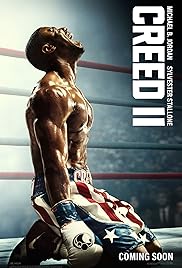
Creed II Poster
Trailer

Under the tutelage of Rocky Balboa, light heavyweight contender Adonis Creed faces off against Viktor Drago, the son of Ivan Drago.

Director:

Steven Caple Jr.

Writers:

Cheo Hodari Coker (story by), Ryan Coogler (characters) | 4 more credits »

How time flies.  Before one knows it, CREED II, the sequel to 2015 CREED is now the 8th instalment of the ROCKIE franchise.  All of the films feature Sylvester Stallone who also co-wrote CREED II.  CREED II is not as good as CREED I primarily because ideas are running out – after all it is the 8th film.

The film follows Adonis Creed (Michael B. Jordan) training in order to defeat the son of Ivan Drago, the powerful athlete who killed his father in the ring more than 33 years prior.

It was in 1985 that the Soviet boxer Ivan Drago (Dolph Lundgren) killed former heavyweight boxing champion Apollo Creed during an exhibition fight in Las Vegas.  That same year, Rocky Balboa (Sylvester Stallone) defeated Ivan Drago in a boxing match on Christmas Day in the Soviet Union. Thirty-three years later, Apollo Creed’s son Adonis (Michael B. Jordan), with Rocky’s training and guidance, seeks to avenge his father’s death by fighting Drago’s son Viktor (Florian Munteanu) while at the same time, Ivan hopes to reclaim his honour through Viktor.  Stallone plays again Robert “Rocky” Balboa, Sr., the two-time world heavyweight champion and Apollo’s rival-turned-friend who becomes Adonis’ trainer and mentor.  He still owns and operates his Italian restaurant in Philadelphia.

The script surprisingly is sympathetic towards the villain Viktor and his over-unforgiving father Ivan.  During a few points in the film, one actually wishes Viktor would win the fight.  Adonis is comes across (unintentionally) as a spoilt celebrity.  Viktor is shown in the script to be a victim of family circumstances that he cannot escape from.  A similar situation was tapped in Steve McQueen’s WIDOWS where the Colin Farrell character is tied in to his family’s reputation.  Both wish to be out.  This is the only positive difference in the ROCKY films.  On the negative, Stallone ups the melodrama several notches.  Adonis’s girlfriend Bianca Thompson (Tessa Thompson) is suffering from hearing loss.  Rocky Balboa has not seen his son and granddaughter for years and finally gets to reconcile (sob-sob!) at the end of the film.  Rocky visits his late wife Adrian’s grave and speaks to her.  Adonis visits his late father’s grave and talks to him too.  It is this melodrama that kills the movie.  

A neat touch is the appearance at the final fight of Viktor’s mother (played with icy coolness by Brigitte Nielsen) who had deserted the family. 

It is clear that Viktor is the bigger and better fighter, so it is a hard task to make Adonis a credible foe that can beat Viktor.  The script devotes the usually hard training sessions (devised by Rocky that Adonis undergoes – like pulling trucks, turning tires and running in the ht desert).

The climax of the film is understandably the heavyweight championship bout between Adonis and Viktor,  executed with all its expected gore and brutal violence.  The fight begins during the last 15 minutes of the movie.

All that can be done with CREED II is to use the recycled formula of what worked in the past.  The result is a lacklustre over melodramatic film with a few good fighting sequences.

Trailer: https://www.youtube.com/watch?v=cPNVNqn4T9I

Film Review: ANNA AND THE APOCALYPSE (UK 2017)

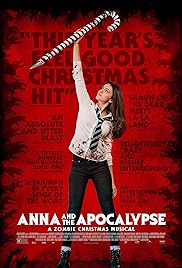
Anna and the Apocalypse Poster
Trailer

A zombie apocalypse threatens the sleepy town of Little Haven – at Christmas – forcing Anna and her friends to fight, slash and sing their way to survival, facing the undead in a desperate race to reach their loved ones. But they soon discover that no one is safe in this new world, and with civilization falling apart around them, the only people they can truly rely on are each other.

Director:

John McPhail

ANNA AND THE APOCALYPSE is the rarity that is a zombie musical set during Christmas directed by John McPhail and written by Alan McDonald and Ryan McHenry.  The film is based on the 2010 BAFTA-winning short Zombie Musical.

The zombies do not appear till 20 minutes or so into the movie.  They are seen only in the background as Anna and her friends do a musical number.  The film takes its 20 minutes in the set up of the story that revolves around Anna and her the sleepy Scots town of Little Haven – at Christmas.

The story is typical for a young teen.  Anna (Ella Hunt) is upset that her father disapproves of her taking a year off her studies in travelling to Australia. Anna’s best friend is John (Malcolm Cumming) who want something more than a plutonic relationship with her.  Nick (Ben Wiggins) woos her though she dislikes him for his wild behaviour.  Her friends include lovebirds Chris (Christopher Leveaux), who loves recording everything on film and Lisa (Marli Siu).  

Though a Scots production, the film fails to use much o the magnificent Scots landscapes usually found in films from Scotland.  The Scots accent is also lowered several notches so that North American audiences can follow the dialogue and song easily.  The dance and song numbers are nothing spectacular – something that in the order of what can be expected in a show put on by a school, which is actually the case here.  The musical novelty in a zombie flick runs out of steam quickly.  After the seconds song, one wishes the distraction of song be left out.  The one exception is the spritely naughty musical number performed by Lisa on stage with lewd lyrics  accompanied by scantily lad boys in  Christmas spangled attire.

The zombies are disposed off with a fair share of violence but done in a matter-of-fact comical way.  No one should complain.

The reason for the zombie outbreak given is a flu type virus.  Nothing is mentioned of what is happening in the rest of the world.  The film totally revolves around the narrowed world of Anna and her friends.

The teen characters in Little Haven resembler pretty much the typical teenager around the world but less annoying.  They are stuck in their little world of non-ambition, fun, romance and independence.  The script could have added some rites-of-passage or coming of age that the teens could have gone through a result of the so-called apocalypse.

The story also ends up predictable fare towards the end.  One can tell who is going to be bitten by the zombie and thatAnna and her father will reconcile.

The reason this small Scots film fined North American distribution is the fact that is is a musical – a rarity.  But it is this same fact that mars the film from going anywhere.  It seems all the incidents are geared towards a musical number from the very first song “Breakaway” which stresses Anna’s desire to travel to Australia.  The film’s target audience for ANNA AND THE APOCALYPSE would be youth interested in horror fare.

Trailer: https://www.youtube.com/watch?v=G9j1CBq1Wj8&t=

Fim Review: TIGER (USA/Canada 2018)

Tiger Poster
Trailer

A practicing Sikh is banned by the boxing commission for refusing to back down from his religious beliefs. Through racial profiling and stereotypical threats, he does what any strong American would do, fight back.

Director:

Alister Grierson

TIGER tells the story of a boxer (based on true events) who also had to contend with battles outside the ring – for his Sikh religion.   He was not allowed by the American Boxing Corporation to box unless he shaved his beard claiming that they held the best interest of boxers in mind for cuts and bruises might not be seen underneath the facial hair.

The film is inspired by the true story of Pardeep Singh Nagra (Prem Singh) aka Punjab Tiger, a practicing Sikh man who was banned from the sport of boxing.   Pardeep fights back with the support of his coach and mentor (Mickey Rourke), family and a community lawyer (Janel Parrish) who he falls in love with.   Obstacles faced include racial profiling by public officials, overtly racist threats, jealous rival boxers and pressure to change from loved ones.  It is within the course of these challenges and at his weakest moment that he discovers love.

One wonders the reason the film is entitled TIGER instead of PUNJAB TIGER, which would be the more appropriate title.   One might think that for an anti-racist film, dropping the PUNJAB word might be taking a prejudiced view that the title might put off general audiences.  On the other hand, one could also argue that the simple TIGER will fetch a larger audience and likely the ones to learn a lesson or two about racism.

Good intentions aside, TIGER feels like a poor man’s version of ROCKY.  There are similarities between the two boxing films.  Both are based on real life characters and both do not qualify as a true biographies.  Rocky Balboa’s character emphasized his Italian background while Pardeep Singh his Sikh background.   Both rely on the expertise of their experienced coach, who were real boxers, Mickey Rourke in TIGER.  There is also the romantic element in both films that show the boxer also as a human being.

Prem Sing delivers as the feisty boxer.  It is good to see Mickey Rourke (Academy Award nominee for Best actor in THE WRESTLER) again on screen though the man is definitely showing his age (and his glass eye).  A photograph of Mickey Rourke int he film shows the boxer/star in his hey day.

The film’s climax is expectedly the middleweight championship fight between The Tiger and the racist bully, Bryan Doyle (Michael Pugliese).  (Pugliese and the real Nagra wrote the script for this film.)  Everyone loves a good boxing match.  The camera work is sufficiently effective, well cut to the fight, the spectators’ reactions and the agony on the fighters’ faces.  Director Gierson cannot resist using the roar of the tiger on the soundtrack during the final bout.

TIGER ends up a predictable and cliched though relatively entertaining part-biography of boxer Nagra who discovers that winning a fight need not always be in the boxing ring.  The film won the Best Film at the San Diego International Film Festival.

Trailer: https://www.youtube.com/watch?v=E2KnrqtAnEE

Film Review: DEAD IN A WEEK: OR YOUR MONEY BACK (UK 2018) **

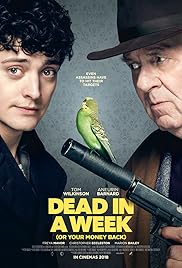
Dead in a Week: Or Your Money Back Poster
Trailer

After his ninth unsuccessful attempt on his own life, a young man outsources his suicide to an ageing assassin. “If you’re serious about ending it, you need professional help”

Director:

Tom Edmunds

Writer:

Tom Edmunds

DEAD IN A WEEK (OR YOUR MONEY BACK) follows the sad life of William (Aneurin Barnard, the Welsh actor from DUNKIRK), a failed writer who has tried to take his life 9 times without much success.  These attempts are sad, not because they failed but because they are shown briefly on screen as attempts at comedy but simply failing at getting any laughs.  The hanging results in ceiling breakage.  The electrocution leads to a blackout.  Yes, not funny.  And neither is the rest of the film.  The premise might have looked good on paper but what transpires is only mildly funny comedy at best and a whole lot of predictable fare.  

William hires a contract killer who needs him to be his last killing to make his quota.   The contract killer, Leslie (Tom Wilkinson) gives William his calling card at the bridge where he attempt his 10th suicide.  William jumps off but no prizes in guessing that he lands on a passing boat below.  William signs a contract for his own death.  The predictable catch is that he falls in love and his next book looks like a success.  So, he now wants to live.  But the killer is not going to stop what he is paid to do.

The worst thing about the film is when it attempts to offer life lessons advice to the audience.  The speech by William just before he is about to be shot is something  everyone could do without.  The contract killer, Leslie is supposed to be super efficient so the scenes in which he shoots and keeps missing William is totally unbelievable.  The running joke of Leslie’s wife supporting her husband in his job  (“Maybe this will help”, she tells him at one point handing him a kitchen knife, sending him off to work) outstays its welcome.

Punch lines like: “Killing is the only thing I live for,” as uttered by the hit man is typically expected from a film like this.  Or “I am an assassin, that is what I do, that is what I am.”  The script also has to resort to foul language, a sure sign of desperation.  The Ennio Morricone-type soundtrack (Clint Eastwood used to play similar lone ‘Man with no Name’ killers)  is an obvious choice for music.

The Aki Kaurismaki film I HIRED A CONTRACT KILLER, by inevitable comparison, that treaded similar territory is more effective on a different level.  Kaurismaki’s film was deadpan comedy which means  that one could watch the weirdly funny film and still not laugh.  The film was depressing but I have seen it three times.  The closing credits have the cheek to claim that DEAD IN A WEEK is based on an original idea by writer/director Tom Edmunds.  Both films has the protagonist change his kind and both have them falling in love.  CONTRACT KILLER had him fall in love with a flower girl with added a nice touch.

The film has an odd rather original ending that does not qualify as a Hollywood ending.  Unfortunately it makes no sense at all.

Trailer: https://www.youtube.com/watch?v=d-HKbDkqpqY