1977 Movie Review: SORCERER, 1977

SORCERER, 1977
Classic Movie Review
Directed by William Friedkin
Starring Roy Scheider, Bruno Cremer, Francisco Rabal, Amidou
Review by Tony Taylor

SYNOPSIS:

Four men, whose past actions have condemned them to a life of living hell in a Latin American country, are hired to transport a deadly and unstable supply of nitroglycerin 218 miles through treacherous jungle.

REVIEW:

William “Billy” Friedkin could do no wrong. In 1971, THE FRENCH CONNECTION made Friedkin the youngest man to ever receive the Academy Award for Best director. By 1974, Friedkin’s THE EXORCIST was on its way to becoming the highest grossing film ever. So, the night THE EXORCIST opened in Paris, Friedkin wanted to meet French Filmmakers particularly Henri-Georges Clouzot whose films had an inspired the young Friedkin to become a filmmaker. After dinner, Clouzot asked Friedkin about what his next project would be. Friedkin replied that he wanted to remake Clouzot’s WAGES OF FEAR. Clouzot was astounded that Friedkin would want to waste his time with what he considered “tired shit”. Friedkin insisted that Clouzot give him his blessing. Flattered, the French director relented. As Friedkin was leaving, he promised Clouzot that his version would not be as good as the original. Three years later, Friedkin’s remake, SORCERER, would premiere and become a resounding flop. Friedkin’s career would never be the same and his film would be readily forgotten in that summer of STAR WARS.

Putting history aside, a reevaluation of SORCERER shows a relentless and epic movie done by a filmmaker at the height of his power. Starting slowly at first and culminating to a tense and horrific journey through the jungle, Friedkin’s movie plunges the viewer into a bleak and desolate environment whose every sound, color, smell, and emotion radiate from the screen to reflect the plight of Friedkin’s characters and their situation.

SORCERER’s characters are not without sin. Vera Cruz. A man(Rabal)enters the apartment of another man and murders him in cold blood. Jerusalem. Three students destroy a public building with a bomb and all those around it. They are tracked down by the Israeli Police, two are killed and one (Amidou) escapes. France. A wealthy businessman (Cremer) steals money from his family bank (in which he is an officer) to cover losses in the stock market. He begs his brother-in-law to intercede with his father on his behalf, but when that request is denied, his brother-in-law commits suicide and the businessman flees the country. New Jersey. A gang of thieves robs a local parish wounding a priest whose brother is the local don. As they escape with the money, there is an argument in the car and it collides with a tractor trailer. One of the thieves (Scheider) manages to crawl away as the police arrive. But the police aren’t the problem. The don has ordered a hit on the man vowing revenge at any cost. The man, along with the three other characters, finds himself in Latin America and his own personal hell. The only chance of escape is the offer from an oil company to transport unstable nitroglycerin through the jungle in two trucks. The explosives are to be used in attempt to cap a geyser of fire that is the result of sabotage at the main drilling rig.

From this point, SORCERER becomes more of an experience than a film. I believe that it is Friedkin’s documentary background that enables all of his films to transport the viewer into an emotional state both repulsive and enticing at the same time. I challenge any viewer to sit through the scene where two trucks cross a dilapidated bridge and not be moved by the intensity of such an experience especially since all of this was done in a time before CGI effects could trick the mind and astound the eye

SORCERER is not an easy journey for its characters or the viewer. These are desperate men whose only redeemable quality is the fact that the viewer understands that the character’s lives could end at any moment with the slightest jostle of what they carry across the jungle. With the anticipation of such a horrible incident, the viewer will find it hard to turn away even though they may bear no strong attraction to such men.

With such an ambiguous title (“Sorcerer” is the name of one of the trucks transporting the nitro), a not-so-headlining cast, and a subject matter especially grim, it could be understood why Friedkin’s SORCERER never found its audience especially in the shadow of STAR WARS. However, I highly recommend this movie. SORCERER is truly a cinematic experience that builds with every continuing minute demonstrating an uncompromising vision from its director. Like all pieces of fine art, SORCERER will continue to confound, exasperate, excite, and challenge its viewer in the years to come.

TOP 100 MOVIESTOP 100 MOVIE PAGES
WATCH and SEE the best of film!
SEXY PHOTOSSEXY PHOTOS TOP 100
Sexiest people on the planet!
TOP 100 SEXTOP 100 SEX PAGES
WATCH and SEE the best of sex pages online
NAKED SCENESWATCH the TOP 100 NUDE SCENES of all-time
SEE the best of naked film!


SORCERER

1977 Movie Review: SLAP SHOT, 1977

SLAP SHOTSLAP SHOT, 1977
Movie Review

Directed by George Roy Hill
Starring: Paul Newman, Strother Martin, Michael Ontkean, Lindsay Crouse
Review by Megan Powers

SYNOPSIS:

The Charlestown Chief’s hockey team is about to be folded due to tough financial times. Player-Coach Reggie Dunlop (Paul Newman) is determined to keep his team afloat even if he has to lie and scheme to make it happen.

REVIEW:

There was no fanfare for Slap Shot during it initial release in 1977. Many critics were put off by its coarse language and locker room humor. But over the years the film has grown in stature. Slap Shot is considered one of the best sports films of the past 50 years, according to sports author Dan Jenkins. Hockey New rated Slap Shot as the Best Hockey film ever made. The critical reevaluation continues to be positive and the film has earned cult status from Entertainment Weekly in their list of the Top 50 Cult Films. In 1998 Maxim magazine named Slap Shot the “Best Guy Movie of All Time.” It’s ironic that a woman, Nancy Dowd wrote this Best Guy Movie of All Time.

Nancy Dowd based the Slap Shot story on the experiences her brother Ned Dowd had while playing minor league hockey for the Johnstown Jets in the 70’s. Violence was a huge selling point for the minor league. Ned told his sister that the team was going to be sold. She asked who owned the club and he didn’t know. Dowd moved to the area to be inspired and wrote Slap Shot. This accounts for the authenticity of the films language and situations. I love the fact that this profanity-laden outrageous comedy was written by a woman. Her characters are vivid and hilariously real. As funny as the film is, there is a very real economic dread throughout. The mill that employs most of the town is shutting down, which puts the hockey team in danger of folding.

The unknown owner of the team plans to fold the operation. This prompts the coach and fellow player Reggie Dunlop (Paul Newman) to plant news stories that Florida is interested in starting a hockey team. This ruse helps keep the team’s morale up and results in winning games. Florida wanting a hockey team was a great joke when this film came out. The thought was ridiculous or was until 1992 when the Tampa Bay Lightning’s hockey team debuted and went on to win the Stanley Cup in 2004.

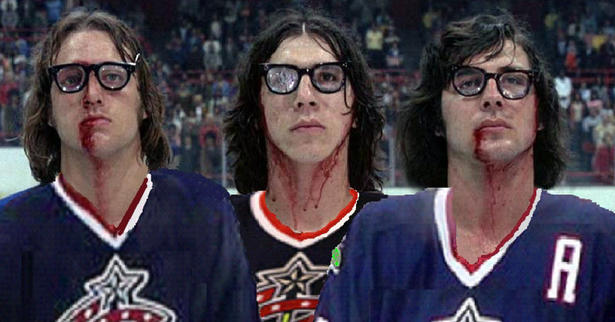
Dunlop continues to try and find out who the teams owner is, so he can talk them out of folding the team. Meanwhile, the General Manager Joe McGrath (Strother Martin) adds the Hanson Brothers, three violent goons to the team. Dunlop protests and doesn’t let the brothers play. When Dunlop eventually lets the Hanson’s play, they are an instant hit with the fans. The Hanson’s are the ultimate violent goons, creating mayhem on the ice. They check players into the boards, slamming players onto the ice and even slapping the opposing players on the bench with their hockey sticks. The Chiefs gain more fans and win more games by being outrageously violent on the ice. During the warm up before the game, the Hanson’s start a brawl. Next we see the Hansons and the rest of the Chiefs bloodied and bruised listening to the National Anthem. A referee skates over to yell at Steve Hanson about not pulling any funny stuff. The Brother tell the ref, “I’m trying to listen to the f**king song.” The ref looks chagrinned. This sequence is so funny in its absurdity.

Dunlop finally blackmails McGrath into telling him who the owner is. The owner is a well off widow living in the suburbs with her children. She thanks Dunlop for making the team winners and that she could easily sell them, but she prefers to fold the team and use them as a tax write off. Dunlop pleads with her to think of the people on the team, but she won’t change her mind. He insults her before he leaves and returns to the team and tells them the truth during their final game. There is no buyer for the team. He asks the team to play old-time hockey and play the game clean. They all agree and they hear the line up for the game. The Chiefs are facing the toughest, most legendary underhanded players. They are outmatched in brutality when they play clean and they are losing the game.

During the first period, McGrath flips out, telling the team that there are NHL scouts in the audience. Next we see the Chiefs back to a slugfest on the ice. Ned Braden (Michael Ontkean) is benched because he won’t fight. Braden is an excellent player without resorting to fighting. Braden skates out to center ice and does a striptease. An opposing player demands the referee to make Braden stop stripping yelling, “That’s disgusting.” The ref doesn’t and the player sucker-punches the ref. The game is forfeit to the Chiefs who win the championship. Braden skates around the rink in his jockstrap.

Slap Shot is another 70’s film that is gritty and realistic. The locations are perfect in depicting a community having financial difficulties. The situations and characters are funny because they are believable. Dowd’s dialogue is entertainingly blue and yet totally natural coming out of the characters. Somehow she’s made the coarse language seem perfectly normal in this world of sports, which I’m sure it is, but so many times in films, bad language seems to be there for no real reason. The characters use of foul language is false and is uninspired. Dowd’s characters would talk this way, so it is fitting. It has been said that f**k is said 176 times in the film. I would love to know who counted them all.

Paul Newman is excellent as the aging morally slippery Coach, who thinks he’s seen it all. Newman had said this was one of his favorite films to make. He is clearly enjoying himself and does his own skating. He is charming and a rascal. George Roy Hill directed Newman for the third time in this film. They worked together on Butch Cassidy and the Sundance Kid (1969) and The Sting (1973). The cinematography by Victor J Kemper shows us exciting action scenes on the ice. All the actors are wonderful especially the real life hockey players and non professional actors playing the Hanson Brothers: Jeff Carlson, Steve Carlson and David Hanson leave an indelible mark as the id’s gone wild brothers. Yvon Barrette is great as the Chief’s put-upon goalie, Denis Lemieux. Jennifer Warren, Lindsay Crouse and Michael Ontkean all contribute to the wonderful cast.

I keep going back and watching Slap Shot over and over again and I rediscover it each time. The scenes that make me laugh out loud are too numerous to cite. I enjoy the normalcy of some of the set ups. A local hang out where the players are engrossed in a soap opera on TV, while they have a drink is amusing or when the players are watching a woman exercising on TV with rapt lascivious attention as they pass the time before a game. This film is a pitch perfect comedy and great sports movie. Discover this underrated rough gem for yourself.

There really is so much to recommend ‘Gilda’. There is a reason that it has been used (The Shawshank Redemption anyone?) over and over again, gets referred to over and over again and has a substantial fan following even now. It is a fabulous movie in so many ways. Few movies even now can boast the great plot, great characters, superb acting, and intelligent directing.

SCREENPLAY CONTESTSUBMIT your SCREENPLAY
Voted #1 screenplay contest in the world!
NEW MOVIE REVIEWSNEW MOVIE REVIEWS
Read Today’s POSTED REVIEWS
MOVIE KILLSEE 1000s of PICTURES
Best of photos, images and pics
MOVIE YEARMOVIES YEAR BY YEAR
Pages from 1900 to present

SLAP SHOT

1977 Movie Review: SATURDAY NIGHT FEVER, 1977

SATURDAY NIGHT FEVER MOVIE POSTER
SATURDAY NIGHT FEVER, 1977
Movie Reviews

Directed by John Badham
Starring: John Travolta, Karen Lynn Gorney, Barry Miller, Paul Pape and Donna Pescow
Review by Jayvibha Vaidya

SYNOPSIS:

Tony Manero, a tough kid from Brooklyn lives for Saturday nights when he can indulge in his favourite things: drugs, women and disco. But when he meets a woman who challenges his moves on the dance floor and in life, Tony is forced to face the consequences of his choices, his relationships and whether dancing is his future.

REVIEW:

“Fuck the Future!”

That strut. That hair. That tight, white suit. It’s pop culture, it’s iconic, it’s Saturday night at the disco. John Badham’s Saturday Night Fever was released in 1977 when large masses were screaming: “death to disco!” The success of the film prevented that from happening.

The film follows Tony Manero (John Travolta), a foul-mouthed, 20-year old from Brooklyn who finds joy on the dance floor every Saturday night. His days are spent stirring up trouble with his friends, working at a paint store and fighting with his family. At the 2001 Odyssey, a club in Brooklyn, Tony commands attention and admiration. He’s liquid sex on the dance floor, spinning, thrusting and sliding. The ladies love Tony and Tony loves who he becomes under the disco ball. But when he meets Stephanie (Karen Lynn Gorney) she refuses to talk or dance with him, challenging his worth. “You’re a cliché,” she tells him. “You’re nowhere, on your way to no place.” See, she has dreams. Dreams that involve life on the other side of the Brooklyn Bridge. And what does Tony have? He has disco, man. And when he finally gets Stephanie to agree to enter a dance competition with him, Tony is ready to achieve his dream. But as he begins to examine the people and choices around him, Tony is forced to question whether his dream will get him anywhere.

The film can be categorized as a musical, but utilizes music in an interesting way. While characters do not burst into song, the music that plays over a scene is incredibly significant, underscoring important emotions and feelings. Songs are played in their entirety while Tony showcases his stellar dance moves in visually fascinating shots. Amazing choreography, angles and editing display some of the most electric dancing seen in a musical. The Bee Gees’ thumping baseline and falsetto cries are heard all over the soundtrack, stamping their mark on the era of disco. The lyrics to their songs not only emphasize the boiling hot emotions of Tony and his friends, but also the desperation, disillusionment and unfulfilling lifestyle of the Bay Bridge youth:

“Music loud and women warm.
I’ve been kicked around since I was born.
Life goin’ nowhere. Somebody help me.”

As the song screams, “we’re stayin’ alive, stayin’ alive,” Tony, in a moment of clarity muses, “There are ways of killin’ yourself without killin’ yourself.”

America in the late 70s was experiencing the effects of the Vietnam War, Watergate and a recession. American citizens were starting to focus on the consequences of their choices as well as the choices that were available to them. While Saturday Night Fever was about fun, escapism and hedonism it was also about the choices one can make in order to grow or accept the status quo. As Tony starts to examine the choices of his parents, his older brother who leaves the priesthood and his friends who repeat the mistakes of the past, he realizes the quiet acceptance present in his life. Tony doesn’t win because he earns it; he gets the prize because he’s popular. And for Tony, he wants to earn his place on the top like he earned his four dollar raise. Because for him, the only time “someone told me I was good in my life [was] this raise today, and dancing at the disco!”

The film alternates from the busy streets of New York to the flashing, coloured lights of the underground disco clubs. Clothes are bright, bold and flashy. Tony lovingly tends to his hair, standing up for it’s right to look fresh against the constant thumping of his father’s hand. The women are sexy, hair feathered à la Ms. Fawcett in her nipple-centric famous photo (which hangs on Tony’s wall). If one chose to enter the doors of the 2001 Odyssey, they had better look good. The high steel pillars of the Brooklyn Bridge at night where the boys challenge their mortality are contrasted with the strobe lights and disco balls where the boys challenge their longevity. And during the week, on days that aren’t Saturday, life goes on; simple, boring and repetitive.

The plot isn’t incredibly original with most characters displaying little self-awareness. But John Travolta manages to give a racist, sexist, cocky character a sense of vulnerability, which ultimately carries the film. The character of Tony isn’t heroic, or even likable, but he questions his world, and that requires some courage. Winning the dance competition is supposed to validate his dreams, but instead Tony is forced to accept his superficial status, the rape of a girl he could’ve have protected and the loss of a friend who needed him. Disillusioned, angry and frustrated he rides a subway into the night, ending up at Stephanie’s apartment. And finally, he brings himself to do what he failed to before: sincerely ask for forgiveness, friendship and help.

Sometimes cheesy, but thoroughly entertaining, Saturday Night Fever is a film that can hold up even more than thirty years after it’s original release. Through the marriage of music and cinema, this film takes a journey into adulthood from the eyes of a brash, passionate kid searching for purpose. It successfully captures the energy, joy and electricity of the underground disco era and the youth that lived for the music.

SCREENPLAY CONTESTSUBMIT your SCREENPLAY
Voted #1 screenplay contest in the world!
NEW MOVIE REVIEWSNEW MOVIE REVIEWS
Read Today’s POSTED REVIEWS
MOVIE KILLSEE 1000s of PICTURES
Best of photos, images and pics
MOVIE YEARMOVIES YEAR BY YEAR
Pages from 1900 to present


SATURDAY NIGHT FEVER

1977 Movie Review: THE LAST WAVE, 1977


THE LAST WAVE, 1977
Movie Reviews

Directed by Peter Weir
Starring: Richard Chamberlain, Olivia Hamnett, David Gulpilil, Frederick Parslow, Vivean Gray
Review by Trevor Hogg

SYNOPSIS:

An Australian attorney defends a group of aborigines who are charged with killing one of their own for violating a tribal taboo. As the murder case progresses, he becomes plagued by apocalyptic visions of water that entwine him with the prophetical beliefs of his clients.

REVIEW:

The roving Australian director, Peter Weir, encountered his creative muse while on holiday in Tunisia. “I found a buried Roman head, a beautiful piece of marble which I somehow knew I was going to find. It was an extraordinary experience,” the respected filmmaker remarked upon recalling his moment of premonition. “I wondered what if a lawyer had found it, someone whom it was harder to assimilate, the rational man rather than the filmmaker who deals with the imagination.” The idea percolated to the point of becoming the starting point for The Last Wave.

It was not the first time the Australian had worked with Aboriginal actor, Gulpilil, who gained international attention as the star in Nicolas Roeg’s Walkabout. “I used him in a T.V. episode in a very straightforward part,” Weir stated. “He was being persecuted by a white overseer in an historical series, and we were chatting in a bar one night after work; he said some things about his family, and then suddenly he said a sentence. It was something like, ‘You see my father and I and that’s why the moon isn’t.” Peter Weir was confused by the remark. “I thought about it that night and the next morning and suddenly I realized what it was. That he was talking about another perception. He was talking about an experience for which there are no words. He’d seen something in another way. That was a breakthrough for me, firstly in writing the screenplay, and secondly in my future conversations with him because then I would look out for these moments or I would provoke them.”

To ensure an authentic representation of Aboriginal culture, the director flew to Darwin where he met with Nandjiwarra Amagula, a respected tribal elder and magistrate on Groote Island. “Anything with the Aboriginals underwent change,” Peter Weir replied. “Nandjiwarra was the key. In accepting to do the film, he accepted the principal of recreating a lost Sydney tribe and their symbols and tokens.” However, there were certain conditions; Nandjiwarra would not allow the use of existing tribal symbols which resulted in the art director creating fictional ones.

Weir continued. “I wanted the film to show the contrast between the European without the dreaming and the tribal person with the dreaming, and we talked about some of those things. Later, Nandji, changed quite a bit of dialogue and asked for certain things be put in.” He went on to give an example. “The dinner scene with the family, which is my favourite scene. It was really constructed by Gulpilil and Nandjiwarra. Nandjiwarra put in all the lines about the law and the law being more important than man, and that is really the heart of the film. It was a marvelous day of filming, one where you call ‘cut’ and nothing really changes, the conversation continues. At the lunch break they didn’t really care about leaving; the conversation between Chamberlain and Nandjiwarra continued.”

On casting Richard Chamberlain as the corporate tax attorney turned trial lawyer, the renowned filmmaker responded, “There was something in his face, there was some alien quality, and in my story my character had that quality. I had one actor, an Australian I thought of using but he was unavailable. Also, we couldn’t raise all the money in Australia. Chamberlain’s name occurred to somebody and I remembered that face, those eyes in particular.”

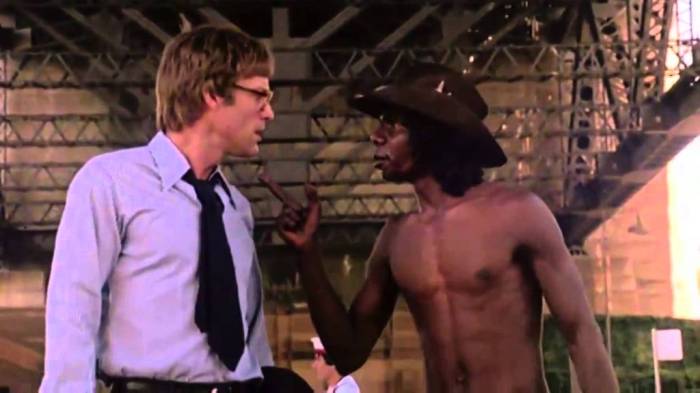
The Last Wave begins with a group of schoolchildren playing a game of cricket; however, they are quickly forced inside by an abrupt hail storm. The strange weather intensifies as David (Chamberlain) becomes obsessed with the ongoing murder trial. Haunted by images suggesting that the end of the world is at hand, he recruits one of the defendants (Gulpilil) to be his spiritual advisor. David’s apocalyptic visions climax when he confronts a tribal shaman (Nandjiwarra) in a sacred subterranean site located beneath the city. David escapes so to warn the people above of the imminent natural disaster. He collapses in hopelessness upon witnessing the rise of a great wave high above the urban landscape.

“I think I have to be honest and say that I didn’t find the solution to the problem of how to end the film,” confessed Weir when addressing the controversial conclusion to the movie. “There is no ending. I was painted into a corner. I have seen it happen with other filmmakers dealing in this kind of area. You can’t end it. You can try to be clever, and I tried a couple of other endings that did stop short of any wave, but they were just too neat. The ending just plagued me, and it was an extremely unhappy period. Part way through the film we broke over Easter. I remember a terrible few days wrestling with this ending and pretending I had found a solution to it.” He also went on to state. “It’s just the last chapter that is missing. I just have to leave it; don’t look back.” Upon further reflection, the storyteller admitted he would have approached things differently. “I think if I did the film today, I would…stay in the court of law.”

SCREENPLAY CONTESTSUBMIT your SCREENPLAY
Voted #1 screenplay contest in the world!
NEW MOVIE REVIEWSNEW MOVIE REVIEWS
Read Today’s POSTED REVIEWS
MOVIE KILLSEE 1000s of PICTURES
Best of photos, images and pics
MOVIE YEARMOVIES YEAR BY YEAR
Pages from 1900 to present


THE LAST WAVE

1977 Movie Review: KILLER OF SHEEP, 1977

KILLER OF SHEEP, 1977
Classic Movie Review
Directed by Charles Burnett
Starring: Henry G. Sanders, Kaycee Moore
Review by Marques Williams

Synopsis:

Stan works in drudgery at a slaughterhouse. His personal life is drab. Dissatisfaction and ennui keep him unresponsive to the needs of his adoring wife, and he must struggle against influences which would dishonor and endanger him and his family.

Review:

Charles Burnett’s Killer of Sheep has spent the last 30 years in cinematic purgatory. Unable to get distribution when it was finished due to expensive music rights, it has been seen only by small crowds in large cities across the country. However, last year it was restored by Milestone Films and the UCLA Film and Television Archive; and how fortunate the world is because of this. Killer of Sheep is one of those works of art that penetrates to the very soul of the viewer. There has never been a film that displayed the Black experience with such sensitivity, honesty, and spirit. Burnett succeeded in making a film that is to Black America what Vittorio De Sica’s “Bicycle Thief” was to post-war Italy.

Killer of Sheep is heavily influenced by Italian Neorealism and presents a simple story all shot on location. The film revolves around Stan, a slaughterhouse worker, who seems to be in a deep depression. He and his family live in the impoverished Watts, where there is always crime and suffering. There really isn’t much of a plot to the film, but is comprised of several vignettes. We see Stan’s son and his friends having a dirt fight, Stan and a friend going out to buy a $15 car engine, Stan’s wife getting dressed for Stan to come home while their daughter sings along to a record, and various other everyday activities. The

film is full of moments of humor and joy, while others are melancholy and heartbreaking. For instance, we see Stan as he slaughters sheep at his job. It’s a disgusting, hard, and thankless job but he has to do it to support his family. It’s obvious he doesn’t like it, but he never complains about it. One night when he gets home, his wife is waiting for him. She’s gotten dressed up for him and greets him with a smile, but Stan is so tired and distant that he barely notices her. They sit at the table in silence as they have dinner. The pain of his wife cannot be ignored and we instantly connect with these two characters.

The film is unique in its approach to its subject matter. Never does a character talk about how bad life is and Burnett never tries to offer any solutions of getting out of this life. The camera just observes these characters that exist the best way they can. Life may not be perfect for them, but it’s the life they have. In doing this, our emotions and reactions feel natural. We don’t necessarily feel sorry for them but instead can empathize with their small victories and failures. This honest depiction of poverty is rare in Hollywood today, and it’s refreshing to see a film that doesn’t attempt to put the blame on anyone or sugar coat the truth. Poverty is, unfortunately, an inevitable truth of human existence and Stan and his neighborhood represent millions of quiet sufferers all over the world.

When hearing the soundtrack, it becomes understandable why Burnett didn’t want to change the music. It gives the film another level of authenticity and sincerity. The music covers several genres and eras, most of which are African American. Blues, early Jazz, Soul, Classical music, and Gospel play during various scenes. Because of this, the film feels almost like a dedication to all of Black America who have suffered throughout centuries of hardships. When he originally shot this film, Burnett set out to make a film that was “anti-Hollywood” and would help provide a “full range of the black experience”. He succeeded admirably. Although other films have gone deeper in exploring the Black experience, Killer of Sheep proves the most successful in capturing the spirit of a culture that has been underrepresented and ignored for too long.

TOP 100 MOVIESTOP 100 MOVIE PAGES
WATCH and SEE the best of film!
SEXY PHOTOSSEXY PHOTOS TOP 100
Sexiest people on the planet!
TOP 100 SEXTOP 100 SEX PAGES
WATCH and SEE the best of sex pages online
NAKED SCENESWATCH the TOP 100 NUDE SCENES of all-time
SEE the best of naked film!

KILLER OF SHEEP

1977 Movie Review: JABBERWOCKY, 1977


JABBERWOCKY, 1977
Movie Reviews

Directed by Terry Gilliam
Starring: Michael Palin, Harry H. Corbett, Max Wall, John Le Mesurier, Warren Mitchell
Review by Mark Engberg

During the Dark Ages, an impressionable cooper’s apprentice is forced to slay the legendary Jabberwock monster in this farcical adaptation of Lewis Carroll’s classic poem.


REVIEW: “Twas brillig, and the slithy toves/ Did gyre and gimble in the wabe/ All mimsy were the borogoves,/ And the mome raths outgrabe.”

After the triumphant release of “Monty Python and the Holy Grail”, director/animator Terry Gilliam makes his solo directorial debut by tackling the historic realm of the Dark Ages yet again with this chaotic adventure regarding a young man and his quest to slay the famed Jabberwocky, a hideous monster that has been burbling through the woods of a nearby city castle and devouring everyone in its path.

Ironically, Gilliam’s dark comedy, which he co-wrote with Charles Alverson, has little to do with the dragonlike Jabberwocky. Like Peter Benchley’s heinous novel “Jaws” (wonderful movie, awful book), the narrative content is reluctant to feature the central monster, and is more involved with the heroic challenger seeking to destroy it. In this case, that story begins with Dennis Cooper (Monty Python’s Michael Palin), and his wretched life as a peasant.

 Hearing his father’s dying words of abandonment, Dennis must travel to the walled big city in order to attain business opportunity. Once inside the castle’s confines, he discovers that the guilds are operating the city’s businesses as a monopoly, thereby making the citizens a desperate and impoverished community. As Dennis sidesteps chaotic turmoil among the starving townsfolk, he discovers that the most successful townsfolk are profiteering off the fear the Jabberwock monster has created.


Due to the increased faith in religion and church attendance, the Bishop is hindered by the King’s mission to slay the Jabberwock. Since King Bruno the Questionable’s list of priorities is hopelessly flawed and ridiculous, he initiates a tournament to select a champion who can defeat the monster. Realizing their profits are in jeopardy, the town’s merchants conspire to send a deadly Black Knight to eliminate this warrior in order to save the monster.

But as Dennis is tossed and shoved in numerous directions by the town’s miserable inhabitants, he finds himself in the center of action staring straight into the Jabberwock’s eyes of flame.

“Beware the Jabberwock, my son!/ The jaws that bite, the claws that catch!/ Beware the Jubjub bird, and shun/ The frumious Bandersnatch!”

Gilliam’s film, however, differs from Carroll’s classic nonsensical poem in that Dennis is not offered any significant guidance or support from his peers. In fact, the only character who openly speaks with him is Ethel the Squire (Harry H. Corbett), who manipulates Dennis into accompanying the champion on his quest to conquer the Jabberwock.

 Almost every other character in this story beats, spits, or urinates on Dennis at one time or another. The only other character who shows him any affection is the King’s daughter (Deborah Fallender), who misinterprets his accidental presence in her chambers as an act of chivalric courtship.

Dennis’ unbreakable ability to remain happy is one of Gilliam’s major themes in this movie. Since he achieves all of the goals typical of a fairy tale hero, his history of pain and aggravation are ultimately insignificant. Dennis defeats the Jabberwock, wins the princess’s hand in marriage and earns the adoration of the King and his people. Like Alice in Wonderland, he attains these goals purely by accident.

“Jabberwocky” is a fitting piece of work definitive of the directorial works of Terry Gilliam. The film is dark, apocalyptic, and suggests a macabre glee that would later prosper in Mr. Gilliam’s subsequent works. It is a departure from his traditional use of sketch comedy in “Monty Python’s Flying Circus.” Indeed, “Jabberwocky” marks the first time the former Python player created a comedy in pure narrative format.

While many fans will no doubt be resistant to its crude sense of humor (the film features countless references to bodily functions), other viewers will respect “Jabberwocky” for its pioneering sense of dark comedy and epic cinematography. Shot by Terry Bedford, the film consists of several glorious scenic views of Pembroke Castle and Chepstow Castle in Wales.In today’s age of computer borne digital effects, it is refreshing to see the monster depicted in costume form, similar to the classic Japanese Godzilla movies. Built as a large marionette, the Jabberwock’s head is controlled by an unseen puppeteer’s pole, while the performer manipulates the beast’s wings with his arms.

Even though, the Jabberwock is only briefly presented to the audience, Python fans will most likely celebrate the intensive use of gore, bloodletting, and nudity.


JABBERWOCKY

1977 Movie Review: HIGH ANXIETY, 1977

HIGH ANXIETY MOVIE POSTER
HIGH ANXIETY, 1977
Movie Reviews

Directed by Mel Brooks
Starring: Mel Brooks, Madeline Kahn, and Harvey Korman
Review by Mark Engberg

SYNOPSIS:

A demented hospital staff in this classic parody of Alfred Hitchcock’s suspenseful classics threatens a renowned psychiatrist suffering from vertigo mental illness.

REVIEW:

After tackling the traditional Western, the classic horror epic, and even the pioneer style of the silent movie, Mel Brooks takes on the most ostentatious of Hollywood entities: Alfred Hitchcock. This is a movie that not only suggests but demands familiarity with Hitchcock’s reputation as the master of suspense in order to get the better half of the jokes.

In traditional Mel Brooks style, the comedy is delivered without subtlety. In fact, he crams the references in your face like it was a pie from an abusive waiter. Or a bellboy (who gets no tip).

While the level of wit can be described as sophomoric, it must also be acknowledged that Mr. Brooks surpassed all level of expectation in this project mimicking the great works of Mr. Hitchcock: “The Birds”, “North by Northwest”, and of course “Vertigo”. Roger Ebert disapproved of Brooks’ satirization here, stating that Hitchcock classics were already full of wit and that a slapstick farce mocking the director’s style of storytelling was inadequate and heedless.

Mr. Ebert may have a point regarding Brooks’ simplistic style of principal shooting. Honestly, did the man ever study three-point lighting? Or how to eliminate a boom mike shadow from a reflecting angle? If not for Brooks’ impeccable sense of timing and unconquered comedy, his production would seem amateur and somewhat unnatural.

But given Mel Brooks’ pampered edge of such a heralded style and his respectful style of soft-core mockery, I must disagree with Mr. Ebert and his speculation of improper irony. Who better to challenge the Master of Suspense than the Master of Farce?

Instead of appearing as a cameo, as Hitchcock did in every one of his own classics, Brooks takes the center stage as the star lead in his sixth directed feature. While some may complain about the director’s preference for his own performed comedy, you have to admire the man’s ability to sculpt his own comedic invention into actual product. Mel Brooks is one of the few filmmakers from Hollywood who can be credited, or blamed, as the writer, director, and star of his own celebrated comedy.

Even though his lounge act performance of “High Anxiety” is badly lip-synced, it is obvious that this man is an extremely talented performer, capable of great physical comedy as well as insight. True, his films may have a production value comparable to art house theatre rather than cinema. But his sense of humor appeals to audiences of all ages, which today is an infrequent occurrence for a live action comedy.

Jaded from his harrowing airline flight, Dr. Richard Thorndyke (Brooks) arrives to assume control of the Institute for the Very, Very Nervous. Harvey Korman resumes his role as a spineless villain with many of the same traits he exposed in “Blazing Saddles”. His character, Dr. Montague, is hip deep in devilish conspiracy with Nurse Diesel. Cloris Leachman plays the demented villainess with such grace, her slurred speech and tightened jaw actually frightened the hell out of me when I first viewed this picture as a young boy. Her Cruella de Vil-like interpretation of Ken Kesey’s Nurse Ratched is a hallmark in comedic performance.

Montague and Diesel are bloodthirsty with deception. They plan to eliminate Thorndyke and run the institute as a prison ground for mental patients. Their imprisonment of a famous industrialist incurs the concerned reaction from his daughter, Victoria Brisbane (Madeline Kahn in yet another scene-stealing performance). Her best scene in this movie is a phone call from Thorndyke while a professional killer is strangling him. Except she thinks it’s a heavy breather. You have to see it to believe it.

As Thorndyke and Victoria join forces, their quest enables a frantic chase sequence, which pits our vertigo-challenged hero against a climactic backdrop of heights and bad men who have only half a mustache. I could explain, but why ruin it?

Howard Morris adds genuine warmth to the story as Thorndyke’s mentor, Professor Lilloman (pronounced “Li’l Ol’ Man”). As he nurtures Thorndyke out of his acrophobia, he supplies many laughs as temperamental comic relief. Comic rule #87: Old Jewish doctor types who swear loudly= huge laughs.

Also, watch for the scene where the bellboy attacks Thorndyke in the shower of his San Francisco hotel. While it may be clear that Brooks is spoofing “Psycho” in this shot-by-shot send-up, it took me repeated viewings until I finally recognized the actor playing the bellboy: none other than Barry Levinson, who co-wrote the screenplay with Mr. Brooks. After “High Anxiety”, Levinson would go on to direct his own immortal comedies such as “Good Morning Vietnam” and “Rain Man”.

HIGH ANXIETY

SCREENPLAY CONTESTSUBMIT your SCREENPLAY
Voted #1 screenplay contest in the world!
NEW MOVIE REVIEWSNEW MOVIE REVIEWS
Read Today’s POSTED REVIEWS
MOVIE KILLSEE 1000s of PICTURES
Best of photos, images and pics
MOVIE YEARMOVIES YEAR BY YEAR
Pages from 1900 to present


1977 Movie Review: GRAND THEFT AUTO, 1977


GRANT THEFT AUTO, 1977
Movie Reviews

Directed by Ron Howard
Starring: Ron Howard, Nancy Morgan, Elizabeth Rogers, Marion Ross, Clint Howard
Review by James Aston

Teenage lovers Sam Freeman (Ron Howard) and Paula Powers (Nancy Morgan) want to get married in Las Vegas. When Paula introduces Sam to her wealthy parents they take a disliking to him, believing that Sam wants to marry Paula for money. Paula’s parents think their daughter would be better suited to local rich kid and busybody Collins Hedgeworth (Paul Linke). They throw Sam out of their house and send Paula to her room but Paula escapes and steals her parents priceless Rolls Royce before picking up Sam and hitting the road. Paula’s father, Bigby (Barry Cahill), deploys his helicopter to chase the couple as they race towards Vegas, Collins Hedgeworth joins the chase shortly after, stealing a car as he goes. Collins calls a local radio station and offers listeners a reward of $25,000 for anyone that can stop the fleeing couple. What ensues is an ever-growing chase full of crashes and explosions as everyone tries to claim the reward. As media coverage of the chase escalates Bigby makes a plea to his daughter over the telephone, but she refuses to listen. Sam wonders whether Paula’s motivation is love for him or a desire to spite her father, but Paula persuades Sam that she loves him. An epic pile-up occurs and the priceless Rolls Royce is destroyed. Sam and Paula manage to escape, eventually getting married in Las Vegas. 

REVIEW:

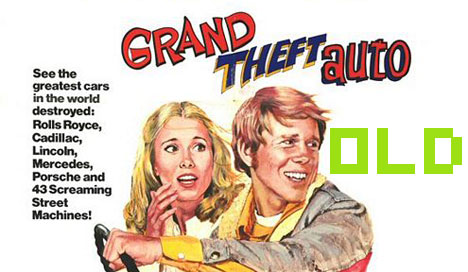
They say the simplest stories are told the best, and Grand Theft Auto succeeds where many exploitation movies failed. Few exploitation flicks made for particularly challenging viewing, but often the plot was so badly paced or paper-thin that it was in no way compelling or believable. Frequently the story was only a background device on which the supposed shocks, thrills and spills were hung. Considering the fact that exploitation movies were made in a matter of weeks to save money there was little time for writers to work on a script anyway. Not that the script mattered to the studios. Their motive was to attract an audience by making big promises about ‘dangerous’ subject matter in order to exploit the curiosity of the paying public. Quite often it turned out that the studio was over-hyping or downright lying about the content of those movies. Yet Grand Theft Auto manages to adhere to its promotional promise of seeing “the greatest cars in the world DESTROYED!” while telling a simple but well paced story that grows from a private affair between a teenage couple and the girls family into an all-out battle that involves the entire town. This is a breathless little comedy chase movie, although in 2009 you’ll probably laughing at delivery of the comedy rather than the jokes themselves. Grand Theft Auto delivers entertainment between the crashes and explosions thanks to a well paced story that is simple and nicely paced. However Grand Theft Auto is not a great movie by any means.

It might come as a surprise that Grand Theft Auto was directed by Academy Award-winner Ron Howard. Anyone that has seen Howard’s newly-released abomination Angels and Demons (2009) will tell you that the film is ridiculously convoluted and makes no sense whatsoever, and yet it is very well directed. Young Ron was never going to win an Academy Award for his direction on Grand Theft Auto, it’s clear that he was just finding his feet here. Admittedly Howard’s direction is on par with most other B-Movie directors of the time, excluding the occasionally brilliant Roger Corman, in that their mantra seemed to be “point, shoot and never retake a scene.” That’s understandable really considering the studios demanded a quick production. The fast turnaround of these movies meant that directors had no choice but to work quickly if they wanted to get paid, so it’s not entirely Howard’s fault that he doesn’t excel as director here. Perhaps it was also the added pressure of taking a starring role in the movie that stunted Howard’s work in both areas because Nancy Morgan shines the brightest out of the two leads. As those well versed in this genre might expect the dialogue is frequently corny and the acting is only a notch above diabolical across the board, but it really doesn’t matter. Every character is played for laughs apart from the lead characters, which makes Howard and Morgan stand out as ‘wooden’. Howard and Morgan are good choices as leads though with his youthful good looks, and while the chemistry between Sam and Paula doesn’t exactly crackle, they are well matched in terms of looks which is what is most important in a movie like this.

Teenagers in the late 1950’s were not visiting movie theaters because there absolutely nothing being produced by the main studios that appealed to them. Small exploitation studios such as New World Pictures made movies cheaply, quickly and frequently with the sole intention of getting those teenagers to spend their disposable income at the theater or drive-in every week, and in doing so made huge profits for decades until the major studios caught up. With Grand Theft Auto New World Pictures skilfully did everything they could to achieve that goal. The fact that this love story is based around a cars is a stroke of genius because of the huge audience that would go with their lover to the drive-in every Saturday. The teenage audience loved the extremely rebellious storyline because their own parents would disapprove, and they loved the promise of illegal activity from the title alone. They were thrilled by the coarse language and the destruction. NWP pitched the movie perfectly for their audience and it shows. NWP spent $602,000 making Grand Theft Auto and grossed a spectacular $15 million. They did have twenty years of refining the formula though, take a look at Teenage Caveman (1958) for a laughably bad early attempt at attracting this audience.

The acting is bad. The direction is sub-par. This could be repeated for many of the mass produced exploitation films that were released during the 50’s, 60’s and 70’s. Grand Theft Auto is by no means a five star movie but when viewed alongside its peers it stands out. Other movies from this genre often gave a whole lot of sizzle without any smoke. They didn’t deliver the incredible, shocking or lurid content that they promised in their trailers and on their posters and those were the things the audience came to see. In fact they were utterly shameless when it came to exploiting their audience, and to add pain to injury these movies didn’t even provide much entertainment as part of the deal, because nobody took the time to pace the story correctly. Grand Theft Auto scores against its rivals by not insulting its audience. Watch this movie for what it is: a 1970’s exploitation movie that for once actually tries hard to deliver what it promises.


GRAND THEFT AUTO

Film Review: BRIGSBY BEAR (USA 2017)

Deadlines to Submit your Screenplay, Novel, Story, or Poem to the festival: http://www.wildsound.ca

BRIGSBY BEARAfter being freed from the kidnappers he thought were his parents, a man sets out to make a movie of the only TV show he has ever known.

Director: Dave McCary
Writers: Kevin Costello, Kyle Mooney
Stars: Mark Hamill, Claire Danes, Kyle Mooney

Review by Gilbert Seah

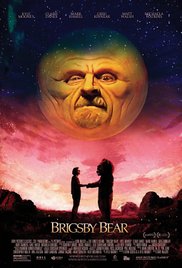
Who is BRIGSBY BEAR? The name indicated a TV cartoon show for kids. That is exactly what Brigsby Bear is, but why has no one heard of this bear? The answer is that Brigsby Bear is a children’s show character totally concocted and made by kidnapper parents to keep the child occupied.

When the film opens, we seen the now adult still kidnapped James Pope (Kyle Mooney) watching an episode of Brigsby Bear on television through VCR cassette tapes. James is shown having dinner with his parents, Ted (STAR WARS’ Mark Hamill) and April (Jane Adams) who practice odd rituals. It is soon revealed that James Pope was kidnapped from a hospital as a baby and since childhood all the way to adulthood has known nothing about the world except Brigsby Bear, a children’s show character fabricated by his kidnapper parents. One day, James is rescued and brought out into the real world where he learns that Brigsby Bear is not a real children’s show. Confused and baffled by these turn of events, James sets out to make a Brigsby Bear movie to show the world what he has learned.

The main flaw of the film is the film’s credibility. The credibility factor is sacrificed for the film’s charm. Director McCary goes all out to show that there is no badness in every character of his story. The kidnappers are revealed to be good hearted people whose only sin is wanting to love their own child. They even admit to knowing their abduction of James being wrong, yet they are desperate to love. For all the trouble that James creates in the environment around him, everyone is forgiving from his family (his sister initially shown as an independent no-nonsense sibling; his doting parents) to all his new friends. Everyone also aids James to make his Brigsby film. The title of his finished film, comically called “BRIGSBY BEAR, the film my friend help me make” tells the whole story.

It is difficult to figure out the intentions of BRIGSBY BEAR. Perhaps the message is that there is goodness in everyone, even if you have kidnapped a baby and kept it for your own for a full twenty years.

The most enjoyable bits of the film are the BRIGSBY BEAR episodes. The cartoon bear costume and his adventures saving the world from the evil Sunsnatcher are nothing short of hilarious – with lots of corniness thrown in for good measure. The special effects are crayon drawn but colourful enough.

BRIGSBY BEAR proves that corny can be funny! The good intentioned film over emphasizes the point of how good intentions triumphs over evil. The film ends up entertaining enough if one can stomach the over saccharine sweetness.

Small indie films like this one and previous successes like NAPOLEON DYNAMITE featuring geeky protagonists have a niche audience which somehow do reasonably well at the box-office. The well-intentioned BRIGSBY BEAR should do likewise.

Trailer: https://www.youtube.com/watch?v=FFUvQi2TVOE

Also, Free logline submissions. The Writing Festival network averages over 95,000 unique visitors a day.
Great way to get your story out: http://www.wildsound.ca/logline.html

Deadlines to Submit your Screenplay, Novel, Story, or Poem to the festival:http://www.wildsound.ca

Watch recent Writing Festival Videos. At least 15 winning videos a month:http://www.wildsoundfestival.com

Film Review: SUNDOWNERS

Deadlines to Submit your Screenplay, Novel, Story, or Poem to the festival: http://www.wildsound.ca

SUNDOWNERSIt’s not the destination wedding that matters, but the journey the hapless videographers have trying to capture it.

Director: Pavan Moondi
Writer: Pavan Moondi
Stars: Phil Hanley, Luke Lalonde, Tim Heidecker

Review by Gilbert Seah
 
SUNDOWNERS follows two young males Alex Hopper (Phil Hanley) and Justin Brown (Luke Lalonde) as they travel to a Mexican resort as videographers to shoot a wedding.

It is a case of everything that could possibly go wrong does, and in the worse possible way. Their trip is already doomed from the start when their boss gives them the incorrect flight information This is followed by incorrect hotel information. It does not help that Justin is recruited as Alex’s photographer and really knows nothing about the camera. When they finally meet members of the wedding family, they find more trouble afoot. The bridegroom has just lost his job and gone bankrupt, with the bride, who appears to be all over him, unaware f the situation. They meet the best man, who is of questionably character though appearing friendly enough. The father urns out gay and hits upon Alex. All the high jinx sounds ripe for crazy and laugh-out loud humour but surprisingly the film is only mildly funny.

For a film with a cast of stand-ups, the laughs are surprisingly few and far between. The film plays like an uncomfortable comedy where the comedy is supposed to come from the misfortunes of the lead characters. A similar example is THE OUT-OF-TOWNERS where a couple lands in New York City and everything goes wrong. Incident after incident work against the couple but as the audience wants the couple to do well, it is hard to laugh at the mishaps. The same goes for the two landing in Mexico where one thing after another do not go as planned.

If one observes the dialogue at many points in the movie, many of the lines can be put together in a stand-up comedy routine. But somehow put in the situation of the film’s plot, they do not come across as funny at all. This is surprising considering that many of the cast and director are real life standup comics. They should be aware of how critical timing is. An example is the horror comedy GET OUT by a director who is a stand up comic. GET OUT was unexpectedly funny, primarily out of timing and camera set ups.

The film benefits from the two lead actors Luke Lalonde and Phil Hanley. They are spirited, good looking, likeable and emit good chemistry. They appear to be people fun to be with which means audiences feel comfortable with their characters.

The film is set in Mexico. The film’s hotel setting looks like any one of the all-inclusive resorts that I have visited in Mexico. But the credits indicate the film being shot in Columbia.

Moondi gives the impression that he is out to get cheap laughs at every opportunity. An example is evident in the scene where the couple rides a cab and the camera focus on a row of bobbing dog heads laid out on the dashboard. Another has them sitting on the steps of a hotel waiting fro a cab when Mexicans walk behind them laughing as if the stand ups are provided by laughter to get the humour going.

SUNDOWNERS should and could have been funnier!

Also, Free logline submissions. The Writing Festival network averages over 95,000 unique visitors a day.
Great way to get your story out: http://www.wildsound.ca/logline.html

Deadlines to Submit your Screenplay, Novel, Story, or Poem to the festival:http://www.wildsound.ca

Watch recent Writing Festival Videos. At least 15 winning videos a month:http://www.wildsoundfestival.com