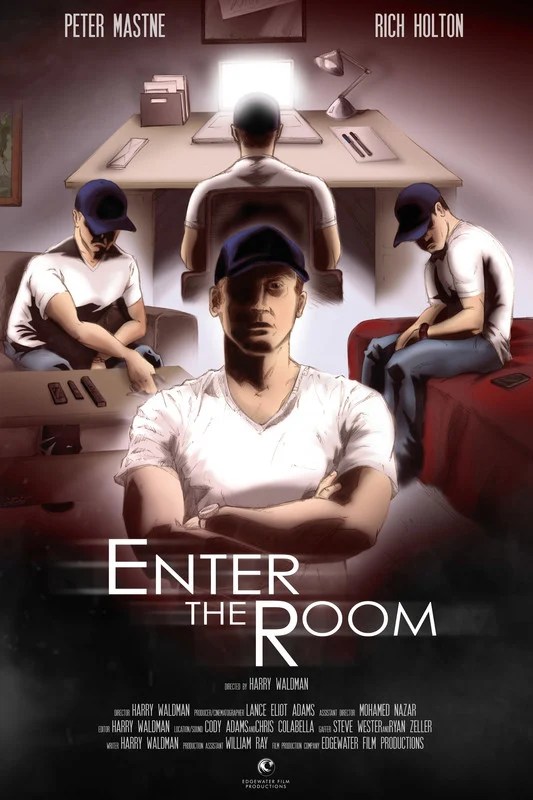
A young adult (Brian) is visited by his brother, Jeremy, who needs a place to stay as he settles into his new city. The two polar opposite personalities begin to clash as Jeremy’s presence poses a threat to Brian’s way of life. Brian’s uptight personality and unreasonable living standards rub off on Jeremy, creating an incredible amount of tension. Bad blood, stemming from a traumatic past event reveals the shocking truth of the brothers’ current situations, as Brian struggles to differentiate between reality and his worst nightmares.
Director Statement I try to create powerful films that make the viewer feel a wide range of emotions and convey ideas that will linger in the viewers’ minds long after the credits roll.
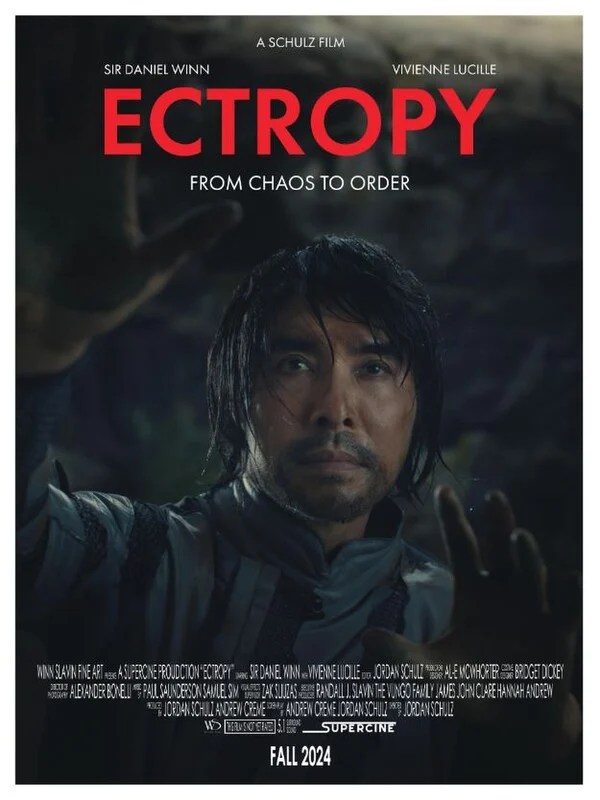
“ECTROPY” follows the Artist, a member of the Timeless Presence species who struggles to see his potential. Aided by the young Gaia, the Artist faces existential challenges and immense pressures as they paint the fabric of nature.
The short, Ectropy, gives the viewer a chance to escape to a fantasy world influenced by the forces of nature, where an artist creates sculpture and paintings with abandon. The visuals are breathtaking, with a sci-fi feel. A hot flaring sun, massive smoking explosions and falling boulders contrast with gentle images of soft pliable clay, and lush plants in the process of blooming.
The actor playing the central figure radiates both awe and sombre intensity, as a strong foil to the gentleness and warmth of the adorable girl playing the role of the young Gaia. Underneath it all, the instrumentals match the grandeur of the imagery, notably the full-scale action film orchestral music, and prominent sound effects such as the ongoing undulation of water.
The editing is stellar — such dynamic movement of a variety of images on screen, the most intriguing being the artist’s rapid fingers on glass and the creation of the angelic human statue. This short is effective in its contemplation that, in the end, nature is in control as the artist eventually goes back into the earth from whence he came.
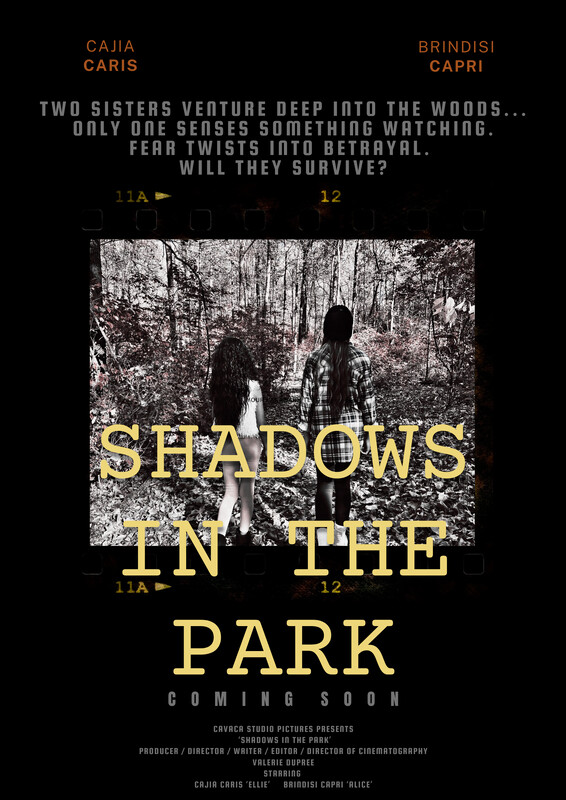
A chilling tale of childhood fear and the unknown, Shadows in the Park follows two sisters on an eerie venture into the forest, where only one senses an ominous presence lurking beyond the trees. The film weaves tension through its atmospheric sound design, autumnal color grading, and the simple yet unsettling premise of what happens when fear twists into something deeper—perhaps even betrayal.
From the opening frames, the melody hints something is amiss. The warm hues of the fall season contrast with the creeping unease introduced by the sound design, creating a dissonance keeping the audience on edge. As golden hour fades, so does the illusion of safety.
When the younger sibling questions if they should even be out this late, Ellie, the older sister, dismisses her fears with a teasing remark: “Yeah, because the trees are about to get us.” It’s playful, but the film’s careful pacing suggests otherwise—something is about to happen.
The tension escalates as the girls push deeper into the woods, ignoring the younger sister’s growing unease. The whispers start—a faint but chilling intrusion. Suddenly, Ellie is gone, and Alice is left alone, ripped by terror. Her fear isn’t just about what might be lurking—it’s the frustration of not being believed.
The sisters’ dynamic, from teasing to desperation, adds a layer of emotional depth beyond the typical horror trope. Are they simply scaring themselves, or is something truly out there?
The film’s biggest strength is its restraint. It never fully confirms what haunts the park, instead leaving the audience with an open-ended question—was there really something watching them?
Or was it just the tricks of the mind in the isolating vastness of nature? Shadows in the Park thrives in ambiguity, proving that sometimes, the most unsettling horror lies in what remains unseen.
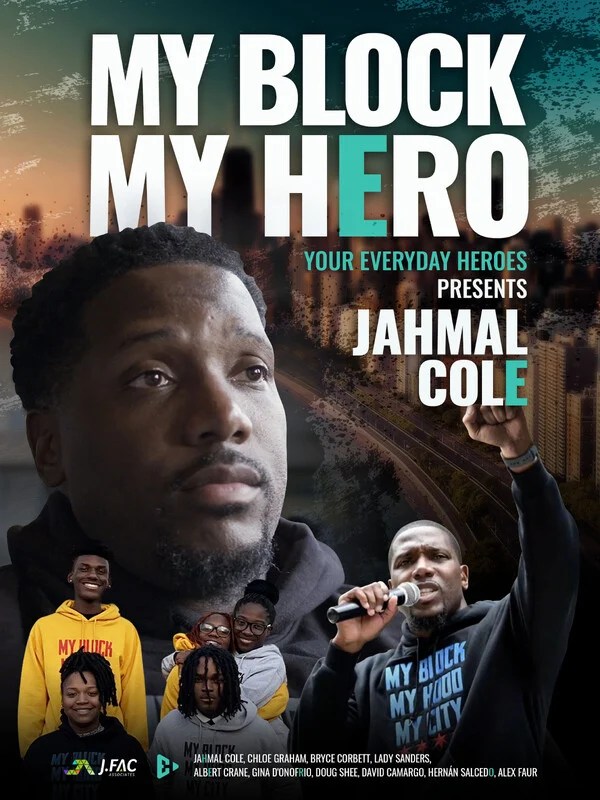
Jahmal Cole is the founder of My Block My Hood My City, a Chicago-based non-profit with a mission to inspire youth and empower local communities. He has been shot twice in his day-to-day life, an unfortunate reality that the teenagers and communities he has dedicated the organization to uplifting face on a daily basis in the murder capital of the United States. By leading community-driven efforts, Cole has made it his goal to build a better world one block at a time, while positively impacting the lives of the teens who grow up there. Through the Explorers program, My Block My Hood My City enables youth from Chicago’s divested neighborhoods to discover the world beyond their blocks, by taking them on enriching experiences across the city and the country that open the doors to new possibilities. In their latest adventure, the Explorers went behind the scenes at the Shedd Aquarium to learn how researchers are working to preserve the world’s endangered coral reefs.
Chicago resident Jahmal Cole is one of those people who naturally inspires others. Just listening to him speak draws you in and the wisdom in his outlook makes you realize that you too can help ignite change for the better. Jahmal is the CEO and Founder of My Block, My Hood, My City and this non-profit is shaping young lives by giving them the knowledge and resources they desperately need.
This documentary was directed by Gina D’Onofrio, who did such a wonderful job weaving not only Jahmal’s story, but the story of what My Block, My Hood, My City is and how impactful it is to the community. A fantastic blend of interviews, photos and videos paint an inspiring picture of a man’s resilience to help his community and form a team of like minded individuals who care about Chicago’s children.
The cinematography and sound design was stunning thanks to Doug Shee and David Camargo. The addition of the uplifting score really added to the emotion running through this. Jahmal is living proof that it only takes one person to start a change and more people will follow until you have a beautiful organization that’s making a massive difference in so many lives.
In this whimsical tale, a young artist’s fantasy becomes reality when he awakens to find the girl from his sketch has come to life. As he marvels at this miraculous creation, a sudden gust of wind snatches away the drawing, causing his dream girl to vanish as quickly as she appeared. They are drawn together and torn apart.
Review by Julie Sheppard;
Drawn Together, Torn Apart, a stirring romantic short reveals how an artist’s rendering materializes into reality. The performer playing the artist does a fabulous job showing both earnestness and expectation, as does the young woman playing the object of desire, whose performance is both delicate and sweet.
The settings in which the two of them find themselves are fitting for their burgeoning young love, notably in the artist’s bedroom/art studio (where his dreams begin) and walks outside on a summer night in front of fireworks and graceful palm trees. The slow build of the soundtrack — with soulful piano, synth and tinkling notes — serves the rather magical tone of the film. The cinematography is quite sophisticated with the use of extreme close-up shots of sketches and enamoured eyes, in addition to the brilliant fade convention at the end.
This film is a testament to the blur between art and life. It is the heartbreaking action of the artist’s rendering of his fantasy lover that moves him from dream to reality and back to dream again.
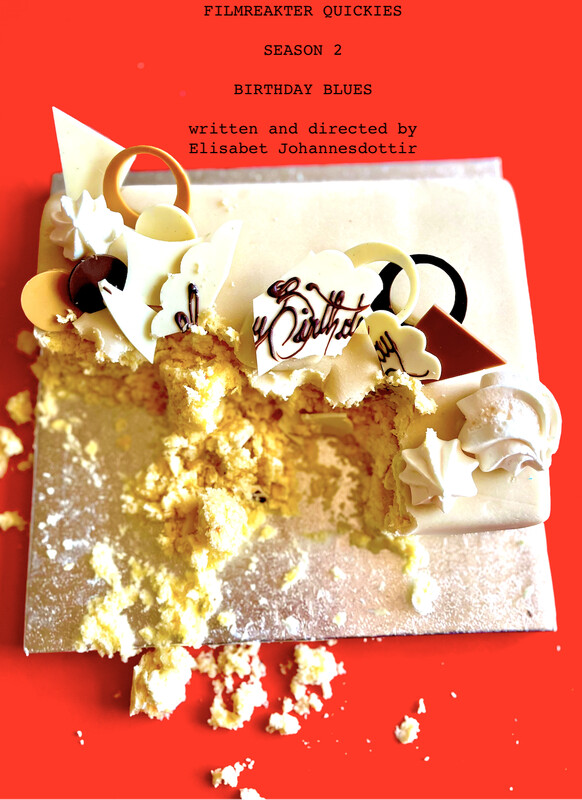
The happiness of what should be a happy day is ruined in the short film BIRTHDAY BLUES. This very tense film depicts a moment between a husband and wife that are near the end of their relationship. It’s made in a way that even makes the audience tense, wanting to look away from this fight as if it’s being done in public though the couple are in the privacy of their home.
The cinematography is shot in a way that adds to the tension, coupled with the fact that there is no score. There are long shots that don’t cut, following the actors as the tension builds up between them. The cuts become quick as the fight heats up, making it come across the screen to the viewer.
The story is one that is quite common across the world. A wife that is married to a narcissistic man that only puts on the appearance of thinking about her. The moment she walks in the door, he makes fun of her for liking ice cream cakes as he presents her with his favorite cake. He continues to attack her, stating fictitious reasons that she would be a horrible mother simply because he does not want to be a father. His wife can do nothing right and when she calls him out on his behavior, he gaslights her by blaming his dark sense of humor.
This very tense film shows how a self centered person can ruin something as joyous as a birthday. It can quickly destroy a person when their significant other is the one destroying their self worth. This is depicted expertly as the husband is the type of person that everyone should run from, someone that will never change and cannot stand when anyone else has a day to celebrate themselves. It’s very well done.
When the spirit of Christmas seems to have left a small town in Gloucestershire, Jake and Pete must find a way to restore it in time for Christmas.
Review by Julie Sheppard:
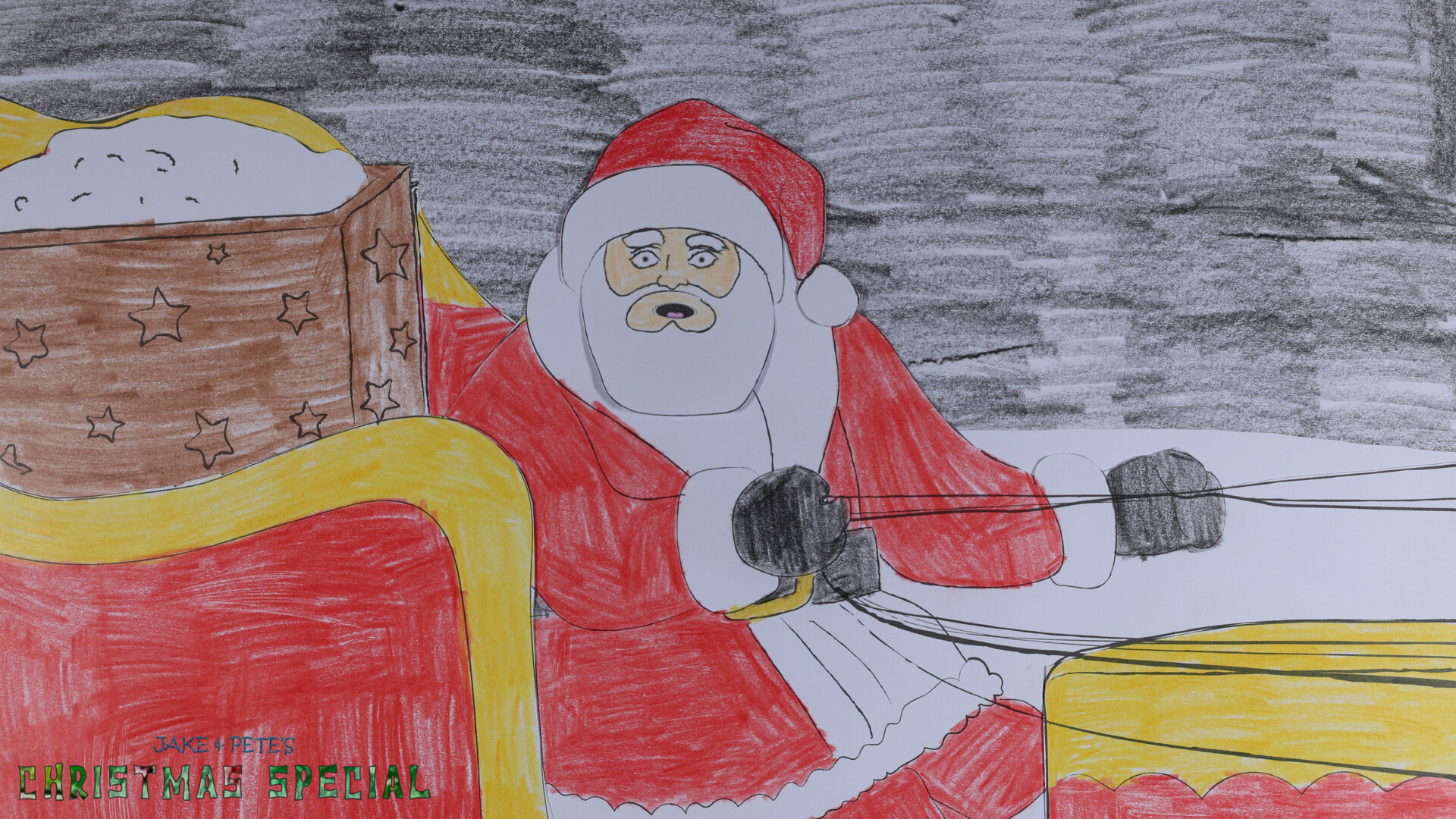
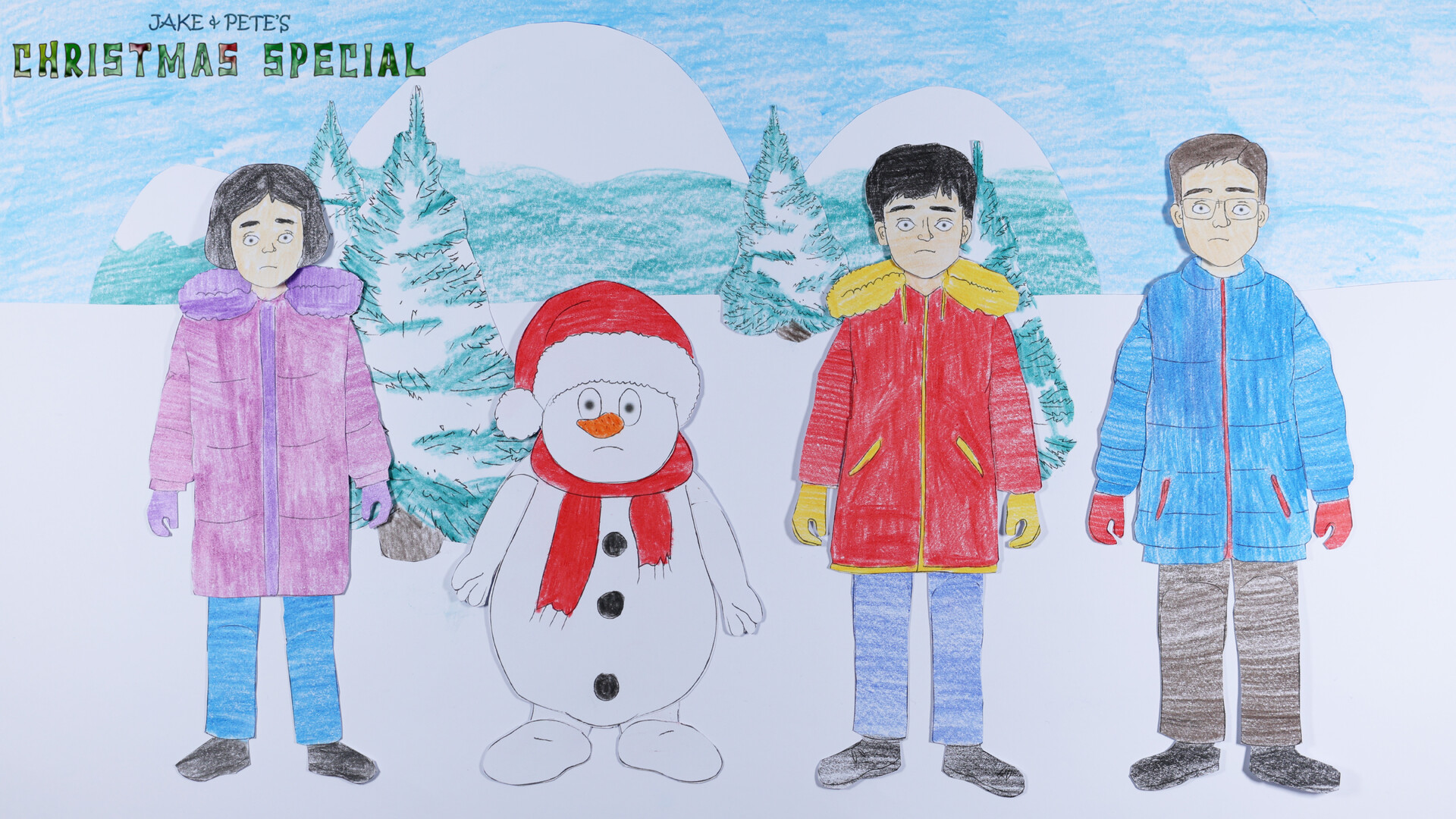
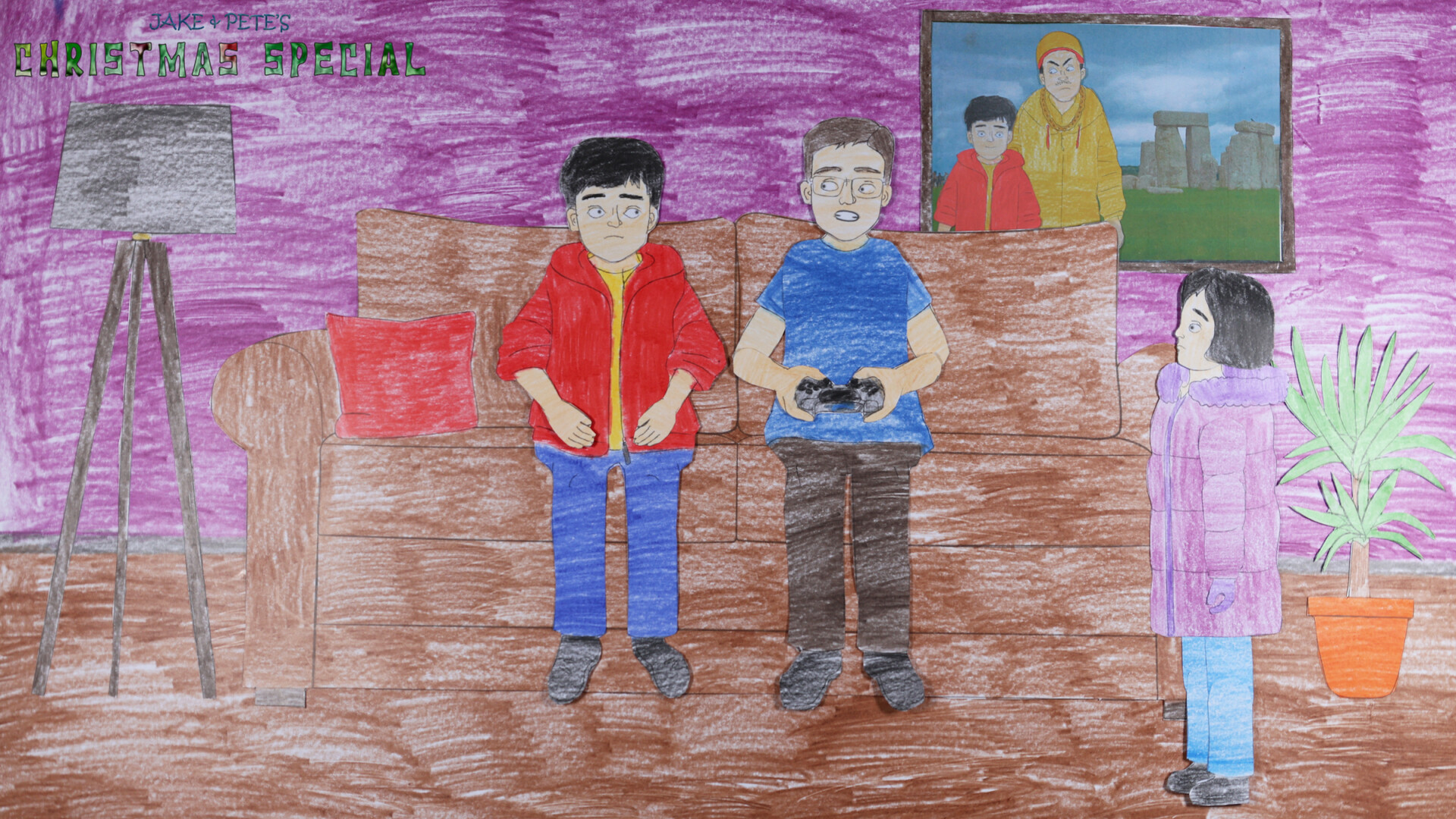
Jake & Pete’s Christmas Special is a riotous short that has its own charm, but also freely refers to other stories and people in popular culture. The characters and settings are cleverly created with scrawling pencil crayons. Cutout figures move across the screen as if paper dolls, in a stop-motion way.
The chatter between the main characters is witty and blunt, full of lively and expletive language, much like in the animated show, South Park. They debate common youth topics such as the popularity of certain video games, are also on a quest to rekindle the Christmas spirit. Depictions of real people such as Joe Wicks, Rachel Zegler, and Keanu Reeves and a showing of Prince Harry’s recent book Spare, are all done in a cheeky, entertaining way.
A Christmas film would not be complete without jingle bells aplenty, and this soundtrack does not disappoint, making the gritty language and characterizations all the more edgy in comparison. The young gravelly voices of the characters give this piece the feeling that the kids are just having fun, using their imaginations and a stream of consciousness, as the tale gets more and more zany. The demise of an evil Frosty-type character and the lead female are shown as mangled pencil crayon drawings, as Santa lists off his favourite things – a list of hard drugs.
Although the rather rough pencil lines give the piece a child-like feel, this project ends up touching on a wide variety of serious adult issues such as economics and politics and makes use of a cornucopia of modern popular icons to address them.
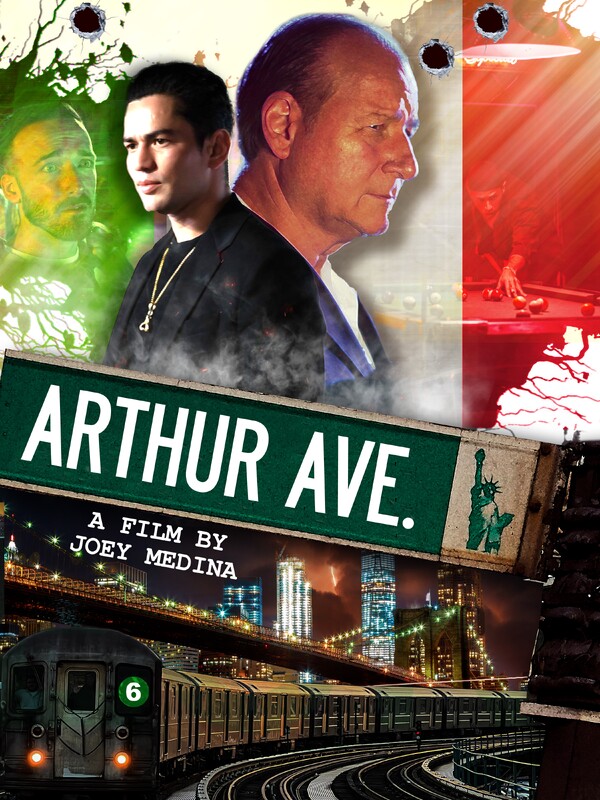
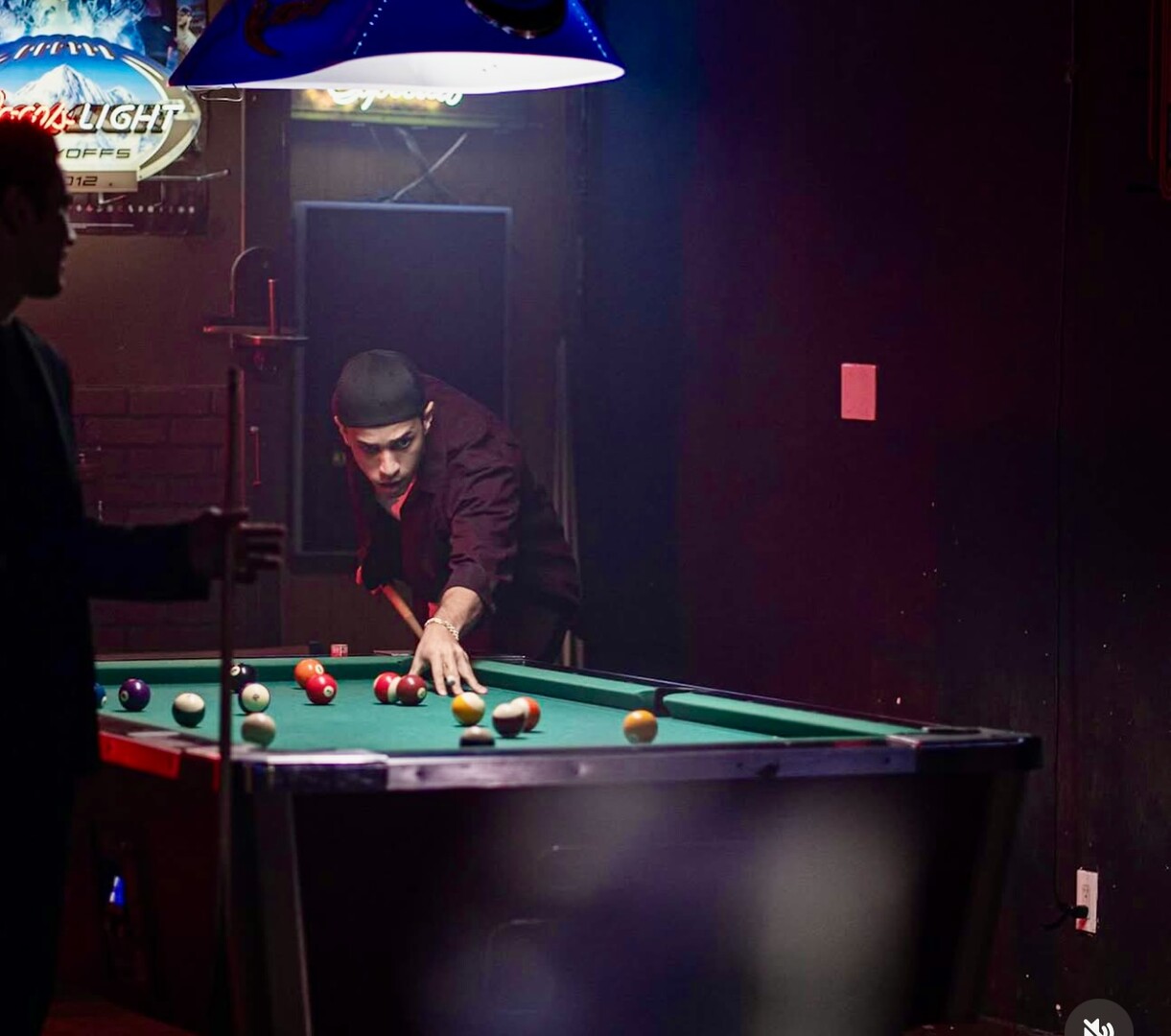
In a Bronx bar, a clash between traditional Italian-American “wiseguys” and the LGBTQ+ community leads to a confrontation that challenges the characters’ preconceptions and the dynamics of power.
Review by Julie C, Sheppard:
Arthur Ave. is a touching short set in the heart of the Bronx, New York City. There are fabulous, dizzying drone shots of the area off the top, then zooming in to Arthur Ave., and then finally landing inside the dark, smoky bar.
The narrative is excellent, with a clear situational arc — starting with the dialogue by the racist, sexist jerks in the bar, the transition to their homophobic cruelty towards the happily married gay couple and, finally, the segment of understanding towards the couple by the bar owner. The performances of the cast are outstanding, notably the gay couple and the bar owner — such genuine vulnerability and warmth in their deliveries. Kudos to Roxy the dog, who also nails her performance.
While it was satisfying to see justice delivered in this fictional tale, the real stat presented onscreen that more than 1 in 5 hate crimes are motivated by LGBTQ+ bias is quite sobering. The film is vitally important for all to see, and underscores the importance of the final note, writ large — “BE KIND TO ONE ANOTHER” — a sincere message of compassion and love.
Audio engineer Becca desperately tries to convince unhinged podcast host Sean Palermo to cancel his provocative live episode featuring a controversial guest, which sparks disturbing online rhetoric and escalating violence outside their studio.
Review by Andie Karvelis:
When a controversial guest appears on a live podcast taping, things go horribly wrong. This suspenseful thriller was written and directed by Christian La Morte and what an intriguing tale he created. Sean Palermo is our influential podcast host, portrayed brilliantly by Thomas Philip O’Neill. He captured that egotistical, narcissistic charm as only a very accomplished actor could. Becca, is Sean Palermo’s audio engineer and you instantaneously like her and feel empathy for her situation. Sophia Lucia Parola portrays Becca and her acting skills are an equal match to Thomas’s making it a joy to watch them interact.
I have to admit, I fell in love with the cinematography in this film. The clarity and depth of colors brought out by Anthony Altamura was just sensational. Every frame had a cohesive look and the lighting was perfect.
Right from the start the filmmakers grab your attention with some lovely foreshadowing and visual fx from Maxwell Seiler and Greg Joblove. Adding in the talents of Benjamin Doherty to create a score that was beautifully unsettling, making you feel there was something sinister on the horizon. The entire team really paid attention to the details and it paid off
The story reminded me of an episode of Black Mirror, this is something that could easily happen in our near future if we aren’t careful. I also appreciate it when a film doesn’t spoon feed the audience everything, instead giving you enough breadcrumbs to figure it out. The filmmakers had a good balance here but I wish there were a couple more breadcrumbs at the very end.
All in all, this was definitely an edge of your seat thriller that is worth a watch.
Between 2015 and 2024, Leonard Alecu filmed the melting icebergs off Greenland’s East coast. Sailing dangerously close to icebergs, Alecu handled his camera to record the ice masses yielding to the ruthless ocean. Filmed in black and white, Ice Breath is a cinematic poem whose only elusive actor is the filmmaker’s gaze. In 43 minutes, a sequence of flat pictures turn into dynamic tableaux, an existential journey from genesis to extinction. The hypnotic feature of the film is enhanced by the soundtrack Become Ocean, a haunting composition by John Luther Adams suggestive of a relentless tidal surge, of melting polar ice and rising sea levels. Become Ocean received critical acclaim, earning the 2014 Pulitzer Prize for Music and the 2015 Grammy for Best Classical Contemporary Composition. More than an environmental documentary, Ice Breath and Become Ocean is an experimental fusion exploring the vast, inscrutable meanings of climate change.
Review by Andie Karvelis:
On Greenland’s east coast from 2019 to 2024 Leonard Alecu lived on a sailing ship filming the ice caps in the area. With the help of an intrepid inuit sailing crew, Leonard was able to capture the most breathtaking footage ever seen. Upon first glance, the detail and texture that he captured in the ice caps almost seemed like it was computer generated with artificial intelligence. It wasn’t! It was all gloriously real and I am sure it was an exceedingly dangerous journey to get that close to these majestic ice caps.
The clarity and depth he achieved with the black and white cinematography was incredibly impressive, as was the sheer size of the ice caps against the ocean. There is no voice over to distract you from the beauty you are witnessing in each frame, only the film’s soundtrack to guide your senses.
The musical score was written as a separate piece called Become Ocean by John Luther Adams. Even though it was not written for this film, it complimented it beautifully. The fading dissonance in the score gave the music depth as it seamlessly transitioned from one musical segment to another. In some areas it was light and ethereal and others it was hauntingly melancholy. Leonard Alecu’s choice to use this particular score was a definite triumph.






 Festival Reviews