This is a HYBRID film festival with live screenings for the audience feedback video you will receive, plus an optional virtual 2nd showcase to enhance the film’s exposure (optional). Festival also conducts blog and podcast interviews with the filmmaker. We have also started a filmmaker’s WhatsApp group with over 150 joined to date to chat about next project and make contacts etc….
Submit via FilmFreeway:
FILM FESTIVAL:
We are proud to announce a FOUR tier festival set up of your accepted film at the festival. Two screenings of your film at our festival, plus two separate interviews.
Screening #1 will take place in NYC and will be a private screening for a select group of people. They will then go home after the festival and record their comments of your film. Then we turn those comments into our regular FEEDBACK Festival Video.
Screening #2 takes place one time only (for FREE) VIRTUALLY for all to see on our online feed every single day. 365 festivals in 2022. Already these screenings are garnering an audience of 1000s each day.
So in the end you will have TWO showcases of your film and you’ll receive your audience feedback video a week before the Virtual Festival.
Then (Tier #3) we will send you a list of questions to answer for our blog interview that will promote you and your film. Then after that (Tier #4) we will set up a podcast interview on our popular ITunes show where will we chat with you about the process of how the film was made.
SCREENPLAY FESTIVAL:
Winning screenplays performed by professional actors and made into a video each month. Film festival also occurs each month.
FULL FEEDBACK on all screenplay submissions. Film submissions can also request the committee’s feedback notes on their film.
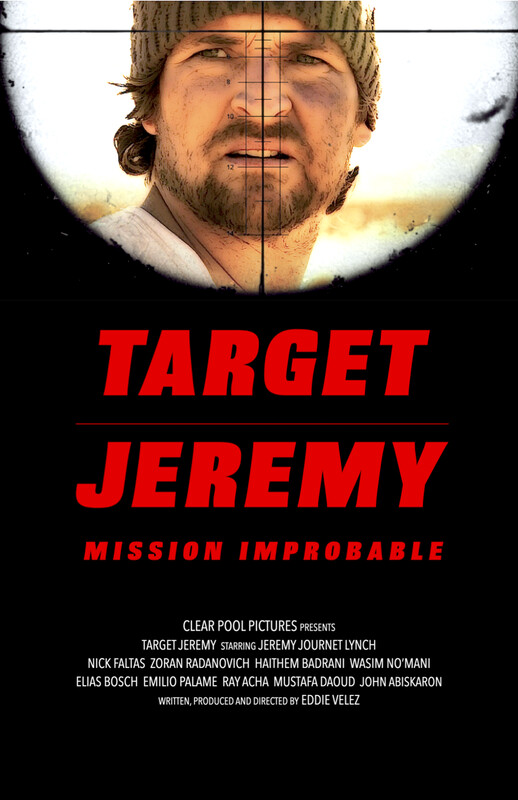
TARGET JEREMY is an action-adventure spy thriller featuring quirky humor, unexpected betrayal, and complex characters. The story follows a Special Agent who cannot feel pain on a seemingly innocent road trip to Babylon, which escalates into a violent climax.
Review by Julie Sheppard:
Target Jeremy takes us straight into the heart of danger, per the Chinese proverb off the top of this US short. It is a riveting depiction of a CIA rescue in the Middle East. The storyline keeps us on the edge — will our hero make it out alive, and complete his government mission?
The actor playing David gives a masterful performance as a wide-eyed, innocent tourist, placing himself in grave danger, who transitions to a first-rate special agent. Another actor, playing a kidnapper who drives David into the desert, does a fabulous job portraying a sly Middle Eastern man, supposedly craving connection with the West. The actors playing the two bickering cousins provide humanness and dimension, much like the two likeable characters in Pulp Fiction, Vincent and Jules.
The lightening-speed editing is stylish and effective, notably during the gripping fight choreography. Scenes transition smoothly between CIA offices and the dusty Middle Eastern desert. The soundtrack is thrilling and upbeat for this high-energy action flick.
Viewers are indeed sent straight into the heart of danger, and then breathe a sigh of relief when rescued.
Hatred and rage are two of the main themes of this poem, as well as the desire for freedom. The narrator recognises that this hatred and anger is negatively affecting them. And they want this person to die, because (in their mind), that’s the only way they will ever rid themselves of these painful and traumatic emotions. I’m not going to say that this belief is correct, but I’m not going to say that it’s incorrect, either.
2) What motivated you to write this poem?
I am a survivor of child abuse. Between the ages of 13 and 16, I was emotionally abused and groomed by an adult who I trusted and looked up to. When I came forward about this abuse, I lost almost everything. I lost my education, my friends, and so much more. What’s more, I’ve been scrutinised and harshly judged because I didn’t react the way people expected me to react. I didn’t behave the way people expected me to behave. A lot of people have this idea of a “perfect victim” and once a victim acts in a way that doesn’t perfectly align with this idea, their experiences are dismissed and invalidated. I wrote this poem because I wanted to challenge this idea of the perfect victim. The narrator is flawed – they think “bad” things, and they’re also angry, bitter, perhaps even a bit immature. But they’re also too afraid and powerless to actually take action against their abuser. I want people to read the poem, and be shocked and unsettled by the content of it. However, I also want readers to understand that the narrator is a product of other people’s actions. Maybe the narrator is a bad person, or maybe they’re just a flawed human being who is attempting to navigate a situation that nobody should have to navigate. When it comes to abuse, there’s no right way to think or respond, and I don’t think the narrator (or any survivors of abuse) should be judged, positively or otherwise, for the way they react to, and feel about, their abuser.
3) How long have you been writing poetry?
For over 6 years.
4) If you could have dinner with one person (dead or alive), who would that be?
Emily Dickinson. I love her poetry, and I also think she has an interesting take on death and religion. She seems to be much more comfortable with the idea of dying than other people (including myself) are. Additionally, in some poems, Dickinson shows scepticism in regards to the existence of a higher power (see – poems such as “I heard a fly buzz – when I died”), whereas, in others, she appears to maintain her belief that something greater exists (see – poems such as “Because I could not stop for Death” and “I cannot live with you.”) I would love to discuss these subjects with her.
5) What influenced you to submit to have your poetry performed by a professional actor?
This poem was always intended to be spoken out loud. The reason why I wrote it was because of an upcoming Spoken Word night. Hearing a professional read it out loud for me is very helpful, and it allows me to strengthen my own performance of the poem, and let’s me focus on the parts of the poem that may not be working very well/may need further rewrites.
6) Do you write other works? scripts? Short Stories? Etc..?
I have written a few scripts and a couple short stories, but poetry has always been my main focus.
The theme of this poem is love; even if it’s secret, it can be beautiful.
2) What motivated you to write this poem?
I was inspired by Li-Young Lee’s poem “Early in the Morning” and my own exploration of my sexuality.
3) How long have you been writing poetry?
I’ve been writing poetry most of my life. I think I started in middle school!
4) If you could have dinner with one person (dead or alive), who would that be?
I’d be happy to have dinner with Maya Angelou (she was such as force, and we could cook together) or Li Bai (I think our appreciation of nature is similar)!
5) What influenced you to submit to have your poetry performed by a professional actor?
It was a new opportunity, and I was interested in how someone else might read my work.
6) Do you write other works? scripts? Short Stories? Etc..?
I’ve written a fantasy fiction novel and some novellas, but poetry has my heart!
7) What is your passion in life?
Writing poetry and teaching others the beauty and benefits of writing poetry!
“Intimacy – The Duality of Being Ace” explores my experience as an asexual individual. In this poem, I aim to highlight the themes of alienation and touch starvation that can arise from navigating life as someone who is both highly anxious and disinterested in sexual intimacy. The poem presents the perspective of an outsider who recognizes the potential for connection yet chooses to reject it, all while yearning for the warmth of human touch.
2) What motivated you to write this poem?
An urge welled up within me while I was at a friend’s house, prompting me to open my notes app and write. I typically don’t assign an overarching theme or structure to my poems during the initial writing process; that comes later. What began as a spontaneous outpouring of words on my phone screen eventually evolved into the polished piece it is today, shaped through rewriting and editing.
3) How long have you been writing poetry?
I have been writing for as long as I can remember. I can vividly recall participating in a county-wide poetry competition during primary school in England, where my first piece was published in “Little Laureates” in 2007, when I was just eight years old. Since then, I have continued to write, even during times when I didn’t publish new work. Now, at 26, I reflect on nearly 18 years of writing.
4) If you could have dinner with one person (dead or alive), who would that be?
If I could meet anyone, living or dead, it would be Mary Shelley. She had such a fascinating life; for instance, she carried her husband’s calcified heart in a silk pouch. Later, when she was older, she kept it wrapped in a page from his poem “Adonais,” stored in her desk. If that is not poetry, I don’t know what is.
5) What influenced you to submit to have your poetry performed by a professional actor?
My mother played a significant role in this journey. When I mentioned that my poem had been published and that there was an opportunity for it to be read by an actor or adapted into a film, she encouraged me to pursue the reading, even offering to pay for it. I’m so glad I took her advice—it turned out wonderfully.
6) Do you write other works? scripts? Short Stories? Etc..?
I mainly concentrate on poetry, as it is my true passion and area of expertise. However, I occasionally experiment with short stories. I also write for my website and, of course, for my university assignments.
7) What is your passion in life?
I aim to become an accredited Australian editor and a published poet, as this is my greatest passion and driving force—my dream, in essence. One day, I hope to edit others’ poetry and short stories, guiding them through the publication process and enabling them to experience the joy of sharing their work.
While doing an audit on a journalist named Ted Simon’s, Delvin Woodhouse auditor follows up to interview the main source for all Ted’s articles only to find that she has been missing for 2 years already.
Get to know the writer:
1. What is your novel about?
The Counterfeit Journalists tells the story of Devlin Woodhouse, who audits news outlets to ensure their stories comply with Generally Accepted Journalism Standards. Devlin lives in Phoenix, Arizona, which is suffering a prolonged drought in the year 2035.
During an audit of The Phoenix Daily Journal, Devlin goes to a restaurant called The Buried Lede to find Lucy Ramirez. He seeks Lucy’s confirmation she was a source of a journalist’s stories. However, he finds out she has been missing for two years and was the journalist’s girlfriend. As Devlin investigates, another woman goes missing; two retired journalists are murdered; and the owner of the Phoenix Daily Journal is colluding with Arizona’s politicians to drain a tribal community’s underground water reservoir to benefit Phoenix.
2. What genres would you say this story is in?
Genres would be Science Fiction and Thriller
3. How would you describe this story in two words?
Heroic Everyman
4. What movie have you seen the most in your life?
Casablanca
5. What is your favorite song? (Or, what song have you listened to the most times in your life?)
Let the Good Times Roll by The Cars
6. Do you have an all-time favorite novel?
No, but I like novels by Tony Hillerman.
7. What motivated you to write this story?
A journalism scandal embroiled the New York Times in the early 2000s. As an auditor I wondered what it would be like to audit news articles in addition to financial statements
8. If you could have dinner with one person (dead or alive), who would that be?
Jack NIcholson
9. Apart from writing, what else are you passionate about?
I like football. It doesn’t matter who’s playing as long as there’s a game.
10. What influenced you to enter your story to get performed?
I saw the offer on Submittable and it intrigued me. Seeing someone read an excerpt of my story is a crazy exciting feeling.
11. Any advice or tips you’d like to pass on to other writers?
You need to read other writers to see what they do. Also, get Pity the Reader by Kirk Vonnegut and Suzanne Sulivan
In the vast loneliness of space, Captain Jonah Marcus pilots humanity’s first solar sail spaceship on a mission to the edge of the solar system. As he faces the psychological and physical challenges of deep space, he uncovers a mystery that threatens not only his mission but his very identity.
Get to know the writer:
What is your screenplay about?
“In the vast loneliness of space, Captain Jonah Marcus pilots humanity’s first solar sail spaceship on a mission to the edge of the solar system. As he faces the psychological and physical challenges of deep space, he uncovers a mystery that threatens not only his mission but his very identity”
What genres does your screenplay fall under?
“Science fiction with elements of adventure and drama.”
Why should this screenplay be made into a movie?
“It offers a fresh take on space exploration, with rich character dynamics and a visually stunning setting. The tension between human ingenuity, the internal conflict of isolation and the vast unknown creates an emotionally compelling narrative that would resonate with audiences.”
How would you describe this script in two words?
“Cosmic exploration.”
What movie have you seen the most times in your life?
“Possibly 2001: A Space Odyssey. It’s a film that captures the beauty and mystery of space, and it has influenced my approach to writing stories set in the cosmos.”
How long have you been working on this screenplay?
“I’ve been developing Solar Sailor for a couple of years. The idea evolved as I explored different themes of human resilience and cosmic discovery.”
How many stories have you written?
“I’ve written over 20 screenplays. Each one is an exploration of new worlds, different characters, and unique challenges.”
What is your favorite song? (Or, what song have you listened to the most times in your life?)
High Hopes – Pink Floyd
What obstacles did you face to finish this screenplay?
“Balancing the technical aspects of space exploration with the human emotional core of the story was a challenge. I wanted to ensure the science felt grounded while keeping the characters’ personal journeys at the forefront.”
Apart from writing, what else are you passionate about?
“I’m passionate about exploring philosophical questions, particularly about the nature of humanity and the universe. I also enjoy fitness and staying active, as it helps clear my mind for creativity.”
You entered your screenplay via FilmFreeway. What has been your experience working with the submission platform site?
“FilmFreeway has been a great resource for getting my work out there. The platform is easy to use, and it’s given me access to festivals and competitions that I wouldn’t have discovered otherwise.”
What influenced you to enter the festival? What were your feelings on the initial feedback you received?
“I entered the festival because it aligned with the genre of Solar Sailor, and I was eager to get feedback from a sci-fi-focused community. The initial feedback was encouraging, which gave me confidence in the story’s potential.”
Based on a shocking 1927 crime, a grieving woman exposes the decades-old truth about her twin sister’s murder to prevent the killer’s lawyer from publishing his own skewed account of the tragedy.
Get to know the writer:
1. What is your screenplay about? My script concerns the December 1927 kidnapping and murder of 12 year old Marion Parker in Los Angeles. It was nation-wide news at the time, but now, almost 100 years later, it’s been mostly forgotten. The screenplay is based on the true story as told in James Neibaur’s acclaimed book “Butterfly In The Rain”, but the core of the script is a fictionalized account of Marjorie, the surviving twin sister, seeking justice for Marion’s murder decades later. The screenplay hops around in time, indicated on screen by changes in aspect ratio and color saturation.
2. What genres does your screenplay fall under? Drama. True Story. Crime. Mystery. Horror. Psychological. Religious. And tangentially, found footage. (Sort of.)
3. Why should this screenplay be made into a movie? The events it’s based on – the kidnapping, the murder, the manhunt, and the trial – tell an incredible tale in and of themselves. But my screenplay adds several unique layers to the storytelling. Firstly, I added a deep family relationship to the drama, exploring the painful guilt of the survivors. Secondly, I did my best to craft an almost “Zodiac”-like mystery surrounding the killer and his motivations. And finally, in the style of Kurosawa’s classic “Rashomon”, the killer’s confession changes drastically with each retelling. Combined with the distinct visual look I’ve indicated, “Pretty Baby” makes for a riveting, chilling, and ultimately hopeful experience.
4. How would you describe this script in two words? Tragic atonement.
5. What movie have you seen the most times in your life? The short answer: “Who Framed Roger Rabbit?”.
The long answer: I worked in a comic book store from 1991 to 1993. We had a TV and VCR in the back of the store, where we would play movies as background noise for the customers. Inevitably during my thrice-weekly shifts, I would pop “Who Framed Roger Rabbit?” into the VCR as I worked. But no matter how many customers I had to serve, I found myself sucked into the movie for most of its run time. So it’s my guess that over those two years, I saw the majority of “Roger Rabbit” somewhere in the neighborhood of over 250 times.
6. How long have you been working on this screenplay? My friend, the late producer Gary Khammar, suggested I try adapting Mr. Neibaur’s book in late 2020. I finished my first draft by November 2021. The version that your judges enjoyed was completed in late 2022. And based on the feedback I received from your readers, I just completed a second revision.
7. How many stories have you written? I have ten completed scripts under my belt. Eight were written by me, two were co-written with my colleague Winter Mead.
8. What is your favorite song? (Or, what song have you listened to the most times in your life?) “Shine”, by Liberty Horses.
9. What obstacles did you face to finish this screenplay? The biggest hurdle was whittling the immense amount of information in Mr. Neibaur’s book down to its most important facts. And then, folding those facts into an original “wrapper” that was plausible and interesting. And then, keeping all that under 120 pages. It was quite a learning experience!
10. Apart from writing, what else are you passionate about? Comic books. Sushi. Music. Cats. Cherry Coke. Autumn. Creating.
11. You entered your screenplay via FilmFreeway. What has been your experiences working with the submission platform site? FilmFreeway is so easy to use. Once you’ve got all your relevant script info input, entering a contest is as easy as clicking a couple of buttons. And it’s also easy to update script listings.
12. What influenced you to enter the festival? What were your feelings on the initial feedback you received? I wanted to get my script in front of new people. To expose it to as many readers an possible. I’ve had an incredibly hard time over the years getting the attention of managers, producers, and agents, so contests have been my main vehicle for exposure.

 Festival Reviews