Maria Djurkovic is one of the most talented Production Designers in the industry today. She has created a multitude of worlds in many critically acclaimed movies and TV shows, including: Sliding Doors (1998), Billy Elliot (2000), The Hours (2002), Mamma Mia! (2008), Tinker Tailor Soldier Spy (2011), and Gold (2017).
Matthew Toffolo: Is there a film or two that you’re most proud of?
Maria Djurkovic: Yes – Tinker Tailor Soldier Spy.
I also was very pleased with The Invisible Woman. I dont think you can tell we had a very small budget.
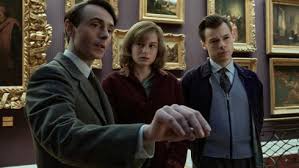
PHOTO: Still from the film”The Invisible Woman” (Director Ralph Fiennes)
MT: What is a director looking for in a Production Designer?
MD: I am certain each director is looking for something different. Wes Anderson will be looking for very different qualities in a designer than Ken Loach.
Advertisement
MT: What is a Production Designer looking for in a director?
MD: I am certain that everyone is different. I like to work with directors for whom visuals are very important. This may seem obvious in such a visual medium as filmmaking, but believe me it isn’t.
I will meet a director for a job with a very clear idea of how I see their film. I actually like to stick my neck out, because I really don’t want to spend the next 6 to 9 months arguing. If a director likes my ideas I will get the job. If they don’t, or if they are not looking for an opinionated designer, I won’t.
The best working relationships for me are the very collaborative ones. Tomas Alfredson is my dream director. We practically finish off each other’s sentences. I enjoy working with directors who are unafraid of bold visuals and who dont get caught up in stuff that actually doesn’t matter. Those who are comfortable cheating locations and are not too literal.
Obviously the material they are wanting to direct has to be good and I have to like their work.
A sense of humor is hugely important to me. We will spend hours and hours in cars, looking at locations. We need to get on.
MT: You were nominated for an Oscar for The Imitation Game (2014). How was the Oscar experience? You didn’t win, but is it just as good being nominated? Or, did you really want to win!?
MD: It was crazy from beginning to end. I knew I would not win because I was up against “The Grand Budapest Hotel” that year. Knowing that I wouldnt win actually made the eremony much more relaxing. The year I was nominated for a BAFTA for “Tinker” I was a nervous wreck during the ceremony and had an anaphylactic shock during the dinner.
I was working in Boston in the coldest recorded east coast winter when I heard about my nomination. I had one Saturday to find a dress. Flew to LA one weekend for the nominees luncheon, the following weekend to London for the BAFTAS and the one after for the actual Oscars.
I was tired and jet lagged but the whole experience was quite extraordinary, and i am thrilled to have had it. Hair/ Make-up / the biggest celeb count on the planet, all huge fun.
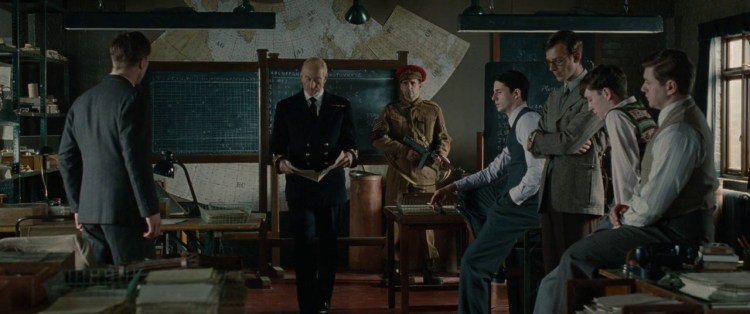
PHOTO: Still from the movie “The Imitation Game” Directed by Morten Tyldum:
MT: How early do you come into pre-production before shooting starts? When do your hire and bring on the rest of your key team members?
MD: I come on board very early, normally after the producer and director. The amount of prep I get varies from project to project. Anything from 10 to an incredibly generous 24 weeks I have had on the movie I am working on right now. The Art Dept. has a massive pyramidal structure and I try to secure my supervising art director and set decorator as soon as i am allowed, everyone else follows.
MT: What film, besides the ones you’ve worked on, have you watched the most times in your life?
MD: Probably Kusturica’s films.
MT: Do you have a Production Designer mentor?
MD: No
MT: Do you have any advice to kids currently in high school or in university who want to be a Production Designer?
MD: Be prepared to work insanely hard, be a monomaniac and really want to do it. Take every opportunity and be persistent. Be prepared to take knocks. Keep immersing yourself in visual culture, refresh your resources. I am always shocked how ignorant many students are about period. Period knowledge should run in your veins
MT: Where did you grow up? How did you get into the film industry? Was this something you always wanted to do?
MD: I grew up in Harrow, wanted to be a Production Designer from about the age of 8 – this is the Monomania I was talking about. Made period clothes for my Barbie dolls and loved going to the v& more than anywhere else.
My dad was an art director and hated the idea of me following in his footsteps. Said that the film industry was full of shits. He was right, but I persisted.
Studied fine art at Oxford. Did a post grad course in theatre design. Started at the BBC the day after I graduated. Stayed there for 3 years before I went freelance, built up my career step by step alternating between set decorating bigger films and designing small TV things and working my way up. I designed my first film in 1995…..
_____
Interviewer Matthew Toffolo is currently the CEO of the WILDsound FEEDBACK Film & Writing Festival. The festival that showcases 20-50 screenplay and story readings performed by professional actors every month. And the FEEDBACK DAILY Festival held online and in downtown Toronto, and Los Angeles at least 2 times a month. Go to www.wildsound.ca for more information and to submit your work to the festival.
Immersed – A Cinematic Immersive Album by Justin Gray, 60min,. Canada
Directed by Justin Gray, Michael Fisher
Justin Gray’s Immersed is a groundbreaking cinematic album that transforms how audiences experience music. Composed, recorded, and produced as an immersive audio experience, the album features 38 artists from Toronto and around the globe, placing listeners at the center of a three-dimensional global orchestra.
A bright, articulate opening monologue by Justin Gray, the mastermind behind this film Immersed, reveals how satisfying it can be to be completely engulfed in and surrounded by the arts. Given this heartfelt preamble, viewers are tipped off that they are in for a real treat.
The film’s structure is well framed with a series of section titles that help shed light about the tone of each of the upcoming musical interludes. The title Flow, for example, is apt in that we are presented a smooth, well-edited section — we are gracefully introduced to the work of several talented musicians who will be guiding us through the piece, such as the guitar of Justin to others on percussion, brass, vocals, keyboard and strings. Repose is a gorgeous meditative section with singing bowls, and the motif of Indian classical music and movement. The use of household items for foley sound effects in the section Tapestry is highly entertaining, as is the fine dance choreography enhanced with various fabrics and lighting, and upbeat, jazzy phrasing. The section called The River’s Edge utilizes striking indigenous movement with gorgeous winter vistas. Joyful, lively refrains come from the section called Orion’s Belt. Pendulum is a section full of rhythm and sensuality and, finally, the section entitled Illuminate blends images of waterfalls and butterflies with soaring violin and other orchestral groups.
The camera comes in close throughout and shows the skill of these artists and captures their heightened emotions when performing this dynamic piece. It is truly inspiring to hear from many of these people who have shared their talents. The extensive credit list alone displays the fierce commitment to this massive undertaking – artists, technicians and producers, all seeking to connect with a cinematic audience, while allowing viewers to immerse themselves in a feast of sight and sound.
Feature Film Winner from the BLACK Feedback Film Festival.
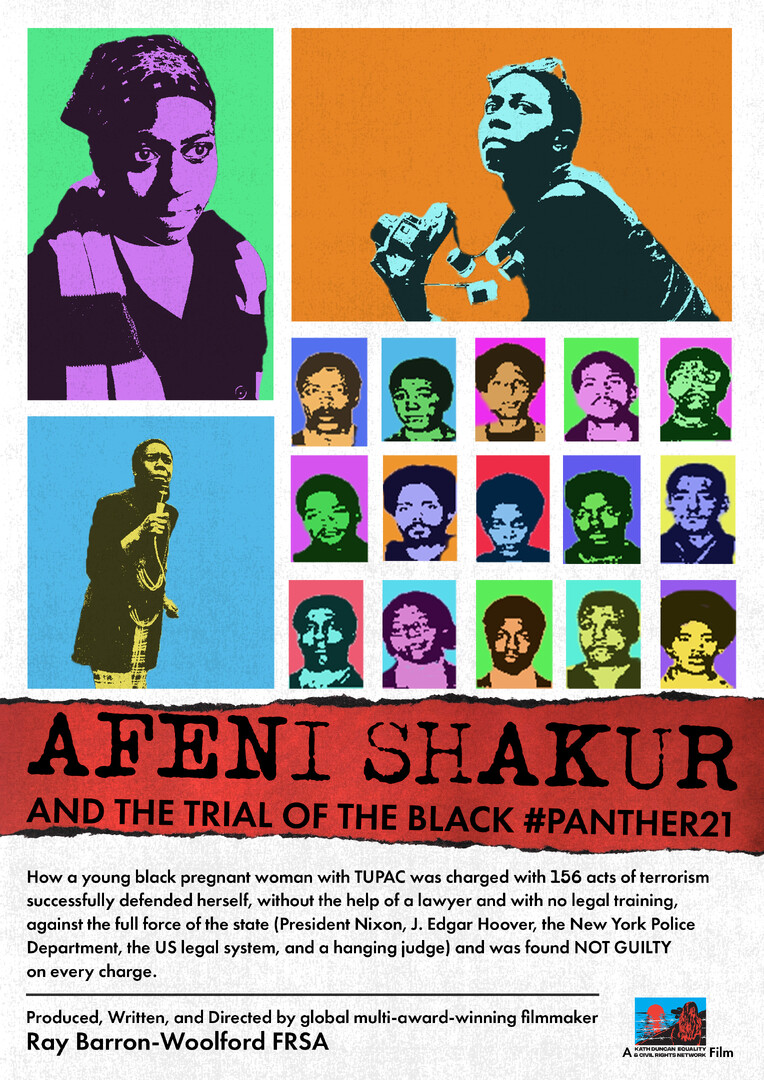
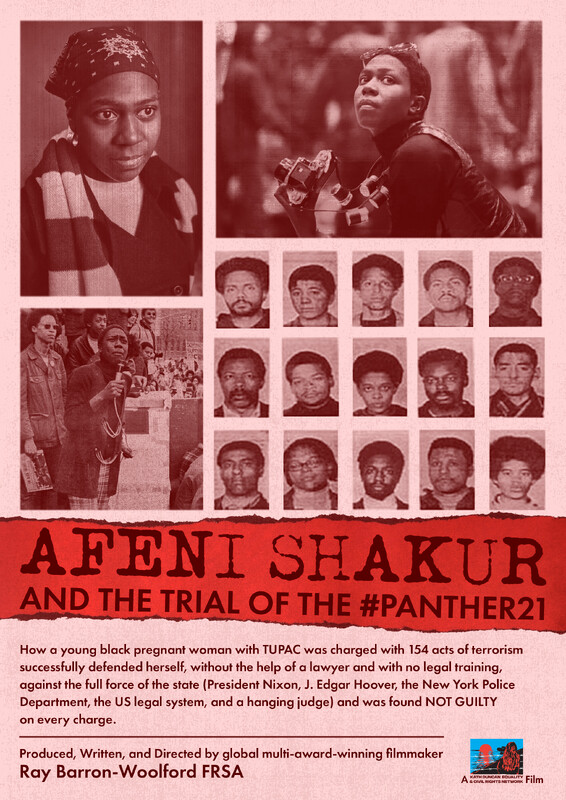
Afeni shakur and the trial of the Panther 21, 70min., USA Directed by Ray Barron- Woolford FRSA The Untold inspired story of Afeni Shakur one black woman pregnant with the rap star Tupac, charged with 156 acts of terrorism with no lawyer or legal training fought her corner to be found NOT GUILTY on every charge
Adam Kirley is one of the best stunt performers in the world today. He has performed in over 60 films in the last 16 years, including: Iron Man 3, Sherlock Holmes: A Game of Shadows, X-Men: First Class, Terminator Salvation, and Munich. He was Daniel Craig’s stunt double in the landmark James Bond movie “Casino Royale”. He is also a Screen Actors Guild and World Stunt Award winner.
Interview with Adam Kirley:
Matthew Toffolo: The action/comedy “Grimsby” is currently playing at a a theater near you. What can we expect to see? How was your working experience doing stunts on that film?
Adam Kirley: Grimsby is a mix of a Bond/Bourne action mixed in a Sacha Baron Cohen comedy film. It was a challenge to do believable gritty action without loosing the SBC comedy elements.
MT: Have you suffered a lot of injuries doing stunts? If so, what has been your worst injury?
AK: Unfortunately its the nature of our game. You can reduce the risk as much as possible but there will always be an element of risk that remains. I have had the usual cuts and bruises that most performers receive on a daily basis. My more serious injuries include: 6 knee surgeries, 1 shoulder reconstruction, and a broken back. These actually weren’t caused by a big accident just years of wear and tear.
MT: You’ve done stunts on over 60 films in the last 16 years alone. Do you have a favorite experience? What film are you most proud of?
AK: I think my proudest moment as a stunt performer would have to be working on Casino royale stunt doubling for James Bond. The Bond movies are such iconic action films with so much history its quite an honour to be a part of.
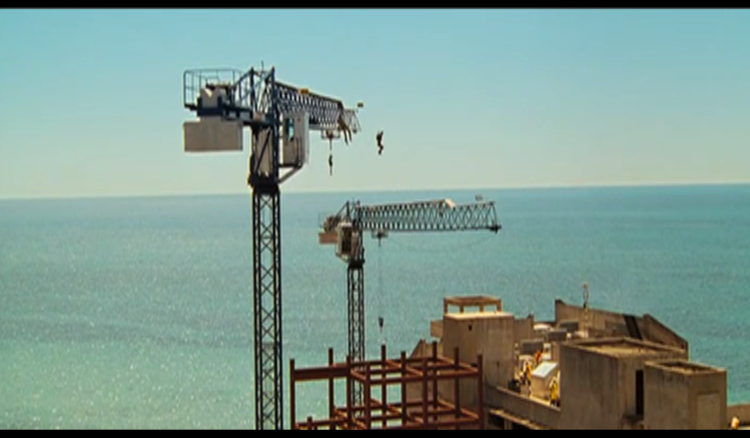
PHOTO: Adam jumps from crane to crane in the opening scene in Casino Royale:
MT: What does a Stunt Coordinator do on set?
AK: On Set the stunt coordinator basically choreographs the stunt team to perform the scene. The job of the stunt coordinator starts well before the shoot day, we have to look at the script, and with the director design the action required. Then we assemble a team that is best suited to perform the action.
Advertisement
MT: Has there been a stunt that you love to perform that you haven’t performed yet?
AK: I have been very fortunate over my career to perform a wide range of stunts so really don’t have an outstanding stunt I wish I could do.
MT: How did you get into the stunt performer game? Was there extensive training involved?
AK: My beginnings were on a traveling stunt show. I performed the human torch & human cannon for 2 years then I did my training to join the British Stunt register which consisted in getting to a high level (Instructor) in 6 different disciplines. I did Swimming, Scuba diving, Judo, Fencing, Trampolining and Gymnastics and had to get my Actors Equity card also. This training is just to get you to a level of fitness and show you have the aptitude to learn new skills. The real training begins when you start working on set with the more experienced stunt performers and coordinators.
PHOTO: Adam jumps off a cliff with another performer and a car:
MT: Where do you see the future of green-screen stunt performing in the motion pictures?
AK: Green-screen sets seem to be increasing on every production I work on. I think its mainly used to reduce costs on set builds and give the director the creative freedom to change things in post Production. It doesn’t really change our job a great deal it just makes it a little boring staring at green walls all day.
MT: What’s the biggest high risk stunt you’ve performed to date?
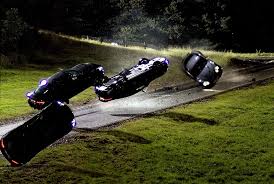
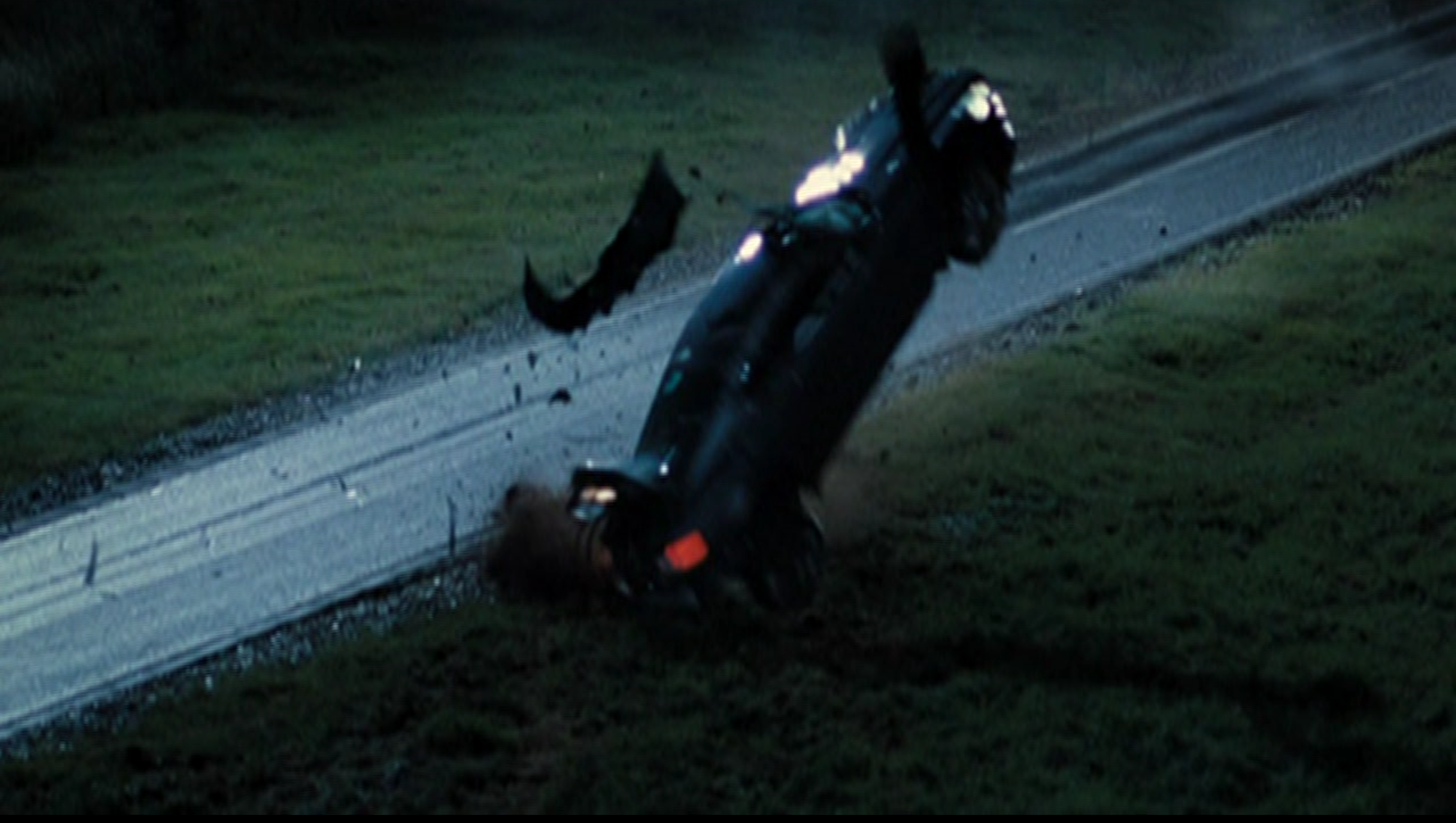
AK: I think the most dangerous stunts I have ever performed would have to be the ones on Casino Royale. I was one of the doubles for Bond so was kept very busy. I was one of the guys that jump from crane to crane for the opening sequence and I also got to drive the Aston Martin DBS that climaxed with a crash at 85mph that ended up being a world record. (see slide show of this stunt below)
MT: Have you done a lot of stunt driving? What type of training does one have to do to become a stunt driver?
AK: When I was about 8 years old I wanted to be a racing driver and after doing a few years of karting, it became very expensive so unfortunately it wasn’t an option. Then when I was 17 I started out in stunts doing traveling shows for 2 years. It was an auto stunt show so was a great place to learn stunt driving. I then went away and practiced a lot and picked up small stunt driving jobs that built my reputation. Its quite a long process becoming a stunt driver.
MT: Do you have a stunt performer mentor?
AK: My mentor was my Step-Father (Steve Griffin) who is a stunt coordinator and a 2nd unit director. He was very helpful showing me how the industry worked in my early days and still offers me great advice.
PHOTO Slide Show: Adam does a car stunt. (Don’t ever try this!)
____ Interviewer Matthew Toffolo is currently the CEO of the WILDsound FEEDBACK Film & Writing Festival. The festival that showcases 10-20 screenplay and story readings performed by professional actors every month. And the DAILY Film Festival held online and in downtown Toronto on Thursday’s of every single month. Go to http://www.wildsound.ca for more information and to submit your work to the festival.
Very impressed with the table read of ‘Auberon’s Last Chance’. Far more professional than other’s I’ve seen. Full marks to all at the Toronto Festival!
Self discovery, healing from trauma and beating the ubiquitous “imposter syndrome”. It is a comedic and sometimes horrific, plant medicine fueled, spiritual journey of self awareness for 3 diverse yet troubled Americans where they emerge victorious and more god-like.
It is a prescient story that reminds viewers of the importance and power of Mexican culture. It also represents a very different story for gay and trans people. One is battling depression and PTSD due to police abuse, and the other, impostor syndrome. Conditions that are the most prevalent mental health challenges today. They are both battling for self-love instead of societal abuse (which does happen). It also reinforces the importance of plant medicines for healing our minds and spirits, which is experiencing more mainstream acceptance. Many cities in America and across the globe are realizing the life-changing healing properties of Psilocybin and Ayahuasca and are legalizing them for use in healing depression and PTSD.
3. How would you describe this script in two words?
Self Love
4. What movie have you seen the most times in your life?
The Wizard of Oz because it’s about an individual’s spiritual journey towards enlightenment. I read a book that covered the back story on L. Frank Baum’s inspirations for the Wizard of OZ and how the author created the story as an allegory for Buddhism. The yellow brick road was written as a metaphor for an individual’s “golden path” to enlightenment. I love the character development and the world-building. Also love how the story totally immerses you and takes you on an unexpected journey. I feel Pueblo is similar in structure. Basically, the hero’s journey.
5. How long have you been working on this screenplay?
So the seed of the story happened about 10 years ago. I had written many notes over that period. The time to write the actual screenplay took about 3 months. It was after a day trip to the ruins of Ek Balam near Cancun Mexico. My best friend and I planned to go visit the ruins but after many unexpected events getting there we felt like we went through some kind of 5th dimensional portal where time and space didn’t exist. Weed aka “The Devil’s Lettuce” was involved so that helped but going through the jungle was many levels of surreal, kind of like Dorothy when she goes into that nightmare forest. We saw so many strange things and once we got to the ruins it had just closed so we never got to see them but the small town adjacent to the ruins was also creepy and a bit of a time portal and we couldn’t find a way out for a bit. Add to this while on the way driving through the jungle on a one lane highway, my best friend shared a story of a past-life regression he had where he saw that he was a Mexican peasant that died a miserable death as an alcoholic. Needless to say, my creative juices started imagining a story that incorporated this wild experience and my favorite ancient culture – the Mayans with their rich mythologies.
6. How many stories have you written?
I have 4 features. 1 is titled The Cuban American Dream, which coincidentally just placed as a top 10 finalist in Screencraft family Contest on the same day I received the email for this win. I also have 2 short film screenplays and 4 TV pilots with 2 pilots having 2 episodes completed. 2 published children’s books (Harper Collins) for ages 3-8 about nutrition and coping with fear. Finally, I am currently pitching a fictional spiritual adventure manuscript that explores benevolent beings from across the galaxy and the Universe written for Middle Grade to Young Adults. It’s kind of like a prequel to The Little Prince.
7. What motivated you to write this screenplay?
So I have a list of stories that I am constantly developing, and I factor in current events and the zeitgeist of our time on whether I complete one screenplay over another. With the current trend of authoritarian governments using LGBT+ individuals and immigrants as scapegoats to gain support, I felt this specific story needed to be born now. It is a story of two LGBT individuals who are successful financially and not battling any of the issues we see in most LGBT+ films (coming out, abuse, etc). They are battling for a full and absolute, unconditional self-love. The other main character, Jahari, who is a heterosexual male, is best friends with Wallace, a gay man, which mirrors a normal situation where many heterosexual males have at least one gay friendship. Jahari is trying to achieve the “American Dream”, battling his materialistic, money-hungry ego that mirrors the psyche of most Americans today. Most films show a female with a gay best friend. I wanted to break stereotypes across the board, especially with Odys, who is a gorgeous, dynamic Trans woman who passes for a biological woman. She owns her own business and is thriving, but her only demon is herself.
The other social issue I wanted to shine a spotlight on was Mexican culture and its many contributions to society today. It seems to be a focus point for our current President Trump to attack and characterize them as rapists and evil people as well as going after trans individuals. I wanted to honor the Mexican culture. To remind Americans that the Mayan civilization was highly sophisticated, making advances in mathematics, agriculture, astronomy and architecture that lasted for over 3000 years and left many contributions to our society today. They invented the number zero, cultivated cacao (chocolate) as a food source, and their calendar was more accurate than the European one at the time. Their cities were more populous and sophisticated than Europe’s largest capital cities. The only thing they didn’t have were guns. That and immunity to foreign diseases ultimately led to their downfall. Being an archaeologist who has studied their rich culture for decades, I used the Mayan Hero Twin Myth as a structure for Pueblo. Our main characters are led down the same path as the Hero Twins in the Mayan underworld (Xibalba) where they are tested in underground houses inside a subterranean cavern system and eventually come out more god-like. Pueblo is essentially like Disney’s Coco, a homage to Aztec and Mayan culture and how their lessons can be applied to modern people of today. I wanted people to remember the importance of Mexico and its fallen empire as a mirror to the United States, which seems to be an empire in decline.
8. What obstacles did you face to finish this screenplay?
Not many. Like I said, I have a lifetime of research on the subject of the Maya so that really helped make sure I was getting their story right. I also hired Rhys Ernst, a trans producer of HBO’s Transparent, for a sensitivity read to make sure the trans character was correct in every way, and he added a few notes that improved Odys overall. Being a gay man myself, I didn’t need help getting Wallace right.
9. Apart from writing, what else are you passionate about?
Anthropology and Archaeology. I’ve done a few digs in Egypt and Bosnia and am a freelance journalist for Popular Archaeology magazine. History overall fascinates me because as they say the past is prologue and we are destined to repeat the same mistakes until we learn the lessons of our past. History is a rich repository for fascinating myths and stories.
10. What influenced you to enter the festival? What were your feelings on the initial feedback you received?
To be honest, there aren’t many LGBT focused screenplay festivals out there, so you came up in my Coverfly feed, and I really love Toronto, so an alarm bell went off to enter.
11. What movie have you watched the most times in your life?
Come to think of it, it’s a tie between The Fifth Element and The Wizard of OZ.
As Long As You Want, 22min., Canada Directed by Matt Santos For as Long as You Want is a tender, conversation-driven short film about two actors, Liz and Brad, running lines in a quiet basement one afternoon. What starts as a simple rehearsal slowly turns into something deeper as they begin to open up about their relationships, their dreams, and the things they’re afraid to admit out loud. Liz is in a relationship that no longer feels right, with someone who doesn’t really see her. Brad’s charming, grounded, and unexpectedly honest. As they talk, laugh, and share food, the connection between them grows easy, real, and a little bit electric. With Liz’s train out of the city approaching, she has to decide whether to go back to the life she’s been trying to make work, or stay in this moment just a little longer. Quiet, raw, and full of heart, For as Long as You Want is about timing, chemistry, and the things we don’t plan for.
Many things. I had been wanting to make a film for a while, that unlike my previous ones, I would actually release. Unfortunately, I didn’t have access to any equipment beyond my iphone and a couple of mics. Being a big fan of Richard Linklater’s Before trilogy and the way in which its entirely conversation driven, I figured I could do something similar, except have it all take place in one intimate location. The story itself is very closely based on a real experience that I’ve had, and so the main goal became to capture that feeling of connecting with another person. Lastly, my co-star, the amazingly talented Liv Corriveau, had directed a riveting romantic drama called “When You Come Over” in which we discovered that we have natural chemistry on screen. I wanted to make something that would be complimentary to her film, but different in that the characters get a happy ending. I like to think that our films are perfect for being watched back to back.
2. From the idea to the finished product, how long did it take for you to make this film?
Roughly five days. I got home after a lunch meeting feeling very inspired and wrote the script in a couple of hours. The next day I decorated the set, my basement, and tried to give it a specific colour palette. The next day we spent about 16 hours shooting. The final two days were spent with my eyes locked onto the computer screen as I edited non-stop.
3. How would you describe your film in two words!?
Human Connection.
4. What was the biggest obstacle you faced in completing this film?
The biggest obstacle I faced in making this film was being both behind and in front of the camera. A lot of time was spent running back and forth trying to figure out the shots. I have never received any formal training in the technical aspects of filmmaking, but I did major in cinema studies in University. However, my vision for this film did take into account my lack of technical skills and equipment, and thus the final product ended up fitting the vision very closely.
5. What were your initial reactions when watching the audience talking about your film in the feedback video?
The feeling was indescribable. Knowing that these lovely people that I am not acquainted with took the time to watch my film and analyze it means the world to me. It was especially interesting to hear that a different aspect of the film stood out to each of them.
6. When did you realize that you wanted to make films?
I always wanted to be an actor, and I always loved writing. I started making little homemade films when I was about five, and they grew more elaborate as time went on.
7. What film have you seen the most in your life?
It feels like I’ve seen this one the most after the many hours I spent obsessing over it. But, in reality, it’s probably Once Upon a Time in Hollywood or Fight Club.
8. What other elements of the festival experience can we and other festivals implement to satisfy you and help you further your filmmaking career?
I have had an amazing experience with your festival and believe that other festivals should be more like yours. I love the fact that you offer a full package of options to help launch films.
9. You submitted to the festival via FilmFreeway. How has your experiences been working on the festival platform site?
Having never submitted to festivals prior to this, I expected the process to be tedious and complicated. I was pleasantly surprised by the ease in which filmfreeway allowed me to gather information and submit my film to multiple festivals in such a short period of time.
10. What is your favorite meal?
Steak with some kind of potato variation on the side.
11. What is next for you? A new film?
My plan is to focus on acting for a while. I am currently a full time student in the acting program at Toronto Film School. In the past few months I’ve been very lucky to get cast in a number of really cool projects and work with many talented people. So for the meantime, I plan to continue auditioning for everything that comes my way, and seize every opportunity. However, I absolutely plan to make more films in the future. Including a sequel for “As Long As You Want” that delves into the testy realities of relationships after the “honeymoon phase” has ended.
Meevil the Weevil: Breakfast of Champions, 4min., USA Directed by Kyle Arneson Meevil https://filmfreeway.com/submissions/32428116#ff_javascriptthe Weevil is a little bug with big dreams of being a stuntman. “Breakfast of Champions” mixes stop motion animation with live action footage where we follow Meevil’s thrilling ride across a 1970s breakfast table on rocket roller skates.
1. What motivated you to make this film? The film came about after developing the character as a hesitant hero with big dreams of grandeur. It’s strongly inspired by the stunt men and women of the 1970’s and 80’s that I found so captivating back when the world was a little more shag-carpeted and wood-paneled. During this initial creative period I lost my father unexpectedly and it was at some point in the haze of the grieving process I realized that the relationship between Meevil, and Olis, his coach, mirrored that of my relationship to my father. So with that guiding light, the ethos of the project became clear and bringing it to reality became a goal for me as a way to honor my dad.
2. From the idea to the finished product, how long did it take for you to make this film? From idea to final prduct this film took 3 years to make. Nothing happens fast in stop motion animation, the puppet had to be designed and built, all of the props and sets were hand made and the entire film was shot one frame at a time.
3. How would you describe your film in two words!? Nostalgic fun!
4. What was the biggest obstacle you faced in completing this film? The biggest obstacles faced in completing this film were time and financing. Stop motion animation is the unique outlier in the field of animation that utilizes every artform and filmmaking department (illustration, sculpting, painting, puppet building, fabrication, set design, cinematography, rigging, lighting, VFX, post, etc) and requires a lot of time, space and hands to accomplish. Because this was an out of pocket venture with a very small crew it meant very incremental progress with a number of pauses in order to take on paying jobs to help propel forward momentum.
5. What were your initial reactions when watching the audience talking about your film in the feedback video? It was so heartwarming and meaningful to hear that the film resonated with a group of thoughtful and earnest viewers. I was delighted to learn that the pacing felt right, that the humor landed as hoped and that the spirit of the project delivered as imagined.
6. When did you realize that you wanted to make films? I knew I wanted to make films and be involved in animation and puppetry since my first exposure to Jim Henson and the Muppets as a child. I started making stop motion films as a lad in the 80’s, first just manipulating clay in front of a borrowed video camera and then progressing on to sculpting characters and telling epic (and entirely nonsensical) stories with a cast of strange creatures.
7. What film have you seen the most in your life? This might be a 3-way tie between Henry Koster’ Harvey, Stanley Donen’s Charade and John Carpenter’s Big Trouble in Little China.
8. What other elements of the festival experience can we and other festivals implement to satisfy you and help you further your filmmaking career? Having recorded feedback is exceptionally meaningful and helpful so it’s very hard to imagine anything else!
9. You submitted to the festival via FilmFreeway. How has your experiences been working on the festival platform site? It has been a mostly positive experience. We’re slowly learning how to vet the thousands and thousands of festivals available through the site and how to maneuver the festival landscape a bit more thoughtfully.
10. What is your favorite meal? I love all things Thai food! Either yellow curry with tofu or Pad See Ew (but really, just about any dish).
11. What is next for you? A new film? We are diligently working to expand the Meevil the Weevil world into episodic stories. This character appeals to children and adults alike so finding that perfect balance is a very fun and challenging pursuit. I am also working on a faux-documentary feature film story about a fan that grew up with Meevil as his hero in the 70’s and 80’s and now, as an adult, is trying to reconnect with the Stunt Bug to bring him back into the public consciousness.
The Abiding, 11min., USA Directed by Ally May A lonely woman reminieces about the three great loves of her life while she decides if trying again is a risk worth taking.
Get to know the filmmaker:
1. What motivated you to make this film? Honestly, my motivation was/is to take every opportunity to develop as a director. I was at a festival, I had a room, a crew and actors, so I put it together really fast and shot it.
2. From the idea to the finished product, how long did it take for you to make this film? I wrote the script several years ago and had it sitting in my computer. Then I got the bright idea to shoot in about a month before we did. So, realistically, about a month.
3. How would you describe your film in two words!? Intimate, mature.
4. What was the biggest obstacle you faced in completing this film? The biggest obstacle was blocking the scenes. We did not have access to the hotel room until the day we shot, so had no time to plan out blocking.
5. What were your initial reactions when watching the audience talking about your film in the feedback video? The first woman was very sterile, it seemed like she hadn’t watched it and was just reading text. The other two that gave feedback seemed very genuine and thoughtful.
6. When did you realize that you wanted to make films? When I was a child.
7. What film have you seen the most in your life? Too hard to answer truthfully. Star Wars, The Ghost and Mrs. Muir, Bridget Jones Diaries, My Life as a Dog, The English Patient, The Piano, Splendor in the Grass. I’ve seen the movies I love so many times I can’t keep track. I watch them over and over, to learn from, to cheer me up, to calm me down, to inspire me.
8. What other elements of the festival experience can we and other festivals implement to satisfy you and help you further your filmmaking career? As a director, the thing I need most is to be connected with people in search of my skill set. So help us actually make connections with producers looking for directors.
9. You submitted to the festival via FilmFreeway. How has your experiences been working on the festival platform site? Always good and always reliable.
10. What is your favorite meal? Risotto with fresh peas and asparagus.
11. What is next for you? A new film? I’m shooting my first feature film in October. STAGULATION – A woman strangled by routine begins to unravel when the past—both imagined and real—starts to dance around her.








 Festival Reviews