1957 Movie Review: THE BLACK SCORPION, 1957

Submit your Screenplay to the Festival TODAY

THE BLACK SCORPION, 1957
Movie Reviews

Director: Edward Ludwing
Starring: Richard Denning, Mara Corday, Carlos Rivas, Mario Navarro, Carlos Múzquiz, Pascual García Peñat
Review by Kevin Johnson

SYNOPSIS:

Recent volcanic eruptions release an army of giant scorpions to the surface; a team of doctors and army officials work up a plan to try and stop them.

REVIEW:

The problem with the monster films from the “Golden Era” of cinema is that, after the well-budgeted, decently refined classics, one inevitably have to watch the less-than-stellar crop of B-movies that, frankly, may not hold up as well from before. These are the films that are wonderfully ridiculed by the Mystery Science Theater 3000 crew. And, unfortunately, I don’t have Tom, Mike, Joel, or Crow to help me through it.

Still, there’s something revelatory when watching these films. The term “Golden Era” in relation to entertainment doesn’t exactly refer to the overall quality but the streamlined, consistent, large number of films actually produced. So, to see the lower-quality and weaker films that were produced gives a clearer picture of the specifics and details of the overall production of films created in this time period. In other words, it averages out one’s perception of the regulated, controlled studio system.

Two geologists go to investigate a series of volcanic eruption taking place in Mexico. When they find evidence of isolated destruction and several dead people stricken with poison, it’s soon discovered that a number of massive scorpions were freed from their obsidian-trapped prisons from the eruption. They attack the local villages and soon set their sights on Mexico City.

If there’s one thing to gleam from a film like this, it’s the regularity to which studio executives and filmmakers maintained a strict necessity for certain conventions – specifically, the need for a female lead and a romantic subplot. And while a variation of this “rule” certainly exist today, the extent to which it was utilized in the 50s is obviously glaring, especially in films with little subtlety. The Black Scorpion, in a nutshell, completely shifts gears to “park,” to try and develop a chemistry between scientist Hank Scott and Teresa Alvarez. It doesn’t work.

It’s a shame, too. The movie starts of very well—intriguingly so. The geologists find a few dead bodies and large-scaled damage, and the local village panics as rumors spreads, injuries mount up, and spooked ranchers rant about sightings of monsters in the fields. Even the introduction of the female lead works – after all, she’s just a brave rancher who’s just trying to find help in all the paranoid madness. Too bad that, by the thirty-minute mark, the film’s flaws become much more pronounced. Several doctor and military characters exposit plot points just to advance the movie (and are just terrible, terrible actors), and, as mentioned before, the romantic moments add nothing to the overall film or the distinct characters’ relationships. And that’s leaving out the unnecessary poor-acting from the young help, Juanito (Mario Navarro), who just gets into random trouble to try and create tension. It doesn’t work, either.

But what DOES work is the special effects from supervisor Willis O’Brien, who was friends with Ray Harryhausen, the special effects wizard for The Beast from 20,000 Fathoms (looks like the connections never end!). Watching the giant scorpions wreck havoc on trains, buildings, people, cars, tanks, and even helicopters is quite amazing, mainly because everything moves really fast and yet remains clear in visual action. And, to be blunt, the scorpions are vicious with their attacks.

There are also a couple of awesome creatures taken from unused sequences from the film King Kong; specifically, the spider that chases Juanito in the cave, and a strange worm-like creature that assaults a scorpion. It’s pretty cool to see some 1933 beasts return from hibernation to see them in action. What’s not so cool is the close-ups of the scorpions’ faces. While awesomely creepy and scary the first time around, they filmmakers rely WAY too much on it, which just makes it ultimatley annoying in the end.

Still, The Black Scorpion is a decent indication of the “less-than-average” type of film made in the 50s. It’s more indicative of the mediocre B-films of that time period, like how the myriad of B-horror films might explain something about the naughts of this decade. While I won’t try and convince people to watch this film, it does make an interesting study. And the special effects are at least worth it, so there is that.

Submit your Screenplay to the Festival TODAY

THE BLACK SCORPION

1957 Movie Review: AN AFFAIR TO REMEMBER, 1957


Submit your Screenplay to the Festival TODAY

AN AFFAIR TO REMEMBER MOVIE POSTER
AN AFFAIR TO REMEMBER, 1957

Directed by Leo McCarey
Starring: Cary Grant, Deborah Kerr
Review by Michael Aloisi

SYNOPSIS:

A man and a woman both involved in relationships, meet, fall in love and plan to meet each other again in six months to spend their lives together. But does it happen?

Review:

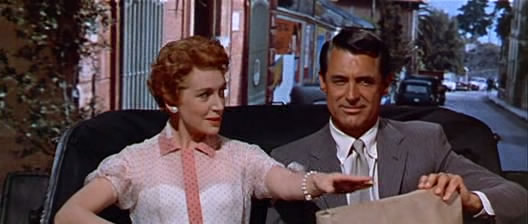
The ultimate playboy, Nickie Ferrante, played by the always enjoyable Cary Grant is about to get married to a famous millionaire. While on a cruise to America to be with his fiancé, he meets Terry McKay (Deborah Kerr), a beautiful woman who is also involved in a relationship of her own. Nickie is at first embarrassed and impressed that she can resist his advances, for almost no woman can. The two begin to spend time together while stuck on the boat for the long journey across the ocean. Slowly but surely they fall madly in love.

Knowing they need time to straighten out their lives and break it off with their current relationships, they make a plan to meet in six months at the top of the Empire State Building. Time ticks by and the two never talk, but work towards their goals to get together. Finally when the day arrives Nickie waits on the 102nd floor, but Terry never shows. Thinking she deserted him Nickie slips into a deep depression as time slips by and the fate of the couple hangs in the balance.

The first hour of the movie takes place almost completely on the cruise ship, with one interlude in Italy. It is thoroughly enjoyable to watch Grant and Kerr play a flirty game of cat and mouse as they both fall for each other. Yet the second half of the film, while the two are apart, lacks the chemistry and enjoyment that the first half does. It feels a bit long and slow and even has two completely unnecessary and long musical numbers that does nothing to help the film. And the fact that the climatic twist in the film is so simple to solve you want to yell at the characters for being stupid, is a bit hard to swallow in modern times. The ending is also a bit anti-climactic and rushed but still satisfying. The chemistry between Grant and Kerr is what placed this movie at number 5 on the greatest romantic movies of all time list by AFI. Those expecting to be knocked over by this classic film should lower their expectations and just appreciate a story of real love.

For those who love Sleepless in Seattle, this movie is a great accompaniment since it mentioned in it several times and even inspired the ending. In fact after Sleepless was released over two million copies of An Affair To Remember were sold! Yet no one seems to remember that Affair is a remake itself of a 1939 film called Love Affair.


Submit your Screenplay to the Festival TODAY
AN AFFAIR TO REMEMBER

1957 Movie Review: 3:10 TO YUMA, 1957


Submit your Screenplay to the Festival TODAY

3:10 TO YUMA, 1957
Movie Review
Directed by Delmer Daves
Starring: Glenn Ford, Van Heflin
Review by Alan Barkley

SYNOPSIS:

Against all odds, a man must deliver a captured outlaw to the afternoon prison train.

REVIEW:

In 1974 Toronto took the bold step of enhancing its system of electric streetcars at a time when they had been virtually abandoned in North America as city transportation. A new design was in order and industrial designer Claude Gidman was the handed the task and the question: should a new streetcar be a sleek urban bullet of contemporary design or something less dramatic. Gidman chose to extend the visual legacy of the streetcar rather than upend it and, while the new design incorporated relevant ergonomic and environmental upgrades from the 1930s version, riders experienced the newer streetcars like compatible cousins of the vintage cars that shared the same downtown tracks. 3:10 to Yuma which began as a short story in 1953 and has seen two film adaptations made in 1957 and 2007 exists in much this way: spanning five decades, these three iterations of the story shift along on the same rails, each version advancing the narrative while remaining deferential to its predecessor.

Elmore Leonard’s short story was published in 1953, the year after the successful release of High Noon in which tension builds towards the arrival of a fateful train carrying outlaws sworn to kill Gary Cooper’s marshal. Echoing High Noon’s ticking clock, Leonard’s lawman guards a prisoner in a hotel awaiting the arrival of the 3:10 train that will take the outlaw to a prison in Yuma Arizona. Standing in the way of the lawman’s duty is the outlaw’s vicious gang surrounding the hotel and the handcuffed outlaw himself who uses all his wiles to undermine the deputy’s resolve.

Screenwriter Halsted Welles kept Leonard’s hotel conflict as the centerpiece of the 1957 film adaptation and backed it up with an invented story of a rancher (Van Heflin) living on hard times who accepts Wells Fargo’s two hundred dollars to take outlaw Ben Wade (Glen Ford) to the prison train. In turn, writers Michael Brandt and Derek Hass (2 Fast 2 Furious) kept Halsted’s backstory for their 2007 adaptation but upped the ante for Christian Bale’s rancher, giving him the additional burdens of a sickly son and an amputated foot, his legacy from the Civil War.

If all this seems like excessive motivation it’s certainly true that audiences didn’t always want such explicit crosses for their heroes to carry. The short story’s deputy marshal doesn’t need special reasons to do his job and both films depart from the original’s understated hero who performs his duty bravely and competently because those qualities are simply part of who he is. Leonard’s story cares less about the hero’s character arc and more about the hero’s character.

These days, however, the John Wayne cowboy is a hard sell. We prefer our heroes to have a plight that intersects with the plot and we want those personal challenges to be detailed and specific. We’ve become suspicious of virtues like courage and resolve that appear shopworn when they’re presented without context. So if Halsted and Hass and Brandt gilded the rancher’s hardship lily, their strategy moves us closer to the action, creating serious doubt about an outcome that might otherwise have felt like a forgone conclusion.

Writer Welles fleshed out the personality of Elmore Leonard’s Ben Wade and created an amalgam of ironic charm, ruthlessness, and womanizing that Hass and Brandt retained including the pivotal scene where Ben Wade seduces the lady bartender while hunting posses and fleeing gang members whirl around him. Ben Wade energizes both movies the way Robert Louis Stephenson’s rogue pirate Long John Silver lit up Treasure Island, his villainy at once repellent and attractive, confounding the viewer’s judgment while pulling one deeper into the story. Glen Ford brought Ben Wade to life in 1957 and Russell Crowe added cockiness and unpredictability to the part in 2007.

Haas and Brandt correctly saw the 1957 version as a two-act play and added a rollicking middle section full of fights, horseback chases, and deadly confrontations that we tend to think western movies are all about. And director Robert Mangold makes the most of it, transforming the earlier black and white film into a vivid and active wild west setting for the solid drama.

Remakes don’t succeed when wrong choices are made about what to keep and what to discard. The 3:10 to Yuma films work because they never try to eclipse the original. It’s interesting to see Halstead Welles’ name listed in the screenwriting credits for the 2007 film, along with Brandt and Haas. Although he had died by the time the new version had begun Welles, like Elmore Leonard before him, had already made his contribution.


Submit your Screenplay to the Festival TODAY

310 TO YUMA

1957 Movie Review: 12 ANGRY MEN, 1957

Submit your Screenplay to the Festival TODAY

12 ANGRY MEN MOVIE POSTER
12 ANGRY MEN, 1957
Movie Reviews

Directed by Sidney Lumet
Starring: Henry Fonda, Lee J. Cobb, Ed Begley, Martin Balsam, John Fieldler, E.G. Marshall, Jack Klugman, Ed Binns, Jack Warden, Joseph Sweeney, George Voskovec, Robert Webber
Review by Christopher Almeida

SYNOPSIS:

A dissenting juror in a murder trial slowly manages to convince the others that the case is not as obviously clear as it seemed in court.

OSCAR nominee for Best Director, Best Picture, Best Screenplay

REVIEW:

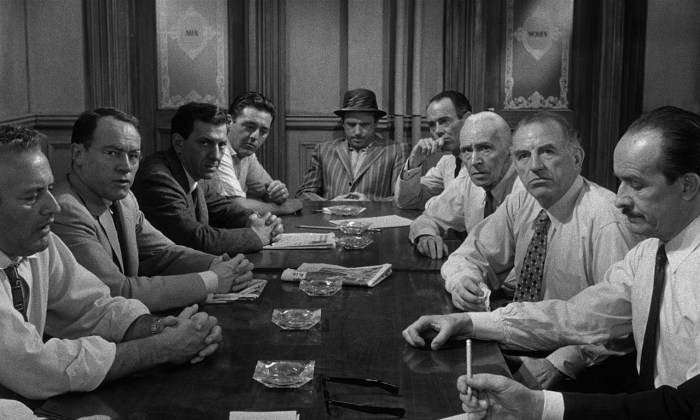
‘All rise…the court is in session…’ Well, actually, it isn’t. The real drama in this Court Room happens in the Jury room. 12 Jurors have to come to an anonymous vote. While everyone votes guilty, our male protagonist, Juror 11, isn’t quite so sure. This case has to be treated delicately – after all, the defendant has the death penalty for murder.

The hero comes in the form of Henry Fonda. The star has appeared in 106 films. The most famous are 12 Angry Men, The Grapes of Wrath and On Golden Pond.

The director comes in the form of Sidney Lumet, who has made the transfer from television to film. However, don’t let that discourage you- judging by this film, he has done it successfully. Lumet churns the issues around the room using character and innuendos and as a result raises the stakes at a steady pace. For further evidence- it won him the Golden Bear award at the Berlin International Film Festival. The film also won three Oscar nominations.

Lumet’s transfer from one Medium to another may explain the number of close-ups. This isn’t bad thing at all – it does create a nice intense, powerful atmosphere. The close-up shots come in handy when searching for empathy. Lumet gives close-ups to every other character except for the hero at the start of the film. It is almost to the effect that we are examining the evidence and, indeed, the other jurors. This creates the most empathy because we don’t know how it’s going to end and neither does Henry Fonda.

Most heroes, in films, are sure of their objective half an hour into a film, this hero is unsure throughout.

At this point you must be thinking what is Henry Fonda’s character name? This is first thing that separates it from other films. We don’t learn any of the character’s names. The film concentrates on hero and his journey. Not a single line is wasted; all the characters are sculpted using actors from the highest caliber. Another distinction is the cinematography. Which mainstream film uses more close-ups than long shots? Yeah, I heard you- except for The Blair Witch Project! The film together with Rose’s screenplay is a masterpiece.

Reginald Rose’s screenplay is very well crafted. Themes of stereotyping, second chances and ageism are perfect ingredients for the story’s substance. A nice cool beer on a hot day and sitting in your deck chair is the only description I have for the story’s substance without using a clinched word such as refreshing. The themes are well placed- two words- pitch perfect!

The only flaws here is that it relies on stereotypical characters to create predictable sub-issues; Sub-issues such as young, naïve boy and angry man. However, Lee.J. Cobbs does such a powerhouse performance that the flaw blows right over your head.

Target audience? It is for anyone who wants to think afterwards ‘Hmm…Now that was worth seeing!’ But seriously though, the ideal target audience is for 20- to however mature you may be.

Twelve Angry Men requires concentrated viewing but that doesn’t mean it’s boring. The dips into and out of story using light humour gives it a nice balance.


Submit your Screenplay to the Festival TODAY
12 ANGRY MEN