Film Review: TRENCH 11 (Canada 2017) ***

 Submit your Screenplay to the Festival TODAY

Trench 11 Poster
Trailer

In the final days of WWI a shell-shocked soldier must lead a mission deep beneath the trenches to stop a German plot that could turn the tide of the war.

Director:

Leo Scherman

Writers:

Matt BooiMatt Booi | 2 more credits »

TRENCH 11 is set in the year 1918, a year well known for being the year World War 1 ended.  There are a lot of interesting events occurring during the last year of a World War that makes good cinema.  The recent Hungarian film entitled 1945 is an example of another film set in the last year of a War.

But TRENCH 11 is a fictional horror film.  The premise is that those no-good Germans have been practicing scientific warfare again under our noses, in fact 78 feet underground in those trenches.  Some virus has gone loose and it must be contained or the outcome of the end of WWI might turn out quite differently.

At its worst, TRENCH 11 disintegrates into a zombie flesh-eating movie set in the trenches with cheap prosthetics effects, like a face with the nose eaten away.  The dialogue can turn clichéd too as in the example of the line spoken:  “This place was not built to keep people out.  It was built to keep people in.”

At best director Schermna uses the effects of the film’s setting to create real horror, as in the darkness and claustrophobia of the trenches.  The lighting is carefully done so that more often then not, only the essentials are seen – the faces as they peer through the corridors of the trenches.  There is always suspense created when a character turns the corner, as it is dark and no one can see what lurks there.  A few worthy scenes here such as throne with the German and Canadian sitting down to have a drink together,

Humour is provided by the German Officer Reiner, who wants to cleanse Europe by the disease.  Austria actor Robert Stadlober camps it up too, playing Rainer as a complete lunatic.  One can almost imagine the froth coming out of his mouth.  The main lead belongs to Rossif Sutherland (brother of Keifer and son of Donald Sutherland) playing a tunneller who is given the dauntless task of leading the group out of the trenches.  The script also calls for an asshole major.  Oblivious to good safety and common sense, he risks everyone’s lives.  ” We are here to complete a vitally important mission and by God I intend to see that it is done.”  He is disposed with early in the picture, which is a shame as he livens up the film.   The tunneller’s romance with a girl called Veronique (Karine Vanasse) is what spurs the tunneller on.  Director Scherman makes good use of  the dynamics of the different forces (Americans, British, Canadian).

The zombies or Germans infected with the deadly disease are scary enough, if one can strain through the darkness to catch a glimpse of them.  What is even more disgusting are the parasitic worms that wiggle in and out of the corpses’ wounds.  The worms are thin and squirmy (as opposed to fat and juicy), still guaranteed to make ones skin crawl.

TRENCH 11 ends up a scary enough horror movie with interesting characters making effective use of its World War setting.  The film has won rave  reviews when it was premiered at the After Dark Film Festival in Toronto.

Trailer: https://www.youtube.com/watch?v=bVDGukfxFAk


 Submit your Screenplay to the Festival TODAY

TIFF 2018 Review: THE SWEET REQUIEM (India/USA 2018) ***

Movie Reviews of films that will be playing at TIFF (Toronto International Film Festival) in 2018. Go to TIFF 2018 Movie Reviews and read reviews of films showing at the festival.

The Sweet Requiem Poster

The film begins with a father and daughter having a very difficult journey travelling in mountain terrain in the snow for a better future, similar to the famous Turkish film YOL.  The two are Tibetans escaping the Chinese who are stealing their land.  The next scene shows a young lady in South Delhi, India, celebrating her birthday, attending dance classes and working in a beauty parlour.  It is then revealed that this lady is the young girl that was traveling with her father in the snow at the beginning of the film.  

Through multiple flashback the journey is shown turning sour.  But the lady escapes to India while the father is killed thanks to their local guide abandoning them.  In South Delhi, a chance encounter brings the lady to meet the same guide now claiming to be a Tibetan rights activist.  She intends to expose him.  A staring flaw in the film is the fact that very few Indians are shown in a film supposedly set in Delhi.  But the film is well paced and an absorbing watch.


 Submit your Screenplay to the Festival TODAY

TIFF 2018 Review: SHOPLIFTERS

 Submit your Screenplay to the Festival TODAY

Shoplifters Poster
Trailer

A family of small-time crooks take in a child they find on the street.

Director:

Hirokazu Koreeda


Hirokazu Kore-ed’s (his masterpiece AFTER LIFE and last year’s THE THIRD MURDER) latest film won him the Palm d’Or at Cannes this year and is a real gem of a movie.

It tells the story of a poor family barely etching out a decent living in the outskirts of Tokyo.  The family is comprised of a couple, a grandmother and  2 children.  The film contains two twists – story turns (not revealed in this review) that occur after the son, Shota is injured while jumping off a highway overpass in order to escape being caught from shoplifting.  This he does to save his little sister.  

What is revealed is unexpected that teaches the audience what an ideal family should be.  Kore-ed’s actors need not act – his camera does.  From, close-ups, long shots, a character’s glance, the turn of a face, Kore-ed knows exactly how to capture a moment or create an effect.  The result is a superior movie from a clear Master of a medium who is not only a great story-teller (telling a story with a clear timely message) but a superb filmmaker.

Trailer: https://www.youtube.com/watch?v=Rwcb5ki1f-4

 Submit your Screenplay to the Festival TODAY

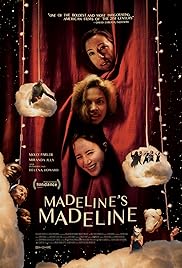
Film Review: MADELINE’S MADELINE (USA 2018)

 Submit your Screenplay to the Festival TODAY

Madeline's Madeline Poster
Trailer

A theater director’s latest project takes on a life of its own when her young star takes her performance too seriously.

Director:

Josephine Decker

Writers:

Josephine DeckerGail Segal (story consultant) | 3 more credits »


MADELINE’S MADELINE, supposedly a largely experiential film begins with an actress told not to be a cat but to be inside a cat, throwing away all metaphors etc.  She purrs like a cat, is stroked like a cat and thus behaves as one.  The screen is also filled with saturated colours for no apparent reason as the audience struggles to make some sense as to what is occurring on screen.

The film centres on a high school student, Madeline (Helena Howard) taking makeshift acting classes under some kooky teacher, Evangeline (Molly Parker).  Evangeline is also pregnant which might explain a bit of the weird behaviour.  Madeline has a eating disorder and is looked after by her overbearing white mother, Regina (Miranda July) who she does not get along with, especially during these rebellious years.  She finds solace in her acting classes including befriending Evangeline who takes a sudden interest in her acting.

Evangeline’s methods lots of improvisation where the actors are ask to do anything from acting out what they feel to pretending to be animals.  It is a wonder that none of the students think Regina is crazy.

At one point, Madeline acts like a sea turtle as the camera gives the audiences the turtle’s eye view of one as it makes itself towards the sea. “Be a sea turtle, not a woman being a sea turtle,” is the response Evangeline gives her.  The rest of the class do weird things like beat the curtains, scream and make sudden body movements.  The class also sit around in a circle to talk about a moment of violence they wish to share.

The film is not without violence, imagined or otherwise.  Most of it is acted out or appear in dreams as in the one Madeline has of pressing a hot iron on her mother.

It is hard to critique a film as different and at times so experimental as this one.  The film could be classified as inventive, exploring and original, going against the grain of narrative film.  It can be also considered as a load of rubbish.  To each his or her own.  But what thing is for sure – MADELINE’S MADELINE is different experience.

There a lot of dramatic mother and daughter confrontations that occur in the car, similar to that of the famous LADY BIRD segment where the daughter suddenly jumps out of the speeding car.  Madeline does the same, getting out of the car when mother becomes too much.

From the very beginning when a voiceover taunts Madeline: “What you are feeling is a metaphor, and your emotions are not yours,” words continually ring that often do not make any sense.  The film requires the audience to surrender to the creative process of the acting workshop and find ones true self like the character of Madeline supposed to be going through.  Unfortunately the workshop is conducted by a very insecure teacher, Evangeline who takes on Madeline like a daughter.  They argue just as ferociously as the real mother and daughter.  Do we really need to watch all this?  Annoying characters, jittery camera, shouting and screaming, no head-or-tail logic and experimental s***.  The film does not allow audiences to think on their own but blare its message and way of story-telling (if one can consider the film to contain one) of ramming it down ones throat.  Decker never answers any of the questions she poses in her film either.  To this critic, MADELINE’S MADELINE is a load of rubbish!

Trailer: https://www.youtube.com/watch?v=S_ezPTjSSPw

 Submit your Screenplay to the Festival TODAY

Film Review: BREATH (Australia 2017)

 Submit your Screenplay to the Festival TODAY

Breath Poster
Trailer

Based on Tim Winton’s award-winning and international bestselling novel set in mid-70s coastal Australia. Two teenage boys, hungry for discovery, form an unlikely friendship with a …See full summary »

Director:

Simon Baker

Writers:

Gerard Lee (adapted screenplay), Simon Baker (adapted screenplay) |2 more credits »


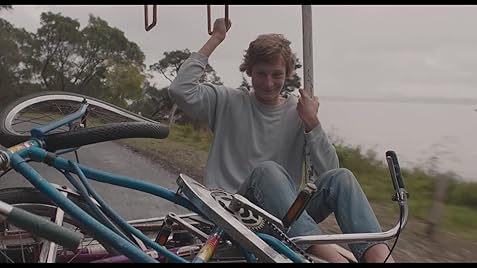
BREATH is Australian actor Simon Baker’s directorial debut based on the multi-award winning author Tim Winton’s novel of the same name.  Besides directing, maker also shares producing and co-writing credit with Winton.

The film is set in the 1970s and two teenage boys form a connection with an older surfer, Sando played by Baker himself.  The boys Pikelet (Samson Coulter) and Loonie (Ben Spence) have grown up in a small western Australian town and through surfing meets up with Sando, who challenges them to take greater and more dangerous risks.

BREATH shows an all white world where no Aborigines or other minorities appear.  The Australians on display are pure white, golden blonde hair engaging in a general all white male sport.   Baker’s film contains repeated explicitly graphic sex scenes with Pikelet and Sando’s girlfriend Eva (Elizabeth Debicki) once  Sando has abandoned them.  The film and novel title BREATH comes from a kinky sex play the two indulge in.  But Samson is only 14, the age he admits when asked at the beginning of the film.  What is displayed on screen various times amounts to accepted pedophilia  The film runs into problems in the second half once Sando is gone from the picture.  Baker’s film lacks the spark it had and slags towards the end.

Understandably, the film’s best moments are the surfing segments, even when the philosophy of the sport is explained.  “Paddle, turn and commit, without a moment of doubt.”  The science of the sport is also explained at one point by Sando.  He explains the contiental shelf, the girth and the pursuit of the right wave.  At best, both the fear and exhilaration of the sport are demonstrated simultaneously.

The two young actors Coulter and Spence are real finds and make the movie.  Veteran Australian actor Richard Roxburgh  has a small role as Mr. Pike, the father.

The surf scenes are nothing short of stunning, credit to cinematographers Marden Dean and Rick Rifici.  One wonders how the camera gets so close to capturing the action, with the smoothness of the waves.  The audiences gets to see the surfers paddling out into the sea, the wave slowly forming and the surfers standing up on their boards, as the wave grows gigantic behind them.  These magnificent scenes create a high not only for the surfers but for the audience as well.  The stung landscapes are also on display in the film – the magnificent cliffs, rocks, sea and vegetation.

The film is tied together by the voiceover from start to end, supposedly the adult voice of Pikelet, bringing meaning to the story.  The film is basically the coming-of-age story of Pikelet.  His friendship with the rather uncontrollable wild-card, Loonie is also given due importance.

BREATH ends up an occasionally uplifting though flawed film about boyhood in an all white male surf setting.  At the start of the film, surf is described by the voiceover as beautiful, pointless and elegant.  The film BREATH can certainly described using the same three terms.

Trailer: https://www.youtube.com/watch?v=17M7kcG0SBQ


 Submit your Screenplay to the Festival TODAY

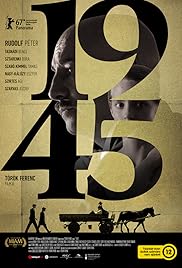
Film Review: 1945 (Hungary 2017) ****

 Submit your Screenplay to the Festival TODAY

1945 Poster
12 August 1945, 11 AM. Two mysterious strangers dressed in black appear at the railway station of a Hungarian village. Within a few hours, everything changes.

Director:

Ferenc Török


The year 1945 is immediately recognizable as the year World War II ended.  While this might be an exhilarating year for most Europeans fighting the Germany and her allies, it certainly isn’t for a small Hungarian village.   Most of the villagers from the film’s unnamed village in Hungary fear that Jews will return after the War to reclaim their property that have been taken away from them and redistributed to these Hungarians.  And some unjustly.  The town clerk, Mr. István (Péter Rudolf ) had informed of his Pollaks neighbours while getting a fellow villager to testify as a witness.  Worst, he guiltlessly watched from his window as his best friend and family were taken away by the Nazis.  He also bribed to get his son out of the army.

Few films on World War II have depicted the effects on those left behind by those who went off to fight during the War.  The excellent recent French film, Xavier Beauvois’ LES GARDIENNES (which is a real crime that it was surprisingly not commercially released in Toronto) demonstrated in great detail how farmworkers survived without any males.  1945 is a Hungarian drama that demonstrates the evil that human beings exhibit as a result of that War, even when staying behind in the village and not going to fight.

Török, who also co-wrote the film directs it in a straight forward manner without resorting to cheap theatrical effects, realizing and relying on the strength of the film’s source material.   The film’s period atmosphere is greatly enhanced by the film’s stark and clear black and white cinematography.

The catalyst of the story is the arrival of two Jewish survivors of the Holocaust (there is a camera closeup of the concentration camp tattooed numbers on one of their arms) by train to the village – a father and son.  The purpose of their visit is unclear to the villagers and they assume they are back to reclaim land that had been taken away from them.  The individual villagers have different reactions, mostly unpleasant.

The story contains a sufficient assortment of characters in varying situations to keep audience’s interest piqued.  Besides the town clerk, his son is a coward about to be married to a woman who clearly does not love him, but the drugstore that his family owns.  She, Kisrózsi (Dóra Sztarenki) has an affair with Jancsi (Tamás Szabó Kimmel) who is unafraid to flaunt the affair as well as side with the liberating Russians in the village.  He is also flirting with a younger woman in front of her.  The town drunk is guilty of being the town clerk’s witness and his wife is hiding all the expensive rugs and silverware the family took from the Jews.  The priest is no Godly saint either, having stolen from the Jews.

This paragraph in bold italics contains minor spoilers: Interesting during the first half, director Török brings his film to an impressive climax where the clerk’s son leaves the village in despair and the deserted bride takes revenge on the groom’s family.  Despite all the gloom and despair on display, there is a bit of hope in the clerk getting his comeuppance and his son finally breaking away from his family’s hold.  When it is revealed the true purpose of the Jew’s visit, there is also some sympathy shown by the villagers.

The film was screened in the Panorama section at the 67th Berlin International Film Festival and was awarded the 3rd place prize in the Panorama Audience Award.  1945, a sincerely made film about the emotional baggage left behind by WWII is one of the best foreign films released so far this year and indeed worthy of a Best Foreign Language Film Oscar nomination.

Trailer: https://www.youtube.com/watch?v=HCg3jVRX85A

 Submit your Screenplay to the Festival TODAY

Film Review: WHAT KEEPS YOU ALIVE (Canada 2018)

What Keeps You Alive Poster
Majestic mountains, a still lake and venomous betrayals engulf a female married couple attempting to celebrate their one-year anniversary.

Director:

Colin Minihan

Writer:

Colin Minihan

Scanty clad female victim is pushed off the cliff and presumed dead.  But she crawls to safety, brutally tending to her wounds.  She then has to rely on her wits to outsmart her killer.  If this premise for the new Canadian thriller WHAT KEEPS YOU ALUVE seems familiar, it is also the premise of the recent French 2017 thriller by Coralie Fargeat REVENGE.  REVENGE premiered at TIFF’s Midnight Madness and had a commercial run and the truth is that it is a much better film.  The irony of it was that REVENGE is similar to another successful horror movie I SPIT ON YOUR GRAVE. 

The film begins with two women Meghan (Hannah Emily Anderson) and Julie (Britanny Allen) arriving at a cottage by a lake.  (The film was shot in beautiful, Muskoka,Ontario.)  It turns out that the two two women are celebrating their first wedding anniversary.  Julie discovers that Meghan is not what she seems.  Meghan has not only kept a secret from Julie but a sinister dark side.  It is then revealed that Meghan is a psycho.

The film is beautifully shot, the lake looking especially inviting.  The overhead shot of the canoe with the dark lake waters is worthy of mention, thanks to the film’s cinematographer, David Schuurman.

The story could have been told with a straight couple instead of a lesbian couple without much change.  In fact the script was initially written with a straight couple in mind.  The update is a welcome one (credit to the filmmakers for taking this route) though it might reduce the size of the film’s target market.

But all good intuitions aside, the film fails because of the credibility element.  The source of the terror is Meghan being a psycho.  There is no explanation for the origin of her disease.  With one year a a wife and wife couple, it  is quite unbelievable that Julie has never suspected anything wrong with her partner.  There is also too many opportunities for her to escape which she never takes.  Megahn and Julie get invited to a neighbour’s dinner party.  Julie has more than one chance to tell her hosts of the danger she is in but never does.  She could also have run off many times but does not.

The phrase WHAT KEEPS YOU ALIVE comes from Meghan’s father when a younger Meghan shoots a bear in self defence.  She was forced to eat the entire bear for weeks till finished as she was taught to kill only what keeps on alive.  The meaning of the phrase comes into effect again at the climax of the film.

The film’s two female leads Anderson and Allen are quite good, they being together before in the horror film JIGSAW.  Allen besides starring in the film, also composed the film’s musical score (which is not half bad).

The film is more violent that needs be.  While Fargeat’s REVENGE’s violence was entertaining, this film’s violence is just plain nasty.

The film has made its rounds at various film festivals:

Official Selection – 2018 SXSW Film Festival

Official Selection – 2018 Inside Out Toronto LGBT Film Festival

Official Selection – 2018 Fantasia Film Festival 

The film is strictly for horror fans.

Trailer: https://www.youtube.com/watch?v=hsZMwwpW6Bg

Film Review: MAISON DU BONHEUR (Canada/France 2016) ***1/2

 Submit your Screenplay to the Festival TODAY

Maison du bonheur Poster
The day-to-day life of a Parisian astrologer, who has been residing in the same Montmartre apartment for over 50 years.


Subjects of documentaries are often famous people, but only a handful have been about ordinary everyday unimportant folk.  MAISON DU BONHEUR (translated in English to House of Happiness), an occasionally brilliant film is one of the latter.

It was not that long ago in 1975 that Belgian director Chantal Akerman stunned audiences and critics around the world with her 3-hour long art house epic on the daily chores of a housewife.   The film was called 23, Quai du Commerce, 1080 Bruxelles.  Though a fictional film that ended with the female protagonist committing suicide as did the director herself  recently, the film repeatedly showed the protagonist eating and cooking not once but repeatedly.  Similarly, in MAISON DU BONHEUR, this one an hour long documentary, Torontonian director Sofia Bohdanowicz shows that the daily chores and thoughts of an ordinary person can be just as interesting as a celebrity.

The doc’s subject is Juliane Sellam is a 77-year-old Parisian astrologer who has lived in the same pre-war apartment in Montmartre for half a century.   In this vibrant documentary, Toronto director Sofia Bohdanowicz focuses on Sellam’s daily life over 30 beautifully shot segments, which are narrated by both Sellam and Bohdanowicz. 

When the film opens, Bohdanowicz (she is revealed as a very young filmmaker) is leaving Toronto to stay in Paris with a person she has never met – Juliane Sellam.  Thus she begins filming Sellam’s life, thoughts and musings.

The matriarch’s life and rich inner world crystallize through her daily rituals of making coffee, applying makeup, and caring for her geraniums. 

Bohdanowicz devotes 10 minutes or so on each ritual.  Sellam describes desiring coffee as a young girl.  Her aunt denies her a taste saying that young girls do not drink coffee.  Her grandmother gives her a taste which she loves, just because she was initially not allowed to have any.  Up to the present, Sallen says she has loved coffee.  Bohdanowicz brilliantly shows, on cue, the slow pouring of steaming coffee into a cup.   Sellam puts on make-up daily, even to just take out the rubbish.  She confesses that she wants to look the best for everyone and that no one needs to see an ugly person in the morning  She goes again to the origin of her love for make up.  Her uncle used to be a nail polish salesman and he lets her try his wide array of samples.  The shot of the samples with dozens of painted false nails on  a platter is something I and not seen for 30 years.  Her ritual with gernaniums is just as interesting.  She waters them either late at night or very early in the morning so that people below her flat will not get wet from the water above.  Bohdanowicz never fails to impress her audience with Sellam and her chores.  And her doc goes on…..

The film has a special engagement run at the TIFF Bell Lightbox with the director present for a Q & A on the films opening day.

Trailer: https://www.youtube.com/watch?v=bInvPokMFH4


 Submit your Screenplay to the Festival TODAY

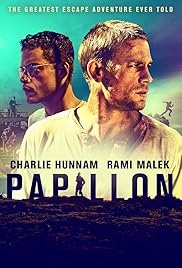
Film Review: PAPILLON (USA 2017) ***1/2

 Submit your Screenplay to the Festival TODAY

Papillon Poster
A prisoner detained on a remote island plots his escape in this second adaptation of the novels by Henri Charrière.

Director:

Michael Noer

Writers:

Aaron Guzikowski (screenplay by), Henri Charrière(based upon the books “Papillon” and “Banco” by) |2 more credits »


Why bother remaking the successful 1973 biography of French convict Henri Charrière nicknamed PAPILLON who escaped from Devil’s Island in 1941?  After all, that film directed by Franklin J. Schaffner and starring two huge stars of the time Steve McQueen and Dustin Hoffman is still readily available on DVD.

A few reasons!  One would be that no one would likely remember anything about the 1973 film.  After all it is is is almost half a century ago.  I can only remember two things about the 1973 film – Dustin Hoffman eating a cockroach and Steve McQueen jumping off the cliff in the final escape scene.

The new PAPILLON is not too bad.  Despite not having as big star names, Charlie Hunnam (THE LOST CITY OF Z) and Rami Malek (I, ROBOT) inhabit their roles very convincingly.  There is no cockroach eating scene but the food served actually looks not half bad, like the consommé with diced vegetables in a tin can.  In fact, Papi (as Charrière is called in short) is tempted with the soup in order to reveal the name of his conspirator.  

PAPILLON is the nickname of Charrière likely from his butterfly tattoo on his body.  The film opens with his frolicking with his girlfriend, Nenette (Eve Hewson) in Paris after nicking some jewels from the big boss he was working for.  Thus framed for murder, Charrière, is unjustly convicted of murder and condemned to life in a notorious penal colony on Devil’s Island in French Guiana, South America.  Determined to regain his freedom, Papillon forms an unlikely alliance with quirky convicted counterfeiter Louis Dega, who in exchange for his protection, agrees to finance Papillon’s escape, ultimately resulting in a bond of lasting friendship.

For a film shot in Paris and set in France and French Guiana, not a word of French is spoken in the film.  The filmmakers must thing speaking English with a French accent is sufficient, though the 1973 original had the same flaw.  But true that commercial audiences rather hear dubbed dialogue than read subtitles.

If one can remember the 1973 version, this film is very similar as the new script by Aaron Guzikowski is based on Charrière’s autobiographies Papillon and Banco, as well as the former’s 1973 film adaptation, which was written by Dalton Trumbo and Lorenzo Semple Jr.  In fact, credit is given to the script by Trumbo and Semple Jr. in the closing credits.

PAPILLON 2017 moves fast enough for its 133 running time.  The film is not a film about escape but a film about the strained but lasting relationship of the two men.  But the film’s only escape sequence with Papi, Dega and two other prisoners (Roland Moller and Joel Bassman) is the film’s highpoint, especially trying to survive a storm in a broken boat in the wide ocean.  The hard prison conditions, though hard to watch make extremely intriguing fodder.  One wonders how inhuman human beings can be.  The film also demonstrates the triumph of the human spirit over mounting adversities.  So, despite the dim outlook of the film’s heroes, it is still a film of hope and not despair.

It would be interesting to watch both films back to back to observe the different treatment of each director and actors towards this timeless material.  Both films are equally well shot and absorbing and definitely worth seeing.

Trailer: https://www.youtube.com/watch?v=xqj7XOv9mC8

 Submit your Screenplay to the Festival TODAY


Film Review: DR. BRINKS & DR. BRINKS (USA 2017)

 Submit your Screenplay to the Festival TODAY

Dr. Brinks & Dr. Brinks Poster
Trailer

After husband and wife aid workers, Dr. Brinks and Dr. Brinks, die in a plane crash, their grown children are reunited for the first time in years. It takes days for Marcus and Michelle …See full summary »

Director:

Josh Crockett


DR. BRINKS & DR. BRINKS must have been a project of love for writer/director Josh Crockett as he had to publicly raise funds to complete the film.  To Crockett’s credit, it is a worthy effort that is relatively entertaining but no masterpiece.

DR. BRINKS & DR. BRINKS is a dysfunctional family comedy/drama (too many Brinks spoil the broth) with more comedy than drama though the drama is still pretty intense in parts.  The title refers to the husband and wife doctor team who work with the Doctors without Borders.  They spend more time with children in underdeveloped nations that with their own.  This results in their own children not really knowing their own parents or family for that matter.  Two of the siblings who hardly see each other are brought together as a result of their sudden death from an airplane crash with disastrous results.

The story devotes almost equal screen time to the brother Marcus Brinks (Scott Rodgers) and sister Michelle Brinks (Kristin Slayman).  Marcus has a relationship with Alex (Ashley Spillers).  A bit more time is spent on Michelle with her character being right most of the time, likely because Slayman playing her is the film’s producer and the wife of the director in real life.  Marcus sports a thick beard and there is a lot of free sex (including bondage and kinky sex) involved so one can guess that director Crockett aims at the new age free spirited era of the forgotten 70’s.   The sexual encounters liven the film as well as reveal certain characteristics of the siblings.

To add fuel to the fire, Kristin begins a sexual relationship with Alex’s father Bill (Robert Longstreet).  She knows it is wrong but cannot stop it.  Bill thinks he is in love all over again and the best thing that has happened to him.  While Marcus finds out, he becomes visibly upset while Alex is unaware initially.  This incident makes up a good part of the film and is used as the catalyst to rock and then stabilize the various relationships.

The film’s main aim is the examination of the relationship between the siblings amidst varying circumstances.  Besides the problem stated, it is also revealed that the house that Marcus and Alex live in is still in the parents’ name and has to be liquidated to pay off their debt.  But this plot point could have been left out in the script without affecting much.  The actor playing the lawyer (Roger Guenveur Smith) is pretty good.

As Marcus’ vocation is singer/songwriter, the film has a nice break when a few of his catchy songs are performed.

The film lacks as strong conclusion thus creating an unsatisfying feeling for the audience  that the film is leading nowhere.  Though more comedy than drama, the comedy is light at best and the drama that escalates towards the film’s end is somewhat predictable. 

DR. BRINKS & DR. BRINKS opens in the U.S. this Friday in select theatres and is available video on demand on September 4th.

Trailer: https://www.youtube.com/watch?v=ba4AD0Rrh3s

 Submit your Screenplay to the Festival TODAY