Film Review: LOVE AT FIRST CHILD (ANGE ET GABRIELLE) (France 2015) ***

Deadlines to Submit your Screenplay, Novel, Story, or Poem to the festival: http://www.wildsound.ca
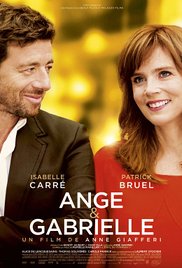
LOVE AT FIRST CHILD.jpgGabriell is a single mother, her 17-year-old daughter Claire is pregnant, however the child’s father Simon has no desire to be involved with his future baby.

Director: Anne Giafferi
Writers: Anne Giafferi (dialogue), Anne Giafferi (screenplay)
Stars: Isabelle Carré, Patrick Bruel, Alice de Lencquesaing

Review by Gilbert Seah
 
The English title tells it all. LOVE AT FIRST CHILD is a French romantic comedy of a couple that falls in love as a result of a baby. But the baby are not theirs but their kids’. This film seems ideal for a Hollywood remake as follows the line of many French comedies. The screenplay by Anne Giafferi and Anne Le Niy is based on a play by Murielle Magellan.

The film begins with a semi-hysterical woman, Gabrielle (Isabelle Carre) barging into the office of Womanizer Ange (singer and actor Patrice Brunel). He is accused of having an uncaring son, Simon (Thomas Soliveres) who has impregnated her daughter, Claire (Alice de Lencquesaing) now studying in school. All this is a lame excuse for Ange and Gabrielle to argue and eventually fall in love.
But writer/director Giaferri’s film is not without its charm. It is difficult to dislike a film that has charm and nice human touches spread throughout the movie, despite the fact that this is a typical Harlequin romance complete with obstacles to the romance and an obvious happy ending. This fact might be the reason the film is going straight to vod in North America after doing only so-so at the box-office.

Director Giafferi takes the play out into the open so that the audience is never aware of the film’s source. There is a neat scene where Angie and Gabrielle kiss in a playground surrounded by children and another showing two loving pigeons on a rooftop. The film also updates the story to include political correctness of a gay marriage of one of Ange’s colleagues.

Like the French comedy THREE MEN AND A BABY, LOVE AT FIRST CHILD contains lots of shots of a cute baby. The baby featured in this film is really cute, impossible to dislike and director Giafferi has captured and exploited (in a good way) all the best baby moments.

Heart throb singer star Patrick Bruno is now 58 and his age shows. But his charm is not lost and his womanizing character and romanced comes across convincingly enough. Cesar winner Isabelle Carrie is also charming enough, looking so much like Diane Keaton with her glasses, But the two young a actors, Thomas Soliveres and Alice de Lencquesaing give he film a fresh look. It is a pity that they only deliver supporting performances. A full movie could have been made on young love, of their characters, perhaps a young adult romantic drama similar to the ones Mia Hansen-love makes.

LOVE AT FIRST CHILD makes its debut on vod (video on demand) Nationwide on Tuesday, July 11 on all major platforms including iTunes, Google Play, Amazon,
Microsoft, Vudu, Comcast, Charter, Cox, Vimeo, and various other cable operators. The film makes a good romantic evening home with a loved one for an alternate night at the movies.

Trailer: https://m.youtube.com/watch?v=SrhGDhu9IzM

Also, Free logline submissions. The Writing Festival network averages over 95,000 unique visitors a day.
Great way to get your story out: http://www.wildsound.ca/logline.html

Deadlines to Submit your Screenplay, Novel, Story, or Poem to the festival:http://www.wildsound.ca

Watch recent Writing Festival Videos. At least 15 winning videos a month:http://www.wildsoundfestival.com

Full Review: INTEGRAL MAN (Canada 2016) ***

Deadlines to Submit your Screenplay, Novel, Story, or Poem to the festival: http://www.wildsound.ca

integral man.jpgHe chose two young architects that would come to change contemporary architecture. Jim Stewart is the most published mathematician since Euclid, a concert level violinist, calculus professor, philanthropist, and gay rights activist. He is a true polymath, a modern day renaissance man. He had a bold vision and the conviction to follow through. It took almost ten years to realize his dream, Integral House, which was completed in 2009.

Director: Joseph Clement

Review by Gilbert Seah

 The human subject of INTEGRAL MAN is Jim Stewart, the most published mathematician since Euclid, a man of unparalleled ambition. The film introduces the man, through voiceover for a full 10 minutes describing his two sides. The first is the classical, exact side where the Mathematics part lies and the second the modern dreamer and dynamic designer.

The film can be divided into 3 segments though the segments are overlapped. One is devoted to Jim Stewart the man. He is shown as a Mathematician, an architect and a music lover. The second shows the design of the house, before, during and after its construction – a magnificent piece of work. The third integrates his love of music (Stewart plays the violin) into the two segments.

Stewart’s books on Calculus (a branch of Mathematics lots of students shudder from) are sold the world over. Stewart goes on books tours around the world including China, signing his books for student and professors alike. Stewart also sets out to create one of the most renowned pieces of residential architecture in North America and succeeded, demonstrating the perfect match between client and architect. Director Clement charts the bond between architect and client with long meetings held between the two. Stewart interviewed many architects before settling with the chosen one. Using time lapse photography, Clement details the landscape of the plot from demolition of the old house, to the barren land to the outer shell to the completion of the house. This residence, overlooking a ravine in Rosedale, Toronto is grand and exhibits decadence beyond comprehension. Clement uses his camera to take the audience on an extended tour of the home, from the top to below. The most fascinating piece of structure is the central staircase, made of metal, and which took a full 3 months on install. The material to be shipped from Europe to Nova Scotia to be moulded in Toronto before installation. The residence is appropriately named Integral House.

An important point in the film, that is mentioned by Stewart himself is that all the wealth is not from luck but from hard, dedicated work. Stewart spent 7 years, working 15 hour full days only taking half a day off at Christmas to write his Calculus books.

Besides Calculus and Architecture, Stewart is a man of music – a true music lover. His house was designed to exhibit concerts, which were conducted time and again for his own benefit and for charity foundations. The film showcases a few of these with music playing while the guests in evening cocktail dress applaud and drink wine.

Clement omits Stewart’s background (it would be good to know where he inherited his artistic and mathematical genes from) but does mention his sexual orientation.

Unbeknownst to Jim however, an unexpected turn of events is set to unfold. The film takes this turn (which will not be revealed in this review) during the last 10 minutes. and brings the film neatly to its conclusion.

(INTEGRAL MAN premiered at Hot Docs and opens this week in Toronto.)

Trailer: https://vimeo.com/209647946


Also, Free logline submissions. The Writing Festival network averages over 95,000 unique visitors a day.
Great way to get your story out: http://www.wildsound.ca/logline.html

Deadlines to Submit your Screenplay, Novel, Story, or Poem to the festival:http://www.wildsound.ca

Watch recent Writing Festival Videos. At least 15 winning videos a month:http://www.wildsoundfestival.com

Netflix Original Film Review: OKJA (South Korea/USA 2017) ****

Deadlines to Submit your Screenplay, Novel, Story, or Poem to the festival: http://www.wildsound.ca

okja.jpgMeet Mija, a young girl who risks everything to prevent a powerful, multi-national company from kidnapping her best friend – a massive animal named Okja.

Director: Joon-ho Bong (as Bong Joon Ho)
Writers: Joon-ho Bong (screenplay) (as Bong Joon Ho), Jon Ronson (screenplay)
Stars: Tilda Swinton, Paul Dano, Seo-Hyun Ahn

Review by Gilbert Seah

Ever since films like LASSIE COME HOME enchanted audiences, a lost pet reuniting
with its owner has been a favourite theme. In the new Netflix original movie OKJA, director Bong (MEMORIES OF MURDER, MOTHER, SNOWPIERCER) has broken all rules with the darkest kids movie since BABE IN THE CITY.

OKJA courted controversy at Cannes when it was argued that films like this Netflix original not slated for theatre release be disqualified from competition. Surprisingly, OKJA opens at the TIFF BELL Lightbox same day it opened on Netflix last week.

OKJA is a tale of a girl and her lost pet. The only difference is that the pet is a super pig named OKJA. For 10 idyllic years, young Mija has been caretaker and constant companion to Okja – a massive animal and an even bigger friend – at her home in the mountains of South Korea. But that changes when family-owned, multinational conglomerate Mirando Corporation takes Okja for themselves and transports her to New York, where an image-obsessed and self-promoting CEO has big plans for Mija’s dearest friend. With no particular plan but single-minded in intent, Mija sets out on a rescue mission. She encounters the Animal Rights group helping her.

The film can be divided into three parts. The first and most family friendly shows Mija in the Korean countryside playing with OKJA. Bong includes a suspenseful sequence where OKJA saves Mija’s life. The second occurs after OKJA is abducted to Seoul. This is the funniest segment which shows how an individual can infiltrate a big conglomerate armed with a strong will never to give up. No glass doors or metal walls can stop Mija. It is hilarious watching the little girl pursued by security calling her ‘a little shit’. The third and darkest segment is OKJA ‘s rescue from New York City. Mija sees an abattoir complete with pig carcasses, something really unpleasant to even an adult. Bong does not shy away from violence. The animal rights group are the main target for the violence as many of them are beaten with batons and kicked on the ground.

Mija is played convincingly by South Korean child actress An Seo-hyun. Hollywood stars Jake Gyllenhaal has a field day with his over the top performance as TV personality Dr. Johnny. Tilda Swindon plays the villain of the piece, Lucy Mirando who wants to put OKJA on the dinner table. Paul Dano is equally winning as the animal rights group leader who aids Mija rescue her pig.

The question is why Netflix financed a film like OKJA. It is reported that most studios would stay away from films that do not fit a certain mould, like the recent Brad Pitt Netflix movie WAR MACHINE. It is clear the reason studios might be afraid of the adult dark tale of OKJA with its dose of violence and company satire. But thanks to Netflix, Bongs’s OKJA got to be made. OKJA is a brilliant dark and original piece of filmmaking complete with excellent special effects. Highly recommended!

Trailer: https://m.youtube.com/watch?v=AfAIP7dqnm8

Also, Free logline submissions. The Writing Festival network averages over 95,000 unique visitors a day.
Great way to get your story out: http://www.wildsound.ca/logline.html

Deadlines to Submit your Screenplay, Novel, Story, or Poem to the festival:http://www.wildsound.ca

Watch recent Writing Festival Videos. At least 15 winning videos a month:http://www.wildsoundfestival.com

Film Review: PAST LIFE (Israel/Poland 2016)***

Deadlines to Submit your Screenplay, Novel, Story, or Poem to the festival: http://www.wildsound.ca

past life.jpgPast Life tracks the daring late 1970s odyssey of two sisters – an introverted classical musician and a rambunctious scandal sheet journalist – as they unravel a shocking wartime mystery that has cast a dark shadow on their entire lives.

Director: Avi Nesher
Writer: Avi Nesher
Stars: Nelly Tagar, Joy Rieger, Doron Tavory

Review by Gilbert Seah

 Director Avi Nesher (THE MATCHMAKER, TURN LEFT AT THE END OF THE WORLD) sets the stage in the film’s first scene when Sephi (Joy Rieger) performs (she is a tenor in a choir) in Berlin. An elderly woman ( Katarzyna Gniewkowska) reproaches her after, in public, accusing her of being a murderer’s daughter.

Back home, she relates the incident to her feisty sister, Nana (Nelly Tatar), a writer for her husband’s journal and she insists of finding the truth of what happened in the war with their father, Dr. Baruch Milch (Doron Tavory).

The film is a period piece, beautifully mounted with vintage cars and sets and set in the year 1977. It is a spellbinding tale that tracks the trans-European odyssey of two sisters as they try to unravel a wartime mystery that has cast a shadow on their lives. Sephi is an aspiring composer, determined to succeed in the male-dominated classical music world. Her older sister Nana is a scandal-sheet journalist and aspiring playwright. The daughters of Holocaust survivors, the two are bent on uncovering the truth behind a dark family secret.

The entire film hinges on what the secret is. To keep the film interesting from start to end, Nesher inserts a rift between the siblings.

Sephi is content not to unravel the skeleton in the closet while Nana is the opposite. Nesher paints a more interesting character in Nana as she is one hot female, always searching, always wanting the truth which damages her relationship with her husband who owns the journal she writes for. To make matters worse, Nana believes that he flirts with Sephi. This makes the story more down to earth though the tension feels forced at times. Nesher also inserts a segment that involves the timely discovery of the father’s document in the archives just before the starting of a concert. This tactic is obvious to heighten tension though it compromises the authenticity of the story.

Nesher’s film is also clearly devoid of humour. The light touches in dialogue come mainly from Nana’s lines, especially the ones in the hospital or seeing the doctor. But rather than being funny, they come across as cynicism.

Neshe’s strength are in the dramatic parts. The film’s best segment is unexpectedly the meeting in the park at night of the girl’s mother (Evgenia Dodina) and the elderly woman at the concert at the film’s beginning. The mother’s begging of her forgiveness for her and her husband is both moving and riveting.

The film was inspired by Dr. Baruch Milch’s book Can Heaven Be Void?, which is based on a diary he kept during WWII, and the extremely difficult decisions he had to face during the times. Nana in real life edited the father’s book while the sister Sephi composed the orchestral piece to exorcise their demons.

Nesher is himself a Holocaust survivor, so making this film must be a story he wanted to tell from his heart. PAST LIFE eventually turns out to be a powerful film about the importance of forgiveness.

Trailer: https://m.youtube.com/watch?v=2nJsh8BHMQ0

Also, Free logline submissions. The Writing Festival network averages over 95,000 unique visitors a day.
Great way to get your story out: http://www.wildsound.ca/logline.html

Deadlines to Submit your Screenplay, Novel, Story, or Poem to the festival:http://www.wildsound.ca

Watch recent Writing Festival Videos. At least 15 winning videos a month:http://www.wildsoundfestival.com

Film Review: THE JOURNEY (UK 2016) ***

Deadlines to Submit your Screenplay, Novel, Story, or Poem to the festival: http://www.wildsound.ca

THE JOURNEY.jpgA fictional account of the extraordinary story of two implacable enemies in Northern Ireland.
Director: Nick Hamm
Writer: Colin Bateman
Stars: Timothy Spall, Colm Meaney, John Hurt

Review by Gilbert Seah
 
Who would think that former enemies Rev. Ian Paisley and Martin McGuiness nicknamed ‘The Chuckling Brothers’ would remain friends for life after their meeting that finally resulted in the long awaited peace in Northern Ireland. No more bombings! No more bullets! Director Hamm underlines the violence as the film starts.

Nick Hamm’s THE JOURNEY is a dramatization about how these two two political opposites came together to change the course of history – an event that resulted in the Democratic Unionist Party and Sinn Féin (the political party of the Irish Republican Army) signing a 2006 agreement, bringing peace to Northern Ireland after nearly 40 years of violence.

Hamm’s journey is basically a two-handler, performed by two actors, one known for his humour the Irish Colm Meaney (THE SNAPPER) and the other for his dead seriousness, Timothy Spall (the Mike Leigh films). Most of the scenes involve banter between both of them. The film imagines a trip in a minivan where the two sort out their differences, come to an agreement and finally bring peace to the different groups. It is a real event though that minivan trip was imagined, as written in the script by Colin Bateman. The real trip took pace in an airplane. But the facts remain true. The reason the film changed the venue is not given but the change offers a visual treat, with lush greenery and rocky shores seen through rain-splattered windows. The drive was to the airport in Glasgow, Scotland.

Spall and Meaney are a pleasure to watch. Other British actors in the film include the late John Hurt (THE ELEPHANT MAN) as M15 boss Harry Patterson and Toby Stephens as Prime Minister Toby Stephens. Freddie Highmore has a small but mischievous role as the chauffeur, a British agent in disguise.

Director Hamm takes his time to set up the stage for the action when the two are finally the car and talking. The chauffeur, through his head set, is prompted to instigate the conversation. It is comical to see two grown men behaving just like children, fighting and wanting their own way. The conversation starts when McGuinness’s mobile is unable to get a signal but Paisley refuses to lend his. Bateman’s script, which imagines the actual conversation involves lots of funnily one-liners and rebuttals. The script is also believable in the way the ice is broken and the two eventually get talking. At the same time, hatred, humour and hard-nosed stubbornness are on full display.

They is a little film that documents a real life-changing event through imagined conversation. It is an entertaining exercise that also reflects strength overcoming the weaknesses of the human character in the strife for the good of mankind. But at the time of writing this review, problems are beginning to resurface again as observed in the recent news.

Trailer: https://www.youtube.com/watch?v=pc3jqf4cdfc

Also, Free logline submissions. The Writing Festival network averages over 95,000 unique visitors a day.
Great way to get your story out: http://www.wildsound.ca/logline.html

Deadlines to Submit your Screenplay, Novel, Story, or Poem to the festival:http://www.wildsound.ca

Watch recent Writing Festival Videos. At least 15 winning videos a month:http://www.wildsoundfestival.com

Film Review: 13 MINUTES (Germany 2015) ****

Deadlines to Submit your Screenplay, Novel, Story, or Poem to the festival: http://www.wildsound.ca

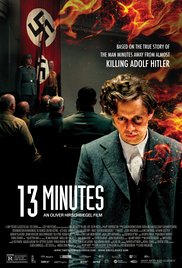
13 minutes.jpgIn November 1939, Georg Elser’s attempt to assassinate Adolf Hitler fails, and he is arrested. During his confinement, he recalls the events leading up to his plot and his reasons for deciding to take such drastic action.
Director: Oliver Hirschbiegel
Writers: Léonie-Claire Breinersdorfer (screenplay), Fred Breinersdorfer (screenplay)
Stars: Christian Friedel, Katharina Schüttler, Burghart Klaußner

Review by Gilbert Seah

A reenacted and partially imagined account of a true event, Oliver Hirschbiegel’s 13 MINUTES tells of the attempted assassination of Adolph Hitler in 1939 by the planting of a bomb inside a column of a Munich bierkeller by German Georg Elser (Christian Friedel). The bomb detonates but misses killing Adolf Hitler, the German leader, by just 13 minutes.

Director Hirschniegel broke into the world film scene with DAS EXPERIMENT and made more headlines with his Oscar nominated Best Foreign Film DOWNFALL. 13 MINUTES lost to LABYRINTH OF LIES that year for Germany’s nominated entry for the Best Foreign Film Oscar though 13 MINUTES is clearly the better film.
Watching the film, one would eventually wonder how Elser’s story came into fruition. It is clear from the film that Elser was arrested and told part of his story. Also, the explosion of the Munich bierkeller did occur and Elser confessed to the Nazis.

The film begins with Elser’s planting of the bomb and his arrest following. With maps of the building on him (why the hell would he not dispose of them after is the big question), the German Security Services link him to the assassination attempt. They believe Elser must have been working with a group of conspirators and torture him for information. They also round up members of his family from his home village, including Else Härlen (Katharina Schüttler), a married woman Elser has been seeing.

When Else Härlen is brought before Elser, he fears for her life and tells the police chief Arthur Nebe (Burghart Klaußner) and Gestapo head Heinrich Müller (Johann von Bülow) that he acted alone, procuring detonators from a steel factory and stealing dynamite from a nearby quarry. All these events including how he came to despise the Nazis are shown in the film through flashbacks when Elser is interrogated in prison. He outlines the two clockwork mechanisms he built to time the explosion and hopefully kill Hitler as he made a speech.

Still believing Elser could not have attempted the assassination alone he once more tortured using drugs (Pervitin) but with the same result as before – he confirms acted alone. The audience is also led to believe this fact, unlikely as it seems that one person from a village could be so tech savvy.

Elser is beautifully played by Christian Friedel, displaying a countryside charm and one that would change character from innocent bystander to convicted assassin.

This is not the first film made on an attempted assassination of Adolph Hitler. The Tom Cruise vehicle VALKYRIE immediately comes to mind, though that was supposedly masterminded by other German generals in 1944. But Hirschbiegel’s 13 MINUTES hits closer to home with a protagonist the audience can feel for.

Sadly, the audience learns at the end of the film that Elser was kept in concentration camps for five years and was shot only a few days before American forces liberated Dachau concentration camp (a few weeks before the war ended). Looks like time was never on the side of poor Elser.

Trailer: https://www.youtube.com/watch?v=8SsIsCWXtV4
 

Also, Free logline submissions. The Writing Festival network averages over 95,000 unique visitors a day.
Great way to get your story out: http://www.wildsound.ca/logline.html

Deadlines to Submit your Screenplay, Novel, Story, or Poem to the festival:http://www.wildsound.ca

Watch recent Writing Festival Videos. At least 15 winning videos a month:http://www.wildsoundfestival.com

Film Review: SPIDER-MAN: HOMECOMING (USA 2017) ***

Deadlines to Submit your Screenplay, Novel, Story, or Poem to the festival: http://www.wildsound.ca

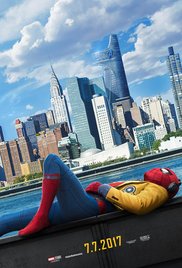
spiderman homecomingFollowing the events of Captain America: Civil War (2016), Peter Parker attempts to balance his life in high school with his career as the web-slinging superhero Spider-Man.
Director: Jon Watts
Writers: Jonathan Goldstein (screenplay), John Francis Daley (screenplay)
Stars: Tom Holland, Michael Keaton, Robert Downey Jr., Marisa Tomei, Jon Favreau, Gwyneth Paltrow

Review by Gilbert Seah

The second re-boot of SPIDER-MAN arrives with all the hype and with it fear that the new look would result in a film as disastrous as the D.C. extended universe films MAN OF STEEL, BATMAN V. SUPERMAN or SUICIDE SQUAD. Thankfully, the new Marvel Cinematic Universe SPIDER-MAN HOMECOMING is not so bad and promises a much better sequel in the making.

The film opens with Peter Parker (Tom Holland) arriving with all his super spider powers intact. Instead of learning to control his new found powers, Parker has to learn how to be Spider-Man. He has arrived several months after the events of Captain America: Civil War, and subject to the help of his mentor Tony Stark aka IRONMAN (Robert Downey Jr.), learns to balance his life as an ordinary high school student in Queens, New York City with fighting crime.
The villain of the piece is introduced at the start of the film as an enterprising business man, Adrian Toomes (Michael Keaton). Forced out of his business by the big boys, Toomes ends up taking revenge on the city by turning himself into the Vulture that eventually battles Spidey. Keaton is exceptionally cynical in his role, the only problem arising is that Toomes is so victimized that one cannot help but root for this poor victim. At one point in the film, Toomes is so convincing in naming Stark Enterprises as the villain that one cannot help but almost believe him. The Vulture’s costume looks too much like Keaton’s Birdman’s outfit, as if reminding the audience of his Best Actor Oscar nominated role.

The climatic battle between the Vulture and Spidey looks too one sided, on the side of the Vulture who seems imminent to win the battle but of course wouldn’t. When Toomes finally ends up beaten, it seems quite unbelievable.

Despite being an action film, the film’s best moments are the interrogation scenes – one where Toomes questions Parker in the car and reveals that he is aware of Parker’s secret identity. The other is Spider-Man questioning one of the crooks regarding Toomes’ activities. Both segments expertly balance humour and surprise while displaying good dialogue expected from the team of the film’s 6 writers.

HOMECOMING is the lightest and goofiest of all the SPIDER-MAN films. But one will eventually get annoyed at Spider-Man’s inability to fight his opponents properly before gaining control of his suit. Instead of learning to use his super powers, Spidey has to learn to use Stark Enterprises’ new Spider-Man suit. In one action set-up, Spider-Man is constantly bungling and falling around learning how to use his suit in extended power mode.

The film features an eclectic cast that carries it out a bit too far. Spidey’s love interest Liz is played by African American, Laura Harrier. His school principal is played by Korean Kenneth Choi and his best friend, Ned by Filipino Jacob Batalon. Tony Revolori as Flash Thompson: Peter’s rival and classmate is latino. The script invests a bit too much time in Ned’s character, his repeated remarks on Spider-Man often ending up more annoying than funny. He is at least given something to do (computer hacking) in the story. The film feels like a teen movie with the humour and high school setting. But one can notice that all the high school kids are performed by actors over 21, Holland included (at 22 playing a 15-year old). The film is not without teen dick jokes (Flash’s song as a d.j.) and the ending song with the lyrics sounding like the ‘f’ word.

It is surprising that director Watts has ended up making more an action comedy than an action hero movie. Watts made two serious films, the thriller COP CAR and the horror chiller CLOWN prior to this. But better funny than too serious. Look what happened to the James Bond and the Planet of the Apes films?

With all the goofiness and Spidey’s learning curve out of the way in this re-boot, the sequel should promise a more mature Spider-Man and hopefully a more mature action film as well – with a better balance between action and humour.

Trailer: https://www.youtube.com/watch?v=U0D3AOldjMU

Also, Free logline submissions. The Writing Festival network averages over 95,000 unique visitors a day.
Great way to get your story out: http://www.wildsound.ca/logline.html

Deadlines to Submit your Screenplay, Novel, Story, or Poem to the festival:http://www.wildsound.ca

Watch recent Writing Festival Videos. At least 15 winning videos a month:http://www.wildsoundfestival.com

Film Review: DESPICABLE ME 3 (USA 2017) ***

Deadlines to Submit your Screenplay, Novel, Story, or Poem to the festival: http://www.wildsound.ca

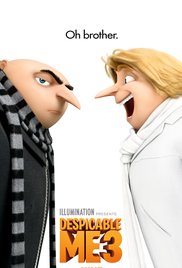
DESPICABLE ME 3Gru meets his long-lost charming, cheerful, and more successful twin brother Dru who wants to team up with him for one last criminal heist.
Directors: Eric Guillon, Kyle Balda
Writers: Cinco Paul, Ken Daurio
Stars: Steve Carell, Kristen Wiig, Trey Parker

Review by Gilbert Seah
 
There are two attractive ingredients in the DESPICABLE ME animated features. One is the super-villain Gru (Steve Carell) or now ex-super villain Gru now working for the AVL (Anti-Villain League). The other are the adorable mumbling Minions. If one is not entertaining one enough, the other strive to be.

The film opens not with the Minions or Gru but with the story of a new super villain named Balthazar Bratt (voiced by South Park’s co-creator Trey Parker). Bratt was a former child actor who portrayed a young super villain in a popular television series before the show was cancelled as a result of his puberty and his waning popularity. This led to him adopting his former persona to become an actual super villain (complete with 80’s eraser head haircut and fashion). Bratt is out to steal the world’s most expensive diamond, in order to fuel his robot invention to destroy Hollywood as revenge, but along arrive Gru and wife (Kristen Wiig) to stop him.

It is obvious that DESPICABLE ME pays homage to the PINK PANTHER films. For one, Inspector Clouseau was French as is director Coffin and the diamond is unashamedly coloured pink. When the diamond is in show, the music comes on, though not with the famous Henry Mancini tune, but with Michael Jackson’s BAD in this case. As Bratt steals the diamond, he moonwalks Michael Jackson style to the diamond.

The main story of DESPICABLE ME 3 involves Gru and Lucy fired from the AVL owing to their failure in capturing Bratt. The others are subplots – quite a number of them – ties in with this event. One of these are the minions who want Gry to go back being a villain. The Minions also have the talent of showing up anywhere and everywhere during the movie. Kids love this, as observed during the film’s promo screening. The kids would scream out every time (adults beware!) the little darlings appear. The subplots involve Lucy bonding with her three adoptive children. The main one involves Gru meeting up with his newly found brother (also voiced by Carell), a more flamboyant character, thanks to his mother (voiced by no less than Julie Andrews).

But with all the subplots including the main story, the film strugglers to create very funny moments or high points that would make this sequel memorable over the others (including THE MINIONS) or even over the other Illumination Entertainment animation like THE SECRET LIFE OF PETS.

The film appropriate premiered at the Annecy International International Film Festival, director Pierre Coffin being French as such. The film opens this weekend alongside two other comedies THE HOUSE and BABY DRIVER and though will face stiff competition should do well at the box-office this weekend coming off at number 1. It also helps that there are countless Minion fans, both adult and kids around the world that will forgive an average DESPICABLE ME sequel, which is very much what this one is. DESPICABLE 3 is good, predictable, harmless family fun.

Trailer: http://universalpictures.ca/detail.aspx?title=DESPICABLE+ME+3&lang=en

Also, Free logline submissions. The Writing Festival network averages over 95,000 unique visitors a day.
Great way to get your story out: http://www.wildsound.ca/logline.html

Deadlines to Submit your Screenplay, Novel, Story, or Poem to the festival:http://www.wildsound.ca

Watch recent Writing Festival Videos. At least 15 winning videos a month:http://www.wildsoundfestival.com

Film Review: MANIFESTO (Australia/Germany 2016) ***

Deadlines to Submit your Screenplay, Novel, Story, or Poem to the festival: http://www.wildsound.ca

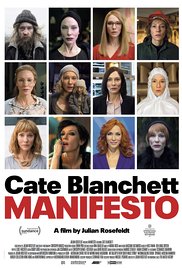
manifesto.jpgCate Blanchett performs manifestos as a series of striking monologues.
Director: Julian Rosefeldt
Writer: Julian Rosefeldt
Stars: Cate Blanchett, Erika Bauer, Ruby Bustamante

Review by Gilbert Seah
 

 It is best to know the definition of the term MANIFESTO before seeing this movie. According to Wikipedia, a manifesto is a published verbal declaration of the intentions, motives, or views of the issuer, be it an individual, group, political party or government. A manifesto usually accepts a previously published opinion or public consensus or promotes a new idea with prescriptive notions for carrying out changes the author believes should be made. It often is political or artistic in nature, but may present an individual’s life stance.

Manifestos relating to religious belief are generally referred to as creeds.
The film integrates various types of artist manifestos from different time periods with contemporary scenarios. Manifestos are depicted by 13 different characters, among them a school teacher, factory worker, choreographer, punk, newsreader, scientist, puppeteer, widow, and a homeless man. All the characters are performed by 2-time Oscar Winner Cate Blanchett, as was envisioned to be performed by a female performer by German writer/director Julian Rosefeldt.

Visual artist Julian Rosefeldt crafts 13 distinct, vignettes that incorporate timeless manifestos from 20th century art movements weaving together history’s most impassioned artistic statements in this stunning and contemporary call to action.

From the press notes: “Art history is a derivation of history and we learn from history,” says Rosefeldt. “And in a time where neo-nationalist, racist and populist tendencies in politics and media threaten again democracies all over the world and challenge us to defend our allegedly achieved values of tolerance and respect, Manifesto becomes a clarion call for action.

There are a few scenes that though watchable, are difficult to make sense of. One best example is the one occurring right in the middle of the film where Blanchett plays a Russian diva choreographer. The segment begins with the tracking camera revealing several unconnected images including one with a man in a bear costume sitting on a bench with the head off. The camera then moves backstage and finally rests on the choreographer and assistant as she blurts out manifesto prose (while smoking a cigarette on a long cigarette holder, often flicking her ashes on her assistant’s clip board). The troupe she is choreographing perform magnificently, but she keeps screaming, in her Russian accent, words that often mean nothing in context.

Watching MANIFESTO is an art experience unless you enjoy sitting for days watching Cate Blanchett. Is this an intellectual experience? Maybe, if you have the patience to decipher what is happening on screen. But the film has been very well put together in all departments from sound to set design to writing and execution.

One has to pay careful attention and follow the logic and flow of the dialogue. Often too, after concentrating for a few minutes, listening to the poetry of words, the dialogue mean nothing – like the quips on dreams, children and worry. This is that rare film that one has to work to earn the pleasure, but it will be one definitely unforgotten.

Though made in 2015, the film originally premiered as a 13-channel film installation at the Australian Centre of the Moving Image. The 90-minute feature version premiered at the Sundance Film Festival in January 2017.

Trailer: https://www.youtube.com/watch?v=Bk1HosLWM0o

Also, Free logline submissions. The Writing Festival network averages over 95,000 unique visitors a day.
Great way to get your story out: http://www.wildsound.ca/logline.html

Deadlines to Submit your Screenplay, Novel, Story, or Poem to the festival:http://www.wildsound.ca

Watch recent Writing Festival Videos. At least 15 winning videos a month:http://www.wildsoundfestival.com


Film Review: THE BIG SICK (USA 2017) ***

Deadlines to Submit your Screenplay, Novel, Story, or Poem to the festival: http://www.wildsound.ca

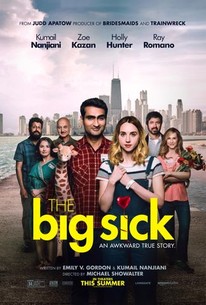
the big sickA couple deals with their cultural differences as their relationship grows.

Director: Michael Showalter
Writers: Emily V. Gordon, Kumail Nanjiani
Stars: Kumail Nanjiani, Zoe Kazan, Holly Hunter

Review by Gilbert Seah
 
When Kumail sees the girl he is dating, Emily in a coma in the hospital, he tells himself that if she ever gets out of this, he would marry her. It would be difficult for one not to feel for this romantic affair, especially when the incident is true. This is what differentiates THE BIG SICK from most romantic comedies. THE BIG SICK is based on the real-life courtship between Kumail Nanjiani and his now-wife, Emily V. Gordon. Nanjiani plays himself using the same first name in the film while Emily is played by Zoe Kazan. Hi real wife co-wrote the screenplay with her husband for the film.
The film project began when producer Judd Apatow (KNOCKED UP) met Nanjiani after he did his stand-up comic routine. So, there are a lot of stand-up routines in the film. In fact, a lot of the dialogue spoken during the film would be typical of what comes out of the mouths of a stand-up comic. This is here a good thing, as the film is pleasantly funny from start to end – dialogue-wise.

Despite the film based on true events and a real life Kumail, the romantic comedy falls into the same trap that most fall into. THE BIG STICK is a predictable Harlequin romance paperback type story complete with awkward first meeting, the necessary obstacles, in this case Emily finding out about Kumail’s other dates from the photographs in his box, not to mention her coma and his objecting parents. These obstacles are conveniently overcome for the couple to live happily ever after.

The film’s story is simple enough. While Kumail is performing stand-up comedy on stage, he is heckled (though she insists is a good heckle) by Emily, there as a spectator. An affair slowly develops. Meanwhile Kumail’s mother keeps setting him up for a Muslim bride. Kumail keeps this from Emily, though she finds out. Emily goes into a coma due to a rare decease and Kumail meets her parents forming a bond with them. It does not take a genius to figure out what happens in the end.

The film’s funniest parts come from Kumail’s Muslim parents. The mother is constantly trying to matchmake her son to marry a Muslim girl. The father is more tolerant but no less funny. Emil’s parents are funny too but they bring a more serious side to the film. The unexpected bonding between Emily’s parents and Kumail add a nice unexpected twist to the story.

The film’s humour is also heightened by having several other standup comics deliver their stand-up acts during throughout the film.

The film ends with shots of the real couple Kumail and the real Emily during the closing credits. THE BIG SICK is one of the better romantic comedies, credit to producer Apatow who seems to have the knack of discovering new comedy talent.

Trailer: https://www.youtube.com/watch?v=jcD0Daqc3Yw
 

Also, Free logline submissions. The Writing Festival network averages over 95,000 unique visitors a day.
Great way to get your story out: http://www.wildsound.ca/logline.html

Deadlines to Submit your Screenplay, Novel, Story, or Poem to the festival:http://www.wildsound.ca

Watch recent Writing Festival Videos. At least 15 winning videos a month:http://www.wildsoundfestival.com