 JULES AND JIM, 1962
Movie Reviews
Directed by François Truffaut
Starring: Jeanne Moreau, Oskar Werner, Henri Serre, Vanna Urbino, Boris Bassiak, Anny Nelsen, Sabine Haudepin, Marie Dubois
Review by Silvana Jakich
SYNOPSIS:
Decades of a love triangle concerning two friends and an impulsive woman.
REVIEW:
Francois Truffaut’s third feature film, “Jules and Jim” has been touted as one of his most poignant masterpieces. Based on a semi autobiographical novel by Henri-Pierre Roche, Truffaut’s film begins just before WW1 in Paris.
Jules (Oskar Werner)- a shy German writer and Jim (Henri Serre)- a more extrovert French writer, meet and forge a friendship that is rooted in a deep respect for one another as both artists and human beings. Through the use of a narrator, Truffaut beautifully sets up the immense bond that forms between these two men as they share life experiences and the arts together. Their close friendship reminded me of the close knit friendships we weave when we are younger which are very much “in the moment”, spontaneous and full to the brim of utter devotion.
Into this tight knit connection explodes the free spirited, uninhibited Cartherine (Jeanne Moreau). In most films, the appearance of such a character would be used as a starting point for conflict between the two friends. There would be competition and the friendship would sour but instead of this typical route, the bond was now between three people instead of two.
The joy of Jim, Jules and Catherine’s relationship coupled with wonderful shots of a European summer holiday together will make any viewer envious. The carefree joyous time they share at the seaside makes the three characters inseparable. Even when Jules and Jim become completely enamored with Catherine, the typical competitiveness which would normally be highlighted in this situation is over ruled by each character’s love for the others.
Ultimately, Jim makes way for Jules to have a relationship with Catherine after Jules wards Jim off by saying: “not this one”. Catherine and Jules marry and move to Austria.
WW1 begins and both men are sent away to fight on opposing sides. The contrast between the visuals of war and previous images of countrysides and sunshine are extreme and violently bring home the drastic change in everyones’ circumstances. Yet, even in the war time moments, Jules and Jim express great humanity as their greatest concern is that they may end up killing one another.
Fortunately, both men survive the war and meet again but now the complexities of their various relationships with Catherine come to the surface and the element of self destruction begins.
Although the character of Catherine is often fickle, selfish,cruel, unstable and vengeful, Jeanne Moreau manages to play her with a bewitching effervescence and joie de vivre which prevents her from becoming a one dimensional villain. Here is an interesting exploration of a woman who requires many lovers during a period in history when women were restricted sexually and boxed into an identity of utter loyalty to one man.
This film is also tribute to the strength of friendship and all that is pure and innocent when it comes to a deep bond. The fact that even betrayal cannot taint feelings of love that human beings have for one another is a testament to the beautiful side of human nature.
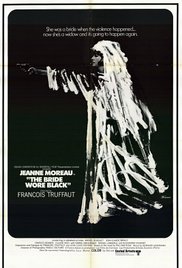 LA MARIEE ETAIT EN NOIR (THE BRIDE WORE BLACK) (France 1967) *****
 Festival Reviews