Deadlines to Submit your Screenplay, Novel, Story, or Poem to the festival: http://www.wildsound.ca
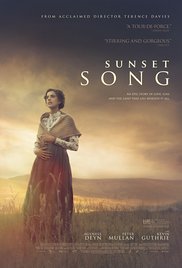 SUNSET SONG (UK/Luxembourg 2015) ****
Directed by Terence Davies
Starring: Mark Bonnar, Agyness Deyn, Peter Mullan, Kevin Guthrie
Review by Gilbert Seah
Terence Davies does David Lean in this adaptation of Lewis Grassic Gibbon’s novel of the same name. SUNSET SONG is considered one of the most important Scots novels of the 20th century.
The central character is a young woman, Chris Guthrie (Agyness Deyn), growing up in a farming family in the fictional Estate of Kinraddie in The Mearns in the north east of Scotland at the start of the 20th century. Life is hard, and made even more difficult as her family is dysfunctional. An early scene shows the patriarch (actor/director Peter Mullan) beating his son Will (Jack Greenlee) for using the words, “Move over, Jehovah,” to a horse in the barn. “I hate him,” Will confesses to Chris that night. But an almost unwatchable scene has Will being flogged later on. Davies shows that more harm comes about from human beings than the land, which is the star of his movie.
SUNSET SONG is Davies’ first film to have a setting in the countryside. All his other works were city bound. Yet Davies manages to bring out great beauty in his films despite their limitations. In THE LONG DAY CLOSES, for example, he has an extended lengthy shot of a carpet in the room, as the sun sets through a window. SUNSET SONG allows him the entire open country as his new playing field. And he uses it at the start of the film, for example, with the wide expansion of wheat in the fields before the camera lingers on its heroine lying in a spot in the field. Davies again shows his fondness for song as his characters often break out into a ditty, though not as often in this film as in THE LONG DAY CLOSES. Davies is also well known for his beautiful tracking shots. These can be observed in segments when his camera scans the deserted battlefields or the village paths where the villagers march to church on a Sunday morning.
A lot happens in the story as time progresses. The First World War arrives and goes. Its impact on Chris Guthrie comes in the form of her husband Ian Pirie (Chae Strachan) who leaves her and returns a different person, often beating her as a result of his postwar trauma. This part is particularly difficult to take by the audience but it follows the style of the book. It is the frailty of human beings that cause trouble. Only the land endures.
Davies omits the incestuous relationship between Chris and her father in the film. In the book, the father tries to persuade Chris to have incest with him, but is unable to force her after suffering a stroke. In the film, the audience sees the father falling out of bed screaming for his daughter, Chris, reaching for the door knob only to have the door locked from the outside by Chris. Davies leaves the scene to be interpreted by the audience.
The film strongest moments occur between Chris and her father. During his funeral, Chris breaks down crying at her father’s casket, unable to leave him a farewell kiss. In reality, she is unable to feel the love for this man who has given up his life for the land and his family.
The title of the film and novel indicates the fond passing of the old, traditional ways and the coming of the new. SUNSET SONG is the first of Gibbon’s trilogy “A Scots Quair”. It would be very welcome if Davies undertook the next book in a sequel to this beautiful SUNSET SONG.
Also, Free logline submissions. The Writing Festival network averages over 95,000 unique visitors a day.
Great way to get your story out: http://www.wildsound.ca/logline.html
Deadlines to Submit your Screenplay, Novel, Story, or Poem to the festival:http://www.wildsound.ca
Watch recent Writing Festival Videos. At least 15 winning videos a month:http://www.wildsoundfestival.com
 Festival Reviews