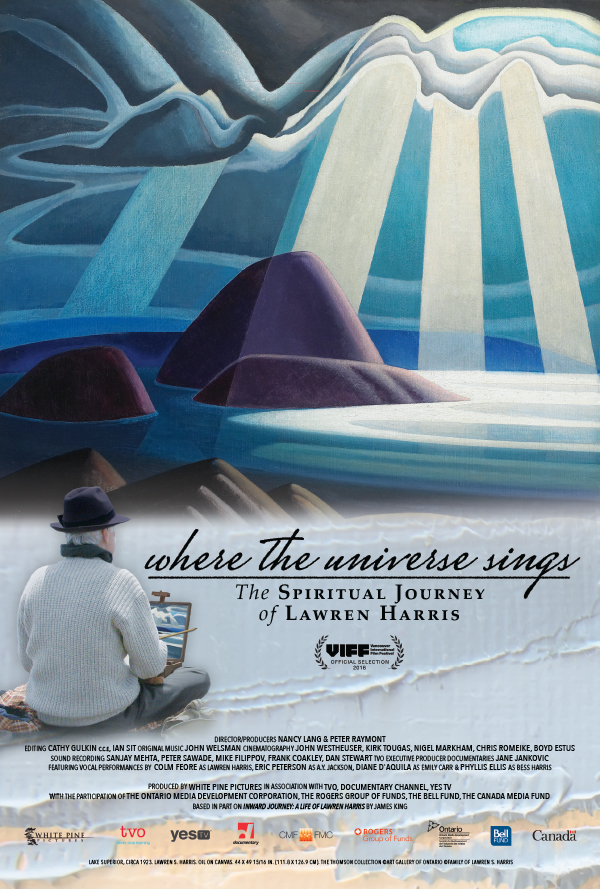
This is the story of Canadian painter and artist, Lawren Stewart Harris, CC (October 23, 1885 – January 29, 1970). After a brief introduction to the paintings, Harris background is outlined. One of his most famous works, “Mountain Forms” recently sold for over $11.2 million. Harris was born in Brantford, Ontario, and is best known as a member of the Group of Seven who pioneered a distinctly Canadian painting style in the early twentieth century. A. Y. Jackson has been quoted as saying that Harris provided the stimulus for the Group of Seven.
The voiceover is often in the first person (voiced by Canadian actor Colm Feore) of Harris as he describes his views and his paintings. Shot in chronological order, which helps the audience understand the shift in his work, the audience sees Harris’s works become more abstract and simplified, especially his stark landscapes of the Canadian north and Arctic. His initial paintings showed the city, the poor parts of Toronto where he moved and lived for a while. Harris is also a humble man, not signing nor dating his work, so that his paintings can be judged for what they are – without prejudice.
While the painting are on display, directors Raymont and Lang constantly remind the audience (sometimes too often) of the Harris’ purpose he envisioned for his paintings. Harris wants his admirers to embark on a spiritual journey to settle on a different plain of consciousness that hopefully is inspired by the paintings.
The film also includes interviews by experts the Art Gallery of Ontario’s Andrew Hunter,
the Vancouver Art Gallery’s Ian Thom, curator and former Globe art critic Sarah Milroy, biographer Peter Larisey, author Dennis Reid, curator Roald Nasgaard, collector Ash Prakash, author Lisa Christensen of Heffel’s and Harris’s grandchildren Stew Sheppard and Toni Chowne. Actor/comedian Steve Martin (in serious mode) also has a surprise appearance here having his say.
It is odd that two thirds through the film. Raymont decides to insert the segment on Harris’s life. He goes on to tell of his unsatisfactory marriage to Trixie as well as his romance with another painter, Beth supposedly his soulmate. Raymont uses the segment to explain Harris’ transition to abstract art.
An additional bonus of the documentary is the archive film footage shot by Harris himself. As he travelled through the Arctic and across Canada, his shots on film are magnificent. Even Toronto with its streetcars and old automobiles look stunning. It is odd that his painting hardly contained people. But people are plentiful in his footage.
The film also features over 130 paintings, dozens of previously un-seen photos and 8mm family films, plus works by those who influenced him, including Van Gogh, Cezanne, Gaugin, Kandinsky, Emily Carr and Georgia OKeeffe.
Director Raymont (Emmy winner Shake Hands with the Devil: The Journey of Roméo Dallaire) does his subject justice. He is fortunately to be able to show Harris archive films which really helps the audience understand the artist.
Like Harris’s paintings, Raymont’s documentary is occasionally therapeutic and inspiring.
Please note that this is the 1 hour 30 minute version, not the 60 minute version previously shown on TV.
Trailer: https://vimeo.com/192636801
Watch Winning Best Scene Readings:
 SUBMIT your TV PILOT or TV SPEC Script SUBMIT your TV PILOT or TV SPEC ScriptVoted #1 TV Contest in North America. |
 SUBMIT your SHORT Film SUBMIT your SHORT FilmGet it showcased at the FEEDBACK Festival |
 1st CHAPTER or FULL NOVEL CONTEST 1st CHAPTER or FULL NOVEL CONTESTGet full feedback! Winners get their novel made into a video! |
 SUBMIT your FEATURE Script SUBMIT your FEATURE ScriptFULL FEEDBACK on all entries. Get your script |
 Festival Reviews