HIGHLIGHTS & VIDEOS: September 2017 ANIMATION FEEDBACK Film Festival

feedbackanimationfestival's avatarFEEDBACK Animation Film & Screenplay Festival

AUDIENCE FESTIVAL AWARDS

Best Film: FRUIT

Best Animation: ONE PER PERSON

Best Characters: Pushing

Best Music: PERFECT TOWN

festival posterestival posterPEPITA & MAX, 6min, Family/Animation 
WATCH Audience FEEDBACK
festival posterUKA, 3min, Spain, Animation/Family
WATCH Audience FEEDBACK
festival posterKARMA, 4min., USA, Animation/Family
WATCH Audience FEEDBACK
festival posterPERFECT TOWN, 4min., Switzerland, Animation/Fantastic
WATCH Audience FEEDBACK
festival posterONE PER PERSON, 10min., Canada, Animation/Comedy
WATCH Audience FEEDBACK
festival posterFRUIT, 7min., Germany, Animation/Experimental
WATCH Audience FEEDBACK
festival posterOUR CRAPPY TOWN, 8min, USA, Animation/Comedy
WATCH Audience FEEDBACK

The FAMILY SEPTEMBER 2017 FEEDBACK Film Festival was truly a great success.

The theme of the festival was “CYCLE OF LIFE”.

Every film showcased was about the process of life. We are born. We live. We pass on.

NOTE: This was a showcase of the best FAMILY films from around the world.

This was a two part night. The first half was the best of live action shorts. And the 2nd half was the best…

View original post 166 more words

HIGHLIGHTS & VIDEOS: September 2017 FAMILY FEEDBACK Film Festival

HIGHLIGHTS & VIDEOS: September 2017 Comedy Short Film Festival

comedyfestival's avatarComedy FESTIVAL

AUDIENCE FESTIVAL AWARDS

Best Film: UNICORNLAND

Best Performances: SUITCASE

Best Cinematography: INGENUE-ISH

Best Music: BAGGAGE

WATCH AUDIENCE FEEDBACK VIDEOS: 

INGENUE-ISH, 10min, USA, Comedy
WATCH Audience FEEDBACK
festival posterSUITCASE, 13min, France, Comedy
WATCH Audience FEEDBACK
MANEKI-NEKO, 12min, USA, Romance/Comedy
WATCH Audience FEEDBACK
festival posterLAST NIGHT WAS A MISTAKE, 15min, USA, Romance/Comedy
WATCH Audience FEEDBACK
festival posterBAGGAGE, 17min, USA, Comedy
WATCH Audience FEEDBACK
festival posterUNICORNLAND, 7min, USA, Comedy/Webseries
WATCH Audience 

The COMEDY LOS ANGELES SEPTEMBER 2017 FEEDBACK Film Festival gave our audiences the best of comedic short movies from around the world.

The theme of the festival was “RESET”.

Every film showcased was about a situation that was about a character(s) needing to start over again.

The first half of the SEPTEMBER 2017 FEEDBACK Los Angeles Film Festival featured a showcase of the best COMEDY short films from around the world.

The crowd was very active for our 4th venture to Los Angeles in the FEEDBACK…

View original post 129 more words

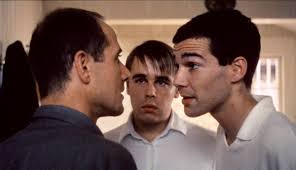
1997 Movie Review: FUNNY GAMES, 1997

FUNNY GAMES
FUNNY GAMES, 1997
Movie Reviews

Directed by Michael Haneke
Starring: Susanne Lothar, Ulrich Mühe
Review by Matthew C Holmes

SYNOPSIS:

Two psychotic young men take a mother, father, and son hostage in their vacation cabin and force them to play sadistic “games” with one another for their own amusement.

REVIEW:

Austria has given the world a variety of coolness over the years: The city of Vienna, Sacher-torte (jam filled chocolate cake), Mozart, and a tidbit of cinematic insanity called Funny Games.

This film just plain works, from the setup to the final frame, there is an uneasy anticipation that permeates the atmosphere and writer/director Michael Haneke is to be cheered and pelted with small plush toys for his manipulation of both the camera and the watching audience.

So, Anna and Georg are going to spend some time at their vacation home with little Georgie and the dog in tow. Relaxation, music, and sailing are all on the menu, but when Peter and Paul arrive at the house, asking for eggs, everything goes out the window and the true horror of the film begins, and doesn’t ever stop.

The classification of this film is a bit tricky, and I am hesitant to stick it with a strict genre label, in spite of the fact that I have already used the word horror. (see previous paragraph) It is definitely a dramatic film, being that it is filled with moments of drama and little to no overt humor.

It also has thrilling moments, filled with tension and unspoken anticipation. And with two tennis-sweater and white short shorts wearing psychos in the mix, the horror elements become obvious and wonderfully disturbing. Writer/director Haneke has stated frequently that he did not make this to be a horror film but instead a “moralistic comment about the influence of media violence on society”. Ultimately it is all of these and more.
The most compelling and the most bizarre aspect of Funny Games is the half a dozen or so times that the two antagonists “break the fourth wall” or acknowledge the watcher, foregoing the illusion of a purely spectator audience. It is not a frequent occurrence, but it happens enough that the mood remains unbroken and the instance it happens becomes unforgettable.

They are as obvious as the character speaking directly into the camera, as obscure as the two psychos discussing the film’s runtime, and as devilishly subtle as a quick wink into lens when the character thinks you might not be paying attention. These little instances are the real meat of the point that Haneke was trying to make.

Bottom line, Funny Games takes psychological and physical torture to place unseen in film. Honestly, it can be difficult to watch at times, not because it is gory or overtly maniacal, but the sheer magnitude of disquiet and discomfort that pours off of the screen will keep you fidgeting in your seat.

Funny Games has since been remade for English speaking audiences. It was written and directed by Haneke himself and is shot for shot, line by line, exactly the same as the original, still called Funny Games, the only difference being the cast. I suggest trying to seek out the Austrian version if you can, the actors, being unknown in this country, put on a truly convincing and terrifying show as the hapless victims and the gentle psychos.

Do not let this film pass you by.
funny games

1997 Movie Review: FROM DUSK TILL DAWN (1997)


FROM DUSK TILL DAWN (1997)
Classic Movie Review
Directed by Robert Rodriguez
Starring George Clooney, Quentin Tarantino, Harvery Keitel, Juliette Lewis
Review by Jared Bratt

SYNOPSIS:

On the run from “Johnny law”, Seth (George Cloony) and Ritchie (Quentin Tarantino) Gecko, two newly escaped convicts, hot off the heels of their most recent bank heist, abduct a family of innocent commuters as they proceed to evade the authorities by fleeing across the U.S. border, into Mexico, so that they can rendezvous with their foreign criminal counterparts at a local dive bar known as the “Titty Twister”. Using their freshly acquired hostages as collateral, so as to ensure the stability of their otherwise expendable lives, the two ruthless brothers force the family’s father, Jacob, a faithless preacher, (Harvey Keitel) and his two kids, his son, Scott, and his daughter, Kate, (Julliette Lewis) to accompany them into the excited bar while they wait to meet up with their Mexican affiliates. Unbeknownst to them, however, is the fact that the seedy establishment actually serves as a well-disguised feeding ground for a bloodthirsty cult of famished vampires lead by their equally ferocious queen, (Salma Hayek) who slyly masquerades as the joint’s main attraction, a seductive stripper who opportunely diverts the club’s clientele from realizing the absurd, horrific horrors that lie ahead.

REVIEW:

From Dusk Till Dawn is one of those movies that appear to always be playing on T.V. throughout all hours of the night. Essentially two films for the price of one, the movie accounts for an extremely distinctive blend of the taught “70sesque” crime-caper, exploitation film meets the comically grounded, gratuitous gore fest of an Evil Dead picture. Both these genres are wrapped up even further in, what you could say, accounts for the film’s third genre known as “Tarantinoism”.

Director Robert Rodriguez makes sure to keep that well known brand of Tarantino madness in tact while he still keeps things fresh, bringing to the table, his own unique eye for a quick cut, spaghetti western, John Woo “shoot ‘em up” style of filmic execution. Essentially, Rodriguez applies the same acclaimed style that initially propelled him to become one of the most innovative filmmakers of his generation to the horror genre. Working from a screenplay written by Tarantino himself, Rodriguez creatively retains that “no-holds-barred” sense of horror movie-making aesthetic. Harkening back homage to the great, grotesque gore-fests of the 60s, 70s and 80s, From Dusk Till Dawn’s own 1996, release, unfortunately, didn’t quite generate nearly half as much the buzz as anyone of those eras, yet since then, it undoubtedly has gone on to be hailed as an innovative cult classic.

The film kicks off with a drop kick to the face that sets the viewer in check reminding us to acknowledge the fact that this is indeed a movie based on all things Tarantino. We are immediately introduced to the movie’s abundant amount of “badassery” from the second the actors start to retort Tarantino’s unique brand of unconventionally witty dialogue.

Michael Parks’ first screen incarnation of Texas Ranger Earl McGraw initially warms us up to the film’s crime-caper element while setting us up for the ridiculously cool, deadpan cast that is to follow directly after his own arrival into the picture. He enters a local convenient store, wandering into a classic Tarantino monologue ranting politically incorrect obscenities with his old-fashioned, raspy voice and squinting Dirty Harry mannerisms in the store clerk’s direction. Park’s screen time, here, is brief, nevertheless, he truly owns every second of it. He is magnetically charismatic in a John Wayne type of way while his poised delivery of Tarantino’s “talky” dialogue alone is enough to make you believe the film itself revolves around his character That is until he is shot dead, with a bullet through the head, by the cold-blooded Geckos. The brothers then proceed to shoot up, and burn down, the convenient store, adding more corpses to their rapidly escalating body count, while the film’s tone is deceivingly established as reflecting yet another exercise in post Pulp Fiction crime lore. Nevertheless, midway though what appears to be a predictable ride, Rodriguez brilliantly shifts his movie into Desperado horror movie mode as the film devilishly reveals its true identity; the local “barflys” populating the film’s sleazy bar setting unexpectedly reveal themselves to be well disguised vampires equipped to feast on anyone unlucky enough to be trapped within their horrific, evil domain.

Once this brilliant shift in genres occurs, From Dusk Till Dawn truly alters into something shockingly different. Not only does Cloony’s anti-hero protagonist become the guy the audience is ultimately rooting for but also the movie itself takes on an exceptionally absurd sense of style and filmic execution. Rodriguez uses the action spawned switch, within the story, as a well advised cue to up the stakes as he takes the opportunity to run creatively rampant shooting every type of gratuitous gore gag in the book. Gone is the downcast, moody, angst filled suspense pacing of the film’s first half and, while the tension is indeed still apparent, accompanying it, is a slyly comedic pastiche blend of “in your face” action and squirting blood and guts-carnage. All of this is eccentrically strung together by an underlining sense of campy hilarity that seems to get stronger as the film’s action scenes grow gorier and more graphically excessive in nature.

Starring in his first screen role post E.R. fame, George Cloony deserves major “cred” as the brothers’ hard-bitten, yet persistently professional, leader; enthusiastically playing the movie’s anti-hero as if he were the rejected reservoir dog cousin of Snake Plisken. Cloony’s Seth Gecko seems bound to leap off the screen, destined to shove a 357 magnum down the throats of the film’s collective viewers. Indeed Cloony stylishly brings a certain amount of suave charm and charisma to the role; however, he fuses these likable traits with such a towering level of contrasting toughness that his performance truly shines as this constant, indestructible force of brooding male machismo. Almost as equally impressive as Cloony’s unconventional acting is Tarantino’s own subdued portrayal of a sex addicted rapist. Atypically restraining his well-known flamboyantness, Tarantino opts to portray Ritchie Gecko as a disturbingly reserved individual with a clear sense of pent up sexual rage. Essentially, Tarantino makes his role work because he plays it straight while, for the most part, cleverly managing to avoid slipping into just another self-referential caricature of himself.

Also, adding to the list of actors playing against type, the great, and underused, Harvey Keitel is featured, here, as a swift speaking, holy man with a shattered belief in god and himself. Keitel humbly downplays his obvious command until it ‘s tonally time for him to digress the faithless preacher persona into a vampire slaying, scripture citing badass. Keitel plays his role with such prevailing and convincing delivery that even when the movie drastically transforms into a surrealistic horror-action-comedy, his performance, and ultimate unflinching dedication to the role, never once seems false.

From Dusk Till Dawn is a volatile burst of creative oomph. While, admittedly anyone looking for an award friendly crime picture will most likely leave with a bad taste in their mouths, Tarantino enthusiasts, action junkies, and horror freaks alike should rejoice in seeking this flick out … and grab a beer.
from dusk to dawn


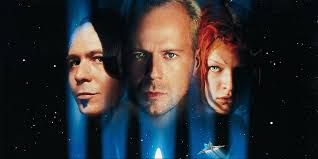
1997 Movie Review: THE FIFTH ELEMENT, 1997


THE FIFTH ELEMENT, 1997
Movie Reviews

Directed by Luc Besson
Starring: Bruce Willis, Gary Oldman, Ian Holm, Milla Jovovich, Chris Tucker, Luke Perry
Review by Emma Hutchings

SYNOPSIS:

A former government agent grudgingly sets out on a quest to save the world from an ancient evil after the only hope of thwarting destruction falls into the back seat of his cab.

OSCAR NOMINEE for Best Effects, Sound Effects Editing

REVIEW:

The Fifth Element is Luc Besson’s big budget futuristic blockbuster, which, at the time, was the most expensive film ever produced outside of Hollywood. Besson again called on the might of Gary Oldman to play the bad guy, following his fantastic performance in Léon (1994). Besson helped out as producer on Nil by Mouth (Oldman’s hard-hitting directorial debut), which was also released in 1997 and also starred Charlie Creed-Miles (Cornelius’ protégé David in The Fifth Element and Billy in Nil by Mouth).

This film is a visual extravaganza. The rich and vibrant colours ensure that the future is a bright and appealing one, not bleak and dystopian, as in so many futuristic films. Besson said that he wanted to show a vision of the future that wasn’t dark and dangerous. Mark Stetson, the Special Visual Effects Supervisor on the film, who had previously worked on Blade Runner, said “One of the most gratifying aspects of working with Luc on this picture is the fact that it’s not another Blade Runner. The look of this film is very different and fresh.” What comes across most about the visual effects is the amazing attention to detail. The shots of 23rd century New York are some of the highlights. Leeloo’s POV shot when she sees the skyline for the first time is remarkable. The skyscrapers, packed closely together, ascend high into the clouds, with subways zooming up and down their sides and the areas in between packed with flying cars. The quirky, original costumes were designed by Jean-Paul Gaultier, who even checked over the extras individually before scenes to make sure they were looking their best. Two famous French comic book artists, Jean Giraud and Jean-Claude Mézières developed the production design. They were responsible for much of the iconography of the film; the vehicles, spacecrafts, buildings, human characters and aliens.

There are references to other films in The Fifth Element. Although described as the Anti-Blade Runner, the cityscape with enormous advertising screens and the flying cars are definite similarities. Brion James (who plays General Munro, Korben’s former commanding officer) played the character of Leon in Blade Runner. The machine that regenerates Leeloo is very similar to the one used to create the robot in Metropolis (1927). The thermal bandages that are strapped to her are reminiscent of the metal bands covering Maria when the Man-Machine is converted into her.

The story boils down to a straightforward good vs. evil narrative. A huge, dark sphere of absolute evil attempts to destroy Earth every 5,000 years and five elements are used together to stop this happening. Earth, wind, fire and water, along with the Supreme Being; an ultimate warrior created to protect life. A simple but effective technique used a number of times throughout the film is cross-cutting. Used to switch between action taking place in different locations at the same time, it is cleverly used here because characters often finish each other’s sentences. For example, when Zorg meets with Aknot (leader of the Mangalores) to exchange crates of weapons for the case of stones, he shuts the lid and then states “This case…is empty.” The scene then cuts to Leeloo laughing and Cornelius asks “What do you mean, empty?” Cut back to Zorg, who tells his lackey “Empty. The opposite of full. This case is supposed to be full! Anyone care to explain?” Cut back to Leeloo, explaining in the divine language that they gave the stones to someone they could trust. Cornelius says “We’re saved” and then a final cut back to Zorg, who says “I’m screwed.” This is an intelligent use of dialogue and editing that is both interesting and efficient.

Korben Dallas is rather a reluctant hero. He was living a lonely, uneventful life before Leeloo crashed through the roof of his cab. At the beginning of the film he says he wants to meet the perfect woman. He hasn’t had very good experiences with women; his wife left him for his lawyer and his mother continuously calls him just to moan at him. He is laconic and very humourous at times. When sent in to negotiate with the Mangalores, he casually strolls in and shoots their leader in the head asking, “Anyone else wanna negotiate?” It is interesting that our hero Korben and the villain of the film, Zorg, never meet or communicate with each other. Usually there would be an epic battle at the end where they would fight until the villain was killed. However, they narrowly miss bumping into each other as Korben gets into an elevator and Zorg leaves the one next to it, ultimately getting himself blown up by the Mangalore’s bomb. There is a connection between hero and villain though; Zorg gets rid of 1 million people from one of his smaller companies, a cab company, and in a later scene Korben gets a message telling him he’s fired. The name ‘Zorg’ is clearly visible at the bottom of the message.

Leeloo is the heroine of the film. Beautiful and very strong, she is often referred to as ‘perfect’. She is a fast learner, able to absorb large quantities of information; she learns 5,000 years worth of Earth’s history from a computer in a very short amount of time. She is kooky and has lots of funny moments in the film, usually when she is trying to understand certain words in the English language (“Big ba-dah boom”, “Auto-wash”, “Mul-ti-pass”). The ‘divine language’ spoken by Leeloo has 400 words and was invented by the director and Milla Jovovich. Jovovich stated that she and Besson wrote letters to each other in the language as practice and by the end of filming they were able to have full conversations.

The number 5 is a recurring motif in this film. Apart from the obvious 5 elements there are also lots of other notable occurrences. Evil returns every 5,000 years, Korben has 5 points left on his licence, the Council asks Zorg to fire 500,000 people, and Korben says to General Munro “Nice to see you in the 5,000 block”. The bomb in Fhloston Paradise has around 5 minutes left when Ruby notices it, Zorg stops it with 5 seconds remaining and the Mangalore’s bomb counts down from 5 seconds. Ruby’s radio show starts at 5, Korben says “If we don’t get these stones open in 5 minutes, we’re all dead.” Ruby says “”Every 5 minutes there’s something, a bomb or something!” and right at the end the scientist says “They’re not ready. They need 5 more minutes.”

Any observant viewers (actually that should be listeners) may notice two occurrences of the infamous ‘Wilhelm Scream’, a distinctive sound effect that has found a following with many sound editors and movie fans. First used in Distant Drums, a 1951 film starring Gary Cooper, it was later adopted by sound designer Ben Burtt who named it after the character of Pvt. Wilhelm in The Charge at Feather River (1953) who screams when he is shot in the leg by an arrow. Burtt included it in many of the films he has worked on including the Star Wars and Indiana Jones films. It grew in familiarity and continues to be heard in new productions released every year. In The Fifth Element it can be heard when Zorg blows up Right Arm at the airport and during Leeloo’s fight with the Mangalores, as two are sent flying out of the Diva’s suite (turn the volume up for this one).

The film ends after the world is saved by the power of love. Leeloo finishes learning all about Earth on the computer and becomes particularly disturbed by W for War. She watches all of the images flash by of chaos and destruction and she despairs at how people could do such things to each other. She tells Korben, “Everything you create, you use to destroy” and he replies “Yeah, we call it human nature.” Her faith in humanity needs to be restored in order for her to save them, Korben must show her the world has some good and there are beautiful things worth saving, like love. She doesn’t know love, she says “I was built to protect, not to love”. She needs him to tell her that he loves her, this empowers her and she draws on the other four elements and destroys the ancient evil. Earth is rescued from annihilation and the two of them can live happily together (he’ll need to get another job though). I highly recommend this film. It has a great cast of actors all having a good time, the visuals are fantastic and it’s very enjoyable as long as you don’t take it too seriously.

THE FIFTH ELEMENT
 

1997 Movie Review: FACE/OFF, 1997

FACE/OFF, 1997
Movie Reviews

Director: John Woo

Stars: John Travolta, Nicolas Cage, Joan Allen, Alessandro Nivola, Gina Gershon, Dominique Swain, Nick Cassavetes, Colm Feore, Colm Feore, John Carroll Lynch

Review by Matthew Toffolo

SYNOPSIS:

A revolutionary medical technique allows an undercover agent to take the physical appearance of a major criminal and infiltrate his organization.

REVIEW:

There is a creepy feeling when watching Face/Off. The main theme of this action packed drama is about dealing with loss and death as Travolta’s character is having an extremely difficult time getting over the murder of his son. Of course fiction became truth later on as Travolta lost a son in real life. So when you’re watching these scenes you can’t help but feel for the real life actor who is crying on screen for his son’s loss, even though it hadn’t happened yet.

I remember when this film came out in 1997 and how much I enjoyed it as a 20 year old kid. My friend Wes Berger and I were what you call teenage idealistic film buffs as we used to go to the movies weekly and see as many foreign and independent movies as we could living in the Niagara Region. To some we were also film snobs, looking down on all of the shoot em up blockbusters that were beginning to hit its peak. But we weren’t ashamed to admit that we both liked Face/Off enormously because it seemed to have a nice psychological edge to it while filled with incredibly unrealistic but exciting action moments.

This was also the time when both Travolta and Cage were at their peaks professionally. Cage in particular was coming off his Oscar win for Leaving Las Vegas as was considered one of the best actors on the planet. That comment seems kind of silly in present day, as Cage is considered kind of a hack, as he continues to do about 3-4 poor films a year. In 1997 Cage had his whole career ahead of him and was in considerable demand in Hollywood. So having Travolta and Cage in this action romp in 1997 caused a lot of attention for me and my friendly film snobs. Perhaps John Woo’s film was more than just blow em up!

There are some interesting moments in Face/Off as Woo sure is a fine director who makes a lot of unique choices to heighten the excitement and emotions in the film. The only thing I remember talking about with people afterwards was the key question – Was Cage better at playing Travolta? Or was Travolta better at playing Cage?

Questions like this is what 20 year olds growing up in the Tarantino generation discuss. Even though in hindsight these are wasted conversations, at the time I do remember having fun with it. My friend Wes was on team Cage as I was on team Travolta. And the circle talk of meaninglessness began for hours on end. Both actors really chew up the scene as they seem to be acting in a strange land of over-the-top-ness while the other actors around them are grounded in reality. The performance of Travolta’s wife (who became Cage’s wife but was actually Travolta – it was confusing!) in particular stands out. Joan Allen pulls off a fantastic performance in the film without anyone really realising it. I remember even at age 20 how pulled in I was by her character. Perhaps today that role would of went to some 30s supermodel who would only be capable of just playing the beats in the script and nothing more.

Face/Off is a fun film even today as I really was impressed how much it stands up. That same year Cage acted in another action film, Con Air, that really doesn’t stand up at all and is almost laughable in its action executions to today’s 21st century world.That says a lot about John Woo. In Face/Off, Woo directs all of the action sequences with the emotions of the character’s angst and inner conflicts. So when Travolta for example is involved in a boat chase with Cage, we as the audience are hooked in because we just previously saw a scene of his struggles to survive the pains of his son’s death. So there is context in the action without just having the action. So his films hold up generation after generation because we feel while the guns are a blazing across the screen.
face off

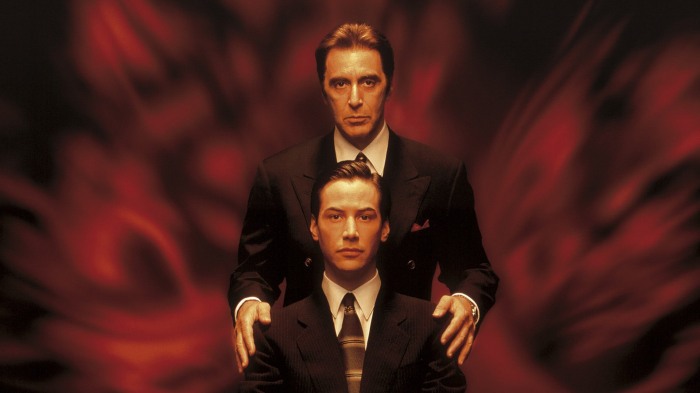
1997 Movie Review: THE DEVIL’S ADVOCATE, 1997

THE DEVIL’S ADVOCATE, 1997
Movie Reviews

Directed by Taylor Hackford

Cast: Al Pacino, Keanu Reeves, Charlize Theron, Connie Nielson, Jeffrey Jones, Craig T. Nelson,
Review by Surinder Singh

SYNOPSIS:

Hotshot lawyer Kevin Lomax (Keanu Reeves) accepts an invitation to join a prestigious New York law firm notorious for it’s track record of getting its guilty clients cleared of all charges. Lomax is drawn in by the money and power that comes with the job; a seduction cleverly orchestrated by the firm’s boss John Milton (Al Pacino). But as Lomax delves deeper into the firm’s legal dealings he discovers there’s more to Mr. Milton’s success than meets the eye…

REVIEW:

It’s fair to say that Pacino did his share of mentoring during the nineties. As well as winning his Oscar and churning out some great central performances, he also played a number of supporting roles aside the new generation of leading men. In Donnie Brasco (1997) he supported Johnny Depp and with Any Given Sunday (1999) he did the same for Jamie Foxx. It’s always important for a screen-acting veteran to take stock in the new generation because it gives them the chance to see how good they really are! Perhaps one of the greatest tests for any upcoming actor is: “can I hold my own against Al Pacino on screen?”

As Kevin Lomax, Keanu Reeves was offered the challenge! Reeves arrives on screen looking suitably sharp and suave, he oozes confidence as soon as he enters the courtroom. We are shown someone so ambitious that he’ll happily tear up a poor young girl on the witness stand to win his case. It’s not long until he attracts interest from like-minded people in his field. As the film’s title suggests we’re witnessing someone on a moral journey in a job that continuously puts morality up for question. Reeves plays Lomax brilliantly as a man who is quite comfortable with drawing a line of professionalism between himself and the case. At this point in his journey it’s not important whether his client is guilty or not, only that he wins!

The film really gets going once Lomax is in New York and poised to begin his case with the new law firm. Enter Al Pacino: in a wonderful scene on top of the huge sky-rise looking down at the world below, Milton acquaints himself with his new employee Lomax. Director Taylor Hackford does a great job of balancing a realistic drama set against a modern day New York with the supernatural and mythic elements at play. The scene is totally plausible but at the same time positions Pacino’s Milton as the Master of the Universe. He’s more than just a successful man; his power clearly reaches further than Lomax is presently aware of.

Many actors in the past have played the Prince of Darkness: Jack Nicholson in The Witches of Eastwick (1987), Robert De Niro in Angel Heart (1987) and of course Tim Curry in Legend (1985). By default, any actor who takes on such a notorious character will be compared to the previous incarnations. Pacino is charismatic and carries his character with a sense of cool that draws you in from the moment you meet him. Pacino may be a small guy but in The Devil’s Advocate he owns every space he walks into and everyone in it! Pacino’s Milton is by far the most contemporary and convincing incarnation of Satan for many years.

Like he did in Donnie Brasco, Pacino plays a mentor and takes Keanu Reeves’ Lomax under his wing. Milton explains his philosophy leaving his new apprentice in awe: “Look at me! Underestimated from day one. You’d never think I was a master of the universe, now would ya?” Rather than exert superhuman physical powers, Milton is the puppet master who prefers discretion: “I’m the hand up Mona Lisa’s skirt. I’m a surprise, Kevin. They don’t see me coming!” Lomax sees this simply as advice to help him progress as a lawyer. All the while his new mentor who is ten steps ahead is manipulating him!

The movie is full of devilishly splendid set pieces. Lomax is advised to seek out a man named Moyez (Delroy Lindo) a witchdoctor who’s on trial for the ritualistic butchering of animals. Moyez offers Lomax a helping hand (via a strange ritual with a decapitated tongue) and sure enough the prosecution cannot get a word out in the following trial. The scene gives supernatural depth to the power of Milton and his associates, showing the unsettled Lomax the extent to which his “unfaltering success” is being secured. Perhaps the greatest set piece is the killing of Eddie Barzoon (Jeffery Jones). As he jogs through Central Park we hear Pacino’s piercing voice off-screen, the feeling of an impending doom takes over until we see the poor Barzoon fall to his bloody fate.

Like most films about the Spirit of Evil (walking amongst us in modern times) The Devil’s Advocate is essentially a story about someone saving their soul from Evil. The idea that through all Evil’s temptations we eventually choose the path to light and salvation. On reflection this movie is unlike the others in the way it delivers the age-old story to you in a fresh, contemporary and engaging manner. The performances are strong and Pacino’s performance completely convinces you he’s the modern incarnation of the Prince of Darkness. Plus, on purely popcorn terms this movie is a solid thriller that doesn’t rest too heavily on religious fact and while the symbols of Christianity are ripe throughout they do not alienate the audience.

The Devil’s Advocate is a great movie to watch over and over. Not exactly ‘light-entertainment’ but a strong contemporary thriller that will satisfy. It also contains arguably the best portrayal of Satan on film…yet another testament to the awesome acting talent of Al Pacino!

 the devils advocate

Short Story Reading: Give Me Truth or Give Me Silence, by Melissa R Mendelson

wildsoundwritingfestival's avatarWILDsound Writing Festival

Performed by Laura Kyswaty

 Get to know the writer:

What is your short story about?

Give Me Truth or Give Me Silence is a Dystopian short story, where individuals are forced to speak the truth, but like with any other society, there are those that still lie. But it might be the last lie that they will ever speak.

What genres would you say this story is in?

Science-Fiction

How would you describe this story in two words?

Honesty Hurts

What movie have you seen the most in your life?

Since I was eight-years-old, I’ve seen a lot of movies and a lot of television shows, but one of my favorite movies is Suicide Kings, which is an intensely written Drama, where the truth is a cool hand played right up to the last bluff.

What is your favorite song? (Or, what song have you listened to the most…

View original post 360 more words