Film Review: SPIDER-MAN: HOMECOMING (USA 2017) ***

Deadlines to Submit your Screenplay, Novel, Story, or Poem to the festival: http://www.wildsound.ca
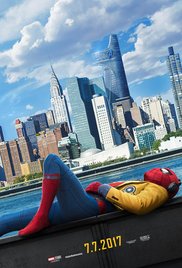
spiderman homecomingFollowing the events of Captain America: Civil War (2016), Peter Parker attempts to balance his life in high school with his career as the web-slinging superhero Spider-Man.

Director: Jon Watts
Writers: Jonathan Goldstein (screenplay), John Francis Daley (screenplay)
Stars: Tom Holland, Michael Keaton, Robert Downey Jr., Marisa Tomei, Jon Favreau, Gwyneth Paltrow

Review by Gilbert Seah

The second re-boot of SPIDER-MAN arrives with all the hype and with it fear that the new look would result in a film as disastrous as the D.C. extended universe films MAN OF STEEL, BATMAN V. SUPERMAN or SUICIDE SQUAD. Thankfully, the new Marvel Cinematic Universe SPIDER-MAN HOMECOMING is not so bad and promises a much better sequel in the making.

The film opens with Peter Parker (Tom Holland) arriving with all his super spider powers intact. Instead of learning to control his new found powers, Parker has to learn how to be Spider-Man. He has arrived several months after the events of Captain America: Civil War, and subject to the help of his mentor Tony Stark aka IRONMAN (Robert Downey Jr.), learns to balance his life as an ordinary high school student in Queens, New York City with fighting crime.
The villain of the piece is introduced at the start of the film as an enterprising business man, Adrian Toomes (Michael Keaton). Forced out of his business by the big boys, Toomes ends up taking revenge on the city by turning himself into the Vulture that eventually battles Spidey. Keaton is exceptionally cynical in his role, the only problem arising is that Toomes is so victimized that one cannot help but root for this poor victim. At one point in the film, Toomes is so convincing in naming Stark Enterprises as the villain that one cannot help but almost believe him. The Vulture’s costume looks too much like Keaton’s Birdman’s outfit, as if reminding the audience of his Best Actor Oscar nominated role.

The climatic battle between the Vulture and Spidey looks too one sided, on the side of the Vulture who seems imminent to win the battle but of course wouldn’t. When Toomes finally ends up beaten, it seems quite unbelievable.

Despite being an action film, the film’s best moments are the interrogation scenes – one where Toomes questions Parker in the car and reveals that he is aware of Parker’s secret identity. The other is Spider-Man questioning one of the crooks regarding Toomes’ activities. Both segments expertly balance humour and surprise while displaying good dialogue expected from the team of the film’s 6 writers.

HOMECOMING is the lightest and goofiest of all the SPIDER-MAN films. But one will eventually get annoyed at Spider-Man’s inability to fight his opponents properly before gaining control of his suit. Instead of learning to use his super powers, Spidey has to learn to use Stark Enterprises’ new Spider-Man suit. In one action set-up, Spider-Man is constantly bungling and falling around learning how to use his suit in extended power mode.

The film features an eclectic cast that carries it out a bit too far. Spidey’s love interest Liz is played by African American, Laura Harrier. His school principal is played by Korean Kenneth Choi and his best friend, Ned by Filipino Jacob Batalon. Tony Revolori as Flash Thompson: Peter’s rival and classmate is latino. The script invests a bit too much time in Ned’s character, his repeated remarks on Spider-Man often ending up more annoying than funny. He is at least given something to do (computer hacking) in the story. The film feels like a teen movie with the humour and high school setting. But one can notice that all the high school kids are performed by actors over 21, Holland included (at 22 playing a 15-year old). The film is not without teen dick jokes (Flash’s song as a d.j.) and the ending song with the lyrics sounding like the ‘f’ word.

It is surprising that director Watts has ended up making more an action comedy than an action hero movie. Watts made two serious films, the thriller COP CAR and the horror chiller CLOWN prior to this. But better funny than too serious. Look what happened to the James Bond and the Planet of the Apes films?

With all the goofiness and Spidey’s learning curve out of the way in this re-boot, the sequel should promise a more mature Spider-Man and hopefully a more mature action film as well – with a better balance between action and humour.

Trailer: https://www.youtube.com/watch?v=U0D3AOldjMU

Also, Free logline submissions. The Writing Festival network averages over 95,000 unique visitors a day.
Great way to get your story out: http://www.wildsound.ca/logline.html

Deadlines to Submit your Screenplay, Novel, Story, or Poem to the festival:http://www.wildsound.ca

Watch recent Writing Festival Videos. At least 15 winning videos a month:http://www.wildsoundfestival.com
Film Review: DESPICABLE ME 3 (USA 2017) ***

Deadlines to Submit your Screenplay, Novel, Story, or Poem to the festival: http://www.wildsound.ca

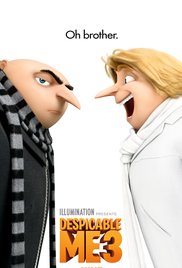
DESPICABLE ME 3Gru meets his long-lost charming, cheerful, and more successful twin brother Dru who wants to team up with him for one last criminal heist.
Directors: Eric Guillon, Kyle Balda
Writers: Cinco Paul, Ken Daurio
Stars: Steve Carell, Kristen Wiig, Trey Parker

Review by Gilbert Seah
 
There are two attractive ingredients in the DESPICABLE ME animated features. One is the super-villain Gru (Steve Carell) or now ex-super villain Gru now working for the AVL (Anti-Villain League). The other are the adorable mumbling Minions. If one is not entertaining one enough, the other strive to be.

The film opens not with the Minions or Gru but with the story of a new super villain named Balthazar Bratt (voiced by South Park’s co-creator Trey Parker). Bratt was a former child actor who portrayed a young super villain in a popular television series before the show was cancelled as a result of his puberty and his waning popularity. This led to him adopting his former persona to become an actual super villain (complete with 80’s eraser head haircut and fashion). Bratt is out to steal the world’s most expensive diamond, in order to fuel his robot invention to destroy Hollywood as revenge, but along arrive Gru and wife (Kristen Wiig) to stop him.

It is obvious that DESPICABLE ME pays homage to the PINK PANTHER films. For one, Inspector Clouseau was French as is director Coffin and the diamond is unashamedly coloured pink. When the diamond is in show, the music comes on, though not with the famous Henry Mancini tune, but with Michael Jackson’s BAD in this case. As Bratt steals the diamond, he moonwalks Michael Jackson style to the diamond.

The main story of DESPICABLE ME 3 involves Gru and Lucy fired from the AVL owing to their failure in capturing Bratt. The others are subplots – quite a number of them – ties in with this event. One of these are the minions who want Gry to go back being a villain. The Minions also have the talent of showing up anywhere and everywhere during the movie. Kids love this, as observed during the film’s promo screening. The kids would scream out every time (adults beware!) the little darlings appear. The subplots involve Lucy bonding with her three adoptive children. The main one involves Gru meeting up with his newly found brother (also voiced by Carell), a more flamboyant character, thanks to his mother (voiced by no less than Julie Andrews).

But with all the subplots including the main story, the film strugglers to create very funny moments or high points that would make this sequel memorable over the others (including THE MINIONS) or even over the other Illumination Entertainment animation like THE SECRET LIFE OF PETS.

The film appropriate premiered at the Annecy International International Film Festival, director Pierre Coffin being French as such. The film opens this weekend alongside two other comedies THE HOUSE and BABY DRIVER and though will face stiff competition should do well at the box-office this weekend coming off at number 1. It also helps that there are countless Minion fans, both adult and kids around the world that will forgive an average DESPICABLE ME sequel, which is very much what this one is. DESPICABLE 3 is good, predictable, harmless family fun.

Trailer: http://universalpictures.ca/detail.aspx?title=DESPICABLE+ME+3&lang=en

Also, Free logline submissions. The Writing Festival network averages over 95,000 unique visitors a day.
Great way to get your story out: http://www.wildsound.ca/logline.html

Deadlines to Submit your Screenplay, Novel, Story, or Poem to the festival:http://www.wildsound.ca

Watch recent Writing Festival Videos. At least 15 winning videos a month:http://www.wildsoundfestival.com

Film Review: MANIFESTO (Australia/Germany 2016) ***

Deadlines to Submit your Screenplay, Novel, Story, or Poem to the festival: http://www.wildsound.ca

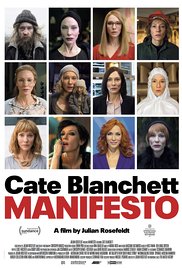
manifesto.jpgCate Blanchett performs manifestos as a series of striking monologues.
Director: Julian Rosefeldt
Writer: Julian Rosefeldt
Stars: Cate Blanchett, Erika Bauer, Ruby Bustamante

Review by Gilbert Seah
 

 It is best to know the definition of the term MANIFESTO before seeing this movie. According to Wikipedia, a manifesto is a published verbal declaration of the intentions, motives, or views of the issuer, be it an individual, group, political party or government. A manifesto usually accepts a previously published opinion or public consensus or promotes a new idea with prescriptive notions for carrying out changes the author believes should be made. It often is political or artistic in nature, but may present an individual’s life stance.

Manifestos relating to religious belief are generally referred to as creeds.
The film integrates various types of artist manifestos from different time periods with contemporary scenarios. Manifestos are depicted by 13 different characters, among them a school teacher, factory worker, choreographer, punk, newsreader, scientist, puppeteer, widow, and a homeless man. All the characters are performed by 2-time Oscar Winner Cate Blanchett, as was envisioned to be performed by a female performer by German writer/director Julian Rosefeldt.

Visual artist Julian Rosefeldt crafts 13 distinct, vignettes that incorporate timeless manifestos from 20th century art movements weaving together history’s most impassioned artistic statements in this stunning and contemporary call to action.

From the press notes: “Art history is a derivation of history and we learn from history,” says Rosefeldt. “And in a time where neo-nationalist, racist and populist tendencies in politics and media threaten again democracies all over the world and challenge us to defend our allegedly achieved values of tolerance and respect, Manifesto becomes a clarion call for action.

There are a few scenes that though watchable, are difficult to make sense of. One best example is the one occurring right in the middle of the film where Blanchett plays a Russian diva choreographer. The segment begins with the tracking camera revealing several unconnected images including one with a man in a bear costume sitting on a bench with the head off. The camera then moves backstage and finally rests on the choreographer and assistant as she blurts out manifesto prose (while smoking a cigarette on a long cigarette holder, often flicking her ashes on her assistant’s clip board). The troupe she is choreographing perform magnificently, but she keeps screaming, in her Russian accent, words that often mean nothing in context.

Watching MANIFESTO is an art experience unless you enjoy sitting for days watching Cate Blanchett. Is this an intellectual experience? Maybe, if you have the patience to decipher what is happening on screen. But the film has been very well put together in all departments from sound to set design to writing and execution.

One has to pay careful attention and follow the logic and flow of the dialogue. Often too, after concentrating for a few minutes, listening to the poetry of words, the dialogue mean nothing – like the quips on dreams, children and worry. This is that rare film that one has to work to earn the pleasure, but it will be one definitely unforgotten.

Though made in 2015, the film originally premiered as a 13-channel film installation at the Australian Centre of the Moving Image. The 90-minute feature version premiered at the Sundance Film Festival in January 2017.

Trailer: https://www.youtube.com/watch?v=Bk1HosLWM0o

Also, Free logline submissions. The Writing Festival network averages over 95,000 unique visitors a day.
Great way to get your story out: http://www.wildsound.ca/logline.html

Deadlines to Submit your Screenplay, Novel, Story, or Poem to the festival:http://www.wildsound.ca

Watch recent Writing Festival Videos. At least 15 winning videos a month:http://www.wildsoundfestival.com


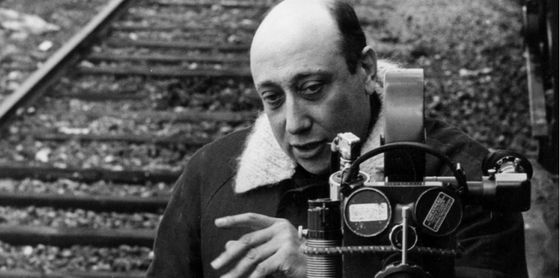
TIFF Cinematheque Presents – Les films de Jean-Pierre Melville

TIFF Cinematheque’s SUMMER IN FRANCE takes a different look this year with a Jen-Pierre Melville tribute.


Jean-Pierre Grumbach was born in 1917 in Paris, France, the son of Berthe and Jules Grumbach.  He took the name of Melville after the war, after his favourite American author Herman Melville.   His family were Alsatian Jews.  After the fall of France in 1940 during World War II, Grumbach entered the French Resistance to oppose the German Nazis who occupied the country. 


After the war, Melville entered film directing, opening his own studio and initially making minimalist films.  His films are known for featuring thee great name French stars -Alain Delon, Lino Ventura and Jean-Paul Belmondo.


His films have a characteristic look and bear common themes.  His themes are often gangster capers where double-crosses and prison (escaped convicts or gangsters coming out after serving their sentences) are tied into the story. Melville’s films are rich in film noir atmosphere and more than often a delight to watch.


For more information of the series, venue and ticket pricing, check the Cinematheque website at:

http://www.tiff.net/#series=army-of-shadows-the-films-of-jean-pierre-melville


CAPSULE REVIEWS of Selected Films:


L’ARMEE DES OMBRES (ARMY OF SHADOWS) (France 1969) **** 

Directed by Jean-Pierre Melville 


Based on real experiences in the French Resistance, Joseph Kessel’s fiction novel is given worthy treatment in Melville’s 150 minutes film adaptation.  The centre of the piece is civil engineer Resistance Fighter Philippe Gerbier (Lino Ventura) who at the beginning of the film is captured by the Vichy police and put in a prison camp.  A violent escape and other adventures allow the audience to be treated to the detailed exploits of the Resistance fighters.  Though not short of action and suspense (the best bit with the audience waiting almost two minutes waiting for Gerbier to execute his second escape), Melville effectively creates the mood of the desperation of the fighters and the atmosphere of the dangers of the times.  Simone Signoret steals the show as Mathilde, one of the chief organizers of the Resistance.  The film is well paced and flows smoothly from start to finish with the Arc de Triomphe in the initial and final shots.  ARMY OF SHADOWS is as meticulously plotted as one of Melville’s heist movies. 


LE DEUXINEME SOUFFLE (THE SECOND WIND) (SECOND BREATH) (France 1966) **** Directed by Jean-Pierre Melville

Melville shows in this crime caper about and scaled criminal Gustave Minda (Lino Ventura) that there is honour among thieves.  Gu (short for Gustave) is well respected in the criminal world for his expertise and loyalty.  He is given a job to do which he needs the money in order to escape to Italy via Marseilles where he can live the rest of his life.  But Inspector Blot (Paul Meurisse) is a cunning sleuth who eventually  puts all the clues together to fps out Gu.  As is most of Melville films, the elements of betrayal, prison, cop vs. crook, heist execution are all present.  his is one of the longer melville films running close to 2 hours and 20 minutes but with really a dull moment.  Both Meurisse and Ventura are excellent in their respective roles of cop and criminal.  It is hard to take sides of either.  This was Melville’s most successful film commercially.


DEUX HOMMES DANS MANHATTAN (TWO MEN IN MANHATTAN) (France 1969) ****

Directed by Jean-Pierre Melville

There are three reasons to watch Melville’s TWO MEN IN MANHATTAN.  The first is that it is a rare screening of the film, which is largely unavailable in other forms.  Second, this is the only film that is both directed and star Melville.  Melville plays Maurice, a French journalist in NYC, one of the two men in Manhattan.  He and Pierre Grasset play two French journalists in New York City searching for a missing United Nations diplomat.  In the process, they uncover some nasty bits on the diplomat, but decide to do the right thing.  The third reason to se the film is to experience the rich film noir atmosphere of this piece. Ironically, it’s is not a general crime caper, but there the typical crime element such as is – hunt for a missing person, dead bodes and coloured characters like the women in the life of the diplomat – an actress, a prostitute, a stripper and a jazz singer.


UN FLIC (France 1972) ****

Directed by Jean-Pierre Melville

Deliciously wicked Melville.  The film begins with a quotation by Eugène-François Vidocq which is repeated by Alain Delon’s character in the film:  “The only feelings mankind has ever inspired in policemen are those of indifference and derision…”   Then Melville attempts and succeeds in proving the saying with his crime tale centring on flic, Edouard Coleman, played by Alain Delon in his first cop role for Melville after playing criminals in LE SAMOURAI and LE CERCLE ROUGE.  Alain Delon’s is just as violent and cool if not more than Clint Eastwood’s DIRTY HARRY.  This can be observed in the hilarious scene where he gets a classic trio of pickpockets to speak up.  There are lots to enjoy in this crime caper, the best of which is a suspenseful bank robbery at the Banque National de Paris in the suburbs of Paris in which one of the robbers is wounded by a bullet.  Melville includes nice bits like a Santa Claus informer, a common love interest (Catherine Deneuve) between flic and crook and American actor Richard Crenna speaking perfect French.  As expected, Melville’s film is rich in film noir atmosphere complete with wicked details like the crooked laid out lit windows of police station building.  More story and easier to follow than the usual Melville film and even more entertaining as a result!  p.s.  Is there a sexier couple than Alain Delon and Catherine Deneuve?


Jean-Pierre Melville
SUBMIT your TV PILOT Screenplay or TV SPEC Script
Voted #1 TV Contest in North America.
Screenplay CONTESTSUBMIT your Short Screenplay or FEATURE Script
FULL FEEDBACK on all entries. Get your script performed

Interview with Festival Director Teddy Grouya (American Documentary Film Festival and Film Fund (AmDocs) )

The American Documentary Film Festival and Film Fund (AmDocs) is one of the largest Docs only festivals in the United States, located near the media capital of Hollywood in beautiful Palm Springs. This unique event focuses on international films in both the short and feature categories as well as showcasing animation. In conjunction with the festival is the American Documentary Film Fund where U.S. filmmakers compete for start-up or finishing funds in order to complete their film masterpieces. AmDocs, seeing the bigger picture.


Matthew Toffolo: What is your Film Festival succeeding at doing for filmmakers?

Teddy Grouya: Our festival has been successful at pushing the boundaries and offering expanded exhibition opportunities for our filmmakers. For example, we were the first festival in the world to introduce a new formal alliance with other prominent events outside of North America. This alliance, the North
South Doc Network, gives filmmakers a chance to have their works screened at other festivals outside of their home country. AmDocs will share a select number of U.S. origin films in Latin America and Europe, guaranteed. In turn, our partner events get to curate films from their regions at AmDocs. Additionally, we pick a number of select films to participate in our local school district program catalog which complements academic curricula. We also screen AmDocs films throughout the year in our non-profit theatre thereby affording our filmmakers the opportunity to make a bit of revenue.

What would you expect to experience if you attend the festival this year (2017)?

For 2018 we will continue to push the boundaries offering a great experience for our filmmakers, industry guests and audience. We already were the first docs only festival in the world to require films to be exhibited in DCP. We want our filmmakers to have a completely enjoyable and successful experience. And while we cannot guarantee sales, those marks have been going up as the
festival continues to gain international acclaim.

What are the qualifications for the selected films?

We screen short docs (40 minutes or less), feature docs (41 minutes or more) and animated works. We are not premiere whores but we always like to discover and share new or recent works. Films cannot have screened at another event within a 70 mile radius. Also, if submitting to us and invited, we will want the filmmakers to pull their films from any internet service like youtube for a month before our festival. (It is not fair for the audience to pay a ticket to see said film if it is offered for free on the web.)

Do you think that some films really don’t get a fair shake from film festivals? And if so, why?

If a festival or programmer is worth their salt, then know that the process is very complex and not always based on the quality of one’s work or story. There is a lot of frustration on filmmaker’s part when submitting their film(s)- we know as we are filmmakers, so we respect how tough the process is. Certainly there are instances where films are not viewed by festivals taking submissions or in many instances, you will see only a very few of submitted films accepted into a program because the festival has invited works from other sources. Of course, we program films from discovery at other festival events, but we can truly say that the majority of our films invited in any given year are
programmed from films submitted directly to us via submission platforms.

What motivates you and your team to do this festival?

Our motivations are simple and complex at the same time. We want to share with the world films that entertain as well as have great import. We realize that all of this is subjective in nature but believe that we are doing a good thing when we help build awareness on a subject without forcing it on our audience and industry guests. We want our filmmakers to be successful, to remember their
experience at AmDocs and to tell the world that this is one of their favorite, if not favorite, festival they have attended. Proudly, many testify to this.

How has your Film Freeway submission process been?

When FilmFreeway came onto the scene we felt we had to add them to our platform options for our filmmakers even though WAB was the main force in the submission business. Each year their number of submissions to AmDocs has increased by about double. We hope this trend continues though it may be a push as WAB’s numbers have concurrently gone down. We offer all submission platforms that we are aware of, trying not to play favorites. FilmFreeway clearly deserves accolades on a number of fronts. They were aggressive and hit the market running. Their acceptance and friendly solicitation of filmmakers has made them a worthy business opponent to WAB which has forced WAB to change their commission formula as well as their branding to be more filmmaker accessible- they are essentially rebirthing themselves as FilmFreeway. Whatever the course of these entities, FilmFreeway’s entry has improved the opportunities for filmmakers and that is what is most important.

Where do you see the festival by 2020?

By 2020 we hope to be acknowledged as one of the top events in the world for docs and animated works. Each year our reputation grows and by 2020 we want to have a full-fledged and respected film market for our filmmakers and industry insiders, a great place to meet and cut deals.

What film have you seen the most times in your life?

When Oliver Stone’s “JFK” came out over 20 years ago on PPV I must have seen it 20-30 times. I tend not want to see films more than once even though I have an extensive catalog. The complexity and editing of this film was mesmerizing. I am not saying this is necessarily my favorite film, but I learned more each time I saw which speaks volumes to its keeping my interest. Certainly, there are
many film favorites and each day that grows as I personally view over 1,600 docs and animated works every year. I fall in love with a good doc, will do whatever I can to share with other festival colleagues and industry friends.

In one sentence, what makes a great film?

A great film is made up of many great moments or one defining and memorable moment that sticks with you your entire life. As far as the process goes, it is vital outside of experimental works, to have a story that you can effect with solid structure. If you can do this you will succeed in making something someone or many people will want to see, no matter the subject.

How is the film scene in your city?

The film scene is Palm Springs (the California desert resort city not far from the mecca of Hollywood.) It’s famous for film festivals, appreciative audiences, weather and fun. One of our new mottos this year is, “Filmmakers Work Hard And Party Hard” and at AmDocs and Palm Springs you have the perfect combination to enjoy the fruits of your filmmaking labors.

amdocs2.jpg

—-

Interviewer Matthew Toffolo is currently the CEO of the WILDsound FEEDBACK Film & Writing Festival. The festival that showcases 20-50 screenplay and story readings performed by professional actors every month. And the FEEDBACK Monthly Festival held in downtown Toronto, and Los Angeles at least 2 times a month. Go to www.wildsound.ca for more information and to submit your work to the festival.

SUBMIT your TV PILOT Screenplay or TV SPEC Script
Voted #1 TV Contest in North America.
Screenplay CONTESTSUBMIT your Short Screenplay or FEATURE Script
FULL FEEDBACK on all entries. Get your script performed

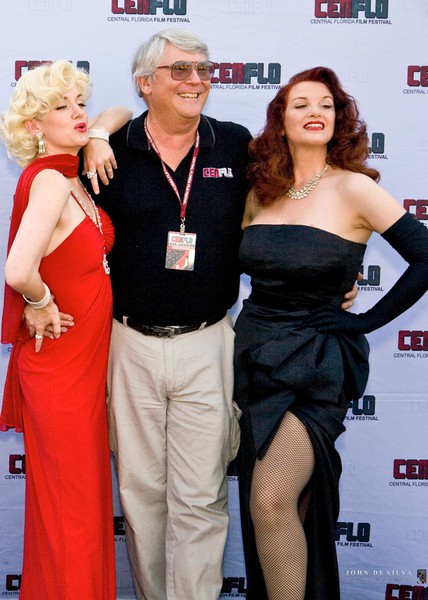
Interview with Festival Director Bob Cook (Central Florida Film Festival)

Fun filled three day event in Ocoee, Florida (15 minutes from Disney World) over the Labor Day weekend (September 1-3, 2017). Networking opportunities, panel discussions, screenings on three screens, excellent award show with guest presenters. Hotel venue walking distance to theater venue. VIP cocktail party and brunch.

Contact

 
Matthew Toffolo: What is your Film Festival succeeding at doing for filmmakers?

Bob Cook: Networking! When filmmakers attend a festival they know where their current film is but where is their next project coming from. We have VIP networking events that matches writers, with directors, producers, and other craftsmen.

What would you expect to experience if you attend the festival this year (2017)?

We have festival screenings on three screens at the West Orange Cinemas and a Filmmaker Lounge right opposite the theater to meet and chat with others. We also have a stage area in a separate venue for panels and on Saturday a “Pitchfest” where filmmakers can give an “elevator pitch” to two accomplished Hollywood Producers. Let’s not forget our evening networking parties at our hotel venue the Fairfield Inn and Suites in Ocoee, Florida.

What are the qualifications for the selected films?

There are no set limitations to films that are accepted. There are ten categories including performance, camera work, sound, story/script, edit, production value, sound, pace & structure, lighting, and directing. Five initial judges watch each film and score each category 1-10. We look for films above the 70 mark our bar us usually 75. Scoring 75 gets you an “Official Selection” and your film is seen by five different judges (same scoring process except the high and low score are dropped). The top eight films move on to the final round where five additional judges screen the film (high and low dropped) and the accounting firm of Dave Cole, CPA and Associates tabulates the final scores and on the award night the five finalists and winner are announced. Categories include, Best Foreign Project, Documentary, Student Film (aka Paul Leder Award with a $2500 prize), Dramatic Short, Comedy Short, Feature, Florida Project and Audience Choice.

Do you think that some films really don’t get a fair shake from film festivals? And if so, why?

Not in our festival by the time the finals are announced fifteen different judges watch the film. I don’t know how the other festival do it but I take the no one watched my film out of the equation.

What motivates you and your team to do this festival?

Networking. We get to see our industry contacts each year and show them new filmmakers and at the same time pitch my own if I have a project. We bring in Producers, Directors, Distributors and other industry people that have been around since the video days.

How has your Film Freeway submission process been?

FilmFreeway has been so easy that we have dropped withoutabox altogether. Our judges love it because they can score online and I love it as they keep and accurate accounting daily. It’s relatively new and they are always coming up with new ways to connect filmmakers with a festival. You can even sell tickets through their site now.

Where do you see the festival by 2020?

Our festival won’t change much as we have found the proper mix which filmmakers and industry people love. If anything I see the festival moving from Ocoee, Florida to Mount Dora which a bit more centrally located to the state.

What film have you seen the most times in your life?

Unfair question as there are a couple of films I always watch when I direct a film. If it’s character driven in a small space I watch JAWS. Three characters on a boat and the camera and actors always seemed to be moving. For ensemble work and action I study John Ford’s work FORT APACHE. Take a look at the shots with seven or eight people in the scene (frame). Each one is in perfect light. Those were the “good ol’ days.”

In one sentence, what makes a great film?

A good story told by an excellent storyteller.

How is the film scene in your city?

Hollywood will on occasion come to town to use Orlando as a location but the Indies are on their own in town. Not as much support as we would like which is another mission for the festival. Miami is a different story but at the festival this year we have several shorts and two really good features make by local filmmakers and support staff.

central florida2.jpg

—-

Interviewer Matthew Toffolo is currently the CEO of the WILDsound FEEDBACK Film & Writing Festival. The festival that showcases 20-50 screenplay and story readings performed by professional actors every month. And the FEEDBACK Monthly Festival held in downtown Toronto, and Los Angeles at least 2 times a month. Go to www.wildsound.ca for more information and to submit your work to the festival.

SUBMIT your TV PILOT Screenplay or TV SPEC Script
Voted #1 TV Contest in North America.
Screenplay CONTESTSUBMIT your Short Screenplay or FEATURE Script
FULL FEEDBACK on all entries. Get your script performed

Interview with Festival Director Guido Franken (Euregion Film Festival)

Euregion Film Festival offers you a festival experience with the best films from all over the world, an award show, workshops, seminars and more. Every year, a multi-day festival program will be presented. This program contains selections of films from all over the world, workshops, seminars, meeting corners, an award show and more. If your film is selected, you are automatically in the running for several prizes during the festival.

Contact

 
Matthew Toffolo: What is your Film Festival succeeding at doing for filmmakers?

Guido Franken: Euregion Film Festival is a fast growing film festival in which we connect filmmakers and public and try to mix those two audiences together by creating all kinds of networking settings. Our main point of focus is to connect new, mostly independent filmmakers and we help them to get to a higher level.

Therefore we organise a lot of opportunities regarding talent development, such as multidays film schools – in which filmmakers learn from experienced experts and train their skills and develop a concrete project -, conference days, masterclasses and competitions where filmmakers can pitch and win production budgets. It’s great to see how everyone merge together and connects, shares their knowledge and boost their skills.

What would you expect to experience if you attend the festival this year (2017)?

Our next edition will be in 2018, with the 2017 edition just behind us in March
of this year. We introduced new types of events, which were very succesful and
will be continued next year. As a filmmaker, you can join one of our film schools (we call them film- or documentary campus), join CineMasters (masterclasses by experienced experts on specific topics) and come to networking events and parties. For the general audience, as well als for filmmakers off course, we organise CineTalks (table talks with experienced and young filmmakers about their vision, work and life), lots of side-events – such as a Virtual Reality Cinema and music parties – and above all we show a curated selection of short- and feature films, mostly with Q&A with the director.

What are the qualifications for the selected films?

In general we accept all kinds of films, from short to feature, and from fiction to experimental, documentary or animation. We have a main focus on productions from our centre region in the Netherlands, Belgium and Germany, which is called the Muse-Rhine Euregion (that’s why the festival is called Euregion Film Festival). Our programmers really try to create a nice mix between genres, styles and topics. That’s why we are known for a very diverse, international and dynamic film program, in which it doesn’t matter how, where or what is made, as long as it has quality.

For up to date information visit:
https://filmfreeway.com/festival/EuregionShorts

Do you think that some films really don’t get a fair shake from film festivals? And if so, why?

With the growth of easy accessible submission platforms, it is inevitable that
fake festivals appears. So the only reason why films wouldn’t get a fair shake is that there are people who try to earn easy money by creating a website, open a call, collect money and never really organise a festival. That’s why platforms such as FilmFreeway are becoming more strict the last one, two years. And that
is good and hopefully will help to close down the fake festivals.

In general, I don’t believe that some films would not get a fair shake. Every
organizer I know is doing his or her job with the best intention and honesty,
watching every film that is submitted and just want to create the best festival
that is possible.

What motivates you and your team to do this festival?

We love to showcase the biggest film talents, discover new (upcoming) diamants and connect filmmakers with eachother and with the audience. A festival is a great place to create in a specific period of time and on a specific location a ‘pressure cooker’ where all kinds of magical things happen: you see talented people grow, you see different types of audience (young, old, from all kinds of backgrouns) getting touched by films created by passionate people … it is a once in a life time experience which, when performed in a good way, can change peoples lives.

How has your Film Freeway submission process been?

From all submissions platforms available, it is the one that is the most easy to use. As well for filmmakers as for festivals. The number of submissions grew
with 150% in the second year, and we just opened the call for the third edition
of Euregion Film Festival and we are very excited to again receive a lot of good
films.

Where do you see the festival by 2020?

As mentioned earlier, we are located in a unique crossborder region in the Netherlands – Belgium – Germany. Till now the festival took place in our
hometown (Heerlen in the Netherlands), but as we speak we are trying to make it a bigger event and cooperate more closely with partners across the borders.

We already attract an international audience, but I hope in 2020 the merge of
filmmakers and general audiences from all these countries (and other ones of course) has grown even more. We live in a truly unique area, which for filmmakers is a very good place to co-produce: within only 30 minutes driving
they can combine funds and incentives from three countries, eight regions and
local initiatives. There are lots of opportunities that we should make use of
more often!

What film have you seen the most times in your life?

Contrary my fellow Dutch citizens, I dó have feeling with our national cinema –
most Dutch people don’t like Dutch films at all –, and especially the work of Paul Verhoeven (now known for Elle, but also director of Basic Instinct and RoboCop for instance). His Soldaat van Oranje (Soldier of Orange) from 1977 is my all-time favorite. I think I watched it over 30 times, and it still gets better every time I see it. And that’s wat good films do: every time you see them, you discover genius (new) details or whatsoever that proves the quality of the film.

In one sentence, what makes a great film?

A great film captures or creates life in which the viewer loses himself.

How is the film scene in your city?

It is quite booming. Since five years I run a non-profit organisation which is called CineSud. We form the community of filmmakers in the province of Limburg in the Netherlands and are a fast growing and reliable platform, organising networking event, workshops, festivals and much more. We help filmmakers to develop their own skills and projects and assist them with there productions. Next to Euregion Film Festival we annually organise SHIFT Film Festival, which focuses on innovation in film in every possible way.

Besides that, in the last five years we were able to create a great infrastructure for film, with an own regional film funds (Limburg Film Fund), a Limburg Film Commissioner and lots of initiatives for talents, professionals and audience. Now we are on the edge of taking a next big step or falling down again: it is really an important period for the future of film in this region. That’s why with Euregion Film Festival we are working now very hard to make it even more ‘crossborder’ in this region, so that we can enlarge the support for
film in this crossborder region and give it even deeper, better and more steady roots. It would be a shame if all efforts that we took last years – with great results and lots of films shot in this region – would slowly vanish again.

euregion film festival2.jpg

—-

Interviewer Matthew Toffolo is currently the CEO of the WILDsound FEEDBACK Film & Writing Festival. The festival that showcases 20-50 screenplay and story readings performed by professional actors every month. And the FEEDBACK Monthly Festival held in downtown Toronto, and Los Angeles at least 2 times a month. Go to www.wildsound.ca for more information and to submit your work to the festival.

SUBMIT your TV PILOT Screenplay or TV SPEC Script
Voted #1 TV Contest in North America.
Screenplay CONTESTSUBMIT your Short Screenplay or FEATURE Script
FULL FEEDBACK on all entries. Get your script performed

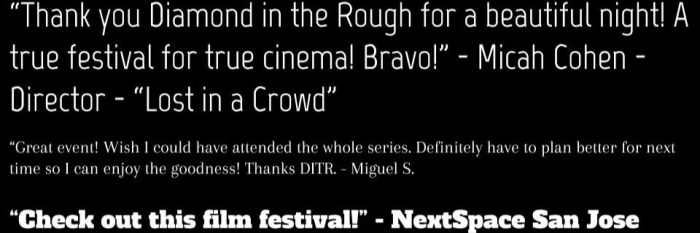
Interview with Festival Director Mark Schwab (Diamond in the Rough Film Festival)

Organized by independent film production company Diamond in the Rough Films, their 3rd annual film festival wants to highlight the TRULY independent film. Even if it is “rough around the edges” or just plain out there. The filmmakers who scrape and sweat to put a good movie together against all odds. They want films that take risks, not hollow 4K mirages.

 Contact

Matthew Toffolo: What is your Film Festival succeeding at doing for filmmakers?

Mark Schwab: I hope it does a few things. 1. Gets their film some needed exposure and feedback, 2. Meeting other filmmakers attending the festival, 3. Meeting us at DITR Films and having us as a resource, 4. Provide them with distribution opportunities.

What would you expect to experience if you attend the festival this year (2017)?

A fun weekend of truly independent films (from short films and docs to feature films and docs) that you can’t see anywhere else (at least not easily) in a great theater with a big screen, digital projection and popcorn with real butter!

What are the qualifications for the selected films?

Mainly that it is something we haven’t really seen before. We don’t care much about budget or premiere status or even the year it was made. If it’s truly different and made with passion….it’ll get our attention.

Do you think that some films really don’t get a fair shake from film festivals? And if so, why?

Maybe a little bit. I think the big festivals (i.e. Sundance, Toronto, SXSW) take fewer risks in curating because they have massive overhead to cover. Ergo, a decent film with a “name” in it will get accepted over the awesome indie film with no names in it. But it’s ok….that’s what we are here for. 😉

What motivates you and your team to do this festival?

To encourage filmmakers to keep making movies. To give them a chance to see their work on a big screen. And especially to expose audiences to movies outside their regular comfort zones.

How has your Film Freeway submission process been?

Just excellent. Very responsive to questions and their interface is literally one of the best I have ever seen. It makes you want to interact with it.

Where do you see the festival by 2020?

I’d really love to be able to afford more days of screenings to show even more films. I’d like to see it run for a week instead of just a weekend.

What film have you seen the most times in your life?

Wow…never really thought about it. I’m going to guess 2001: A Space Odyssey.

In one sentence, what makes a great film?

A great film is one that absorbs your visual and auditory senses fully while simultaneously engaging your soul.

How is the film scene in your city?

Unsettled. The South Bay Area used to be a major movie city but with rents/leases being so prohibitive it is difficult to keep a true art scene alive. Movie theaters are having a very tough time staying alive when developers are so greedy to turn them into offices or luxury condominiums.

diamond in the rough2.jpg

—-

Interviewer Matthew Toffolo is currently the CEO of the WILDsound FEEDBACK Film & Writing Festival. The festival that showcases 20-50 screenplay and story readings performed by professional actors every month. And the FEEDBACK Monthly Festival held in downtown Toronto, and Los Angeles at least 2 times a month. Go to www.wildsound.ca for more information and to submit your work to the festival.

SUBMIT your TV PILOT Screenplay or TV SPEC Script
Voted #1 TV Contest in North America.
Screenplay CONTESTSUBMIT your Short Screenplay or FEATURE Script
FULL FEEDBACK on all entries. Get your script performed

Interview with Festival Director Michael York (MY Film Festival)

MY Film Festival is a brand new and exciting event which will take place in Toronto, Ontario. Our mission is to connect emerging artists with local filmmakers. We are anticipating a solid turn out with many press, bloggers, casting directors and agents to be in attendance this year. If you are a resident of ONTARIO, please get in contact with us for your free waiver code.

Contact


 Matthew Toffolo: What is your Film Festival succeeding at doing for filmmakers?

Michael York: MY Film Festival is a great way for filmmakers to get the opportunity to display their work in the biggest city in Canada – Toronto. I hope someday people can reflect on their screenings at the festival and see that it helped start/ shape or promote their career.

What would you expect to experience if you attend the festival this year (2017)?

I would expect to exchange info with other great, passionate filmmakers and expand my network, as well as being inspired by great films.

What are the qualifications for the selected films?

MY film festival are looking for well written and shot films, do to an over welcoming amount of submissions our first year we look for great sound quality as well as well thought out lighting. We don’t discriminate against run and gun productions but we intrigued by unorthodox shots and seemingly flawless cuts.

Do you think that some films really don’t get a fair shake from film festivals? And if so, why?

I feel from personal experience that films that are not in english have a tougher time standing out or holding the attention of viewers due to the subtitles that can take away from the beautiful cinematography or performances.

What motivates you and your team to do this festival?

Our motivation and our goal is to be able to launch careers, we want to help people make those connections that a blind email or call may not be able to have.

How has your Film Freeway submission process been?

FilmFreeway is actually the only platform we use to promote the festival due to it’s very user friendly layout. They have done a great job of building up a strong database of filmmakers and if it wasn’t for them we wouldn’t have had a single submission.

Where do you see the festival by 2020?

I have a lot of big ideas for MY film festival, I could see it going many different directions. I had a thought that it could someday grow into an art show in a large warehouse where we would have multiple film screenings at once with different rooms dressed in different themes based on the genre of the films being shown. The viewers/festival attendees would have the freedom to sit and watch something or quietly excuse themselves to a separate room with another film playing. There are also talks about bringing in a partner who would award the winner of the best short film with one hundred and fifty thousand dollars to turn their passion project into a feature film.

What film have you seen the most times in your life?

That is a good question, I think it would still have to be Scarface. I must have watched that a thousand times when I was a kid.

In one sentence, what makes a great film?

What makes a great film for me is a well shot, captivating story with character arcs and a solid ending. (Not always a happy one)

How is the film scene in your city?

We are based out of Toronto, Ontario. The film scene here is booming! Both union and non union films are in constant rotation. We have massive tax incentives for American productions to save a buck and have access to countless great locations and industry professionals. This draws a lot of traffic, we actually have had to turn down several feature films due to lack of studio space.

my film festival2.jpg

—-

Interviewer Matthew Toffolo is currently the CEO of the WILDsound FEEDBACK Film & Writing Festival. The festival that showcases 20-50 screenplay and story readings performed by professional actors every month. And the FEEDBACK Monthly Festival held in downtown Toronto, and Los Angeles at least 2 times a month. Go to www.wildsound.ca for more information and to submit your work to the festival.

SUBMIT your TV PILOT Screenplay or TV SPEC Script
Voted #1 TV Contest in North America.
Screenplay CONTESTSUBMIT your Short Screenplay or FEATURE Script
FULL FEEDBACK on all entries. Get your script performed

Interview with Festival Director Petio Petkov (DroneUp International Film Festival)

Get ready for the second edition of Europe’s funkiest drone event – DroneUp International Film Festival! Once again, DroneUp IFF will celebrate and acknowledge the world’s best drone cinematography in front of an 3000+ live audience in the magnificent ancient Roman Stadium in Plovdiv, Bulgaria.

Contact

 
Matthew Toffolo: What is your Film Festival succeeding at doing for filmmakers?

Petio Petkov: We’re first and only drone film festival that is primarily a public event, focused on taking aerial cinematography out of the standard, darkened and closed theaters and making the best of it readily available to the general public at eye-level. We’ve managed to create an open platform where innovative cinematic technologies and means of expression are synergised them with the rich history present at our hosting venue, which is an astonishing 1800 year old Roman Stadium located right in the heart of the city. Personally, I am particularly happy about the fact that we not only showcase the very best of the world’s drone filmmaking but also manage to meaningfully combine them with other live performances (music, dance, art, etc) that, to me, are just as an important part of creating a happening and dynamic festival.

What would you expect to experience if you attend the festival this year (2017)?

Once again, the audience can expect that we will present the world’s best drone cinematography in 6 different categories: Nature, Urban, Travel & Culture, Extreme, Narrative & Cinematic and Bulgaria (to honour our host country). This year the festival will be more interactive and allow the audience to have a first hand experience of what it means to fly a drone. We will be hosting numerous drone demos, workshops, exhibitions and competitions, which I think will be an interesting feature that we will be focusing even more on in the years to come.

Naturally, there will be plenty of live performances and surprises to spice up the package and to make DroneUp a vibrant and hip festival.

What are the qualifications for the selected films?

It’s all pretty simple actually – the short films must be shot at least 50% by a drone. And of course be super creative – there’s nothing like a new mean of expression and technology that can stir up your established views of what’s possible!

What motivates you and your team to do this festival?

We just want to provide a great and new experience to as many people as possible. I think that aerial cinematography is developing in such an interesting direction that it deserves a larger audience. And on the other hand, it’s great for the audience to experience their everyday life from a different vantage point!

How has your FilmFreeway submission process been?

It’s been great. We’re fortunate enough to have submissions from every corner of the world, despite being a “young” festival, so there really isn’t much to complain about.

Where do you see the festival by 2020?

DroneUp is held in Plovdiv, Bulgaria in relation to the city’s hosting of the European Capital of Culture in 2019. After that, the vision is to have the festival traveling each year to different city’s as they take turns in hosting the ECoC.

What film have you seen the most times in your life?

Probably Forrest Gump 😉

In one sentence, what makes a great film?

A great film succeeds in portraying the flaws, the beauty, the internal fights, the calm and storm, the interrelations in every individual – always in a relatable but magical setup.

How is the film scene in your city?

Our festival definitely makes it better 😉

drone up 2.jpg

—-

Interviewer Matthew Toffolo is currently the CEO of the WILDsound FEEDBACK Film & Writing Festival. The festival that showcases 20-50 screenplay and story readings performed by professional actors every month. And the FEEDBACK Monthly Festival held in downtown Toronto, and Los Angeles at least 2 times a month. Go to www.wildsound.ca for more information and to submit your work to the festival.

SUBMIT your TV PILOT Screenplay or TV SPEC Script
Voted #1 TV Contest in North America.
Screenplay CONTESTSUBMIT your Short Screenplay or FEATURE Script
FULL FEEDBACK on all entries. Get your script performed