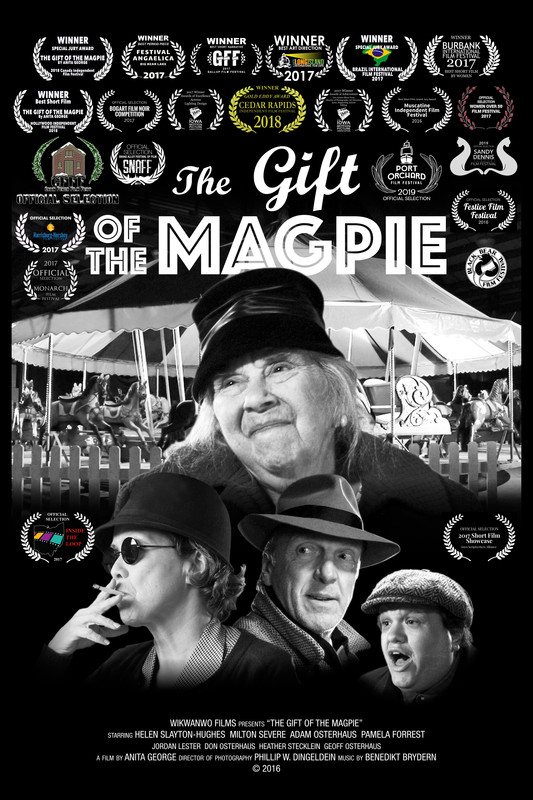
Filmmaker Anita George (THE GIFT OF MAGPIE)

THE GIFT OF MAGPIE, 11min,. USA
Directed by Anita George
It’s carpe diem for a couple of small time grifters on Christmas Eve 1934.

Get to know the filmmaker:

1. What motivated you to make this film?
I love the genre and thought it might be interesting to tell a story about expectation and balance of power.

2. From the idea to the finished product, how long did it take for you to make this film?
I wrote the screenplay a few years before filming actually started. Once that was completed it was about 11 months until the film’s first public screening.

3. How would you describe your film in two words!?
Noel Noir

4. What was the biggest obstacle you faced in completing this film?
Time and keeping current with evolving technology

5. What were your initial reactions when watching the audience talking about your film in the feedback video?
That was a wonderful experience! Especially since the pandemic, when so many film festivals either took a break or went entirely virtual, the communal experience of film-filmmakers-and audience has been greatly diminished. This was a great way to share.

6. When did you realize that you wanted to make films?
From a very early age I knew I wanted to be a part of this kind of storytelling. It took some time to realize what my personal role would evolve into.

7. What film have you seen the most in your life?
Probably The Wizard of Oz

8. What other elements of the festival experience can we and other festivals implement to satisfy you and help you further your filmmaking career?
I think you are on the right track. Exposure, feedback, community and tangibles feel like the most salient elements of a successful festival.

9. You submitted to the festival via FilmFreeway. How has your experiences been working on the festival platform site?
For the most part, FilmFreeway is a very good platform, at least in my experience. The glitches I’ve experienced in the past (being notified of the wrong acceptance status, for example) have turned out to be operator error on the part of the festivals and not the platform itself.

10. What is your favorite meal?
Angel hair pasta with garden fresh tomatoes, garlic and herbs.

11. What is next for you? A new film?
I am currently working on a new animated short. There are a couple of live action scripts that are in pre-production

Filmmaker Julian Robles (IGUANA LIKE THE SUN)

IGUANA LIKE THE SUN, 100min., USA (March Festival)
Directed by Julian Robles
In a humble coastal compound of southern Mexico, amidst a total eclipse of the sun, an unexpected guest arouses the broken dreams of a family that has lost its guardian figure, overshadowed by the cosmic loneliness where they were left to their faith.

https://www.imdb.com/title/tt21741112/
https://www.twitter.com/todoloiguana
https://www.facebook.com/Estoytodoloiguanaquesepuede/
https://www.instagram.com/estoytodoloiguanaquesepuede/

Get to know the filmmaker:

1. What motivated you to make this film?

When I was very young, I worked with Mexican playwright Carlos
Olmos. Although I was unable to see the original play “The eclipse”,
nor have I ever seen it staged, I was dazzled by it from the moment I
read it and thought it may be a great movie. The idea of becoming a
film director hadn’t even crossed my mind yet.

2. From the idea to the finished product, how long did it take for you to make this film?

Olmos wrote a previous script that was optioned a couple of times
but never came to fruition. Years after his death, I took up the idea
once again, made my own version, and decided that I would direct it
myself. Almost a decade passed between the first draft and the moment
I stepped on set.

3. How would you describe your film in two words!?

Cosmic loneliness

4. What was the biggest obstacle you faced in completing this film?

Recreating the light of a total solar eclipse was perhaps the most
complex challenge. Beyond the solar corona, which can be recreated in
VFX, the entire celestial vault is altered from the previous moments,
a very peculiar light impossible to generate by CGI. For this reason,
we filmed all the magic hours, in a hurry because they only last 20
minutes, and thus have enough shots for this long sequence.

5. What were your initial reactions when watching the audience talking about your film in the feedback video?

I was surprised by the way they had connected with the story and
also understood what lies behind the plot, even though these
characters seem quite far from them.

6. When did you realize that you wanted to make films?

I am the grandson of a projectionist who learned the trade when
cinema was silent and projectors were hand-cranked. I was destiny to
do films.

7. What film have you seen the most in your life?

Gone with the Wind. And if you don’t like it, frankly…

8. What other elements of the festival experience can we and other festivals implement to satisfy you and help you further your filmmaking career?

I did not attend the fest. I cannot say nothing about it.

9. You submitted to the festival via FilmFreeway. How has your experiences been working on the festival platform site?

Food is like movies, books, or love: our tastes are always changing.

10. What is your favorite meal?

Fruta verde (Unripe Fruit), an adaptation of the famous novel by
Enrique Serna.

Filmmaker Ethan Grahek (PEGASUS HIGHWAY)

PEGASUS HIGHWAY, 15min., Australia
Directed by Ethan Grahek
Two Bronies (Adult male fans of small, collectable Pony toys) are out to buy weed for their first time. Unbeknown to them, it is also their dealers first deal. What should have been a simple transaction quickly devolves, forcing one of the Bronies to chauffeur the eccentric drug dealer on a psychotic road trip. But there is more to these Bronies than the dealer could ever fathom.

Get to know the filmmaker:

1. What motivated you to make this film?
This film was my Honours film I completed at Deakin University, Melbourne.
For the very first assessment presentation I attended at uni, a young woman did a presentation on bronies, they really piqued my interest, i’d never heard of them before because I grew up in a small, rural town.
I went down a bit of a rabbit hole and discovered the uh… interesting… world of the Bronie fandom. Whilst searching I wondered how a Bronie would be perceived at my small town high school, that seed of an idea developed into the final film.
I thought the idea was pretty unique so that really motivated me to see it through to completion over the years it took!

2. From the idea to the finished product, how long did it take for you to make this film?
I conceived the idea in 2017 and began research and development of it for my Honours year in 2020. But we all know what happened that year. There were going to be heavy COVID restrictions imposed on our film sets so I decided to flee back to my hometown until the lockdowns subsided. I returned to Melbourne to finally complete the production in Oct 2022 – Feb 2023. So realistically, even though the process took all those years to finally complete, the actual time spent on it was approximately 7-8 months.

3. How would you describe your film in two words!?
Unexpected, Whack

4. What was the biggest obstacle you faced in completing this film?
The Covid pandemic for sure, plus the constant rain during production, as well as the long hours spent completing all the VFX solo.

5. What were your initial reactions when watching the audience talking about your film in the feedback video?
I honestly thought it was pretty incredible, almost surreal hearing people from another country comment on and more excitingly, seem to enjoy my whacky little film!
It was really great and insightful listening to people say they dug the details that you put so much time, research and effort into!

6. When did you realize that you wanted to make films?
When I was in year 9. I originally thought I wanted to be an actor, growing up in a small town, there were very few opportunities to act so I started making youtube videos to practice, through this process I discovered that I found it much more endearing being behind the camera than in front of it.

7. What film have you seen the most in your life?
If we’re talking about my entire lifetime, I’d say Star Wars II: Attack of the Clones.
If referring to my adult life, I’d say Two Hands.

8. What other elements of the festival experience can we and other festivals implement to satisfy you and help you further your filmmaking career?
Honestly, the fact that you guys provide these feedback videos is awesome, and is certainly what drew me to screen my film with you!
Especially as someone that is fresh out of uni and can’t necessarily afford travelling to film festivals.

9. You submitted to the festival via FilmFreeway. How has your experiences been working on the festival platform site?
I love FilmFreeway! It’s so good having everything available in one place! Saves on a lot of the research time!

10. What is your favorite meal?
Burritos

11. What is next for you? A new film?
For sure. I’ve made up a bit of a roadmap of what I’d like to achieve over the next few years and next up is either an action short or a horror short about a drag queen. I’m thinking more likely the latter because action is very expensive.

Filmmaker Donald Rayne Mitchell (MARION GRUBER: PREPAREDNESS IS PREVENTION)

MARION GRUBER: PREPAREDNESS IS PREVENTION, 30min. USA
Directed by Donald Rayne Mitchell
Dr. Marion Gruber is a world-renowned expert in vaccine development, regulation, and licensure. She worked at the U.S. Food and Drug Administration (FDA) for many years, serving as the director of the Office of Vaccines Research & Review (OVRR) from 2012-2021. In this short film, Dr. Gruber and several of her colleagues describe their efforts to ensure that life-saving vaccines were available during some of the most recent and well-known public health emergencies and why preparing for the next infectious disease threat is critical.

https://hillemanfilm.com/marion-gruber

Get to know the filmmaker:

1. What motivated you to make this film?

In collaboration with the Vaccine Education Center at Children’s Hospital of Philadelphia, I helped to create the educational initiative we call the Vaccine Makers Project (VMP). The VMP is made up of K-12 curricula which are supported by a variety of films and animations, the feature documentary, HILLEMAN among them. From the beginning, one of our goals with the project has been to put a human face to the science of vaccines. There’s a lot of noise out there around vaccine science but at the heart of the conversation are people that, in many cases, have dedicated their lives to protecting their fellow human beings through the prevention of disease. Marion Gruber is one of those people and her inspiring career is what motivated us to make this film.

2. From the idea to the finished product, how long did it take for you to make this film?

In the summer of 2022 we were exploring the idea of making a film about Operation Warp Speed, the government program that made the rapid development of the COVID-19 vaccines possible. But it didn’t take long to realize that we just didn’t have the budget or the people power to do justice to that subject. During the course of that research, however, we were fortunate enough to interview Dr. Gruber and the more we learned about her involvement in not just the COVID-19 pandemic, but the 2009 flu pandemic and the Ebola outbreaks in the mid-teens, the more we felt that her story was one the world should know about. My first interview with Dr. Gruber happened in mid-September, 2022 and we finished the film by mid-April, 2023.

3. How would you describe your film in two words!?
“Tempered urgency.” Think about what’s at stake when an infectious disease strikes. Lives are being lost with every passing minute. To stop those lives being lost we must act with urgency, but not with haste, because if we’re not careful our actions could cause more harm. Dr. Gruber and her colleagues understood both the urgency of shielding the public from the COVID-19 pandemic and simultaneously protecting the public from unproven products. They met that massive responsibility by tempering their desire to act fast with their need to rigorously evaluate the science. And they did that admirably!

4. What was the biggest obstacle you faced in completing this film?
Imagine what happens on a daily basis at the FDA; maybe a meeting with your staff in the morning, a catch-up over lunch with a colleague, lots of phone calls and Zoom calls and then probably another meeting or two in the afternoon. Ebola is wreaking havoc in West Africa and you’re saving the world by having one meeting after the next. That’s not a very visually exciting story to tell. (And by the way, the FDA doesn’t video record all their meetings anyway so good luck finding archival footage of your subjects doing their jobs.) So as a filmmaker telling this story, the biggest obstacle was finding the visual language to convey the drama and the stakes that were at play in the work of Dr. Gruber and her team. We found that visual language primarily through news footage. And even though our protagonist wasn’t the subject of that news footage, our antagonists were, and that’s what drove our story forward.

5. What were your initial reactions when watching the audience talking about your film in the feedback video?
Honestly, the audience reactions to the film were exactly what I would hope for; that realization that scientists working in public health are people just like us, and that they have families and they’re in this boat with us. If there’s one thing we need right now it’s more faith in each other. I think a film like this reminds you that institutions are made up of people, and that most people strive to be the best they can be and want to help where and when they can.

6. When did you realize that you wanted to make films?
Like every filmmaker that grew up in the 1970s, I knew I wanted to make films when I saw Star Wars for the first time.

7. What film have you seen the most in your life?
In high school I worked as an usher, then a projectionist at the local movie theater. The cinema had two screens so I spent a lot of time managing the various movies that were running. But in between shows I would stand in the back of the theaters and watch the films. Raiders of the Lost Ark was one of the movies we hosted during that time and so I’ve probably seen that movie more than any other during my lifetime.

8. What other elements of the festival experience can we and other festivals implement to satisfy you and help you further your filmmaking career?
The New York SCIENCE & NATURE FEEDBACK Film Festival is doing it right by bringing the festival experience into the virtual theater. It’s great to be able to experience a film with others in the same room but so often in today’s world creating that experience is really hard or even impossible. And that’s when this kind of experience is invaluable, not only to support filmmakers but to also create community around important subjects. Anything you can do to bridge that gap between the theater and our living rooms is so appreciated.

9. You submitted to the festival via FilmFreeway. How has your experiences been working on the festival platform site?
Nothing but good things to say about both FilmFreeway and the New York Science & Nature Feedback Film Festival!

10. What is your favorite meal?
Chicken Korma w/ rice, Chana Masala and Naan 🙂

11. What is next for you? A new film?
I’m just finishing a short illustrated animation about the History of Vaccine Science in Pennsylvania and continuing to develop a feature film project based on Bill Foege’s book, House on Fire: The Fight to Eradicate Smallpox.
Filmmaker Leo Rojas (APHASIC DREAM)

APHASIC DREAM, 24min,. Bolivia
Directed by Leo Rojas
Fernando, a guy with a messy life, starts having strange dreams of a kid in an abandoned warehouse.

http://leorojas.me/
https://www.instagram.com/steverojas00/

Get to know the filmmaker:

1. What motivated you to make this film?

– My main motivation is to make Bolivian films to be recognized worldwide, I want to show the quality of stories we can tell.

2. From the idea to the finished product, how long did it take for you to make this film?

– Approximately 4 months.

3. How would you describe your film in two words!?

– Opportunity and proud.

4. What was the biggest obstacle you faced in completing this film?

– The money, we had no much money and that limited us to many things that we wanted to do. But I think we managed to deliver a very good job with the little budget we had.

5. What were your initial reactions when watching the audience talking about your film in the feedback video?

– I was very proud and happy to see that other people enjoyed my short film, I think that’s the most beautiful thing about filmmaking.

6. When did you realize that you wanted to make films?

– Since I was 11 years old, I knew I wanted to dedicate my whole life to make films.

7. What film have you seen the most in your life?

– The Lord of the Rings trilogy

8. What other elements of the festival experience can we and other festivals implement to satisfy you and help you further your filmmaking career?

– Maybe record the reaction of the audience while they are watching the short films.

9. You submitted to the festival via FilmFreeway. How has your experiences been working on the festival platform site?

– It is a very comfortable and easy to understand platform, quite intuitive.

10. What is your favorite meal?

– Lasagna

11. What is next for you? A new film?

– I will continue to make a few more short films, until I get the opportunity to make my first feature film, after that, I will not stop.

Filmmaker Suniva Maya Miller (ROOM OF MEMORIES)

ROOM OF MEMORIES, 2min., Australia
Directed by Suniva Maya Miller
The story of heartbreak told from the memory center of the brain.

https://instagram.com/caffeinated_dream_dream

Get to know the filmmaker:

1. What motivated you to make this film?

It was my first ever animated film that I developed during my first year of university. For some reason I had this feeling that I had to make something so emotional and deep. At the time I had just been through a pretty rough breakup with someone who I had been friends with for much longer. So I wanted to write and make something that would reflect the complicated emotions I had surrounding this person and our relationship.

2. From the idea to the finished product, how long did it take for you to make this film?

The idea initially formed itself in March 2023 and finally had a developed script by around June. After that I created storyboards and a production schedule for when I started the animation in September and completed everything in November 2023.

3. How would you describe your film in two words!?

Love and heartbreak.

4. What was the biggest obstacle you faced in completing this film?

Initially this film was supposed to be a minute long, however I found that the story really required to be longer in order to be as impactful

5. What were your initial reactions when watching the audience talking about your film in the feedback video?

I thought that a lot of it was quite on track and I’m glad that despite being quite short the message of the film came across. I noticed that despite the implications of the girls having shared a romantic relationship however I understand that might not have come off as strongly as I would have hoped. Either way, however people interpret their relationship, the story still fits.

6. When did you realize that you wanted to make films?

When I was twelve I realised how much love I had for telling stories and exploring all these different ideas and emotions. I especially had a love for drawing and making comics, so then I decided that I wanted to go into film making and animation.

7. What film have you seen the most in your life?

This would probably be a tie between so many films, but I would say that either Back to the Future or Coraline. I have studied these movies endlessly.

8. What other elements of the festival experience can we and other festivals implement to satisfy you and help you further your filmmaking career?

Honestly this has been such a great experience as one of the first festivals I have ever submitted to and been accepted. I don’t have much experience with festivals so I’m not sure how to improve them.

9. You submitted to the festival via FilmFreeway. How has your experiences been working on the festival platform site?

I really love using FilmFreeway, it’s such a great tool for exploring all sorts of festivals at the touch of a button.

10. What is your favorite meal?

Gnocchi al ragù d’anatra (gnocchi with duck ragu).

11. What is next for you? A new film?

I have already started developing a new film for my second year of animation at university.

Filmmaker Fernando Alberto Broce (OJUE)

OJUE, 13min,. USA
Directed by Fernando Alberto Broce
A panamanian fashion designer living in the US, who is embarrassed about her culture, is forced to bring her dad with dementia (who is convinced that he is still in Panama) to her most important exhibition.

Get to know the filmmaker:

1. What motivated you to make this film?

Since I moved to Los Angeles two years ago, I have felt a great nostalgia for my country, Panama. I wanted to tell a story whose characters would reflect this. I wanted to tell a story that would serve as a collage of the things I miss most about my country.

2. From the idea to the finished product, how long did it take for you to make this film?

It took about three months writing it, four months of pre-production, 7 days of filming, and four months of post-production. In total, almost a year.

3. How would you describe your film in two words!?

Panama, identity.

4. What was the biggest obstacle you faced in completing this film?

The last two minutes of the short film were definitely the most challenging. Replicate a festival like the “Thousand Skirts”, with more than thirty women arranged with the Panamanian skirt, shooting inside the lock in the Panama Canal, shooting with a band of more than seventy members. Undoubtedly, that final montage was challenging but the best thing that could happen to the short film.

5. What were your initial reactions when watching the audience talking about your film in the feedback video?

I was very happy that even though this is a story with Panama in the middle, the feeling was effectively transmitted to the audience of this festival, despite the fact that they were from other parts of the world.

6. When did you realize that you wanted to make films?

When I was little I watched an astronaut movie and spent a month wanting to be an astronaut. Then I saw one about writers and I wanted to be a writer. Then about lawyers, about doctors, etc. at the age of 13 I realized, that what I wanted was to make movies.

7. What film have you seen the most in your life?

Her, The Swiss Army Man, Interstellar.

8. What other elements of the festival experience can we and other festivals implement to satisfy you and help you further your filmmaking career?

To have the recording of the audience reacting was more than enough. The more spaces we have to see and talk about the reactions of our work, the better.

9. You submitted to the festival via FilmFreeway. How has your experiences been working on the festival platform site?

Very easy and smooth!

10. What is your favorite meal?

Octopus ceviche.

11. What is next for you? A new film?

Currently writing my first feature film as writter and director. Also working daily as an editor and production designer

Filmmaker Andre Joseph (DISMISSAL TIME)

DISMISSAL TIME, 29min,. USA
Directed by Andre Joseph
When a black high school student in a reputable prep school becomes the victim of a vicious form of cyberbullying, his history teacher makes it her mission to bring those responsible to task when the administration fails to act. Inspired by true events.

Get to know the filmmaker:

1. What motivated you to make this film?

I experienced racially-motivated bullying as a high school freshman where I was one of the few black students in my class. For years, I tried to suppress the trauma privately even though there were times I was uncomfortable in my skin. When the murder of George Floyd in 2020 sparked a national reckoning on race relations in America, I felt motivated to speak about my experience through film and I began to write Dismissal Time that summer inspired by my history.

2. From the idea to the finished product, how long did it take for you to make this film?

It was roughly one year of rewrites plus fundraising through the non-profit organization Fractured Atlas. Once it was cast and the crew was assembled, we shot 4 days in October 2021 in locations around Philadelphia and South Jersey. Then it was 6 months of post-production work.

3. How would you describe your film in two words!?

Social responsibility.

4. What was the biggest obstacle you faced in completing this film?

Filming during the pandemic. It created some limitations as far as the amount of student extras we could have on set among other factors. Luckily, everyone played it safe by taking precautions and following COVID protocols in all locations.

5. What were your initial reactions when watching the audience talking about your film in the feedback video?

For the most part, I felt the audience members who spoke gave a fair assessment of the film. The most important part of their feedback was how they could relate to the situation at hand and saw the importance of taking a stand when an injustice gets swept under the rug.

6. When did you realize that you wanted to make films?

Probably at 10 years old when I used to play with my cousins at our grandmother’s Brooklyn apartment and begged our late uncle to use his video camera. It motivated me to write a wish list of ideas I wanted to make as movies until I finally owned a camera at age 14.

7. What film have you seen the most in your life?

Great question! There are so many to choose from! If I had to choose at least one, it might be the original RoboCop. The effects and the story themes still hold up today.

8. What other elements of the festival experience can we and other festivals implement to satisfy you and help you further your filmmaking career?

More networking opportunities and helping filmmakers find ways to raise funds as well as educating us on successful distribution outlets.

9. You submitted to the festival via FilmFreeway. How has your experiences been working on the festival platform site?

It’s generally good from the standpoint of keeping all submission materials streamlined and reviews help to separate legit festivals from bad ones. Though FilmFreeway could do better on weeding out illegitimate festivals that aim to rip off the filmmakers financially.

10. What is your favorite meal?

A nice grilled sirloin steak with extra veggies.

11. What is next for you? A new film?

I’m in post-production on my next feature THE LAST VENDETTA which is the third and final entry of my trilogy that began with DISHONORABLE VENDETTA and VENDETTA GAMES which you can find on Amazon as well as Tubi. Additionally, I’m reworking a Western idea I have into a web series and a few other scripts I’m currently preparing.