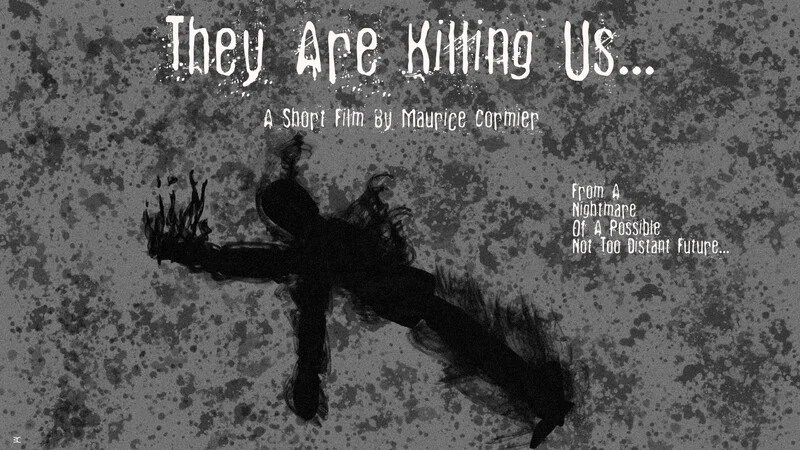
From A Nightmare Of A Possible Not Too Distant Future….
Project Links
Review by Parker Jesse Chase:
They Are Killing Us declares its intentions with an utmost unflinching clarity. This is not a film that eases the audience in. This is a short drawing from the living archive of human atrocity; intertwining the use of audio, claymation, and layers of mixed-media animation into something that feels like an alarming notice. Filmmaker Maurice Cormier showcases what we are about to experience is not abstraction. These are events happening in real time, in the present state of the world. The screen is no longer a safe distance to live.
A sphere of orange clay suspends in darkness. In fact, it pulses. The camera moves toward it in rhythmic cuts, closing the gap between the viewer and the violence with each heartbeat. When the sphere is sliced and blood begins to seep through its cracks, the metaphor needs no translation: this is a world bleeding. This is the earth as a body. This is humanity at its core.
The violence and innocence intertwined is where the groundbreaking imagery lives.
The choice of clay is childlike in texture and innocent in its associations. This sits in deliberate tension with what social commentary it is made to depict. Orange, is the color of decay and warning, bleeds across the canvas in layers of spray paint until the frame itself is consumed. This is a visual argument for saturation: the world has absorbed so much violence that it can no longer contain it. Cormier understands the medium is the message. Animation, particularly in this hand-crafted form, grants access to the unbearable. This artistic choice allows the filmmaker to go where live action cannot.
The film’s structure is cumulative and relentless by design. A god-like figure enters who is imposing and unclear of intentions. However, is put down by gunfire before the eye can fully register him. Limbs fall. Bodies wrapped in gauze populate the frame in rows of pure death and decay. A human silhouette crosses the screen engulfed in flame, then falls. Couples burn in each other’s arms. The sphere, now split, reveals muscle-like tissue connecting its severed halves. This is the final image of a world torn apart but still, grotesquely, holding on. And then the heart monitor flatlines.
By the time you realize you are only three and a half minutes into a five-minute film, Cormier has already accomplished something remarkable: he has made the viewer feel the exhaustion of living inside an ongoing catastrophe. The pause you take to breathe is not incidental. It is the film working exactly as intended.
The audio is the film’s spine. Screams that may well be real, gunshots that accumulate past the point of shock into something closer to demise, and a sound design that scratches at the nervous system. Cormier leads the viewer’s distress entirely through sound. The design is deliberately, masterfully uncomfortable.
The mixed-media approach between the use of clay, paint, and layered animation is not simply stylistic indulgence. This is the precise tool the subject demands. This range of texture and form is what allows a film this unflinching to be experienced rather than merely endured.
The camera implicates extreme close-ups on pools of blood, the steady rhythmic cuts synced to a heartbeat, each visual handcrafted and intentional. Every compositional choice narrows the distance between screen and viewer. Cormier puts you directly in the shoes of those undergoing the violence, and he achieves this with precision.
The childlike quality of the medium pressed against the enormity of its subject creates a dissonance that is the film’s defining achievement. They Are Killing Us is not an easy film. It is not meant to be. It is a call to awareness in the form of a five-minute confrontation. This short intrudes with violence until it ultimately flatlines, leaving behind the question it has been asking all along: what are you going to do about it? Maurice Cormier has made something visceral, necessary, and genuinely haunting. The innocence of its form and the brutality of its content are not in conflict. That tension is the point. That tension is the film.

