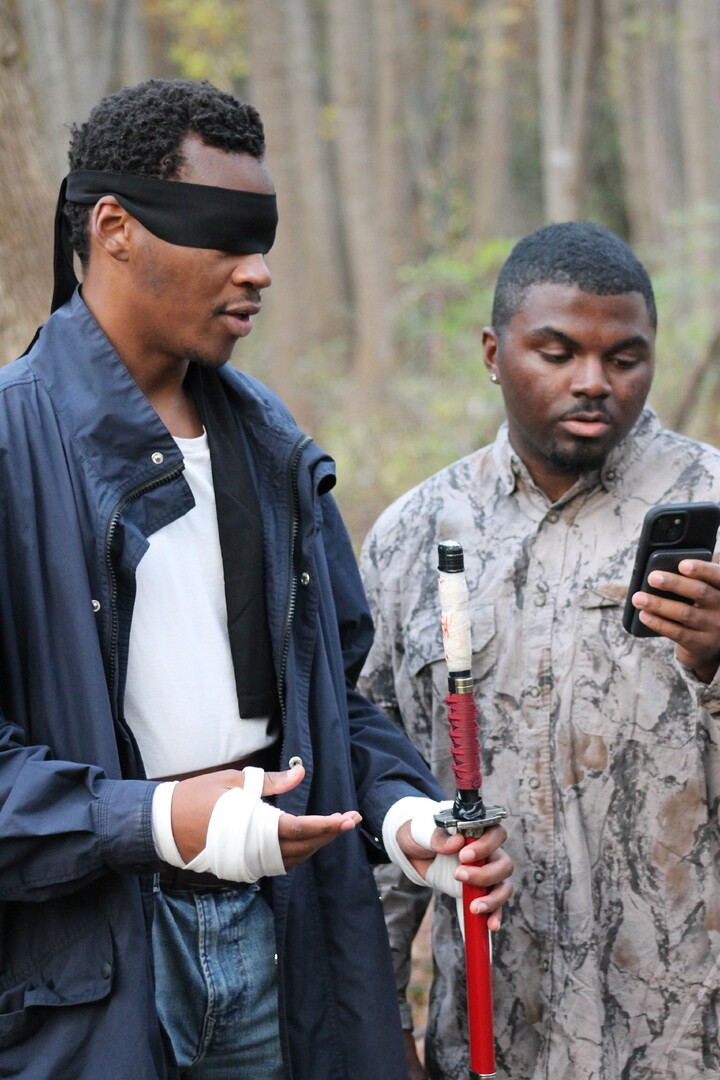
In a post-apocalyptic wasteland where water is the last resource, a blind swordsman with heightened senses becomes the reluctant protector of a desperate young man, forcing them both to fight for survival and hope.
Project Links
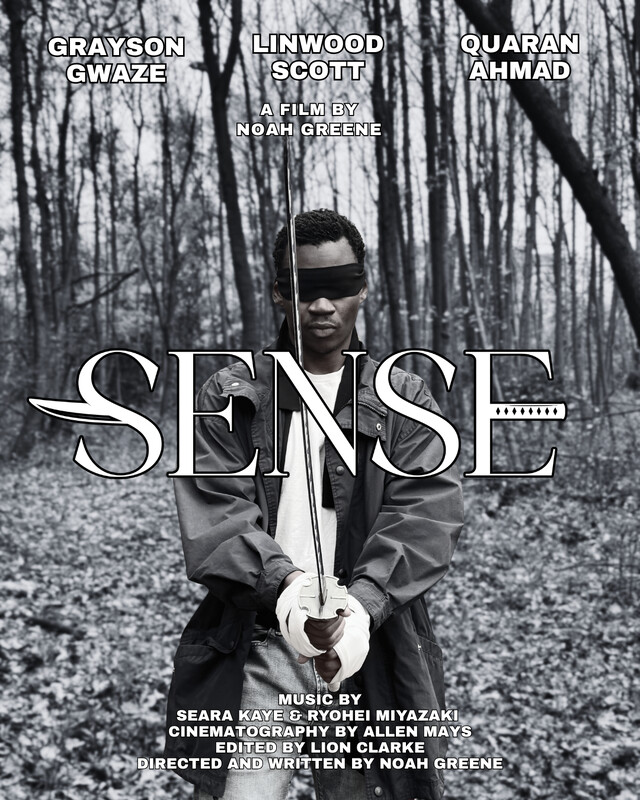
Review by Parker Jesse Chase:
Before a single character speaks, Sense earns its place at the table. An animated title card rendered in
calligraphic strokes showcases the story by a hand-drawn, scrappy, alive with intention opener. This
action ultimately sets the mythology of a world that burned itself into oblivion. Humanity tore the sky apart.
What remained was ash. And from that ash, remarkably, an everlasting forest rose.
Sense is a story about human responsibility and what it means to protect something precious when the world has decided it is not worth protecting. A blind swordsman stands between the last living forest and the Ravagers who would strip it bare, leaving bodies where they go, not warnings. Into his orbit wanders David, a younger figure still learning the cost of defiance. Their pairing is not incidental: it is the film’s moral architecture. One man who cannot see, yet perceives everything. One who can see, yet understands so little.
A meditation on what we owe the earth and what it may yet ask of us in return.
The thematic resonance runs deeper than its post-apocalyptic genre trappings might suggest. The forest is not merely a setting…it is the last argument for life itself. The Ravagers are a mirror: a portrait of humanity’s most self-destructive impulse, the one that already scorched the sky. The blind swordsman, then, becomes an act of resistance, a figure of reckoning between what was lost and what might still be saved. Bishop carries a necklace close to his chest, pressing it to his lips in the quiet of the blue-lit night, suggesting this duty might not be abstract. The potential for this fight to be personal, exists. This grief could be made into purpose.
The interplay between Bishop and David unfolds with a patient elegance. Bishop sensing a hidden observer purely through the rhythm of breath and footfall is one of the film’s finest moments. It reframes what “sight” means entirely. His perception is not diminished; it is refined into something almost supernatural, a kind of empathy sharpened to a blade’s edge. David, by contrast, is raw material: frightened, reactive, but capable of something the film wisely leaves unnamed until the moment demands it. When he takes the final shot, it leads as a quiet rite of passage.
The soundtrack carries unmistakable Asian musical influences, threading the world-building through sound as much as image. As the tension builds toward the film’s closing shot, the score swells with a weight that lingers well past the final frame. The filmmaker understands restraint is its own form of power. The king observing from a distance in the film’s final beat where he is silent, still, and watching is a compositional choice that transforms a fight scene conclusion into an ominous new beginning.
Sense carries the weight of something much larger already fully formed inside it. What lingers is not the action, impressive as it is, but the quiet in between: a man kissing a necklace in the dark, a boy learning that survival sometimes means community. This is a world worth returning to, and a story that understands the most powerful things are often what we cannot see.