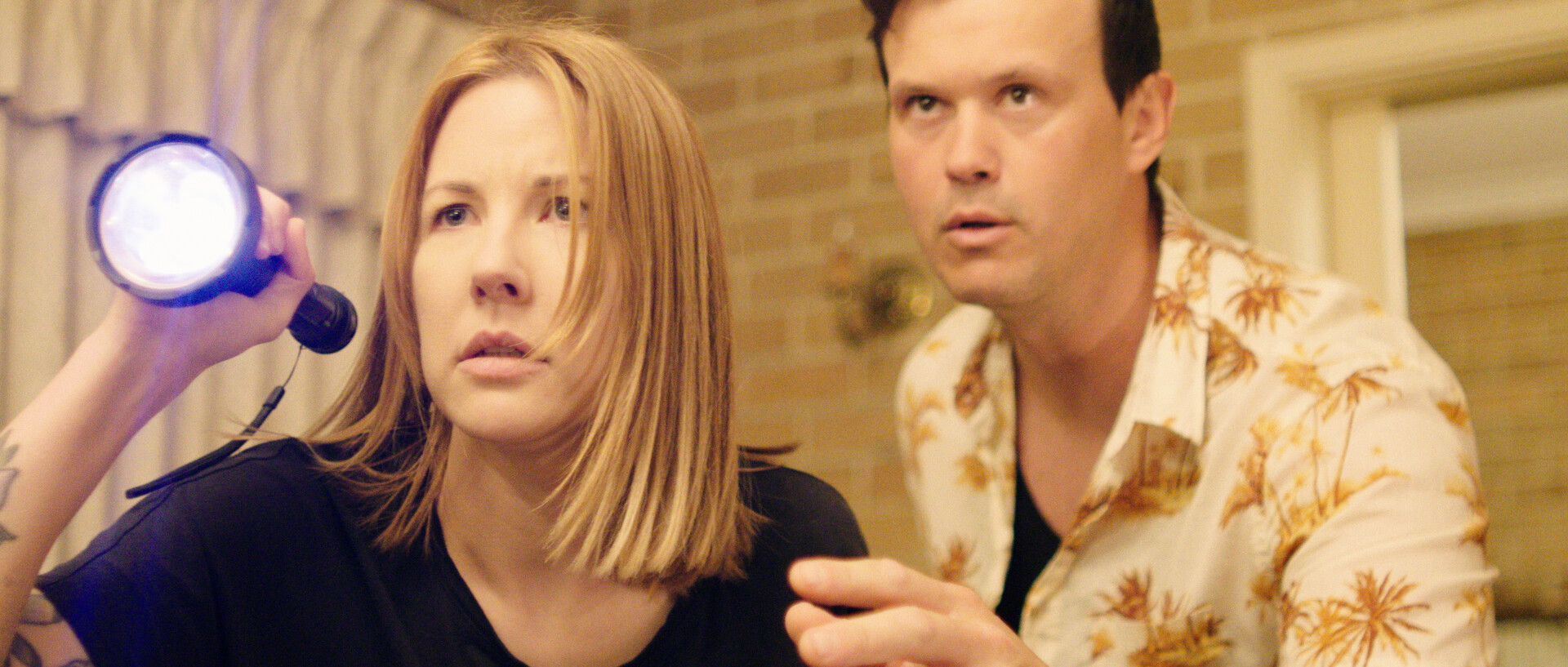
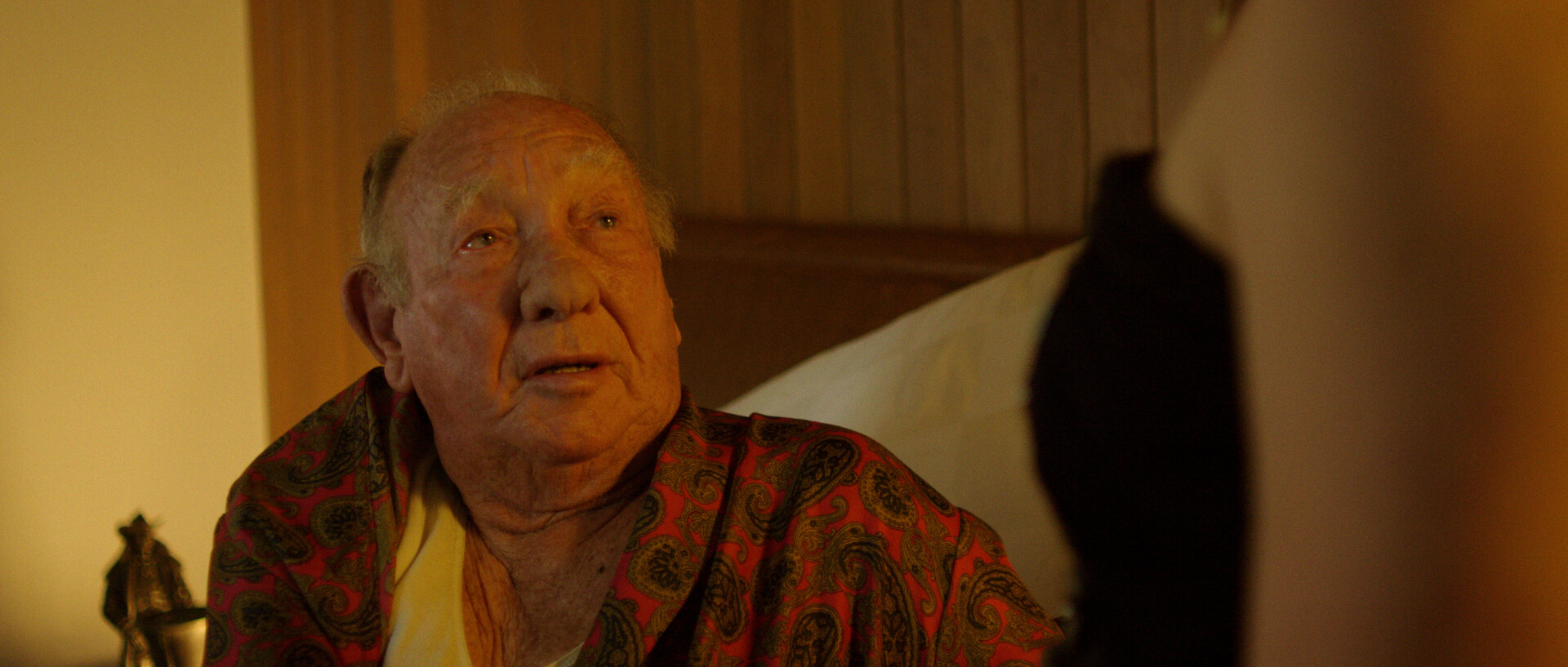
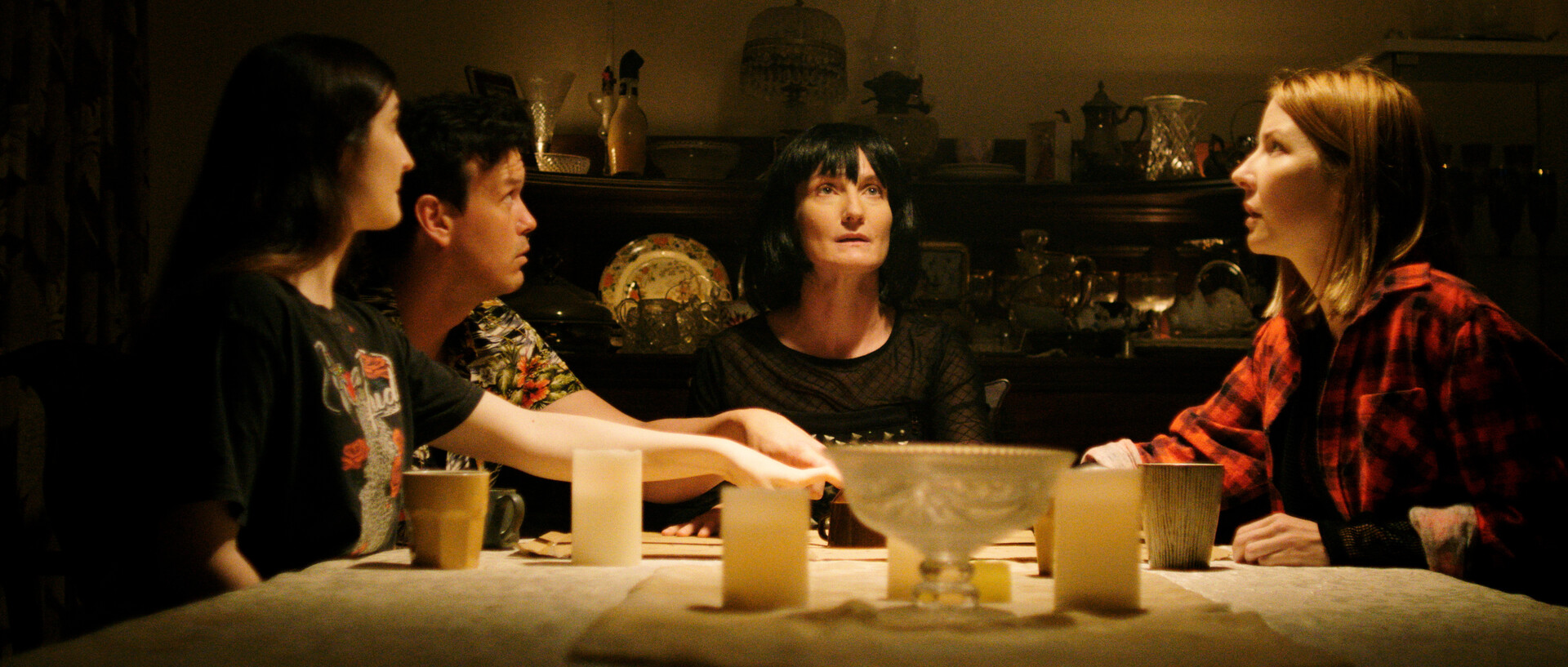
‘Savannah’s Curse’ is set in the future where resources are limited, and reserved only for society’s elite and privileged. The destitute, poor, afflicted and those who cannot be understood either by language or adversity, are institutionalised. Some of these people are ‘saved’ by the elite and forced to work in degrading circumstances, their vulnerability taken advantage of. A woman’s spirit returns, her ghost unable to rest until retribution for herself, those she left behind, and her daughter born into this world, is served.
Savannah’s Curse is set in an apocalyptic future where the wealthy have the monopoly on power and keep indentured servants to serve their every whim. Writer/Director Tamara Cook set up the premise of this story beautifully and the Cinematographer Rakib Erick did a great job making it look wonderful.
I really have to commend the Visual FX expertise of Jacob Horan because it was done so incredibly well. All of the actors were very likable, and did a good job with their roles. The paranormal aspect of this was great and I loved how the filmmakers did the seance scene. However, I think there were scenes in the film where they shied away from making it clear to the audience what they had to do for their employer. I really wished the genre of the film was a bit more defined but I did enjoy the story and the journey it took you on. It had some cool twists and we all love to see a tyrant get his comeuppance.
Festival played at the end of September 2025. Showcasing the best of NEW movie trailers from around the world. Over 170 submissions.
AUDIENCE AWARDS:
Best Movie Trailer: CLAWS
Best AI Trailer: ROMEO LOVES JULIET: A LEGO LOVE STORY
Best Action: U3030
Best Adventure: THE OUTLAW WIND
Best Animation: THE PATCH
Best Comedy: FROM BROOKLYN TO BOCA
Best Documentary: Honoring Adaptive Athlete: U.S Army Veteran – Marc Dervaes
Best Drama: IN THE SHADOW OF GRACE
Best Editing: FINAL TRANSMISSION
Best Experimental: A Little Monsters Book Trailer – The Case of the Missing Pink Piggy
Best Fantasy: LEGACY OF ELYRIANS
Best Mystery: SKIN CIRCUIT
Best Proof of Concept: BRINKCHASER — Cinematic POC
Best Relationship: STRONG ENOUGH
Best Romance: LUNA DE SANGRE
Best Sci-Fi: ENTHUSIASM
Best Story: KIM WESTON: MOTOWN TO BLACK BOTTOM
Best Thriller: I/O
A Little Monsters Book Trailer – The Case of the Missing Pink Piggy, 2min. USA Directed by Zachary Simpson A squeaky-clean mystery brought to life with heart, humor, and a whole lot of Little Monsters magic! With charming illustrations, lively music, and Studio Story Monster sparkle, this trailer invites kids (and kids at heart!) to join the adventure. Let our young narrator guide you through the pages of Linda Harkey’s delightful world of friendship, curiosity, and a case of a missing pink piggy…
KIM WESTON: MOTOWN TO BLACK BOTTOM, 2min., USA Directed by Valerie Denise Jones A haunting, narration-driven trailer that traces the journey of Motown artist Kim Weston through the cultural shift from Motown to Black Bottom, where music, memory, and identity collide.
BRINKCHASER — Cinematic POC, 3min., USA Directed by J.A. Lemos BRINKCHASER is a cinematic proof-of-concept extended trailer for a feature project currently in development, based on the published source novel. The piece presents the project’s tone, atmosphere, visual language, and larger story world in a compact form.
LEGACY OF ELYRIANS, 2min., Poland Directed by Marcin Zawistowski Marcus Zane spent his entire life believing he was an ordinary person. Yet ever since childhood, strange and unexplained events followed him wherever he went. He knew things he should never have known, heard people’s thoughts before they spoke, and strong emotions could trigger dangerous phenomena that someone had spent years hiding from the world.
ENTHUSIASM, 1min., USA Directed by Anthony Burkhalter Teaser trailer for the feature film based on the award-winning science fiction short, Enthusiasm Abounds.
SKIN CIRCUIT, 2min., USSA Directed by David Heath Ferguson Jason Wilder, a small-town private investigator and martial arts expert, launches a relentless mission, navigating through the criminal underworld, to rescue his best friend’s sister from a mysterious human trafficking ring.
ROMEO LOVES JULIET: A LEGO LOVE STORY, 1min., USA Directed by Lawrence Jones This project is an original, AI-assisted film and series concept set in a futuristic cyberpunk LEGO world. It follows two mercenaries navigating violence, loyalty, and emotional vulnerability while attempting to maintain a relationship in a city designed to keep people broken.
U3030, 2min., USA Directed by Wendy Crouse A medical officer (Grace Lyons) traveling with her first officer (G2) delivers medical supplies across the Universe. When their year mission is over, they head home to Mars.
THE OUTLAW WIND, 2min., USA Directed by Wendy Crouse
THE PATCH, 2min., Greece Directed by Ioulia Lymperopoulou “The Patch” (2026) is a short art animation that was inspired by my short illustrated story “The Patch” (Kondyli, 2025). It is an allegoric narration about resilience through change in life and about our inner child that needs to be nurtured and protected to be happy and creative. It works as well as a Pilot Trailer for “The Patch” my upcoming short art experimental animation.
I/O (Proof of Concept), 2min., USA Directed by Molly Vernon On her eleventh birthday, gifted gamer Sky accidentally unleashes hybrid alien beings imprisoned for decades inside a Cold War–era program disguised as a video game. As civilization collapses and the creatures hunt humans for the dopamine that allows them to feel, Sky must survive the world she helped create—and find a way to close what she opened.
From Brooklyn to Boca, 3min., USA Directed by Josh Louis Sharon – shardan323@hotmail.com
N THE SHADOW OF GRACE, 1min., USA Directed by Jessica Lee Wrabel Our stories are never fully written, and within these pages are stories of healing. In exploring the raw and real depths of the human experience, we uncover a chapter of the heart where redemption and healing meet. In the Shadow of Grace follows three individuals who share honest testimonies of mental health struggles, addiction, and family trauma. Their journeys reveal how faith carries them from brokenness into restoration, and a closing message from a local pastor reminds us that hope and renewal remain possible even in our darkest seasons.
Honoring Adaptive Athlete: U.S Army Veteran – Marc Dervaes, 2min., USA Directed by David Goodman Tradition Production Group, Outdoor Immersion, K9 Heroes 4 Heroes, and Operation Hunt 4 Heroes, in association with Humanity Pictures, present a teaser for the film of the inspiring true story of Marc Dervaes, an Army veteran who lost his right arm from the elbow down while serving in Iraq. This powerful narrative follows Marc’s journey of resilience, recovery, and purpose — a story forged through the healing power of outdoor therapy, brotherhood, and unwavering determination. Through nature, service animals, and community, Marc reclaims not just his strength—but his mission.
LUNA DE SANGRE, 1min., USA Directed by Lorenzo Patanè, Alessandra Rucco When elite spy Luna’s forbidden romance is discovered, the Agency murders her lover and orders her execution. Captured by Mercurio her mentor and handler, she witnesses his final sacrifice. Reborn in blood and grief, Luna chooses vengeance, setting out to destroy the organisation that engineered her life and tried to erase her.
STRONG ENOUGH, 3min., USA Directed by Rose Maria Mitchell Strong Enough follows a woman as she reflects on a love that once felt all-encompassing yet ultimately required her to let go. Through tenderness, vulnerability, and emotional honesty, she moves from surrender to self-awareness, discovering that true strength lies in honoring her own worth. The video captures a quiet but powerful transformation – from love lost to self-reclaimed. rosemaria.vitae@outlook.com
FINAL TRANSMISSION, 1min., UK Directed by Sean Coleman Alone aboard a crippled transport drifting through deep space, Commander Elias Walker records what will become humanity’s final message. Earth is gone, and the ship, once a vessel of hope, now carries only failure and silence. As oxygen fades, Elias begins a calm mission log, clinging to duty and procedure. But as systems die around him, the truth surfaces. He isn’t just facing his own death, he’s witnessing the extinction of mankind. sean@silvermontpictures.com
REDLINING, 18min., USA Directed by Jason Stuart REDLINING is about a black & white family who live on the same property during the 1970s in the Georgia REDLINING era. The film explores the themes of generational wealth, prejudice, homosexuality, women’s rights and the legacy of discrimination in the American South. Who gets to live where? What happens when the parents pass? Who gets the house? And why?
I’ve always created my own work alongside acting in TV and film. This time, I wanted to make something quiet and visually contemplative, in the spirit of Terrence Malick or the film “Tender Mercies”. The subject of “Redlining” drew me in because it gets at something fundamental about how America has systematically separated people by race, religion, and sexuality and I wanted to tell that story.
2. From the idea to the finished product, how long did it take for you to make this film?
Six months was the gestation. I wrote the film by myself first and felt that I needed more structure to the story and I asked my friend actress Lee Garlington, who is a wonderful writer to read it and she said that she’d love to work with me on the script so we co-wrote the finish project together.
3. How would you describe your film in two words!?
Beautiful and tragic.
4. What was the greatest obstacle you faced in completing this film?
Money its always money. I have a reputation for taking the work seriously and not taking myself seriously. So I gathered friends and they gathered their friends and all these wonderful artists came together and made a film that I’m really proud of.
5. There are 5 stages of the filmmaking process: Development. Pre-Production. Production. Post-Production. Distribution. What is your favorite stage of the filmmaking process?
I have to say rehearsal. Which would be preproduction. The creativity in creating a character as an actor and the behavior of the person you’re playing, the voice the way you move is always exciting for me to develop. And as a director, I love to guide an actor to do their best work. Make them feel safe so they can create something that they’re proud of and that they enjoy doing at the same time.
6. When did you realize that you wanted to make films?
I don’t think there was a time that I didn’t ever want to be a part of the process of making a film. When I’m cast a film, I always think of how can I fulfill the Director and writers vision of what they wanted the film to be. That’s always exciting to me to create the previous circumstance for the character, the way they move, the way they speak and what affects them emotionally. As a long time character Actor, I believe that’s my job to tell the story for my performance to support the execution of the film.
7. What film have you seen the most times in your life?
I would say the film that made me want to be an actor and not just somebody who was funny and successful. Was “Ordinary People”. The simplicity of the story and the way it was photographed and interacted was heartbreaking and Mary Tyler Moore performance was one of the most shockingly original characters I ever seen on the screen a mother who was unlikable and in such pain she couldn’t love her child and it was played by a woman who was known as America’s sweetheart that really interested in me and made me want to be a character I can play different roles. And at the time I wanted to be like dustin hoffman and go from playing a street person in “Midnight Cowboy” to Lenny Bruce and the Film “Lenny” to “Tootsie” he was just Brilliant and seem to have such love for what he did. It really maybe fall in love with the work. And it’s been a love affair since I was a teenager..
8. In a perfect world: Who would you like to work with/collaborate with on a film?
This is a very long list, but I’ll give you some of my heroes in filmmaking Martin Scorsese, Spike Lee, Jane Champion, Yorgos Lanthimos, Host Safdie, Paul Thomas Anderson, and so many more. And of course Sean Baker again who I did “Tangerine” with a 10 years ago
9. You submitted to the festival via FilmFreeway. How has your experience been working on the festival platform site?
FilmFreeway is honestly one of the easiest platforms I’ve used, and I’m grateful for that. I remember the days of filling out endless paper submissions with “Out Of The Box”. That said, I’d love to see the experience feel more personal. There’s often very little communication between curators, programmers, and filmmakers, and I think that’s worth addressing. For those of us who’ve spent decades in this industry, it would mean a lot to be seen as colleagues rather than just entries in a queue.
10. What is your favorite meal?
Chocolate cake always! incredible bread and great cheese
11. What is next for you? A new film?
I have several independent films that I’m acting in. One would be a drama about a little girl who has Williamson syndrome where I play basketball coach called “I Got Next”, the horror film “Blackwood” that I play that creepy guy down the road that everyone thinks is the killer. And a few others. Right now I’m playing a self involvedHollywood Producer in the romantic comedy “Only Bears”. Most will end up in Film Festivals hopefully and will be set for streaming on multiple platforms.
WHITE SHADOW, 98min., Singapore Directed by Gloria Chee, Eileen Cheng An untimely diagnosis of a terminal illness sends Ren Jie into a tailspin. Determined to experience love in the limited time she has left, Ren Jie sets out to give her all to Kai Ting, a premature widow still grieving the tragic death of her husband. Through her relentless pursuit, Kai Ting eventually softens. The two friends who have known each other for decades experience the most powerful emotion – love. A moving journey ensues – two individuals learning to trust, communicate, be brave, and vulnerable, but neither are prepared for the agony and heartache in their inevitable separation.
Get to know writer/director Gloria Chee:
1. What motivated you to make this film?
I made White Shadow because I kept thinking about what happens when death walks into the room before we are ready. Do we become numb and decide life means nothing, or do we suddenly love with a kind of terrifying honesty? Ren Jie and Kai Ting are two people standing in that doorway, between denial and acceptance, fear and devotion, and I wanted to ask what love looks like when there is no time left to perform it politely. For me, this film is about “big love” — love without possession, without gendered rules, without the safety of distance. It is about loving someone as if time is already running out — because it is.
2. From the idea to the finished product, how long did it take for you to make this film?
From the first idea to the finished film, it took about two years but emotionally, I had been carrying it all my life. Some films begin as scripts; this one began as a question that would not leave me alone: if you knew the ending was near, would you still procrastinate or risk loving fully?
I have always known the answer. It has always lived with me in the quietest places — under MRT tracks, in corridors, on pedestrian bridges, in spaces where people are always passing through but rarely arriving. That is why I chose to make this film in liminal spaces: because Ren Jie and Kai Ting are also passing through invisible doorways within themselves. They stand at emotionally unspoken thresholds — the moment before love is confessed, before death is accepted, before fear gives way to tenderness. These are the places where nothing seems to happen, yet everything inside a person changes.
3. How would you describe your film in two words!?
I can’t decide. So please let me have 2 options. Tender Mortality and Big Love.
Because White Shadow is about death being the shadow; love is the light that makes it visible.
But more than that, it is about the tenderness that becomes possible when people stop pretending they are permanent.
4. What was the greatest obstacle you faced in completing this film?
The greatest obstacle was daring to be restraint; not make death loud, love dramatic and pain to announce itself. White Shadow needed the opposite. It needed silence, glances, hesitation, the almost-touch, the breath before someone says what they really mean.
The hardest thing was trusting that the audience would feel the earthquake even if we only showed them the cup trembling on the table. The film lives in the moment before the words come — because sometimes the most difficult truths are often the quietest ones.
5. What is your favorite stage of the filmmaking process?
I don’t have a particular favorite stage. Writing is immensely personal and cathartic. Production and post-production are magical because it is the moment when the film stops belonging only to me. Suddenly the light changes, an actor pauses half a second longer than written, the wind moves through a corridor, and the scene becomes more alive than the plan. There is a beautiful surrender in that. I prepare obsessively, and then I wait and see what the film becomes in front of me.
6. When did you realize that you wanted to make films?
In my teens, when I understood that cinema could hold what ordinary language could not. Some feelings are too fragile for conversation — grief, longing, shame, the kind of love that has no approved name — but on screen, a hallway or a shadow or someone’s hand resting too long on a railing can say everything. I wanted to make films because I have owned and witnessed many silences. And cinema became the place where silence could finally speak.
7. What film have you seen the most times in your life?
I have lost count. In different stages of my life, I watch different films on loop till I can recite the lines. I return to it not for the plot, but for the feeling it leaves in the body — like a bruise you press because somehow it reminds you that you’re alive. The films that stay with me are not the ones that explain everything. They are the ones that leave an imprint in me so much so that days, weeks, months, years later, its visuals or line or feeling creeps into my consciousness unannounced. And so, I believe a great film does not end; it echoes.
8. In a perfect world: Who would you like to work with/collaborate with on a film?
There are many directors whose work I deeply admire, but I don’t feel I’m in a position to speak casually about collaborating with them, so I won’t name names.
I’m drawn to artists who are unafraid to sit with silence, ambiguity, and discomfort; directors who don’t rush to explain the human heart. I hope to work with people who are not only brilliant but truthful. Because talent impresses, but truth stays with you.
9. You submitted to the festival via FilmFreeway. How has your experience been working on the festival platform site?
FilmFreeway made the submission process feel very direct, which matters because independent filmmakers already carry so much invisible labor. There is something strangely vulnerable about pressing “submit”. After years of doubt, drafts, edits, and private terror, your film suddenly leaves your hands and enters the world. So, I’m grateful for any platform that makes that crossing a little less lonely. A submission button can look small, but sometimes it is the door to a new life for a film.
10. What is your favorite meal?
My favorite meal is a good plate of sashimi. There’s something beautiful about its simplicity — the coldness, the texture, the quiet discipline of it. Like cinema, it reminds me that the deepest pleasure is often in what is not overdone.
11. What is next for you? A new film?
Yes. My next film is Unsevered, or 残藕. It is a psychological drama about Maya, a woman who takes refuge in a Buddhist nunnery after devastating trauma, trying not to heal but to disappear — until memory begins to return like weather entering a sealed room.
Where White Shadow asks what love means under the shadow of death, Unsevered asks what survival means after the self has been broken. It is not a film about forgetting pain. It is about building a life strong enough to contain it. The final image I keep returning to is not a miracle, not a cure — just hands that were once clenched, finally open, resting in the present. She is not cured. She is whole.
TOUCH, ME, PLEASE!, 8min., USA Directed by Xinran Wendy Tong A 50-year-old woman with Parkinson’s disease, PEACOCK, applies to receive her first sexual service from Hand Angel NICKY. After Peacock’s sister leaves, they secretly meet at Peacock’s home for the first time to plan for the service…
Get to know the filmmaker:
1. What motivated you to make this film?
I was initially inspired by the documentary Still Tomorrow and the raw intensity of Yu Xiuhua’s writing, which expresses desire in a way that feels both vulnerable and unapologetic. That led me to think about how female desire—especially for marginalized bodies—is often silenced. When I came across the “Hand Angel” organization in Taiwan, I realized this wasn’t only about sexuality, but about dignity, agency, and the right to intimacy. What struck me most was reading volunteers’ journals, where some described these encounters not as acts of charity, but as mutual experiences of connection and pleasure.
That complexity stayed with me. I wanted to make a film that resists pity, and instead explores intimacy as something shared, awkward, tender, and deeply human—especially for women whose desires are often overlooked.
2. From the idea to the finished product, how long did it take for you to make this film?
About five months of active work, though the overall timeline stretched longer due to pauses in between.
I spent around a month on writing and pre-production, followed by a two-day shoot. Post-production took the longest, as I kept refining the film over time. There were also delays due to scheduling conflicts, particularly with editing, which extended the process by several months. Later, I reconnected with a sound mixer and composer, which added another layer of development to the final version.
3. How would you describe your film in two words!?
Intimate. Unsettling.
4. What was the biggest obstacle you faced in completing this film?
One of the biggest challenges was shaping the characters. Although it’s a short film, the characters carry complex inner worlds and layered backstories. Translating that depth into performance within a limited runtime required a lot of precision and trust. I was very fortunate to work with two incredible actors, Wendy Zhuo and Mingjie Zhai, who brought a deep understanding to their roles. Their sensitivity and commitment made it possible to convey that complexity in a subtle and authentic way.
5. What were your initial reactions when watching the audience talking about your film in the feedback video?
My favorite stage is working with actors, especially during rehearsals. I really enjoy the process of discussing the script with them, exploring motivations, and shaping the emotional rhythm of each scene together. It’s often in these conversations that new layers of the characters begin to emerge.
Table reads are particularly meaningful to me. Hearing the script spoken aloud for the first time always changes how I understand it. The actors bring their own interpretations, sometimes revealing nuances I hadn’t fully realized while writing. That exchange feels very alive and collaborative.
For me, directing is less about controlling performance and more about creating a space where actors can explore, question, and build the characters from within. That process is always the most exciting part.
6. When did you realize that you wanted to make films?
It started during my undergraduate years, when I began filming small fragments of everyday life as a way to cope with emotional pressure. Recording and editing those moments helped me process what I was going through, and I realized that filmmaking could be both a creative outlet and a way of thinking.
My background is in documentary, and I’m deeply drawn to reality. But over time, I also became interested in narrative filmmaking. There are certain experiences and emotions that are difficult—or even impossible—to capture through documentary alone. Fiction gives me another space to reconstruct and reimagine those realities in a more expressive way.
7. What film have you seen the most in your life?
Probably Hachi: A Dog’s Story. I’ve watched it many times, and it still moves me every time. I’ve always had a deep love for animals, and there’s something about the film’s simplicity and emotional honesty that really stays with me.
In a way, it also connects to my long-term dream—I would love to make films about animals or even wildlife documentaries in the future.
8. What other elements of the festival experience can we and other festivals implement to satisfy you and help you further your filmmaking career?
Hito Steyerl. I’m deeply inspired by the way she approaches images—not just as visual objects, but as entities that circulate, degrade, and carry political and economic power.
Her work challenges ideas of image “quality” and authorship, which resonates strongly with my own interests. I’m especially drawn to how she blends essay, documentary, and fiction into hybrid forms that feel both critical and poetic.
In fact, my current film Image Exile, which is now in post-production, is directly inspired by these ideas. It explores low-resolution images, memory, and the politics of visual restoration. I think collaborating with her would be an opportunity to further push how I think about images—not just as representation, but as something that can construct, distort, or even resist reality.
9. How has your experience been working on FilmFreeway?
It’s been very smooth and accessible. It lowers the barrier for independent filmmakers to reach a wide range of festivals.
10. What is your favorite meal?
Hot pot. It’s less about the food itself and more about the shared experience.
11. What is next for you? A new film?
I’m currently working on my thesis film, a hybrid documentary titled Image Exile. The project explores low-resolution images, memory, and the politics of visual restoration. It’s a continuation of my ongoing interest in how images carry emotional and cultural meaning beyond their surface quality.
The film follows a collector who preserves forgotten or discarded low-resolution footage, while confronting the growing dominance of AI-driven image restoration. As technologies attempt to “improve” images through interpolation and enhancement, I’m interested in what gets lost in that process—especially the emotional texture, ambiguity, and historical traces embedded in imperfect images.
Formally, the project blends documentary, fiction, and essay elements. It moves between archival materials, staged scenes, and speculative narratives to question ideas of authenticity, memory, and visual truth. I’m currently in post-production.
Separate Roads, 14min., Canada Directed by Shalina Saleira When former high school sweethearts Daniel and Tyler meet again years after a painful breakup, they’re forced to confront the scars of their past – including Tyler’s attempt to ‘cure’ his love through religious conversion therapy. They try to bury the hatchet and find closure, but old wounds may be too deep to heal.
1. What motivated you to make this film? I wanted to show the ramifications that gay conversion therapy can have on people, and that it shouldn’t be pressed upon you by any outside force in your life. Especially with many USA states rolling back the bans that were put in place on these practices. This film shows the damage this so called “therapy” can inflict onto you and others around you.
2. From the idea to the finished product, how long did it take for you to make this film? This is a true story from my life, and it’s always something I’ve wanted to share with the world. But, from start to finish it was about 9 months.
3. How would you describe your film in two words!? Unspoken Truths.
4. What was the biggest obstacle you faced in completing this film? Our limited budget was a major constraint. Having to get people onboard with this shoestring budget was a challenge. But we had some incredibly talented cast and crew that believed in the story enough to come on this journey with me. And I’m proud of what we made. There are some technical things I wish I could fix if I had a bigger budget, but I’m sure every other filmmaker thinks the same.
5. What were your initial reactions when watching the audience talking about your film in the feedback video? I was incredibly happy that the audience really liked our movie for our storytelling and understood the journey we were taking them on. I loved how they talked at great length about the nuances about the various subject matters, and I’m glad it resonated with people.
6. When did you realize that you wanted to make films? I’ve been an actor my whole life. Acting is what I live and breathe to do. But, in the last few years, I’ve leaned into making my own content. And creating “Separate Roads” has been an incredible journey. I love making films, sharing my art, and being part of the filmmaking community.
7. What film have you seen the most in your life? I love Fantasy and Sci-fi films the most. I’m enamored with the world building, the fantastical imagery, and being transported into those dimensions. Who doesn’t love a bit of escapism? .
8. What other elements of the festival experience can we and other festivals implement to satisfy you and help you further your filmmaking career? It would be amazing if festivals could somehow collaborate with investors who are looking to back short films to help create a feature length film or help finance the next project.
9. You submitted to the festival via FilmFreeway. How has your experiences been working on the festival platform site? It’s a great tool to have everything centralized and see what each festival offers. It’s very user friendly.
10. What is your favorite meal? Pepperoni Pizza.
11. What is next for you? A new film? At the moment, we are just at the very beginning of the festival run for “Separate Roads”. We have 3 more festivals we’ve been accepted to, and more on the way. But after that, it would be amazing if we had interest in the film to create a feature length. But, I also have more projects in mind that I want to work on next.
Entrelacés en Bleu, 18min., Canada Directed by Tayler Gladue 3 strangers struggle to find where they fit in a world that demands too much from them. Little do they realize how impactful and connected their lives actually are.
Get to know the filmmaker:
What motivated you to make this film?
As a small Indie filmmaker I Calgary, we are often constrained by physical and economic factors when deciding to make a film. Due to low budgets most of the crew and cast usually get played very little, this causes the filmmaker to decide to cut aspects of the script, shoot in a location they do not want and have an ever increasingly production process.
I was tired of watching short films that you could tell scenes were cut, they had few locations and for most of them you could tell they were filmed in a day or two. For me this drastically impacte4d the story of the film in certain cases, and I thought to myself, what if we shot a short like a feature?
Keep relatively the same budget as a short but plan it out so we could use all the locations we wanted, all the cast we wanted and the crew.
I am a member of a very diverse art community and I thought, what if we treat this film like a residency? Have a group of artists who would not normally work together, create a film by solving the problems the others couldn’t?
It’s kind of a love letter to Jean-Luc Godard, what if a bunch of artsy friends run around the city with camera, a mic and some beautiful people and capture what happens. This was the inception of Entrelaces en Bleu.
From the idea to the finished product, how long did it take for you to make this film?
The film took from conception to release 1 year and 4 months. I know that seems a long time for a short film, however from the get-go I had decided that we need to make sure we capture the right moments. I was frustrated with overall concept of short filmmaking here in my hometown. Often you would only shoot over a weekend and on a shoestring budget, and you could often tell by the quality of the product shown.
For me, I wanted to make sure I had the right cast, the right locations and the right crew to shoot the scenes I had envisioned. So, with that in mind we made a long form schedule to accommodate everyone’s schedule. This had a secondary benefit you often do get on low budget short films; I had time to personally work with the cast and crew to truly make sure they had grasped my vision. It was a luxury most short films don’t consider, however that is why I wanted to change that.
How would you describe your film in two words!? Avant-garde
4. What was the biggest obstacle you faced in completing this film
I think the biggest obstacle I faced was convincing the people involved to trust the process. It’s so foreign for a short indie film to have such a long time to work on the film, this was a good thing, but we often found ourselves drifting, especially in post, having never worked with an actual band who gave us their music and a composer was intimidating but exhilarating as well.
There are 5 stages of the filmmaking process: Development. Pre-Production. Production. Post-Production. Distribution.
What is your favorite stage of the filmmaking process? Having been able to be a part of every step of this film was thrilling, I’m a producer by trade, but I was excited to try directing. Being able to work one on one with the cast and crew and express my vision to them and direction of the film was one of the highlights for me. I can only hope the cast and crew felt the same…
When did you realize that you wanted to make films?
I was a Chef in my previous life before covid, and when covid happened, I made the decision to follow a real passion I have had since a child. After covid I enrolled in film school and learned very quickly my abilities of chef, organization, planning and execution were transferable into the role as a producer.
What film have you seen the most times in your life? That’s a tough one… I would have to say my go to is usually the Birdcage, but I have to admit I watch gremlins way to often to be normal.
In a perfect world: Who would you like to work with/collaborate with on a film?
Unfortunately, the person I would have love to is no longer with us, but if I could even just pick John Waters brain over a beer, that would be amazing!
You submitted to the festival via FilmFreeway. How has your experiences been working on the festival platform site?
Yes, I use film freeway for all my projects. I find it incredibly helpful, especially when finding the right festival fit of my film.
What is your favorite meal?
Ceasar Salad. I have a personal recipe that I used in all my restaurants that I absolutely love. Everyone else seems to like it to.
What is next for you? A new film?
Currently I have a few film in development and pre-production. As well as a few docs. After the experience of working with all the amazing artists, musicians, painters and creatives who helped bring Blue to life, we have also decided to start a art group here in Calgary to help promote independent artists and their creative projects.
GOSSAMER, 21min., UK Directed by Hamish Sturgeon Set between glamour and decay, Gossamer explores identity, memory, and transformation through a character caught between survival and self-expression. As past and present blur, a fragile alter ego emerges, revealing the delicate threads that hold a life together.
I’ve always been interested in stories about identity and the parts of ourselves we keep hidden. Gossamer came from a desire to explore loneliness, self-acceptance, and the fragile line between who we are and who we wish we could be. I wanted to create something intimate that invited the audience to experience those emotions rather than simply observe them.
2. From the idea to the finished product, how long did it take for you to make this film?
From the initial idea to the finished film was approximately a year. The script evolved over several drafts before we shot over three days, followed by many months of editing, sound design, music, and festival preparation.
3. How would you describe your film in two words?
Quietly haunting.
4. What was the biggest obstacle you faced in completing this film?
Independent filmmaking is always a balancing act between ambition and resources. We had a very small team, limited time, and a modest budget, so every decision mattered. The biggest challenge was making sure the emotional truth of the story never got lost despite those practical limitations.
5. What were your initial reactions when watching the audience talking about your film in the feedback video?
It was incredibly rewarding. As filmmakers, we spend so much time wondering whether audiences will connect with what we’re trying to say. Hearing people discuss the themes, performances, and emotional impact reminded me that film is ultimately a conversation between the filmmaker and the audience, and it’s a privilege when that conversation resonates.
6. When did you realize that you wanted to make films?
I’ve loved storytelling for as long as I can remember, but working as an actor made me realize I wanted to tell stories from behind the camera as well. Directing and writing allow me to create worlds, collaborate with talented artists, and explore ideas that stay with people long after the credits roll.
7. What film have you seen the most in your life?
Probably classics like Terms of Endearment/Out of Africa
8. What other elements of the festival experience can we and other festivals implement to satisfy you and help you further your filmmaking career?
One of the most valuable aspects of festivals is connecting filmmakers with one another and with industry professionals. More opportunities for networking, roundtable discussions, and conversations with distributors, producers, and programmers are incredibly valuable. Building lasting creative relationships is often just as important as screening the film itself.
9. You submitted to the festival via FilmFreeway. How has your experience been working on the festival platform site?
FilmFreeway has been an excellent platform. It’s intuitive, easy to navigate, and has made the submission process far more accessible for independent filmmakers. It simplifies what used to be a very complicated process.
10. What is your favorite meal?
A traditional Sunday roast with family and friends. Being British, it’s hard to beat.
11. What is next for you? A new film?
I’m currently developing several projects. I’ve written a feature screenplay called Evensong, a stage play titled The Night Anonymous, and a television pilot called The Towers. I’m excited to continue directing while also expanding my work as a writer, and I hope Gossamer is just the beginning of a much longer filmmaking journey.
GOOD STUFF, 3min., Hong Kong Directed by Edwin Lai Good Stuff is the lead single from Joya’s third EP, “What If It All Works Out?”, written just before her daughter arrived, when the world felt paralysing. The song is the moment of deciding to turn toward the small things instead, choosing hope and love as an act of rebellion against a world that encourages us to feel numb.
Get to know the creator / originator / artist Jodie Chan:
1. What motivated you to make this film? The life I live now and the art I make as an openly queer and married singer-songwriter and actress are what I wish I’d seen more of growing up. I wanted to show a relationship between two Asian women who were simply living, with joy, love, domesticity and warmth. That kind of narrative and representation is still rare, and at some point it struck me that as an independent artist I had the ability and the voice to make it myself. I felt it would be extraordinary in its ordinariness, and that it could be relatable to anyone who has found safety and love in a relationship.
2. From the idea to the finished product, how long did it take for you to make this film? 2 months! I had the song written and produced for some time, but from the decision to make a music video for it and to make it from idea to finished product the process was about 2 months. If anything the execution of the filming was just 1 day, 2 with travel. The longest part of this process besides the incredible editing work done so efficiently by director/editor/colorist Edwin Lai was in thinking of the concept and coming up with references that would allow this music video to feel more like a short film and cinematic, but also convey the simple idea without being overly flat and on the nose. I had spoken and spent time with a few good friends of mine and felt like it was really important to get this right with feedback even prior to production.
3. How would you describe your film in two words!? Queer joy.
4. What was the greatest obstacle you faced in completing this film? Getting out of my own head was the biggest challenge. Even though I was closely involved in the concept and vision, it was another thing to execute it in front of the camera, especially as the “storyline” had no planned dialogue, more a set of vignettes of an intimate home life. I had acted before, but I’d never kissed anyone other than my partner on screen! So it was a real challenge to stop watching myself in the third person and trust the team instead. If anything, I felt more nervous doing that than performing in front of thousands. Now that I’ve done it, I feel much more empowered and excited to do it again, because it’s so satisfying to take something imagined, make it real. But I have to say with this project, the most moving part is receiving direct messages from strangers about how this moved them individually, and how they felt like they could resonate with it – both those in the LGBTQ+ community but also those outside. That’s the best possible outcome I could’ve hoped for.
5. There are 5 stages of the filmmaking process: Development. Pre-Production. Production. Post-Production. Distribution. What is your favorite stage of the filmmaking process? Though, tight close calls with production because I love working with my team and that collaborative energy is probably my favorite part of the whole process, and best felt during production itself. That camaraderie, challenge, and coming together of ideas.
Close second to that is distribution! I love putting and sharing the completed works out there, even if I wouldn’t say I’m the best at marketing – I think I’m of the camp that the right people are drawn to what you’re doing when it’s real and made with sincerity. It’s also just so satisfying at that stage because it’s being able to see the finished product but through the finished product, have memories of the behind the scenes that it took to get there.
6. When did you realize that you wanted to make films? Accidentally, and incidentally not until I started making them at the end of last year! It was by doing that after being tapped on the shoulder to act in a short film as lead, that I’ve slowly started to really fall in love with the incredible artform that is filmmaking beyond just as an audience member.
Who would you like to work with?
I feel like I’d have to answer this by role and also my evolving list would probably be too long but…as of today,
Directors: A close tie between Greta Gerwig and Noah Baumbach, or The Daniels, because they’ve held onto their indie instincts while telling deeply human stories, and they can communicate something fundamental at scale through the absurd and the specific.
Writer-performers: I’d love to work with Rashida Jones or Jane Fonda. Witty, powerful women who command and communicate so much both on screen and behind it. My dream is to be involved on and off screen, front of house and backstage, and they’re the example I’d point to.
Actors: Olivia Colman, Jodie Comer and Paul Mescal all jump to mind. They’re mesmerising to watch for completely different reasons, and they seem like they’d be great company on and off set!
I imagine I’d learn so much just from being up close, or better yet from being directed by or collaborating with any of them.
8. You submitted to the festival via FilmFreeway. How has your experience been working on the festival platform site? Smooth!
9. What is your favorite meal? Cheeky answer would be one with my favorite people, though that’s not entirely untrue.
10. What is next for you? A new film? Yes, I want to get involved in the script writing process and maybe even writing a musical. But most immediately, it’s actually putting out my EP “What if it all works out?” coming out.
boysick, 26min., France Directed by Maël CARADEC Milàn has a broken heart since his breakup with Gaëtan. In denial, Milàn makes one last attempt by following him on a dating app.
Get to know the filmmaker:
1. What motivated you to make this film?
Like many of us, I went through a breakup that left me a bit traumatized. I couldn’t move on, I thought about him all the time, I felt like I’d never find anyone else again. I even went too far into stalking, and let’s just say Grindr didn’t help me turn the page — quite the opposite. It’s horrible to know where the person you still love is, to see when they’re online, and to guess who they’re sleeping with. That problematic obsession and attachment issue is where the film was born from.
2. From the idea to the finished product, how long did it take for you to make this film?
The idea came to me during a feature-film writing workshop, but I’d say I really started writing BOYSICK in 2023. I wanted to shoot quickly, and although France has a wonderful funding system for creation, it’s still limited and very selective — you have to be patient and submit a lot of applications, keep pushing, reapply, sometimes wait 2 to 3 years before shooting a 20-minute film, and I think all of that dampens the desire to make a film. That’s why we tried for that funding, but in the end, together with the team, we decided to shoot without it because the desire to make this film was overflowing, and the wait was unbearable. We shot in August 2024 over 5 days, and post-production lasted several months, until around February 2025, due to budget constraints.
3. How would you describe your film in two words!?
Two words: Obsession, Love. Or Love. Obsession.
4. What was the greatest obstacle you faced in completing this film?
Honestly, financing this film was very complicated. No one could quite understand from the script how I was going to stage this story of heartbreak, especially with the on-screen messages. People found the script “too young,” “too simple,” and the character “annoying and passive.” Three weeks before shooting, we still didn’t know if we’d be able to film, the budget was so tight. I even lost an actor 3 days before the shoot started! And then, in the end, it worked out. That same script, which we decided to shoot anyway, became a small victory when the decision-makers came to the film’s premiere to congratulate me — and asked if it was really the script I had submitted!
5. There are 5 stages of the filmmaking process: Development. Pre-Production. Production. Post-Production. Distribution. What is your favorite stage of the filmmaking process?
I love shooting — I really feel like I’m bringing the film to life at that stage. Sure, it’s also where you can see what you imagined in your head slip away, and face disappointments over a set or a costume, but most of the time, the actors’ performances are better than anything I could have imagined, even during rehearsals. I also love editing — I’m an editor at heart, so I really enjoy that part too.
6. When did you realize that you wanted to make films?
I had a bit of impostor syndrome — I’d always said I wanted to do editing since I was 13-14. I used to film videos with my neighbors and my little sister, we even had a green screen… And then, when I convinced my parents to let me go to film school, I reassured them by saying they shouldn’t worry, that I’d become an editor since there’s more work in that field. But at film school, I realized I loved editing… my own films! And that all the writing and shooting steps were things I was doing beforehand without realizing that was directing.
7. What film have you seen the most times in your life?
If you’d asked me my favorite film, I’d probably have said something else, but to be honest here, I think it’s TITANIC. I must have seen it between 30 and 35 times!
8. In a perfect world: Who would you like to work with/collaborate with on a film?
I’d love to shoot with music artists as actors. I find they often have overflowing energy on stage or in their music videos, they’re very magnetic on camera, and you just want to film them. I’m thinking of artists like Troye Sivan, Conan Gray, or Lil Nas X.
9. You submitted to the festival via FilmFreeway. How has your experience been working on the festival platform site?
Nothing to say about FilmFreeway.
10. What is your favorite meal?
I’ll sound cliché, but cheese! So cheese pizza, cheese pasta… with a soft spot for goat cheese with honey.
11. What is next for you? A new film?
I have a third short film that I co-directed with Axelle Vinassac, which should come out late 2026/early 2027. SAD PRIDE GENERATION is a hybrid film between fiction and documentary, shot during the Paris Pride in a real-life setting but with actors. I’m also currently working on feature-film projects. I’ve finished the first draft of a feature film with Nicolas Guigou, my co-writer, and I took part in a writing workshop at Les Gobelins in Paris to develop a second feature-length fiction script set in Paris and New York across two different time periods.