Film Review: ROOM FOR RENT (Canada 2017) ***

Room for Rent Poster
Trailer

When a broke thirty-two year old ex-lottery winner convinces his parents to rent their spare room to save from downsizing, a creepy stranger with a hidden agenda moves in.

Director:

Matthew Atkinson

Direct from Manitoba!  I seriously cannot recall any Canadian film from Manitoba (excepting Guy Madden films) but this one is not half bad.  It is in fact, quite good.

Mitch Baldwin (Mark Little) is a classic case of a loser.  As an adult, he is still living with his parents and too unmotivated to work.  Worst still, Mitch had won $3 million in senior year. Three years later, he is flat broke and a laughing stock after becoming famous on TV upon winning the lottery.  The status quo is challenged when his father, Warren (Mark McKinney) loses his job.  Short of money, Mitch convinces his parents to take in a lodger.  The stranger, Carl Lemay (Brett Gelman) turns out more than Mitch anticipated.

Written and directed by Matthew Atkinson, this simple premise proves ample opportunity for twists and turns in the plot.  The stranger Carl is the biggest wild card and Atkinson keeps the secret of who he actually is right to the very climax of the film.

“My parents are hounding me all the time”, says Mitch at one point in the film.  Of course, Mitch does nothing but sit around all day, never looking for work as he is supposed to, expecting his parents to bring snacks and food for him all the time.

Carl does everything that director Atkinson can imagine to annoy Mitch.  And these are really annoying.  

Among them: 

bringing Mitch’s old girlfriend, Lindsay (Carla Gallo) back into the house

bonding with Mitch’s parents – something that Mitch was never able to do

showing up talk to Mitch all the time and lastly

annoying Mitch just because he can

The reason all this works is that Mitch deserves what he is getting from Carl.  Mitch is plain lazy, unmotivated and takes advantage of his parents.

All the above take place during the first half of the film.  Then Mitch starts taking action.  He begins taking a stand and protecting himself against his enemy.  Mitch even starts to gain respect from his ex-girlfriend who begins helping gather evidence against Carl.  All this is made more interesting for the fact that Carl turns out to have a few skeletons in the closet.  The two eventually end up in a face off when Carl confronts Mitch in his bedroom and punctures his waterbed as revenge.

Director Atkinson has a keen eye for comedy.  His comedic setups are meticulous and the humour comes across well.  It helps too that his 4 main actors playing Mitch, Carl and the parents are very good.

A little comedy, a little romance, a little message movie – all surprisingly twisted and unexpectedly inventive for a small budget Canadian feature.  Definitely worth a look.

And the climax where everything about Carl is finally revealed is a real hoot! If the climax does not get one laughing aloud, nothing will!

Trailer: https://www.imdb.com/title/tt5796156/videoplayer/vi2493626905?ref_=tt_pv_vi_aiv_1

Film Review: JOHNNY ENGLISH STRIKES AGAIN (UK 2018)

Johnny English Strikes Again Poster
Trailer

After a cyber-attack reveals the identity of all of the active undercover agents in Britain, Johnny English is forced to come out of retirement to find the mastermind hacker.

Director:

David Kerr

Writer:

William Davies (screenplay by)

The third instalment after JOHNNY ENGLISH and JOHNNY ENGLISH REBORN, JOHNNY ENGLISH STRIKES AGAIN sees one again bumbling secret agent (Mr. Bean who can speak) Johnny English (Rowan Atkinson) saving the world, in this case from internet hacking by super villain Jason Volta (Jake Lacy).

When the film opens, English is a retired M17 agent now teaching geography at some boarding school.  When M17 is on the receiving end of a massive cyber attack from an unknown entity, that exposes the identities of all its current field agents, the Prime Minister (Emma Thompson looking more puzzled than anything else probably wondering what she is doing in this dud) instructs M17 to reinstate older, inactive agents like Johnny English to be employed to solve the case.  As a result of accidentally killing off three other older retired agents (cameos by Edward Fox, Michael Gambon and Charles Dance), he is given the job, which he undertakes with the help of his faithful and unfunny assistant, Angus Bough (Ben Miller).

British TV series expanded into feature films often take their characters on holidays (KEVIN AND PERRY GO LARGE, ABSOLUTELY FABULOUS, ON THE BUSES etc. etc) to some foreign country.  This sequel takes the agents to the south of France for their investigation.  Nothing much in terms of comedy improves.

The oddest thing about the film is that the script by William Davies contains no shortage of elaborate comedic set-pieces.  These includes among others these two:

English and Bough dressed up as French waiters devising ways to get close to a suspect dining   in a French posh restaurant with his girlfriend.  This involves a fire resulting from flambé prawns in order to nab a cellphone while eventually setting the entire restaurant ablaze

a Virtual Reality simulation with English taking down a number of innocent strangers in public while imagining he is fighting Volta’s men in his mansion home.  This involves hitting a bakery eatery employee with two baguettes, toppling a tour guide on a double decker bus and pushing an old lady in a wheelchair out of a store.

Yet none of these generate any laughs – I did look around the theatre many times to see if anyone even remotely smiled

A smart idea of self parodying involves a glamorous Russian agent Ophelia Bulletova, played by former 007 James Bong girl, Olga Kurylenko who investigates Volta.  Any segment involving her and English also fail to incite any humour.

On the positive side, the film contains no toilet or barf jokes, though there is a harmless (and again unfunny one) involving the agent caught with his trousers down.

The film has so far grossed, at the time of writing almost $100 million while garnishing generally unfavourable reviews by critics.  The first two made around $160 million each which explains this third outing from Universal Pictures.  At best, what can be said is that younger kids might find this whole espionage exercise entertaining.

Trailer: https://www.youtube.com/watch?v=-Qv6p6pTz5I

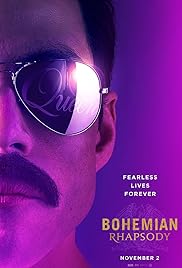
Film Review: BOHEMIAN RHAPSODY (USA/UK 2018) ***

Bohemian Rhapsody Poster
Trailer

A chronicle of the years leading up to Queen‘s legendary appearance at the Live Aid (1985) concert.

Director:

Bryan Singer

Writers:

Anthony McCarten (screenplay by), Anthony McCarten (story by) | 1 more credit »


BOHEMIAN RHAPSODY is a biography of the British rock band Queen concentrating on lead signer Freddie Mercury (Rami Malek from I, ROBOT and PAPILLON) set from the band’s formation to the band’s performance at the 1985 Live Aid concert in 1985.  Director credit goes to Bryan Singer though he was replaced before shooting was compete by Dexter Fletcher.  (America’s director’s guild, the DGA only allows one director credit).

The story centres on Freddie Mercury.  He is shown at the start of the film at odds with his Pakistani family, particularly his strict father in his small London home.  After a visit to a small club, he replaces the band’s lead singer and before long, he leads the band now called Queen to fame.  The script by Anthony McCarten gives Mercury a lot of credit (perhaps too much) for the band’s success.  The other band members (with Gwilym Lee as Brian May, Queen lead guitarist, Ben Hardy as Roger Taylor, Queen drummer and Joseph Mazzello as John Deacon, Queen bass guitarist) are given brief mention.

Besides this flaw giving Mercury too much credit – the film even bookmarks the film with his entrance onto the Live Aid Concert- the film is overlong, stretching past the 2 hour length.  The climax of the film – Queen’s performance of their hits could have been shortened for  better effect.  The desire to please audiences results in the film falling into clichéd territory.  Father of the family finally approves his son’s success, including the father’s advice of good thoughts, good words, good deeds being repeated at the film’s conclusion.  The blowing of a kiss by Mercury to his mother, as promised is yet another example.  Mercury’s story also falls into the standard mould of rock band/singer’s biographies – of rise to stardom, fall from grace and recovery back to existence with life lessons learnt, with hit songs dispersed in the process.

What the film benefits from is lead actor’s Rami Malek’s diversified performance, especially his showmanship during the Live Aid Convert.  Malek has demonstrated his acting chops already this year with an unforgettable performance in PAPILLON.

Mercury’s relationships are also given full display including his bi-sexualilty.  Mercury’s first girlfriend Mary Austin (Lucy Boynton) is demoted from first-class lover to best friend as Freddie finally takes on a male partner, Jim Hutton (Aaron McCusker).

As in most biographies on subjects with AIDs, the audience is informed that Mercury has contacted the decease with credits informing that his death later followed from complications due to the disease, with no details of his suffering or maybe regret.

Queen fans should be pleased with the rendering of most of the band’s hits including the title song, “Another One Bites the Dust and “We are the Champions.”

One of the film’s producers is Queen’s third manager, Jim Beach, played by veteran Brit actor Tom Hollander.  Mike Myers has a small role as n EMI executive.

What BOHEMIAN RHAPSODY has going for it are the performances of the band’s songs and Malek’s acting.

Trailer: https://www.youtube.com/watch?v=ZQ5uRRIZrBI

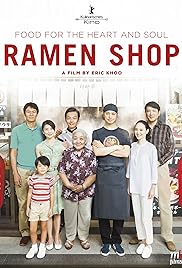
Reel Asian Film Festival 2018 Review: RAMEN SHOP (Singapore/Japan/France 2018) ***1/2

Ramen Shop Poster
A young man who is curious about his deceased parents’ past takes a food journey to Singapore where he uncovers more than just delicious meals.

Director:

Eric Khoo

The third film of Singaporean director Eric Khoo named after noodles (after MEE POK MAN and WANTON SOUP) RAMEN SHOP shows Khoo at his sappiest and most melodramatic.  Despite this flaw, RAMEN SHOP still shows the director’s brilliance especially when he meticulously examines both sides of the Singapore-Japan relationship.  

Not many westerners are aware that the Japanese did far worse than the Nazis in torturing their enemies especially during the Japanese Occupation in Singapore during WWII.  The film sees a young Japanese, Masato (Takumi Saito) travelling to Singapore to discover his roots and to make peace with his grandmother (Beatrice Chien).  This is achieved with the help of his comical uncle (Mark Lee) through the fine-tuning of a gourmet dish – bak-kut-teh.  

This is Singapore as it really is, as depicted by Khoo in all his movies where the Chinese speak ‘Singlish’ and not perfect English with a western accent as in CRAZY RICH ASIANS and where the citizens live in cramped single or double roomed flats and not in mansions holding extensive parties.  

Khoo is Singapore’s film pioneer and his films have won awards the world over including at Cannes.  This is the chance for Reel Asian fans to watch a quality film made by a top-notch Singapore director.

Trailer: https://www.youtube.com/watch?v=joHJKFC77ic

Movie Review: JULES AND JIM, 1962, Directed by Francois Truffaut

JULES AND JIM,   MOVIE POSTERJULES AND JIM, 1962
Movie Reviews

Directed by François Truffaut
Starring: Jeanne Moreau, Oskar Werner, Henri Serre, Vanna Urbino, Boris Bassiak, Anny Nelsen, Sabine Haudepin, Marie Dubois
Review by Silvana Jakich

SYNOPSIS:

Decades of a love triangle concerning two friends and an impulsive woman.

REVIEW:

Francois Truffaut’s third feature film, “Jules and Jim” has been touted as one of his most poignant masterpieces. Based on a semi autobiographical novel by Henri-Pierre Roche, Truffaut’s film begins just before WW1 in Paris.

Jules (Oskar Werner)- a shy German writer and Jim (Henri Serre)- a more extrovert French writer, meet and forge a friendship that is rooted in a deep respect for one another as both artists and human beings. Through the use of a narrator, Truffaut beautifully sets up the immense bond that forms between these two men as they share life experiences and the arts together. Their close friendship reminded me of the close knit friendships we weave when we are younger which are very much “in the moment”, spontaneous and full to the brim of utter devotion.

Into this tight knit connection explodes the free spirited, uninhibited Cartherine (Jeanne Moreau). In most films, the appearance of such a character would be used as a starting point for conflict between the two friends. There would be competition and the friendship would sour but instead of this typical route, the bond was now between three people instead of two.

The joy of Jim, Jules and Catherine’s relationship coupled with wonderful shots of a European summer holiday together will make any viewer envious. The carefree joyous time they share at the seaside makes the three characters inseparable. Even when Jules and Jim become completely enamored with Catherine, the typical competitiveness which would normally be highlighted in this situation is over ruled by each character’s love for the others.

Ultimately, Jim makes way for Jules to have a relationship with Catherine after Jules wards Jim off by saying: “not this one”. Catherine and Jules marry and move to Austria.

WW1 begins and both men are sent away to fight on opposing sides. The contrast between the visuals of war and previous images of countrysides and sunshine are extreme and violently bring home the drastic change in everyones’ circumstances. Yet, even in the war time moments, Jules and Jim express great humanity as their greatest concern is that they may end up killing one another.

Fortunately, both men survive the war and meet again but now the complexities of their various relationships with Catherine come to the surface and the element of self destruction begins.

Although the character of Catherine is often fickle, selfish,cruel, unstable and vengeful, Jeanne Moreau manages to play her with a bewitching effervescence and joie de vivre which prevents her from becoming a one dimensional villain. Here is an interesting exploration of a woman who requires many lovers during a period in history when women were restricted sexually and boxed into an identity of utter loyalty to one man.

This film is also tribute to the strength of friendship and all that is pure and innocent when it comes to a deep bond. The fact that even betrayal cannot taint feelings of love that human beings have for one another is a testament to the beautiful side of human nature.


Movie Review: THE 400 BLOWS, 1959. Directed by Francois Truffaut

THE 400 BLOWSTHE 400 BLOWS, 1959
Movie Reviews

Directed by Francois Truffaut

Cast: Jean-Pierre Leaud, Claire Maurier, Albert Remy, Guy Decomble, Georges Flamant, Patrick Auffay, Daniel Couturier
Review by Vinny Borocci

SYNOPSIS:

A young adolescent boy by the name of Antoine is not cared for at home by his parents. The boy begins to misbehave in class, steal from his parents, form lies, and engage in criminal activities. He escapes with his friend and finds other places to stay, while avoiding his parents. Ultimately, the parents send him to reform school in order to help clear his thoughts and shape his poor behavior. While there, he is left with a choice: to cooperate and attempt to work out his problems, or continue to act inappropriately. What will this troubled young boy decide?

REVIEW:

As we all should know, Francois Truffaut first made his name working for the film journal, Cahiers du Cinema, a magazine which spent heavy time evaluating Hollywood films and directors. Unabashed and undaunted, Truffaut zealously began writing critically on films offering his own unique style. Spending arduous time studying the works of Alfred Hitchcock, Howard Hawks, and Nicholas Ray, bringing a new perspective to criticism, combining somewhat blatant words with sincere appreciation, Truffaut helped solidify the idea that the director has omnipotence and authority for engineering the cinematic experience. Through his passion for films and literature, Truffaut’s uncommon criticism became the forefront in cinema evaluation. It was in this way, Truffaut’s name caught the attention of readers and avid cinema followers. The result: recognition and popularity, culminating in Truffaut venturing out to make his first (personal) feature film, The 400 Blows.

In The 400 Blows, Truffaut continues his writing approach and simply applies it to directing his first feature film, becoming the so-called “author” of the film. From the very beginning sequence, as the opening shots are beautifully shot, with the camera gracefully capturing various shots of the Eiffel Tower, Truffaut sends a message that the director’s artistic vision “towers” over the medium itself. Incorporating his own techniques while also including overt references to his admirers (mainly of Renoir in this film with the use of long tracking shots), Truffaut creates an environment dedicated to the distinct visual styles in which the director exhibits. For The 400 Blows, in recognition of his writing icon, Andre Bazin, who died just before production, the director’s style is clearly nothing more than a personal exposition.

The story revolves around a young, troubled preadolescent boy named Antoine, whom Truffaut utilizes to represent his own childhood struggles. Through multiple instances, Antoine is presented with a set of unprincipled values: we see in the classroom Antoine initiating disturbance by mocking his teacher; Antoine roguishly scampers through his own parents belongings and steals money, along with stealing a typewriter from his father’s work later in the film; not only performing an ill-advised action by ditching school and his studies, Antoine foolishly creates lies to cover his school’s absence by falsely claiming his own mother’s death. In these ways, however, Truffaut is not depicting Antoine’s character to distribute a sense of immoral behaviors, but rather establishing Antoine as an image of pathos, to voice his idea on the meaning of family and parenting, while in the process, brazenly expressing his deprecation for his own childhood upbringing.

As we see Antoine repeatedly scurry through the bustling city streets, almost all of the time on his own, Truffaut reinforces the idea of the importance of the parent in a child’s life. The boy’s mother gives him harsh orders, while never showing an offering of care – only after the boy catches her having an affair with another man is when she attempts to suck up to him. The relationship between Antoine and his mother’s husband – as we find out that the father is not Antoine’s – is nothing more than a token friendship. They talk about sports and women, but the man never gives Antoine a sense of “fatherly” direction. In some ways, the man looks forward to the boy getting out of the house for good. On multiple occasions we hear the man and mother having conversations about sending the boy away to reform school, while Antoine listens in the background, dejected but unruffled.

In the scene where Antoine skips school with his friend, the boys wander off to an amusement area. While there, Antoine decides to go on a “Wheel-spinning” ride, where Antoine stands against a wall, and the ride spins at an incredible rate, forcing Antoine and the other adventurers to rise in the air and stick to the wall. Truffaut decides to capture this scene with mostly point of view shots, where we see through Antoine’s eyes the blurry and chaotic vision in which he sees, or in some ways, understands. Because of the insecurity provided by his parents, Antoine deliberately acts foolish; with the lack of comfort in his own home, filled with displeasure, punishment, and alienation, Antoine does not recognize a sense of stability, but identifies with the jumbled interactions which he finds in the streets causing disarray and confusion. Ironically, it is here, on the lively, brisk and active streets, running away from the lack of affection from his parents, where Antoine finds his repose and his depth of solitude.

After Antoine continues to create havoc for his parents, they finally agree to send him away to reform school. As this happens, Antoine is taken away in a truck, as he looks out from the vertical, impenetrable bars, blocking his view and access from the city streets. In some ways, as we see from Antoine’s point of view, or Truffaut’s own, we can say that the bars are blocking his sense of freedom; Antoine can no longer escape from his struggles, but must find within himself a sense of self-determination. Later, at reform school, Truffaut expands this message when Antoine is presented within the confines of a cell, with images of similar bars like those of the truck, surrounding the boy in four corners. This time, we see the bars suffocate the boy, as he exhaustingly enhales the smoke from his tattered cigarette.

Finally, while the group of problematic children are playing a game of soccer, Antoine escapes the surveillance of authorities. In the same fashion as escaping from his parents, Antoine runs away from the reform school. This time, running through the barren woods, Truffaut utilizes an extremely long, tracking shot following Antoine running. It is in this way, by shooting this long, tense, and fatiguing take, that Truffaut reflects the “auteur’s” approach by indicating the pain and suffering produced not only in Antoine’s life, but of his own. When Antoine arrives at a shore, still running from authorities, trying to keep his breath, he continues toward the ocean. After taking a few steps into the water, Antoine quickly and suddenly looks back. Truffaut ends the film on this frame exactly, as he provides the shot of Antoine’s face with a still image; even though Antoine senses freedom as he enters the ocean, his footprints will remain: Truffaut splashes away his troubled past, but his childhood isolation will never be forgotten. As a result, it is not whether or not Antoine has looked back because the authority might be there, but rather Truffaut asking if he can avoid revisiting his troubled youth. In the same fashion with Antoine, the end result is probably not good.


Full Review: SEARCHING FOR INGMAR BERGMAN (Germany/France 2018) ****

Searching for Ingmar Bergman Poster
Trailer

Internationally renowned director Margarethe von Trotta takes a closer look at Bergman’s life and work and explores his film legacy with Bergman’s closest collaborators, both in front and … See full summary »

Writers:

Margarethe von Trotta (concept), Felix Moeller (concept)

German director Margarethe von Trotta pays tribute to Swedish director Ingmar Bergman

in honour of the centennial of his birth. Von Trotta presents a detailed account of his life and his impact on filmmaking through excerpts of his work and interviews with family and contemporaries (Olivier Assayas, Mia Hansen-Love, Ruben Ostlund).  

Her film begins with a segment of THE SEVENTH SEAL with actor Max Von Sydow and explanation of each shot in detail.  Von Sydow is seen waking up on a beach with his squire by his side.  He is seeing washing his face before meeting the Grim Reaper.  There is a fadeout of a chess board with the pieces washed away by the sea.  Each shot is explain by the voiceover, thus allowing the audience to see a different interpretation of the details as well as the mastery of Bergman’s work.

There is a compilation of Bergman’s other films including his more famous ones like WILD STRAWBERRIES, CRIES AND WHISPERS, HOUR OF THE WOLF and his later works like my personal favourite, the over 3-hour long FANNY AND ALEXANDER.

These and many other films are also displayed and put into perspective by actresses who have worked on many of Bergman’s films like Liv Ulmann who speak fondly of the man.  His thoughts and inability to love his own children are also revealed.  FANNY AND ALEXANDER however showed his brilliant portrayal of children.  Von Trotta maintains that all the children portrayed in his films are images of himself.  

The film briefly traces his personal life living in Stockholm as a child.  Nothing is said of his birthplace, the religious town of Uppsala, which I visited when I was in Sweden, being an ardent Bergman fan.

The film has limited footage of Bergman in interviews and on the set.  But these are rare footages prized in the documentary. 

The film is a bit long because it includes quite a few clips from the past Bergman classics.  But thy are an absolute pleasure to watch, so who is one to complain?  The most famous scene of all the Bergman’s films (the one where the elderly man looks into a coffin to see himself in it) is of course, in it.  I am surprised there was no shot of the image with the clock which has no hands.

The film whets the appetite for watching Bergman films, a retrospective of the Master’s work that will be presented by TIFF Cinematheque the fall of 2018.  Extremely insightful and a treasure for cineastes!  Von Trotta’s own film THE GERMAN SISTERS was selected by Bergman as one of his favourite films.

SEARCHING FOR INGMAR BERGMAN is a doc to be seen by all those who not only love the Master but for all those who love the medium of film.  (Bergman was the first auteur that introduced me to non-commercial film in Singapore, his films provided courtesy by the Swedish Institute in Singapore).

Trailer: https://www.youtube.com/watch?v=E91QEXSJ1Es

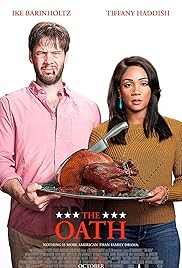
Film Review: THE OATH (USA 2018) ***

The Oath Poster
Trailer

The Oath is a fictional black comedy about American citizens given the supposedly option of signing a loyalty oath to the President.   As far as black comedies go, they do not often generate many laughs, and neither does this one.  THE OATH can be best considered a comic look at America and something that could but hopefully never happen.  Citizens are required to sign before the next Thanksgiving is up.  The oath is hopefully to isolate terrorists in America.  The incentive given to those who sign is a huge tax cut, but it seems that those opposing are being persecuted.

This controversial White House policy turns family member against family member when Chris (Ike Barinholtz), a high-strung progressive news junkie, and his more level headed wife Kai (Tiffany Haddish) learn bout it.  Their reaction is disbelief, followed by idealistic refusal.  But as the Thanksgiving deadline to sign approaches, the combination of sparring relatives, and the unexpected arrival of two government agents sends an already tense family gathering completely off the rails.  Chris mentions that this is not the America he knows or the one he wants to grow up with.

Director Barinholtz keeps the film’s budget in check.  Instead of showing an actual riot with cars and buildings set on fire, the above is seen on the television screen.  Most of the action takes place at the dining table with a few exteriors.

The film’s best joke also happens on the television when it is announced (heard) that actor Seth Rogen has disappeared because he was opposed to the oath. 

For a man so geared on Thanksgiving, the film allows the man (Chris) to throw away etiquette and allow him to use his cell phone.  This incident is the catalyst for the big break up at the Thanksgiving dinner. This is a scene well done with tempers flaring and foul language running loose.

Performances-wise, every actor seems to be overdoing their parts.  All this looks normal for the fact that the events unfolding are so over the top.

The film reaches great intensity once the CPU (Citizens Protection Unit) agents invade Chris’s home without a warrant.  Someone in the dinner party had complained that Chris is advising others not to sign the oath, and hence the agents’s sudden intrusion.  Agent Mason (Billy Magnussen) taunts Chris to the point that he pushes him resulting in him taking out his gun, and punches Chris.  As a result Chris’s dad hits Agent Peter (John Cho) with the chimney stoker knocking him out cold.  Mason is tasered and is tied up.  Mason is crazy and continue to threaten Chris while Agent Peter appears the rational one.  Director Marinholtz surprisingly keeps the audience at the edge of their seats during all the action combined with verbal shouting.  The children of the family are never seen during all the commotion, having being conveniently locked in another room or whisked off to another location.

One troubling flaw are the mixed messages sent by Barinholtz’s film.  Should one stand up for ones belief despite opposition from family or should one put family first and personal principles second?   The message is blurred more by the words uttered by Chris’s dad: “One has to do whatever it takes to keep ones family safe.”

When one wonders how all the mayhem and violence will end, Barinholtz gears his film towards an unexpected plot twist.  THE OATH ends up disappointing audiences’ expectations despite some solid compelling set-up drama.

Trailer: https://www.youtube.com/watch?v=9LcVhhno-Uo

Film Review: RESTORING TOMORROW (USA 2018) ***

Submit your Film & Screenplay via FilmFreeway:

Restoring Tomorrow Poster
Trailer

In these divided times, religious institutions are losing young members and even closing their doors at an alarming rate. Director Aaron Wolf’s personal journey of rediscovery comes alive …See full summary »

Director:

Aaron Wolf

Star:

Aaron Wolf

The film begins with these announcements, on titles as well as heard aloud as voiceover.  ‘Historically, the percentage of Americans without religious affiliation has been 10%.  Since 2012, the number of young Americans in this category has been growing 30%.  Historical houses of worship around the world have been closed forever.’

The religion under study here is the Jewish religion, with thought centred on the destruction of their magnificent synagogues.  What is feared that, in the words of an interviewee, these buildings will be brought down like a beautiful cut flower fading in a vase.

The film then narrows down on one person, a good thing as to make the documentary more personal.  The person is Aaron Wolf (the doc’s writer, director and actor), who has moved from L.A. to New York to study and then returned to L.A. He was a third generation belonging to the Wilshire Temple – a huge and handsome structure, but he feels that the connection is lost when he returned.

As religious institutions are losing young members and even closing their doors at an alarming rate, director Aaron Wolf’s personal journey of rediscovery comes alive in RESTORING TOMORROW, a universal story of hope as a treasured local temple near demise, is lifted up by a community’s determination to achieve the impossible.  Wolf’s journey explores how when any community puts their mind to it, the impossible becomes possible.  Wilshire Boulevard Temple, a Los Angeles treasure built by the original Hollywood moguls, needs to raise millions to restore its majesty and vibrancy, thus also restoring the future of the Jewish community, the greater Los Angeles community-and on a personal level, Wolf himself.

  One of the great men examined in the film is Rabbi Edgar Magnin, a well connected man (a photo is shown with human his wife with the Reagans).  Another Rabbi examined in the doc is Rabbi Alfred Wolf, The director’s own father who is described as a visionary and dreamer.  He was selected between two German Jews to study in the U.S. (this meant, at that time, the difference between life and death) and he left Germany.  He founded an inter-religious group that aimed to make peace and give respect to all different religions.  This is the segment of the doc that not only makes most sense and is the most interesting but also more relevant in today’s current affairs.  

Though the documentary lacks a climax (though not without many inspirational moments including the rending of the well-known Hal David and Burt Bacharach song ‘What the World needs Now’ ), it makes up for it by an important message.  The last portion  of the film shows the restoration of the temple in L.A. from its planning to its physical restoration.  The message, and one of one of the Jews’s fulfilment is to make more Jews who will themselves make even more Jews, so that they can do good for the Earth.  

Trailer:  https://vimeo.com/220395027

Full Review: WHAT THEY HAD (USA 2018) ****

Submit your Film & Screenplay via FilmFreeway:

What They Had Poster
Trailer

Bridget (Hilary Swank) returns home at her brother’s (Michael Shannon) urging to deal with her ailing mother (Blythe Danner) and her father’s (Robert Forster) reluctance to let go of their life together.

Director:

Elizabeth Chomko


Before reading this review, it be best noted that the writer’s mother passed away from Alzheimer’s.  The film thus hits more than a number of soft spots, and though WHAT THEY HAD a film about a mother with the decease is occasionally flawed, the film kept me at most parts in tears. 

Playwright and theatre actress Elizabeth Chomko delivers a gut wrenching directorial debut with her award winning screenplay.  The film is fortunate to have four top notch actors delivering unforgettable performances – Hilary Swank and Michael Shannon playing duelling siblings trying their utmost best to look after their parents, Robert Forster playing the father looking after his dementia stricken wife played by Blythe Danner.

The film’s plot can be summed up simply with a few lines tut it is the drama and details that create the movie (i.e. the writing and direction).  Bridget (Hilary Swank) returns home at her brother Nicki’s (Michael Shannon) urging to deal with her ailing mother, Ruth (Blythe Danner) and her father Burt’s (Robert Forster) reluctance to let go of their life together.

The film fails to identify the ugly aspects of living with the disease.  For example, my mother did not shower for 8 months before I discovered it and and to get a caregiver come into help her shower weekly.  And still, every week she would forget and we and to literally drag her to the bathroom.   She would also do her number two before reaching the toilet and not remember about it a day after.  The film also never showed at any point Burt’s loss of patience over his wife’s forgetfulness.

The drama works as the script offers each of the family’s point of view on the problem.  And each member is right and has sacrificed in her or his own way.  There is no one correct solution.  As the Burt character talks about love: “You find someone you can commit to, and then you work at it.”  This line is also true even if you one finds ones soulmate or love at first sight.  One has to work at it.  The film contains many dramatic sets-ups with excellent dialogue and tearful moments.

The script shows its occasional brilliance.  One is the use of the scenario of the dementia-ridden mother hitting on Nicki, her son.  The incident is first milked for laughs and then the same one for sympathy.

One might complain that the film tugs too are at the heartstrings.  The Christmas setting adds on to the sentiment especially in the exchanging of gifts scenes.  But audiences love a good cry just as a good laugh at the movies.

Two-time Oscar Winner Hilary Swank (MILLION DOLLAR BABY and BOYS DON’T CRY) who not only stars in the film but co-produced it is known to make films about subjects that matter.  They might have been successful such as in BOYS DON’T CRY about LGBT rights or less successful such as in FREEDOM FIGHTERS about at-risk students.  WHAT THEY HAD is an earnest and sincere film about a subject every human beings will face in their families at one time or other, sooner of later.

Trailer: https://www.youtube.com/watch?v=1kBGxsyp__o