Film Review: SUSPIRIA (USA/Italy 2018)

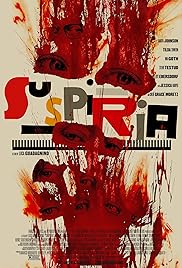
Suspiria Poster
Trailer

A darkness swirls at the center of a world-renowned dance company, one that will engulf the artistic director, an ambitious young dancer, and a grieving psychotherapist. Some will succumb to the nightmare. Others will finally wake up.

Director:

Luca Guadagnino

Writers:

Dario Argento (characters), Daria Nicolodi (characters) | 1 more credit »

What happened to good old fashioned subtlety?   And what happened to the maggots dropping from the ceiling of the boarding school?

SUSPIRIA 2018 is the curious remake of the 1977 Gallo horror classic by Dario Argento about a young girl entering a new ballet school, discovering it to be run by a coven of witches.  The director here is Luca Gaurdagnino who helmed the overrated CALL ME BY YOUR NAME, whose talent (or lack of) is more evidently displayed here.  

Jessica Harper who starred as the innocent girl in the original has a cameo in this updated version as the doctor’s wife who went missing during the war.  Dakota Johnson plays the lead role here with Tilda Swinton playing Madame Blanc and an elderly male doctor using heavy prosthetics.  

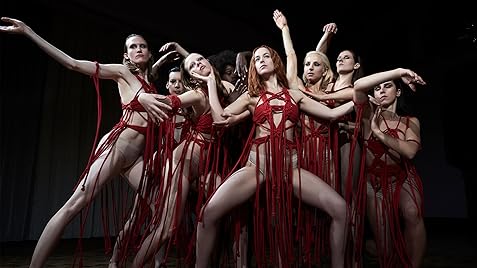
SUSPIRIA opens with words implying a long film (2 and a half hours) with 6 Acts and an epilogue.  The film is and feels lengthy.  It looks great, courtesy of cinematographer Sayombhu Mukdeeprom with haunting music by Thom Yorke who won an Award for it at the Venice International Film Festival.

SUSPIRIA is all looks but it is unfair to say all looks and no substance.  There is more plot than the original though the script is based on Argento’s screenplay.  The story is still set in a German dance school.  But the problem is that Guadagnino’ s storytelling technique appears not to be in use.  It was ok for his last film CALL ME BY YOUR NAME that worked on a weaker narrative, the beauty of the Italian countryside and first love.  In SUSPIRIA many scenes appear unconnected and after reading the story from the press notes, a lot of what transpires is not communicated to the audience.  The plot is made more complicated by its setting in 1977 with the politics of the Berlin Wall.

SUSPIRIA is a complete mess.  Take this scene near the end as a classic example.  The old doctor, Dr. Klemperer (played by Swinton herself)  and his lost wife (now re-untied and played by Jessica Harper) are out walking out in the snow before she disappears for no reason.  The doctor is then dragged into a building by two elderly women, screaming at the top of their lungs.  The doctor is supposed to be lured to the building by a witch disguising herself as the wife.  A huge witch ritual begins with no shortage of nudity (the sort with lots old old withering bodies, sagging breasts and drooping buttocks) but the type one does not want to witness.  Madame Blanc (Tilda Swinton) is killed in this ritual or isn’t she?  – All too confusing.

Director Guadagnino has put too much effort and has obviously become too serious with the project.  The original SUSPIRIA was a slasher film, scary but fantastic cheesy entertainment that is on every horror fan’s list as a must-see.  Gaudagnino has definitely taken all the fun out of the horror classic.  This one is elaborate, creepy and disgusting for no reason it was meant to be this disgusting.  SUSPIRIA has so far got mixed reviews from critics, as most probably are unsure what to make out of this mess of a horror movie.  Argento’s SUSPIRIA was funny, clever and short.

Trailer: https://www.youtube.com/watch?v=BY6QKRl56Ok

Film Review: ROOM FOR RENT (Canada 2017) ***

Room for Rent Poster
Trailer

When a broke thirty-two year old ex-lottery winner convinces his parents to rent their spare room to save from downsizing, a creepy stranger with a hidden agenda moves in.

Director:

Matthew Atkinson

Direct from Manitoba!  I seriously cannot recall any Canadian film from Manitoba (excepting Guy Madden films) but this one is not half bad.  It is in fact, quite good.

Mitch Baldwin (Mark Little) is a classic case of a loser.  As an adult, he is still living with his parents and too unmotivated to work.  Worst still, Mitch had won $3 million in senior year. Three years later, he is flat broke and a laughing stock after becoming famous on TV upon winning the lottery.  The status quo is challenged when his father, Warren (Mark McKinney) loses his job.  Short of money, Mitch convinces his parents to take in a lodger.  The stranger, Carl Lemay (Brett Gelman) turns out more than Mitch anticipated.

Written and directed by Matthew Atkinson, this simple premise proves ample opportunity for twists and turns in the plot.  The stranger Carl is the biggest wild card and Atkinson keeps the secret of who he actually is right to the very climax of the film.

“My parents are hounding me all the time”, says Mitch at one point in the film.  Of course, Mitch does nothing but sit around all day, never looking for work as he is supposed to, expecting his parents to bring snacks and food for him all the time.

Carl does everything that director Atkinson can imagine to annoy Mitch.  And these are really annoying.  

Among them: 

bringing Mitch’s old girlfriend, Lindsay (Carla Gallo) back into the house

bonding with Mitch’s parents – something that Mitch was never able to do

showing up talk to Mitch all the time and lastly

annoying Mitch just because he can

The reason all this works is that Mitch deserves what he is getting from Carl.  Mitch is plain lazy, unmotivated and takes advantage of his parents.

All the above take place during the first half of the film.  Then Mitch starts taking action.  He begins taking a stand and protecting himself against his enemy.  Mitch even starts to gain respect from his ex-girlfriend who begins helping gather evidence against Carl.  All this is made more interesting for the fact that Carl turns out to have a few skeletons in the closet.  The two eventually end up in a face off when Carl confronts Mitch in his bedroom and punctures his waterbed as revenge.

Director Atkinson has a keen eye for comedy.  His comedic setups are meticulous and the humour comes across well.  It helps too that his 4 main actors playing Mitch, Carl and the parents are very good.

A little comedy, a little romance, a little message movie – all surprisingly twisted and unexpectedly inventive for a small budget Canadian feature.  Definitely worth a look.

And the climax where everything about Carl is finally revealed is a real hoot! If the climax does not get one laughing aloud, nothing will!

Trailer: https://www.imdb.com/title/tt5796156/videoplayer/vi2493626905?ref_=tt_pv_vi_aiv_1

Film Review: JOHNNY ENGLISH STRIKES AGAIN (UK 2018)

Johnny English Strikes Again Poster
Trailer

After a cyber-attack reveals the identity of all of the active undercover agents in Britain, Johnny English is forced to come out of retirement to find the mastermind hacker.

Director:

David Kerr

Writer:

William Davies (screenplay by)

The third instalment after JOHNNY ENGLISH and JOHNNY ENGLISH REBORN, JOHNNY ENGLISH STRIKES AGAIN sees one again bumbling secret agent (Mr. Bean who can speak) Johnny English (Rowan Atkinson) saving the world, in this case from internet hacking by super villain Jason Volta (Jake Lacy).

When the film opens, English is a retired M17 agent now teaching geography at some boarding school.  When M17 is on the receiving end of a massive cyber attack from an unknown entity, that exposes the identities of all its current field agents, the Prime Minister (Emma Thompson looking more puzzled than anything else probably wondering what she is doing in this dud) instructs M17 to reinstate older, inactive agents like Johnny English to be employed to solve the case.  As a result of accidentally killing off three other older retired agents (cameos by Edward Fox, Michael Gambon and Charles Dance), he is given the job, which he undertakes with the help of his faithful and unfunny assistant, Angus Bough (Ben Miller).

British TV series expanded into feature films often take their characters on holidays (KEVIN AND PERRY GO LARGE, ABSOLUTELY FABULOUS, ON THE BUSES etc. etc) to some foreign country.  This sequel takes the agents to the south of France for their investigation.  Nothing much in terms of comedy improves.

The oddest thing about the film is that the script by William Davies contains no shortage of elaborate comedic set-pieces.  These includes among others these two:

English and Bough dressed up as French waiters devising ways to get close to a suspect dining   in a French posh restaurant with his girlfriend.  This involves a fire resulting from flambé prawns in order to nab a cellphone while eventually setting the entire restaurant ablaze

a Virtual Reality simulation with English taking down a number of innocent strangers in public while imagining he is fighting Volta’s men in his mansion home.  This involves hitting a bakery eatery employee with two baguettes, toppling a tour guide on a double decker bus and pushing an old lady in a wheelchair out of a store.

Yet none of these generate any laughs – I did look around the theatre many times to see if anyone even remotely smiled

A smart idea of self parodying involves a glamorous Russian agent Ophelia Bulletova, played by former 007 James Bong girl, Olga Kurylenko who investigates Volta.  Any segment involving her and English also fail to incite any humour.

On the positive side, the film contains no toilet or barf jokes, though there is a harmless (and again unfunny one) involving the agent caught with his trousers down.

The film has so far grossed, at the time of writing almost $100 million while garnishing generally unfavourable reviews by critics.  The first two made around $160 million each which explains this third outing from Universal Pictures.  At best, what can be said is that younger kids might find this whole espionage exercise entertaining.

Trailer: https://www.youtube.com/watch?v=-Qv6p6pTz5I

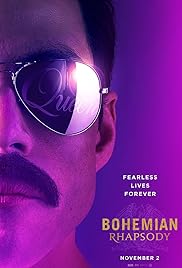
Film Review: BOHEMIAN RHAPSODY (USA/UK 2018) ***

Bohemian Rhapsody Poster
Trailer

A chronicle of the years leading up to Queen‘s legendary appearance at the Live Aid (1985) concert.

Director:

Bryan Singer

Writers:

Anthony McCarten (screenplay by), Anthony McCarten (story by) | 1 more credit »


BOHEMIAN RHAPSODY is a biography of the British rock band Queen concentrating on lead signer Freddie Mercury (Rami Malek from I, ROBOT and PAPILLON) set from the band’s formation to the band’s performance at the 1985 Live Aid concert in 1985.  Director credit goes to Bryan Singer though he was replaced before shooting was compete by Dexter Fletcher.  (America’s director’s guild, the DGA only allows one director credit).

The story centres on Freddie Mercury.  He is shown at the start of the film at odds with his Pakistani family, particularly his strict father in his small London home.  After a visit to a small club, he replaces the band’s lead singer and before long, he leads the band now called Queen to fame.  The script by Anthony McCarten gives Mercury a lot of credit (perhaps too much) for the band’s success.  The other band members (with Gwilym Lee as Brian May, Queen lead guitarist, Ben Hardy as Roger Taylor, Queen drummer and Joseph Mazzello as John Deacon, Queen bass guitarist) are given brief mention.

Besides this flaw giving Mercury too much credit – the film even bookmarks the film with his entrance onto the Live Aid Concert- the film is overlong, stretching past the 2 hour length.  The climax of the film – Queen’s performance of their hits could have been shortened for  better effect.  The desire to please audiences results in the film falling into clichéd territory.  Father of the family finally approves his son’s success, including the father’s advice of good thoughts, good words, good deeds being repeated at the film’s conclusion.  The blowing of a kiss by Mercury to his mother, as promised is yet another example.  Mercury’s story also falls into the standard mould of rock band/singer’s biographies – of rise to stardom, fall from grace and recovery back to existence with life lessons learnt, with hit songs dispersed in the process.

What the film benefits from is lead actor’s Rami Malek’s diversified performance, especially his showmanship during the Live Aid Convert.  Malek has demonstrated his acting chops already this year with an unforgettable performance in PAPILLON.

Mercury’s relationships are also given full display including his bi-sexualilty.  Mercury’s first girlfriend Mary Austin (Lucy Boynton) is demoted from first-class lover to best friend as Freddie finally takes on a male partner, Jim Hutton (Aaron McCusker).

As in most biographies on subjects with AIDs, the audience is informed that Mercury has contacted the decease with credits informing that his death later followed from complications due to the disease, with no details of his suffering or maybe regret.

Queen fans should be pleased with the rendering of most of the band’s hits including the title song, “Another One Bites the Dust and “We are the Champions.”

One of the film’s producers is Queen’s third manager, Jim Beach, played by veteran Brit actor Tom Hollander.  Mike Myers has a small role as n EMI executive.

What BOHEMIAN RHAPSODY has going for it are the performances of the band’s songs and Malek’s acting.

Trailer: https://www.youtube.com/watch?v=ZQ5uRRIZrBI

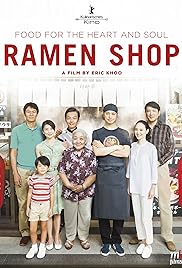
Reel Asian Film Festival 2018 Review: RAMEN SHOP (Singapore/Japan/France 2018) ***1/2

Ramen Shop Poster
A young man who is curious about his deceased parents’ past takes a food journey to Singapore where he uncovers more than just delicious meals.

Director:

Eric Khoo

The third film of Singaporean director Eric Khoo named after noodles (after MEE POK MAN and WANTON SOUP) RAMEN SHOP shows Khoo at his sappiest and most melodramatic.  Despite this flaw, RAMEN SHOP still shows the director’s brilliance especially when he meticulously examines both sides of the Singapore-Japan relationship.  

Not many westerners are aware that the Japanese did far worse than the Nazis in torturing their enemies especially during the Japanese Occupation in Singapore during WWII.  The film sees a young Japanese, Masato (Takumi Saito) travelling to Singapore to discover his roots and to make peace with his grandmother (Beatrice Chien).  This is achieved with the help of his comical uncle (Mark Lee) through the fine-tuning of a gourmet dish – bak-kut-teh.  

This is Singapore as it really is, as depicted by Khoo in all his movies where the Chinese speak ‘Singlish’ and not perfect English with a western accent as in CRAZY RICH ASIANS and where the citizens live in cramped single or double roomed flats and not in mansions holding extensive parties.  

Khoo is Singapore’s film pioneer and his films have won awards the world over including at Cannes.  This is the chance for Reel Asian fans to watch a quality film made by a top-notch Singapore director.

Trailer: https://www.youtube.com/watch?v=joHJKFC77ic

Movie Review: BEING JOHN MALKOVICH, 1999, Directed by Spike Jonze

BEING JOHN MALKOVICH MOVIE POSTER
BEING JOHN MALKOVICH, 1999
Movie Reviews

Directed by Spike Jonze
Starring: John Cusask, Cameron Diaz, John Malkovich, Catherine Keener
Review by Eli Manning

SYNOPSIS:

A puppeteer discovers a door in his office that allows him to enter the mind and life of John Malkovich for 15 minutes. The puppeteer then tries to turn the portal into a small business

REVIEW:

First a Background

Being John Malkovich was a script that was passed around Hollywood for the latter part of the ’90s. Written by then-virtual unknown sitcom writer Charlie Kaufman, it was said by all to be a clever but an unfilmable script. But like a lot of classic films, a lot of stars were aligned to make this landmark movie:

-Sony Classics wanted to work with music video director Spike Jonze, who had never worked in film before. They gave him a group of scripts to read, and Jonze loved Malkovich and wanted to meet the writer.

-Jonze and Kaufman got along instantly. Perhaps because they were total opposites. Kaufman was an NYU-educated, six-paper-a-day reader, and very well informed. Perhaps too informed by most Hollywood standards. Jonze was a high school dropout who was raised on dirt bikes, sports magazines and music videos. He was shockingly not well-read and not versed at all in the history of his craft. But they were both shy and felt like outsiders in the system. And they were determined to make this script.

-Sony was in a midst of a corporate takeover and everything was in disarray. No one really wanted to make this film, but with a studio chief who believed in Jonze, a few phone calls asking for favors from Jonze’s father-in-law Francis Ford Coppola (he married Sophia Coppola), and getting Cameron Diaz/John Cusask on board, the tiny budget of 15 million was given for a project greenlight.

-Getting John Malkovich was the final step. Jonze convinced him to do it because it was a career-ending role if the film boomed, and a forever mocking of himself if it succeeded. The brash Malkovich loved the no-win odds and signed on. Who was Malkovich’s backup? No one. If he wouldn’t do it, then they wouldn’t do the film.

-After filming, Jonze and his editor spent almost a year editing the movie, something that never happens because of studio deadlines to open the film, and especially never for a film with virually no post-production special effects. But the studio was in the midst of being taken over by new owners who avoided the film as they had other things to take care of. They kept cashing the checks, so they kept editing and tweaking to try to make the mess of the coverage they shot into an actual film.

-The first cut of this final 1 hour and 45-minute film was four hours. Jonze kept on bringing in people off the street each week to watch their recent cut. They took their advice, did some reshoots and kept editing. They changed a lot of the original script and basically cut out one of the main characters, Mr. Lester, and made the film more of a relationship story.

-A year later, they had their cut, it got shown at some film festivals, and then the film become the classic that it was, making Kaufman and Jonze’s careers. They worked together again on their next project, the film Adaptation, which was another hit (this time Jonze and his editor took 18 months to edit that film).

Now the review

What makes this film great is that this is a film that totally plays like it’s a regular drama. The plot is extremely out there when Craig Swartz (John Cusask), the creatively frustrated puppeteer-turned-office filer finds a porthole that leads to actor John Malkovich’s head, where you can be inside of his brain for 15 minutes.

Jonze shoots this film on the nose, never letting the audience think this is nothing more than a relationship film between the married Craig and Lottie (the almost unrecognizable Cameron Diaz), and their mutual obsession with Maxine – the sexy vamp who is also Craig’s business partner when they start a company to let people off the street be inside Malkovich’s head.

This very funny film is perhaps one of the most realistic films in terms of the characters. We all know these types of people. Craig is a frustrated artist who feels very unloved and unsupported, as his craft is just not being recognized. Lottie is the animal-loving nice girl who just shows love in everyone she meets but never really gets it in return (you only can get so much love from an animal). And Maxine, the woman who knows how to take advantage with the skills she was given, and fit it into the world she’s currently living. The type of person who is confident because the world has been easy for her so far.

Together these characters face conflict because of the porthole to Malkovich that was found. Craig and Lottie become addicted to the fact that they can become someone else, something many people would love to do. And Maxine takes full advantage of this weakness of both of them. Maxine is not the type of person who is even the slightest bit interested in going into the porthole. She just loves herself too much.

Other than that, if you haven’t seen this spectacular film, please do. And if you’ve seen if before, watch it again because there are so many other insights that you probably missed the first time. This is one of those films with so much going on, you have to watch it twice. And it all starts with Charlie Kaufman’s original script. This is a man who has a complete understand of the three keys of storytelling: plot, theme and character. He juggles these tools in every scene and shows us the world most us knows, while telling us a whole lot about humanity.

One final note is that I have to honor the performance of John Malkovich himself. He is spectacular playing a version of himself and the version of the people inside his head playing themselves within himself. I can’t think of another actor in that time who could of played this role better than him. It could be one of the best performances of the ’90s.


Movie Review: WHERE THE WILD THINGS ARE, 2009, Directed by Spike Jonze

WHERE THE WILD THINGS ARE, 2009
Movie Reviews

Directed by Spike Jonze
Starring: Max Records, Catherine O’Hara, Forest Whitaker, Catherine Keener, James Gandolfini, Mark Ruffalo, Paul Dano, Chris Cooper, Lauren Ambrose
Review by Matthew Toffolo

SYNOPSIS:

Young, mischievous Max is sent to bed without his supper, but when his bedroom turns in to a magical jungle landscape filled with strange creatures, he embarks on a wild imaginary adventure.

I walked into this film knowing nothing. All I knew was Spike Jonze directed it and they were using the Arcade Fire song to promote it in the trailer. I also heard right before that this was based on a children’s book, but I never read it as a kid or adult.

So I saw this film with virgin eyes. And what I saw I was impressed with. This is a movie almost all of us can relate with because we’ve all been that kid who would rather live inside of our imagination than real life. And we’ve also been that adult too.

Where The Wild Things Are is a movie for everyone because this is a film about FEAR. We all have it and we all react differently to it. Our hero Max (played by 11 year old Max Records) is a young boy who is scared about his new surroundings. He’s alone and doesn’t really like it so he runs away inside of his own world.

What makes him alone is that his teacher is not aware that what he says carries a lot of weight with the children. And saying that the sun is dying might not be the best thing to say to a group of 10 year olds. His father is also gone and his mother is moving on with another man and Max doesn’t like it. And his sister is a teenager and is now living in that teenage girl world that most of them do.

So Max goes off into his own world. And when I was 10 years old I did the same thing. My own parents had their own issues and I had two older teenage sisters who were going through that stage. So in my basement I created my own world and I was the only member because it was just my imagination. And I’m sure there are millions of kids doing the same thing now.

Where The Wild Things Are gives us characters in the wilderness who are purely Max’s creation. And all of these characters are dealing with their own inner fears and loneliness. It’s like the 7 animals are all versions of his own personality. And every character just wants to find peace in their world.

But life isn’t always about peace and fun. The characters decide to create a fort where all their dreams can come true, they can always be together forever and their is a shield that doesn’t let in any fears. The fort seems to be working at first but then conflict occurs because everyone has a different idea of what happiness is.

And that’s the point of Where The Wilds Things Are. We all want to be happy and not alone all the time but sometimes a little conflict is needed in order for perspective to occur. And as we grow from kids to adults our version of happiness changes year to year. We can’t just live in a fort all the time even when you’re 10 years old. And for Max he needs to learn when it’s time to leave that fort and come back home to reality.

The most interesting character from Max’s imagination is Carol (voiced by James Gandolfini). He just wants things to remain the same all the time and when it doesn’t he doesn’t know how to handle it. His friend KW has found new friends and Carol is threatened by that because they are not what he’s familiar with. Just like how Max’s mother has a new boyfriend. Carol reacts in anger by damaging things he loves. Just like Max damages his sister’s Valentine’s present when she decides to hang around with her friends instead of him.

This is a highly fascinating movie that really deserves a second viewing because there is more than meets the eye. Max learns from his imaginary world just like an adult would by going to a therapist or writing a journal. And it’s all about how we deal with our FEARS. Something that isn’t taught for some reason in school.

Where The Wild Things Are crosses generations. A film a 5 year old can get something out of and also a 90 year old. And they said only Pixar is capable of that.

Movie Review: ADAPTATION, 2002, Directed by Spike Jonze

ADAPTATION,      MOVIE POSTERADAPTATION, 2002
Movie Reviews

Directed by Spike Jonze
Starring: Nicholas Cage, Meryl Streep, Chris Cooper, Brian Cox, Tilda Swinton, Maggie Gyllenhall
Review by Russell Wray

SYNOPSIS:

Charlie Kaufman writes the way he lives… With Great Difficulty. His Twin Brother Donald Lives the way he writes… with foolish abandon. Susan writes about life… But can’t live it. John’s life is a book… Waiting to be adapted. One story… Four Lives… A million ways it can end.

REVIEW:

“Nothing happens in life. Life is boring.” writer Charlie Kaufman (Nicholas Cage) declares to screen writing wiz Robert Mckee (played by Brian Cox) whilst at one of his writing seminars. To this Robert Mckee fiercely replies “Nothing happens in life? Are you mad? People find love. People lose it. Everyday someone makes a conscious decision to destroy someone else”. With these two characters there is a strong summary of all of Charlie Kaufman’s work which is finding the interesting and extraordinary in everyday life. Adaptation is a great example of this because Kaufman tries to answer this question through his characters as oppose to his usual device of creating surreal scenarios to attempt to answer this question.

Writer Charlie Kaufman is given the task of adapting a book about orchids into a movie. He struggles to find a story in the book. He has to make one up. He cleverly decides to make the movie about himself and his struggle to write the movie. With the help of his twin brother Donald (also played by Nicholas Cage) he follows the writer and the subject of the book to find out who these people really are. In the same way that Kaufman has become fascinated with his subjects, the writer of the book, Susan Orlean (Meryl Streep) has become obsessed with her subject John Laroche (Chris Cox). Susan lives a seemingly ordinary suburban life and seeks to escape this with flower thief Laroche. Laroche is no stranger to tragedy and leads a different life to Susan. He poaches orchids in Florida, runs an internet porn site, and is missing his front teeth.”

The most interesting area of this film is Kaufman’s struggle to write the movie. Kaufman uses the film as a tool to discuss writing conventions. Kaufman himself declares that he does not want to make a fantastical film about car chases, guns or characters faced by obstacles that they must overcome. He simply wants to make a film about flowers. As the film shows this is no easy task. The contrast between the neurotic Charlie Kaufman with twin brother Donald Kaufman works brilliantly. Donald Kaufman has followed his brother’s footsteps and begins to write a screenplay of his own. Donald attends regular screenwriting workshops and generally writes with conventions and stereotypes. Kaufman shows his cleverness here by showing the audience these conventions to enhance his more complex style of writing.

In Kaufman’s quest to find adventure in naturalism he still creates a line in the film where fact and fiction meet. The problem is trying to find where that line is. Even to the extent of his characters it is unclear how accurate they are. In this auto-biographical piece it is not clear what Kaufman has contrived to drive plot and what he has kept close to real life. Charlie Kaufman shows bravery in creating himself as a timid weak person and yet does not hint to the audience that his character is merely a representation and not his real persona. The heart pumping close of the film leaves the audience wondering about these small details. This is a different approach for Kaufman as the audience usually leaves the film wondering what the hell they just saw. This once again sticks to Kaufman’s new deconstructive approach to writing and it clear that Kaufman is attempting to master a much more subtle style of writing.

Spike Jonze’s direction doesn’t stand out but that is a good thing. It is obvious that the director has a great respect and love for Kaufman’s writing since they worked together on Being John Malkovich. Jonzes does not try anything too absurd. He works very much as a silent director and lets the characters live out the story. This is not to say that Jonze does not construct some brilliant pieces. When Laroche’s past story is revealed, Jonze’s works very simply but effectively to create a very cold but extremely naturalistic scene which will definitely shock any audience member.

Nicholas Cage puts in one of his best performances in recent memory. No offence meant to Mr. Cage but he does portray paranoia and insecurity brilliantly. He never goes over the top with his performance. He also shines as the brother Donald who is confident yet naïve. The chance to play two roles which show an actor’s range so strongly must have been a challenge for Cage but he fully leaps in and created one of his best pieces of work here. Chris Cooper won an Academy Award in 2003 for his performance in this film and rightly so. Laroche is an interesting character from a less privileged world to the other characters. Cooper plays the tragedy and emotions of the character on such a subtle level that the audience believe this character to be flesh and blood. Streep is excellent as always in portraying the naturalistic tone that Jonze creates. Some of the smaller roles in this film really stand out, especially Brian Cox as screenwriter Robert Mckee whose bite is not as bad as his bark but you would still not like to see his bite.

Adaptation is definitely not a film to be missed. It is another landmark in screenwriting from Charlie Kaufman. Even if it does not include the surreal and absurd moments that audiences loved in Being John Malkovich it works as a much more subtle and sensitive piece of cinema which drags all of the excitement out of ordinary life as best as it can.

Movie Review: DAY FOR NIGHT, 1973, Directed by Francois Truffaut

DAY FOR NIGHT,  MOVIE POSTERDAY FOR NIGHT, 1973
Movie Reviews

Directed by François Truffaut
Starring: Jacqueline Bisset, Valentina Cortese, Dani, Alexandra Stewart, Jean-Pierre Aumont, Jean Champion
Review by Jordan Young

SYNOPSIS:

A film company at work. Actors arrive and depart; liaisons develop. Julie, the beautiful but possibly unstable lead, is recovering from a breakdown, aided by an older physician, her new husband. Alphonse is insecure, he babbles. When his fiance exits with a stunt man, he threatens to quit. Julie must convince him to stay. Alexandre, a consummate pro on the set, runs back and forth to the airport hoping a certain young man will visit. Severine, no longer young, hits the bottle and covers blown lines with emotional outbursts. At the center is Ferrand, the writer director, who must make constant decisions, answer a stream of questions, and deliver the film on schedule.

REVIEW:

In Truffaut’s film about a film “Day For Night”, he accurately (for better and for worse) shows the ups and downs that are involved in film making. This was my introduction to working on a film crew… a month later.

Some of you are more familiar with the American remake of this film, “State and Main”, which I believe is a little more chaotic, but nonetheless a good movie. In this version, Truffaut himself plays the director, Ferrand, and how he deals with the struggles of the actors and the actresses.

Jacqueline Bisset plays Julie Baker who is the actress on rebound from a nervous breakdown, and who’s ridiculous demands are only fulfilled because of her A-list star power. (My personal favorite, being the request of making a specific butter sculpture, which is unavailable and is therefore handmade by the script supervisor.) I had a similar experience where I had to drive an multiple miles for batteries, hard drives, and yerba mate… in the middle of central Pennsylvania.

Then there is the very difficult encounter with an actress who won’t wear a swimsuit because she is pregnant. These are just some examples of the difficulty of movie-making. “Day for Night” is genius in depicting the illusions within cinema. There are many clear examples of this, but there are vague examples as well. This film does a bit of demystifying the cinematic process, yet it doesn’t cast a film shoot in a completely negative tone.

The films plot revolves around the character’s struggles in regards to acting and to living, but this is more than enough to fuel the narrative development… This isn’t like Richard Linklater’s “Slacker”, in that regard. But it does gets you to sympathize with all of these character’s endeavors.

This film dealt with much bigger crises than the average shoot, like actors and actresses threatening (and succeeding) at leaving the shoot, as opposed to the minutia of, where can we plug this in and waiting for the sun to get to just the right space. But nonetheless, it accurately depicts, the turbulence of the movie shoot.

Nearly all of the picture is summarized in the beginning by a voice over by Truffaut. “Shooting a movie is like a stagecoach trip. At first you hope for a nice ride. Then you just hope to reach your destination.” In this tumultuous trip that viewer is about to be shown, this point is definitely realized. Very entertaining and highly recommend to anyone about to start their first shoot as well… it could be thought of as a training ground for aspiring film makers.

Movie Review: JULES AND JIM, 1962, Directed by Francois Truffaut

JULES AND JIM,   MOVIE POSTERJULES AND JIM, 1962
Movie Reviews

Directed by François Truffaut
Starring: Jeanne Moreau, Oskar Werner, Henri Serre, Vanna Urbino, Boris Bassiak, Anny Nelsen, Sabine Haudepin, Marie Dubois
Review by Silvana Jakich

SYNOPSIS:

Decades of a love triangle concerning two friends and an impulsive woman.

REVIEW:

Francois Truffaut’s third feature film, “Jules and Jim” has been touted as one of his most poignant masterpieces. Based on a semi autobiographical novel by Henri-Pierre Roche, Truffaut’s film begins just before WW1 in Paris.

Jules (Oskar Werner)- a shy German writer and Jim (Henri Serre)- a more extrovert French writer, meet and forge a friendship that is rooted in a deep respect for one another as both artists and human beings. Through the use of a narrator, Truffaut beautifully sets up the immense bond that forms between these two men as they share life experiences and the arts together. Their close friendship reminded me of the close knit friendships we weave when we are younger which are very much “in the moment”, spontaneous and full to the brim of utter devotion.

Into this tight knit connection explodes the free spirited, uninhibited Cartherine (Jeanne Moreau). In most films, the appearance of such a character would be used as a starting point for conflict between the two friends. There would be competition and the friendship would sour but instead of this typical route, the bond was now between three people instead of two.

The joy of Jim, Jules and Catherine’s relationship coupled with wonderful shots of a European summer holiday together will make any viewer envious. The carefree joyous time they share at the seaside makes the three characters inseparable. Even when Jules and Jim become completely enamored with Catherine, the typical competitiveness which would normally be highlighted in this situation is over ruled by each character’s love for the others.

Ultimately, Jim makes way for Jules to have a relationship with Catherine after Jules wards Jim off by saying: “not this one”. Catherine and Jules marry and move to Austria.

WW1 begins and both men are sent away to fight on opposing sides. The contrast between the visuals of war and previous images of countrysides and sunshine are extreme and violently bring home the drastic change in everyones’ circumstances. Yet, even in the war time moments, Jules and Jim express great humanity as their greatest concern is that they may end up killing one another.

Fortunately, both men survive the war and meet again but now the complexities of their various relationships with Catherine come to the surface and the element of self destruction begins.

Although the character of Catherine is often fickle, selfish,cruel, unstable and vengeful, Jeanne Moreau manages to play her with a bewitching effervescence and joie de vivre which prevents her from becoming a one dimensional villain. Here is an interesting exploration of a woman who requires many lovers during a period in history when women were restricted sexually and boxed into an identity of utter loyalty to one man.

This film is also tribute to the strength of friendship and all that is pure and innocent when it comes to a deep bond. The fact that even betrayal cannot taint feelings of love that human beings have for one another is a testament to the beautiful side of human nature.