Film Review: SICARIO: DAY OF THE SOLDADO (USA 2018) ***

Submit your Screenplay to the Festival TODAY

Sicario: Day of the Soldado Poster
The drug war on the U.S.-Mexico border has escalated as the cartels have begun trafficking terrorists across the US border. To fight the war, federal agent Matt Graver re-teams with the mercurial Alejandro.

Director:

Stefano Sollima


Italian director Stefano Sollima takes over the director duties from Denis Villeneuve in the SICARIO sequel, both films written by Taylor Sheridan.  The director’s imprint makes a difference with the sequel, a solid one at that playing more like a no-nonsense action suspensor.  In case one is wondering, the film translating to English would read: Hitman: Day of the Soldier.

The film’s trailer shows the film’s key scenes where the task and thus the subject of the film is at hand.  It is an operative that has no rules, and one that is as dirty as it gets.

The film is as current as it gets with Trump wanting to build a wall between the border of the the U.S. and Mexico.  The setting is the U.S. Mexican border where illegal aliens are crossing the river to get into the States.  The drug cartels are, according to the film, smuggling terrorists across the U.S. border.  When the film opens, a terrorist attack has just occurred with innocent Americans killed.  The Americans want revenge and hire CIA agent Matt Graver (Josh Brolin) from the first movie to start a drug war. so that these drug lords will destroy each other.  Graver hires undercover operative Alejandro Gillick (Oscar Winner Benicio Del Toro) to kidnap Isabela Reyes (Isabela Moner), the daughter of a drug lord, in a false flag operation designed to incite war between rival cartels.   The mission goes awry when it is discovered by the Mexican government, prompting Graver to order Reyes’ execution.  When Gillick refuses, he turns rogue to protect her as Graver assembles a new team to hunt them both.  

One of the film’s extended segments shows Isabela in school having a schoolyard fight with another girl who she punches in the face.  At the principal’s office, she challenges the principal to expel her.  Her toughness is clear but after her kidnapping, all she does is scream and get scared.  It is puzzling the reason Isabel is shown to be tough unless it is to show the trauma she is going through while being kidnapped.  The film also omits any scene with her father, Carlos Reyes.

The script by Sheridan opens the film up for many subplots.  One is the young Mexican who is an expert on the area around the border, and who is hired to guide the illegal aliens across the border.  His character is smart, merciless and yet vulnerable with a family he cares for.

Benicio Del Toro and Josh Brolin make the movie.  They play hard-ass characters who are violent, determined and efficient sicario (hit-men) in what they do.  Christine Keener does well as Graver’s boss who is just as brutal in the execution of her duties.  The screen lights up when these characters come head to head in confrontation.

If this SICARIO makes money, the ending prepares the audience for yet another sequel.  There are plenty of potential and opportunities for more action packed stories.  If Brolin, Del Toron and Keener are in for another SICARIO, that would indeed be a good thing.
Trailer: https://www.youtube.com/watch?v=Pymm6cmE9uQ

Submit your Screenplay to the Festival TODAY

Film Review: LEAVE NO TRACE (USA 2018) ***

Submit your Screenplay to the Festival TODAY

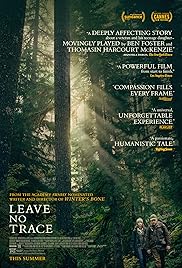
Leave No Trace Poster
Trailer

A father and his thirteen year-old daughter are living in an ideal existence in a vast urban park in Portland, Oregon, when a small mistake derails their lives forever.

Director:

Debra Granik

Writers:

Debra Granik (screenplay by), Anne Rosellini (screenplay by) | 1 more credit »


LEAVE NO TRACE is another strong female character drawn adventure drama after her successful WINTER’S BONE.  Written and directed by her and based on the book My Abandonment by Peter Rock, the film premiered at the 2018 Sundance Film Festival.[2][3] Bleecker Street will release the film in the United States on June 29, 2018.[4]

The summarized plot tells the story of a father and his thirteen-year-old daughter .  Will (Ben Foster) is an ex-military who has lost his faith in humanity for reasons not disclosed.  When the film opens, he and daughter Tom (Thomasin McKEnzie) live in an isolated existence in a vastly urban park in Portland, Oregon, (the film was shot in Eagle Fern Park in Clackamas County) when a small mistake derails their lives forever.  They are taken in by social services.

The film contains several embedded messages.  The first and foremost is the question on homeschooling.  Will and Tom live an isolated existence at the film’s start, living in conditions unacceptable by normal Americans.  Tom sleeps in close proximity with her dad.  Though this is a no-no, nothing sexual occurs.  To is home schooled.  When interrogated about this, The interrogator admits that Tom is advanced in her schooling though cautioned that she lacks the social aspect of education.  But director Granik eventually pushes Tom towards normal life which she has not experienced.  Tom loves the social and interactive aspect as they are slowly integrated into society.  Until Will escapes with Tom back to square one.  When an Will has an injury, Tom is forced to choose between the two lifestyles.

LEAVE NO TRACE is Granik’s gentler more accessible film.  There is much kindness depicted in this movie than in WINTER’S BONE.  The truck driver and other strangers that encounter Will and Tom are always more than eager to help them.  

Both actors Ben Foster (THE PUNISHER, X-MEN) and Thomasin McKenzie deliver believable an human performances, worthy of any audience’s sympathy.

As far as anticipation goes, one keeps wondering where everything is leading to and how everything will end.  One can predict some friction between father and daughter when she makes her stand on independence. “The same thing that is wrong with you is not wrong with me,” is the all important line Tom confronts Bill with.  And the reply; “I know.”   The film moves on a different tangent when the father is an understanding and caring one.

The film contains a few originally performed songs with original music by Dickon Hinchliffe.  The cinematography of the vegetation and fauna of the national parks is effectively captured by Michael McDonough.

LEAVE NO TRACE is that rare film that proves that confrontation in a story need not always be resolved by shouting, screaming and cheap theatrics.  Here, the confrontation is resolved with reason and understanding.  And the film succeeds as a quiet yet effective drama of human inadequacies that sort themselves out.

Trailer: https://www.youtube.com/watch?v=_07ktacEGo8


Submit your Screenplay to the Festival TODAY

Film Review: MARLINA: THE MURDERER IN FOUR ACTS ****

Marlina lives quietly in Sumba until one day a man named Markus and his gang tries to rob her house and she kills him. Eventually, she is haunted by Markus, and her life turns in 180 degrees.

Director:

Mouly Surya

It is rare that a film from Malaysia or Indonesia, less an art film at that, receives commercial release in North America.  But MARLINA: THE MURDERER IN FOUR ACTS which premiered here at the Toronto International Film Festival is a special film that comes highly recommended.

The film plays like an Indonesian western.  It opens with a sparse landscape of dried brown vegetation to an Ennio Moricone-like soundtrack.  In the distance, is a figure of a man on a motorcycle (instead of one on a horse).   Director Surya is fond of distant shots with her characters slowly moving into her frames.  Her frames are beautifully crafted, many of which could make perfect paintings.

Marlina (Marsha Timothy), recently widowed is unable to pay her husband’s funeral services.   A troupe of ugly and unforgiving men use this excuse to take her livestock and have their way with her.  

“What do you want?”  Marlina first asks them.  “I want your money, your livestock and if we have time, we will sleep with you  All seven.”  But they are not prepared for the fury of this woman, in this revenge fantasy where women are warriors and will take no shit.  The film is surpassingly relevant in these times of female abuse.

Marlina poisons them with a soto ayam (local chicken soup dish) dinner and beheads Markus, the head of the gang, as she is riding him.

Marlina the Murderer in Four Acts (Marlina si Pembunuh dalam Empat Babak) is divided into 4 roughly equal parts titled The Robbery, The Journey, The Confession and The Birth.  

The confession is the most intriguing of the 4 acts where Marlin confesses her crime to a policeman at the station who nonchalantly records the facts as if they mean nothing.  He is obviously goes by the book, having being doing the same job for too long.  The last act is the most shocking and violent, bringing the film to an exciting climax.

Though the film is a slow moving and artsy, it is no less engaging a piece of storytelling that will grab one from start to end.  Humour is deadpan and always present as Marlina takes a bus with the head of Markus to make a report at the nearest police station.  She meets a pregnant neighbour, Novi who also has man trouble.  Her husband Umbu believes her late delivery is due to the fact that she has cheated on him.  The humour is mainly local, on the practices and beliefs of Marlina’s encounters.

Surya’s film is also intriguing from the observation of the unfamiliar Indonesian country culture.  I never knew horses were common in Indonesia, but I recognize much of the local dialect as I have relatives living in Indonesia, though in Jakarta.

Marsha Timothy is nothing short of amazing in her portrayal of a women of fury who will not put up with any nonsense.  The soundtrack is impressive and includes the song “Lazuardi”, composed and performed by Jakarta indie rock band Efek Rumah Kaca.

A stylish but violent film proving Surya as a fantastic storyteller.  The film is set on an island in East Indonesia shot in the language of Malay.

Trailer: https://www.youtube.com/watch?v=Ikgy2Xukwng

Film Review: DARKEN (Canada 2017) **

Submit your Screenplay to the Festival TODAY

Darken Poster
A nurse finds herself in a dark and mysterious world.

Director:

Audrey Cummings

Writer:

RJ Lackie

The words at the beginning of tho new Telefilm Canada horror film DARKEN tells the audience: DARKEN is the resting sanctuary for all souls – whatever that means.  Darken is set in a bizarre, mysterious, and violent unknown world supposedly set with danger and death around every corner.  

Mother Darken appears to be the God in some alternative universe or different dimension.  Her high priestess, Clarity (Christine Horne) and oddball looking and acting assistant, Martin (Ari Millen) accuse a member of their religious sect of betrayal.  When the betrayer admits her guilt, she is stabbed and pushed out a door out of this universe.

A nurse, Eve (Bea Santos) helps the wounded girl, but ends up entering DARKEN through a one-way door.

Eve finds a violent prison-like world of labyrinthine rooms, interconnected with no apparent rhyme or reason and no way of escape.  If all this sounds weird and unbelievable – it is! As she fights for survival within this brutal place, she finds allies who are rebelling against the rule of a self-appointed religious despot who demands allegiance to the all-powerful god called “Mother Darken.”  Eve and the exiles, as they are called must fight with everything they have if they are to have any hope of surviving the horrors Darken has in store for them.  The exiles are told that they have to keep moving.  But apparently, they are moving nowhere – and getting to nowhere fast.  And again when one exile is wounded, Eve (humorously) says:” We need to move her now.”  

The film plays like a children’s playground game adults that have forgotten to grow up indulge.  The fight scenes are executed for more gore and violence that excitement.  Lots of pain are inflicted on the wounded.

Olunike Adeliyi playing an exile, Kali deserves an acting award for the most over-acting performance in a movie this year.  She demonstrates how to act with her eyeballs, nose, lips and grimaces.   The dialogue is terribly silly: “Mother (Darken) is terribly upset!”  “Whenever I turn my back, they always disobey me.”  “Mother is so angry with us.”  – being a few examples.  The character Clarity is exceptionally good at giving orders and doing nothing.  The exiles use lighters that they somehow have, to light their way in the darkness though none of them smoke.

Prior to the film’s theatrical release, the producers Shaftesbury had released an 11-part digital prequel series, Darken: Before the Dark on YouTube, taking audiences deep inside the fantastic otherworld of DARKEN.  The audience is presented here with multiple points of entry on a range of platforms to build a world around the film. With DARKEN, audiences can watch the digital series, connect and discuss on social, immerse themselves via the VR experience, see the film on the big screen, or pre-order it to re-watch at home

DARKEN went on to win Best Science Fiction Feature at Buffalo Dreams Fantastic Film Festival, Best Fantasy Feature at Motor City Nightmares International Film Festival, and won four awards at Blood In The Snow Festival including Best Director and Best Cinematography.  Whatever all these awards mean, DARKEN is not a very good horror film – overacted, overdone, unbelievable story – a textbook case of maximum effort and minimum results.  But DARKEN is recommended for its unintentional humour!

Trailer: https://www.youtube.com/watch?v=Itt-itaQZi0


Submit your Screenplay to the Festival TODAY

Film Review: WESTWOOD: Punk, Icon, Activist (UK 2018) ***

Submit your Screenplay to the Festival TODAY

Westwood: Punk, Icon, Activist Poster
Trailer

The first film to encompass the remarkable story of one of the true icons of our time, as she fights to maintain her brand’s integrity, her principles – and her legacy.

Director:

Lorna Tucker


The Westwood mentioned here is Dame Vivienne Westwood, fashion’s notorious rebel.  Westwood defined the British Fashion scene for 40 years and she is responsible for creating many of the most distinctive looks of our time.  Her partner at the time was Sex Pistols’ manager Malcolm McLaren.

The film begins with Westwood speaking freely to the camera.  Director Tuckers knows her subject’s quaint personality and instead of asking questions with her answering lets her do the talking. “I do not like to answer questions,” she confesses to the camera. “Terribly boring.”  But Tuckers does ask her tot all about the Sex Pistols, which she grumbles about, ‘but that makes uninteresting talk.”  By letting Westwood talk, Tuckers intersperses her words with archive footage and images that are obtained on the subject.  The film surprisingly, flows very smoothly as if all the images and words matching identically.  Amidst all this, the audience learns of the origin of her design, together with watching many of her originals, many weird yet fascinating.  It is more is insightful to watch a documentary about a subject when the subject is still alive and able to speak about herself and her work to the camera.  Vivienne’s son and her manager, Carlo (both of whom do not get along) also have their say in the film.  Pamela Anderson, Christina Hendricks and Kate Moss make welcome cameo interviewees.

Despite the fact that Westwood is a worldwide known celebrity designer, Tuckers brings her down to earth by devoting a fair amount of screen time to her personal and business problems.  Her breakup with then husband Malcolm, her relationship with Andreas from Austria as well as her business problems make her a more vulnerable person.

The second half of the doc reveals Westwood as an activist for the environment.  She works with Greenpeace and is concerned about the end of humanity that comes with a dying planet.

There film blends archival footage, beautifully crafted reconstruction, and insightful interviews with Vivienne’s fascinating network of collaborators.

Director Lorna Tuckers herself spent her 20’s working behind the camera and jumping on tour buses with bands creating tour videos and music promos.  She understands the problems that come with success.  The film emphasizes Westwood’s reluctance of expanding her brad too fast.

And what is Westwood the person like?  She is shown to be bossy, fond of uttering foul language like the frequent use of the ‘f’ word and also not afraid to come down on her employees.  On a more personal level, she is shown to be a caring mother and one who would not take any nonsense from her at times, jealous husband, Malcolm.

Tuckers’s film moves along at a good pace,and her documentary makes as compelling a watch as her subject Dame Vivienne Westwood is compelling.

WESTWOOD the documentary comes to Toronto June 29 for a one week engagement at the Hot Docs Ted Rogers Cinema. 

Trailer: https://www.youtube.com/watch?v=qvYmFcAegH4

Submit your Screenplay to the Festival TODAY

Film Review: NORTH MOUNTAIN (Canada) ***

Submit your Screenplay to the Festival TODAY

North Mountain Poster
In the dead of winter a young aboriginal hunter falls in love with a fugitive ex-con and helps him fight off an army of crooked cops seeking revenge.

Director:

Bretten Hannam


Made in 2015, NORTH MOUNTAIN is an almost full indigenous film from its direction, actors, setting, story and script.  

NORTH MOUNTAIN is the film’s setting as well as the area where the film’s protagonist a 30-something Mi’kmaw hunter first discovers the wounded body of a man that changes his life, also providing him some coming-of-age maturity for good measure.

Wolf (Justin Rain)is a young Mi’kmaw hunter, spends his days hunting and trapping on the isolated North Mountain.  His simple routine is disturbed when he discovers Crane (Glen Gould), a wounded ex-con on the run from the law.  Wolf brings him to his home, where he lives with his grandmother, Nan, nurses Crane back to health, and an intimate bond forms between them.  Some excitement is introduced with the arrival of a dirty cop from Crane’s past sets into motion a series of dark events that tests their relationship and changes their lives forever.  There is a huge bag of money.  Crane tries his best to remain incognito to prevent the family helping him from getting into trouble with the killers hunting him down.

It is a good story (that could be se anywhere) made even more intriguing with an indigenous setting.  A few snags in the plot involve how easily the bad guys keep finding Crane.  Best these overlooked as many Hollywood thrillers contain plot holes.  Director Hanna is also unafraid to include some violence (finger breaking) and gore to add a bit of flavour to his thriller.  The film is initially vague about Wolf’s family though everything comes clear towards the middle of the film.

“It would not be Christian if I did not look after her.” the film has minimal dialogue and each one indicates more than one bit of information.  The line for example, tells of the shopkeeper’s religion, her kind and caring nature and her relationship to the person mentioned in the sentence.

A good blend of drama, emotions with some suspense and thrills, NORTH MOUNTAIN is a well made indigenous film that should both appeal and entertain mass audiences.  Wolf uses his native hunting skills yo get better of the villains who hunt down him and Wolf for the large amount of money stolen from them.  How Crane got the money is never dealt in detail.

North Mountain is the directorial feature debut from Bretten Hannam, a Nova Scotia filmmaker, himself  of Mi’kma, Ojibweorigin while having a bit of Scottish ancestry.  He is a Fellow of the Praxis Centre for Screenwriters, Outfest Screenwriting Lab, as well as an alumnus of the Canadian Film Centre’s Screenwriting Lab.  After a wildly successful festival run and racking up multiple awards, including the Screen Nova Scotia Award for Best Feature Film, North Mountain gets a week-long engagement at The Carlton Cinema, beginning on June 29.

Shot in Mi’kmaw and English with some subtitles.

Trailer: https://www.youtube.com/watch?v=uQyhnIHEzx4&feature=youtu.be

Submit your Screenplay to the Festival TODAY

Film Review: AMERICAN ANIMALS (UK 2018) ***

Submit your Screenplay to the Festival TODAY

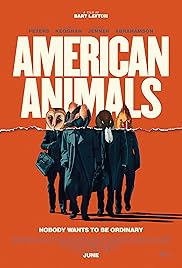
American Animals Poster
Trailer

Four young men mistake their lives for a movie and attempt one of the most audacious heists in U.S. history.

Director:

Bart Layton

Writer:

Bart Layton


Spencer Reinhard (Barry Keoghan), Warren Lipka (Evan Peters), Eric Borsuk (Jared Abrahamson) and Chas Allen (Blake Jenner) are four friends who live an ordinary existence in Kentucky.   They plan, from watching old crime movies, to to steal the rarest and most valuable books from the university’s library that are worth $12 million or so.   The film unfolds, documentary style with the real men (other actors) re-telling the stories in flashback.  Writer/director Bart Layton, redoes the similar style of his hit 2012 documentary THE IMPOSTER which had won him a BAFTA Award.

“We must suppose that AMERICAN ANIMALS  – slowly migrated by successive generations from the outer world to the deeper and deeper recesses of the Kentucky caves.”  These words inform the audience right at the start of the story.

One can tell from the film’s start AMERICAN ANIMALS is not going to be the ordinary run-of-the-mill heist film.  It begins with the word “Based not on a True Story” followed by the fading out of the words followed by the word ‘not’ faded out.  Which implies that this fictional tale cold very be a true one.  Or a true tale that could be fiction.

“There was nothing in that background that would suggest something like that might happen.  They were pretty good kids.”  says the teacher at the start of the film, as a teen puts up blue make-up around his eyes, for a disguise to commit a heist.

There is a segment in the film when the director demonstrates a textbook example on how to life the spirit of an audience.  This includes arousing music, dancing and other scenes involving throwing caution to the wind.

Well written with lots of movie references, the film’s best line after they discover the enormous value of their loot: “We need  a bigger boat.”   Another involves Eddie trying to convince his friend to decide whether to be in or out of the venture without disclosing any details of the it: “This is your red or blue pill moment.”   The RESERVOIR DOGS nod is also surprisingly funny.  Another well-written set-up involves Eddie being bright into the Dean’s office for a pep talk which turns around once Eddie turns the tables on the talk.

As one character, the professor talks about the robbers in his classroom, the chalk scribblings on the board in the background make intriguing details that might give some additional insight into the film.  These are the details and little nuances that make AMERICAN ANIMALS stand out from the many heist films.  Needless to say, the film is often smart, funny and fresh.

Barry Keoghan plays Spencer, one of the robbers.  Keoghan was discovered by director Yorgos Lanthimos in THE KILLING OF A SACRED DEER and was last seen in Christopher Nolan’s DUNKIRK.  He has that special look of a disturbed youth.  I would see any film Keoghan is in, he being one of the brightest new presence in films.  Actor Udo Kier who is fond of playing odd characters has a cameo as a ‘fence’, the person who guys valuable questionable goods.

AMERICAN ANIMALS is funny, fresh, smart and original while still playing homage to classic films.

Trailer: https://www.youtube.com/watch?v=SKvPVvy2Kn8

Submit your Screenplay to the Festival TODAY

Film Review: OCTAVIO IS DEAD! (Canada 2018

Submit your Screenplay to the Festival TODAY

Octavio Is Dead Poster
Tyler tries to discover the father she never got the chance to meet in this stirring psycho-sexual ghost story, exploring themes of gender and sexual identity.

Director:

Sook-Yin Lee

Writer:

Sook-Yin Lee

Sook-Yin Lee, best known as the actress in the hit HEDWIG AND THE ANGRY INCH directs this odd film produced and starring Sarah Gadon who broke into fame with David Cronenberg’s COSMOPOLIS.  Gadon plays,

Tyler the daughter of an obsessive over-spirited mother (Rosanna Arquette).  She decides to leave her mother for Stelton City (Ontario’s Hamilton standing in for the city) to learn about the father she never met.  She discovers his ghost, trapped and unable to escape his apartment. They forge an uneasy bond, but by communicating with him, and learning about his tumultuous and secret past, Tyler discovers new ways to engage with the world, to seek love in unexpected places, and to explore life in new and unfamiliar territories. 

 Love is discovered in death!  She falls for the cute blonde student that had an affair with his father, who she learns left both her mother and her because he was gay.  The supernatural angle fails to blend with the coming-of-age drama.  Nicely shot, but the film fails in that it leads nowhere and turns terribly annoying with Lee’s attempt to create a moody atmosphere.  


Submit your Screenplay to the Festival TODAY

Full Review: LES GARDIENNES (France/Switzerland 2017) ****

Submit your Screenplay to the Festival TODAY

The Guardians Poster
Trailer

Women are left behind to work a family farm during the Great War.

Director:

Xavier Beauvois

Writers:

Xavier Beauvois (screenplay), Marie-Julie Maille (screenplay) | 2 more credits »


(Spoiler Alert: Last paragraph in bold italics.  Skip this last paragraph though reading it will not spoil the film’s impact.)

Director Xavier Beauvois (director of DES HOMMES ET DES DIEUX, 2010 last seen as an actor playing Vincent in Clare Denis’ LET THE SUNSHINE IN) returns with a World War 1 historical drama about women looking after the farms when the men are send out to fight during the great war.  It stars Nathalie Baye in a dramatic but controlled performance as Hortense, a strong willed woman and matriarch of the Pardier family who manages the family farm.   The film is based on the novel by Ernest Pérochon and written by Xavier Beauvois, Marie-Julie Maille and Frédérique Moreau.                     

Beauvois’ film like his previous film moves at a leisurely pace with an authentic period atmosphere of rural France.  The film plays out like the waiting of the war to end.  The farm chores like ploughing the land, harvesting the crops, milking and driving the cows help in the creation of rural farm life.

The story is told from the points of view of both Hortense and Francine (Iris Bry), the new female farmhand (known eventually as the best farmhand in the region) that Hortense hires to help in the harvest who she eventually keeps on. 

The film is a handsomely mounted period piece of World War I told during the period from 1916 the war’s start to 1919 the year after it ended.   It is a story that needs ti be told – of

the devastation of war as examined from many angles

the absence of men

– the change of characters of the fighting men when they return from war (I do not recognize him: says one of the women of hr husband)

the hardship of those fighting and also of those not fighting in the war

shortage of the essentials like food  (as the camera pans a field of corpses in the film’s first image)   

as well as modernization had on a typical farm family in France. 

The women of the Pardier farm, under the deft hand of the family’s matriarch, Hortense must grapple with the workload while the men, including two sons, are off at the front.  Her husband, daughter and grand-daughter remain with her.  Romance and trouble brews when Francine and the grand-daughter fall in love with the same man, Georges (Cyril Descours).  Director Beauvois also shows the erotic sex scene is necessary to show the passion between the two lovers.

Beauvois use of close ups and editing especially the switching of the camera shots of the different faces (Hortense, Georges, the Americans, Francine) is masterfully demonstrated in the film’s best segment after harvesting.

The film is also quick to point out that there are equal casualties on both sides.  Clovis (Olivier Rabourdin) returning from furlough to the farm points out that Germans are like the French at war – ordinary men.  One nightmare segment has Georges screaming in the middle of the night when he dreams of killing an enemy with a knife, only to pull of the dead man’s h]gas mask to find himself looking at his own image.

The film also benefits from Michel Legrand’s grand musical score. 

LES GARDIENNES proves (like CASABLANCA and LES PARAPLUIES DE CHERBOURG) that not living happily ever after with ones true love can also make an unforgettable love story.

Trailer: https://www.youtube.com/watch?v=HsdDm-mcczQ

Submit your Screenplay to the Festival TODAY

Film Review: THE LOCKPICKER (Canada 2016) ***

Submit your Screenplay to the Festival TODAY

The Lockpicker Poster
A teenage thief tries to leave town to escape the violence that threatens him and he people he loves.

Director:

Randall Okita

Writer:

Randall Okita


THE LOCKPICKER is the low budget multi-award winning feature debut of director Randall Okita, arriving at big screens in Toronto, Vancouver and Calgary for special screenings this week.  

THE LOCKPICKER was shot in actual Toronto classrooms over a span of two school years with a cast of non-professional teenagers in key roles.   This intimate coming-of-age drama follows high school student Hashi (unknown and newcomer Keigian Umi Tang) as he struggles to maintain a state of calm in the wake of the sudden suicide of his friend.  When people close to him are victimized by violence, he is forced to choose between fighting back and becoming what he fears, or leaving behind everyone and everything he knows.

Tang inhabits his role as the restless student with relative ease.  This is not an actor’s but director’s film.  There are no extensive monologues or other acting demands required of Tang.  Much of the character’s personality is established by the director.  For example when Hashi steals money from the jackets hug outside the classrooms, he only takes the small notes and not the larger twenties.  The director intends to show Hashi as a thief but with some conscience.  He takes only what he needs for the moment.  Hashi is displayed as the normal teenager at school, easily distracted with hardly a thought of his future.  Hashi  smokes weed, crashes parties and badgers adults to buy him liquor.  He is distracted enough not to complete the assignments necessary for him to quality for a sailing outing,  He goes around constantly distracted with a head set on.  Hashi is a fairly good-looking and fit kid who works occasionally at a shoe store.  Director Okita does not have Hashi commit acts that determine his character to be a likeable or unlikeable one.

As a first feature, THE LOCKPICKER looks sufficiently fresh.  It appears that Okita experiments quite a it with lighting, cinematography and camera placement.  The film is also variedly shot with steady cam and hand-held camera.  His eye for natural landscape and surrounding architecture is alas apparent when Hashi travels around the icy winter by transit or waiting at a bus stop  with the transit map in the background.  The Toronto winter is revealed to be a cold one with dirty snow and litter blowing across the snow and ice.  The film contains a comfortable mix of staged and free flowing improvised parts.

In Toronto, THE LOCKPICKER will be screened with a special Question and Answer a with Okita discussing the film’s powerful themes and its deeply personal connection on June 22 at 6:45 PM at TIFF Bell Lightbox.The film won the Canadian Screen Award for Best Picture in the Discovery Section.

It should be noted that Okita was the recipient of the Toronto Film Critics Association’s (of which the writer is a member and involved) Technicolor Clyde Gilmour Award with a cash prize of $50,000, which made the production of The Lockpicker possible.

Trailer: https://vimeo.com/181642231

Submit your Screenplay to the Festival TODAY