Movie Review: MIRACLE ON 34TH STREET, 1947

Top Christmas Movie of All-Time

MIRACLE ON 34TH STREET, 1947
Movie Review
Directed by George Seaton
Starring: Maureen O’Hara; John Payne; Edmund Gwenn
Review by Tom Coatsworth

SYNOPSIS:

When a nice old man who claims to be Santa Claus is institutionalized as insane, a young lawyer decides to defend him by arguing in court that he is the real thing.

REVIEW:

This movie was made with great care. It tells in the writing — which won it’s director an Academy Award. It tells in the casting — there is not one performance that seems at odds with the whole. There is not one extra who doesn’t fit perfectly into the overall work. The photography is beautiful. The direction is confident and invisible.

Kris Kringle is alive and well and roaming the streets of Manhattan. The beginning of the film follows a man in a fedora and overcoat in a montage of shots that have a documentary feel to them. When he finally stops at a shop the window-dresser does a double-take. One simple close-up later and we can understand why — it is Santa Claus, there can be no doubt. Or rather it is Edmund Gwenn as Santa in his Oscar nominated role. He’s enjoying the winter day and taking in the Macy’s Christmas Parade. The streets are lined with children. All’s right with the world until he has a run in with a float Santa who’s been imbibing. He insists on seeing the parade manager, Doris Walker (O’Hara). She’s a clear-eyed technocrat but she knows talent when she sees it. She convinces Kringle to replace the drunk Santa. He’s such a hit with the kids the store decides to keep him on as their resident Claus.

Back on the home front Doris is a single Mom. Her daughter Susan (a young Natalie Wood) is watching the parade from the apartment window of a neighbour, Fred Gailey (John Payne). The two have hatched a plot to get Fred invited to Christmas dinner — well, it’s Maureen O’Hara, so half the eligible men in the city are hatching plots. But Fred’s a handsome, gentlemen lawyer and Doris views the see-through ruse with a smile and she consents. They have differing world views, however. She is a hard-core realist: she won’t tell her daughter fairy tales or myths such as Santa Claus. Fred on the other hand is a bit of a dreamer. When he escorts Susan to Macy’s to see her Mother the following day they stop to see Santa (Kringle). This won’t fly with Doris and she tells him so.

Meanwhile a nasty personnel manager, Sawyer (Porter Hall) is trying to have Santa sacked: if the man claims he’s Claus then he must be a nut and possibly violent. Kris in turn is oblivious to store policy — when a customer chides him for promising an out-of-stock toy to a child he tells the woman exactly where in town to find it. Macy higher-ups bristle until the gesture spirals into a good will bonanza. Suddenly Macy’s is the store that puts customers above commercialism. Kringle’s winning streak ends, however, when he learns Sawyer has been feeding a young protege with negative psycho-babble. He cracks Sawyer on the noggin with his cane and Sawyer has him committed. R.H. Macy sees a public relations nightmare and orders Sawyer to spring Kris. But the State is involved now and a hearing is set. Fred quits his job at the firm and represents Kringle. This flies in the face of all reason and Doris breaks up with him. Fred retorts that it is the intangibles: the things you can’t see — love, hope and faith — that make life worthwhile.

Kringle’s magic is beginning to work on Susan. She’s starting to believe in him (and so is her Mother). Before the hearing she writes him a letter of support. Her Christmas wish has been a home on Long Island — she’s given Kris a picture and it’s a tall order but he’s promised to try.

She addresses her letter to the court house. The Post Office, in a humerous mood, sends all the letters addressed to Santa to the court house — mountains of them. This is the proof Gailey needs and the judge and prosecutor are happy to drop the case. Everyone is either relieved or elated, and Fred and Doris reunite.

After a Christmas party the following day Susan sees the house she’s dreamed of — she has them stop the car and she rushes inside. The house is for sale. It seems a childish dream until they see a familiar cane leaning in a corner. Was it Santa? Or just a nice old man? The script walks a thoughtful line; but jaded Academy members weren’t taking any chances — they gave Gwenn the Oscar.


Watch Winning Best Scene Readings:

TV CONTESTSUBMIT your TV PILOT or TV SPEC Script
Voted #1 TV Contest in North America.
FILM CONTESTSUBMIT your SHORT Film
Get it showcased at the FEEDBACK Festival
writing CONTEST1st CHAPTER or FULL NOVEL CONTEST
Get full feedback! Winners get their novel made into a video!
SCREENPLAY CONTESTSUBMIT your FEATURE Script
FULL FEEDBACK on all entries. Get your script

Movie Review: A CHRISTMAS STORY, 1983

Top Christmas Movie of All-Time

A CHRISTMAS STORY,   MOVIE POSTERA CHRISTMAS STORY, 1983
Movie Reviews

Directed by Bob Clark

Starring Peter Billingsley, Melinda Dillon, Darren McGavin and Zack Ward
Review by Andrew Kosarko

SYNOPSIS:

This vignette-laden, nostalgic view of Christmastime in 1940s Indiana follows nine-year-old Ralphie, who desperately wants a Red Ryder BB Gun for Christmas–and is waging an all-out campaign to convince his reluctant parents that the toy will be safe in his hands. By turns warped and winsome, the comedy follows Ralphie as he prepares for the big day with his rather idiosyncratic family. Based on the novel by humorist Jean Shepherd, who also narrates the film.

REVIEW:

A Classic.” “The timeless story of Christmas” “Child hood Favorite” ….but to this reviewer? A tad bit overrated. Yes, that’s right I said it. I watched this film on December 5th, not the all day Christmas Eve marathon like many of you. And maybe the farther away I get from the holiday the more unbias I am to the flaws of the movie. Maybe as I grow into an adult or become more experienced as a film maker I lose touch with being part of the audience. Or maybe I’ve just seen this movie one too many times. Either way – the film is far from being technically perfect.

The Story: A “single” story from a collection of short stories that Jean Shepherd wrote for – get this; Playboy magazine. Who would have knew eh? Anyway, my problems from the structure come out of the fact that it’s pretty scatter brained. It’s episodic and tangential 99% of the time. Which may make it a horrible film, but it makes for great TV viewing – act breaks that really don’t matter and things happen that never really have anything to do with the overall story. It’s basically a short film’s plot littered with little “slices of life” to fill the cracks. And yes, there are some interesting characters that really ride the waves and keep us watching. For me, it’s really Ralphie and his father. Randy and the mother annoy the living Christmas out of me. All the other characters are pretty flat and one dimensioned. And the narrating is really the only thing pulling it all together.

Acting: You may not have noticed it, but I did. The narration not only holds the story together but it hides a lot of the bad acting as well. Whatever the actors can’t get across themselves is covered in VO. Not exactly strong film making to me, but I’ll live with it. It adds only to the “slice of life” of it all. Darren McGavin is the only actor to really fill his role in a way that I enjoy, and Zack Ward, aka Scott Farguson is the only actor to have moved on to a fulfilling career. Strange since he has the least amount of dialogue in the film.

Directing: Now, Bob Clark may have a story and some acting that I don’t connect with. However, he did hit the nail on the head in terms of the production value. I also give him credit for going from a film like Porky’s to a film like this. While I have problems with it, the film does have a lot of heart to it and I think that’s what rings true to everyone when they watch it.

Cinematography: This is one of the elements that really nails it’s column. The film was shot in the 80’s but set in the 40’s. It even has the grit and grain of the 40’s production value and look it all. This, combined with they 70’s overblown yellows adds a mood to the film that makes it instantly nostalgic. Even upon first viewing, you’re visually intrigued as to what your seeing.

Production Design: Same as above – this is another area that really draws you into the world. Christmas wasn’t as high tech as it is today. It was the kind of presents you really could believe that Santa could make and deliver on. Now he’d need a degree from MIT. The ancestry of the production design is the salt and pepper of the main feast of the cinematography. It really is part of what makes the movie work. And not only is it perfect, but it also did more for the novelty lamp industry than any movie in history.

Editing: Here’s a place I take issue with. The editing is part of the reason that the film is scatterbrained and episodic. Yes, I understand it all comes from the story and then most of all it’s about shooting for the edit in production, but something here is awry. Shots hold for entirely way to long and things happen in sequence that hold no connection to what we just saw a moment before. Every scene feels like a cut away that happens and ends up distracting us from the fact that most of the things we just saw remain unresolved. I guess it’s gets away with it because we just let it go since they didn’t mean much to us anyway.

Score: There’s Christmas music and also pieces from productions of Hamlet. I’d say that’s quite an ingenious combination myself. But the actual production of the Christmas music matches the time period of the film so once again, that nostalgia factor grabs at our heart strings.

Special Effects: Not applicable. At all. Unless sped up film counts. And if so, then it’s cheap.

In closing: There’s a reason most people watch this once a year on Christmas day. It’s because it pulls the nostalgia card a little too often and that’s the number one thing people are looking for on Christmas day. Mix in a bit of witty dialogue and one or two relatable characters in situations that have no plot meaning but are all too familiar and you have a classic. I’ll still watch the film on Christmas as I’m not special from that day and the love of this movie, but this isn’t a movie I can watch the day after thanksgiving and get all Christmasy because of it. I’ll save that for a few other films that were better achieved.


Watch Winning Best Scene Readings:

TV CONTESTSUBMIT your TV PILOT or TV SPEC Script
Voted #1 TV Contest in North America.
FILM CONTESTSUBMIT your SHORT Film
Get it showcased at the FEEDBACK Festival
writing CONTEST1st CHAPTER or FULL NOVEL CONTEST
Get full feedback! Winners get their novel made into a video!
SCREENPLAY CONTESTSUBMIT your FEATURE Script
FULL FEEDBACK on all entries. Get your script

Movie Review: THE REF, 1994

Top Christmas Movie of All-Time

The Ref, 1994
Classic Movie Reviews
Directed by Ted Demme
Starring: Dennis Leary, Kevin Spacey, and Judy Davis
Review by Carey Lewis

Synopsis:

A cat burglar is forced to take a bickering, dysfunctional family hostage on Christmas Eve.

Review:

Christmas brings out the craziness in everyone as the holiday season becomes more and more festive. There are great family movies to watch during this time that will put you into the yuletide spirit, such as A Christmas Story, It’s a Wonderful Life, and Miracle on 34th Street. However, I’ve always been the type to go against the grain, for better or worse, and I quite enjoy my counter-culture programming. The Ref isn’t as counter-culture as say, Black Christmas (one of the all time best horror movies), but it’s not a movie that you can sit down and watch with young children.

The movie starts with Lloyd and Caroline Chasseur (Kevin Spacey and Judy Davis respectfully) at a marriage counseling session. Right away from the language that’s used, and the timing, and the vulgarity, you can tell this is a different kind of Christmas movie. It’s pretty clear that their marriage is on shaky ground.

Meanwhile Gus (Dennis Leary) is robbing a rich home. After the botched attempt, his partner, Murray (Richard Bright) fleas the scene, leaving Gus to fend for himself in this upscale Connecticut town. Gus ends up taking Lloyd and Caroline hostage.

The comedy starts right away as Lloyd and Caroline can’t help but bicker with each other, even when being held at gunpoint. Gus is forced to wait at the house until his partner can find and steal a boat, as all the roads are blocked off as the cops scour the town for the robber. But it’s not going to be that easy…

The Chasseur’s son, Jesse (Robert J. Steinmiller Jr.) comes home from Military School, where he’s been sent for being an unruly child, and has been blackmailing one of his teachers. Not only that, but Lloyd’s brother and his family are coming to dinner, along with his despicable mother. To get through this mess, Gus pretends to be the marriage counselor, Dr. Wong. How Leary explains his name to the mother is an example of one of the many great dialogue exchanges through this film:

Mother: Your name is Wong?
Gus: My Mother was Irish.
Mother: And your Father?
Gus: Wasn’t.

During this night, Caroline decides she wants a divorce and gets a little drunk, and the gloves really come off. Gus won’t let Caroline and Lloyd be in separate rooms from him, so they’re forced to confront each other and talk. Or maybe yell. It’s a bit of both. Because they have no escape they’re forced to finally communicate. And communicate they do; and the whole family gets in on it. Gus, who’s the criminal, actually has it together more than anyone else in the room.

The way the family members face each other and stop “acting” in front of each other is hilarious. No subject is taboo, and everyone finally learns how they’re really thought of, and how they feel about the others.

Ted Demme does a great job walking the tightrope in this comedy. Everyone is hilarious, but he manages to keep it from going over the top and becoming a comical farce. Certain elements to the plot are setup, but don’t seem like a setup because they’re funny, which is very important. In too many movies, there’s something near the beginning that happens that you know will come back later to tie the story up, because it seemed to serve no purpose. Well, the setups in The Ref, you think are there because they’re funny, so there’s a satisfaction that comes when you realize later that it was a setup for a payoff later in the film.

Demme also does a great job setting up the differences between the class system which exists in the world, and he manages to do this without being heavy handed about it.

The script by Richard LaGravenese and Marie Weiss is comic gold in the hands of the fine actors in this film. Every character is defined and not alike another in the film. I’m sure most people will recognize some elements of every character in their own family, which is another reason this film is so great. Everyone knows people like these, and chances are, you’re related to some of them!

The Cinematography by Adam Kimmel is always warm, which is important for a film like this. Many people won’t realize this, but the look of this film is part of its heart. The warmness of the picture is the reason why we can find humor in this family’s misery, and why we know things will be better in the end. If it had been cold, or desaturated, we wouldn’t want to laugh, and we’d take the movie in a much more serious tone. There’s nothing flashy about the photography, which is good for this movie.

And then of course there’s the cast, which really makes this picture work. Every character gets to spit out some fantastic dialogue, but they also get their serious moments too. Leary does a great job of restraining himself (if you’ve ever seen his stand-up you’ll know what I mean), but Demme gives him enough room to let fly at the right moments. In this film, before Kevin Spacey was THE Kevin Spacey, you’ll see that he had great acting ability all along. His timing is impeccable and his line delivery is nothing short of perfect. Davis is also great as the hurting wife who feels cornered, who has more than a few jabs to lash out, but also does a fantastic job of exposing her inner turmoil. These three roles are really key as the film is about stripping away the facades until you get to the core of the truth.

So if you want to sit down with the family and get the warm and fuzzy feelings of Christmas, I don’t recommend this movie. But if you want an anti-Christmas movie, and ever wish of telling family members that you only see a couple of times a year what you really think of them, throw this flick into your DVD player. You won’t be disappointed, and you might find a new holiday favorite.


Watch Winning Best Scene Readings:

TV CONTESTSUBMIT your TV PILOT or TV SPEC Script
Voted #1 TV Contest in North America.
FILM CONTESTSUBMIT your SHORT Film
Get it showcased at the FEEDBACK Festival
writing CONTEST1st CHAPTER or FULL NOVEL CONTEST
Get full feedback! Winners get their novel made into a video!
SCREENPLAY CONTESTSUBMIT your FEATURE Script
FULL FEEDBACK on all entries. Get your script

Movie Review: A CHRISTMAS CAROL, 1951

Top Christmas Movie of All-Time

A CHRISTMAS CAROL, 1951
Movie Review
Directed by Brian Desmond Hurst
Starring: Alastair Sim, Kathleen Harrison, Mervyn Johns, Francis De Wolff, Michael Dolan, Glyn Dearman, Michael Hordern, George Cole
Review by Megan Powers

SYNOPSIS:

Bitter miser Ebenezer Scrooge is visited by the ghost of his dead partner Jacob Marley on Christmas Eve. He’s told he’ll be visited by three more spirits in an attempt for him to changes his unfeeling ways. He is given one night to re-examine his life and redeem himself.

REVIEW:

Alastair Sim was born in Edinburgh, Scotland in 1900. He was an elocution and drama lecturer at Edinburgh University from 1925 until 1930. He loved the stage and made his London stage debut in Othello in 1930 and appeared for a season at the Old Vic. Sim made his film debut in 1935 and started a decade of prolific supporting actor roles. He was often stole the scene from the star. By the 1940’s, he advanced to leading roles, and became one of the most popular actors in Britain. Comedian Ronnie Corbett (of The Two Ronnie’s) described Sim as a “sad faced actor with the voice of a fastidious ghoul.” Very funny and true, Sim had a long successful career that end with his death in 1976.

Sim’s most indelible role was his portrayal of Ebenezer Scrooge in A Christmas Carol (1951). This story has had many incarnations, but in my opinion this version is the best. The story is well known and has been told and retold, from Mister Magoo to The Odd Couple television show to Bill Murray in Scrooged. Why would this film be the best? Well, because it tells the story in the best way, it feel authentic and because Alastair Sim is the personification of Scrooge.

In Hollywood versions I find the lead actor’s unbelievable as the miserly Scrooge. But Sim is frightening as the bitter and emotionally bankrupt Scrooge. Scrooge’s negative energy just about leaps off the screen at you. His misery is palpable and he chooses to be this way. Every withering look and condescending tone in his voice is chillingly real.

The film opens with Peter Bull’s wonderful narration, his booming voice sets the tone letting us know we are about to be told a great story. The crisp black and white cinematography is beautiful in its depiction of England in the 1800’s. We are transported there to bear witness to the story as Scrooge will have to witness his past and present. There’s a beautiful scene of Tiny Tim looking through a toy shop window. All the toys look magical in their splendor. Tim sees a big toy sail boat taken out to be sold and we see his sad longing face. But Tim is an optimist and doesn’t dwell long on this and is soon smiling again at the bountiful toys. We watch Scrooge’s empty lonely existence turning down charity donations, eating alone, refusing his nephew’s invitation to dinner, and he notices nothing wrong with his life. A blind man’s dog drags away his master as Scrooge approaches. This scene is a wonderful example of the dread that this man carries.

Scrooge is visited by his old partner Jacob Marley (Michael Hordern) on Christmas Eve. He’s told that he’ll be visited by three more spirits to help save his soul. Scrooge remarks that Marley was a good friend and good man of business Marley laments “Business…mankind was my business.” To illustrate the point Marley shows Scrooge spirits attempting to help a woman and her child and they are unable to assist. It torments them. Scrooge looks on in horror.

Scrooge is dubious that he can be helped or that what he’s seeing is real. As Scrooge is shown by the spirit of Christmas Past we see a young Scrooge (George Cole) lonely and left behind at school. His sister comes for him explaining that their father is much kinder know. Scrooge’s mother died giving birth to him and his father had always blamed him. Scrooge truly loves his sister Fan and is devastated when she dies giving birth to her son. Scrooge reacts just as his father did and blames the child for her death. But this time he hears her final wish that he would take care of her boy. He is stricken by this revelation. “Forgive me, Fan, he cries.

Noel Langley, who also wrote the adaptation of The Wizard of Oz (1939), does a wonderful job of creating the chapters in Scrooge’s life. We see the character and the milestones in his life and how those events and his choices slowly changed his disposition. His sister’s death, his sweet-natured employer loosing his business, the insidious love of money over people leading to losing his fiancé, meeting, working with and growing deceitful together with Mr. Marley all contribute to the man we first meet and wonder how he became that man.

Sim gives a rich layered performance. We can see his cold heart slowly melt as he views his past and present. As he watches the poor Cratchit family celebrate Christmas with a robust spirit despite having little money, he is visibly ashamed of how he acted towards Bob Cratchit (Mervyn Johns). He begins to invest his feelings in the family, especially Tiny Tim. Once Scrooge returns from his visits and awakes in his room, he is a man possessed. He vowed to change and he’s good to his word. He has an amusing exchange with his housekeeper (Kathleen Harrison) who believes he’s gone insane since he’s never been hospitable or kind to her before. Sim displays a manic euphoria as Scrooge is grateful that the spirits have allowed him a chance to redeem himself to mankind. He is suddenly full of life and is clearly enjoying the warmth of connecting with other people. I watch this film every Christmas and have done so since I was introduced to it as a child. I continue to enjoy it and discover new nuances in Sim’s performance every time. When Scrooge changes at the end, it as if Sim’s changed every molecule in his character’s body and truly became a new man. That’s what a great actor he was. The supporting actors are all excellent. Mervyn Johns as the put upon clerk Bob Cratchit embodies the good-natured loving husband and father of the Cratchit brood. Kathleen Harrison as Scrooge’s housekeeper Mrs. Dilber is wonderfully dour. Hermione Braddeley as the feisty Mrs. Cratchit. Patrick Macnee better known for the British TV series the Avengers, is the young Jacob Marley. Ernest Thesiger from The Bride of Frankenstein makes an amusing appearance as The Undertaker. Young Scrooge is played by George Cole, who Sim later unofficially adopted to his family. They appeared together in five more films.

Charles Dicken’s message in A Christmas Carol is more relevant then it’s ever been. Mankind is our business and it’s important to practice kindness and compassion all of the days of the year and not just one. Enjoy the film!


Watch Winning Best Scene Readings:

TV CONTESTSUBMIT your TV PILOT or TV SPEC Script
Voted #1 TV Contest in North America.
FILM CONTESTSUBMIT your SHORT Film
Get it showcased at the FEEDBACK Festival
writing CONTEST1st CHAPTER or FULL NOVEL CONTEST
Get full feedback! Winners get their novel made into a video!
SCREENPLAY CONTESTSUBMIT your FEATURE Script
FULL FEEDBACK on all entries. Get your script

Movie Review: WHITE CHRISTMAS, 1954

Top Christmas Movie of All-Time

WHITE CHRISTMAS, POSTERWHITE CHRISTMAS, 1954
Movie Reviews

Directed by Michael Curtiz

Starring: Bing Crosby, Danny Kaye, Rosemary Clooney, and Vera Ellen
Review by Jayvibha Vaidya

SYNOPSIS:

Two former war buddies join showbiz forces with a pair of talented sisters to increase business for their old general’s fledgling inn during the Christmas holiday. But they’ve got their work cut out for them: no snow, no audience and no luck with romance.

NOMINATED FOR 1 OSCAR – Original Song “Count Your Blessings Instead of Sheep”

REVIEW:

“Where’s the snow?!”

Meeting in the army during World War II, Bob Wallace (Bing Crosby) is saved in battle by Phil Davis (Danny Kaye) and a friendship is born. Showcasing their singing and dancing skills, they give their beloved general, Thomas Waverly (Dean Jagger) a rousing send-off as the war comes to an end. Years later, Wallace and Davis are a successful producing team when they meet their former general again. General Waverly is a struggling inn-keeper with a heart of gold, and Wallace and Davis decide to save him from bankruptcy by throwing a Christmas show to end all shows. White Christmas was released in 1954 and was the first film produced in Paramount’s wide screen VistaVision, becoming the year’s top grossing film.

Essentially a buddy film, the story follows Bob and Phil as they bicker, entertain and support each other in their mission to save the Vermont inn. Bob is the more serious of the two, constantly putting in long hours. Phil requests Bob find a bride so he can get some “time to go out and get a massage or something.” The scene when they discuss this matter in their dressing room is shot well; they change out of their costumes, tossing hangers, shirts and matching movements in a perfectly timed scene with energy and humour. Crosby and Kaye display an ease with each other and on screen.

Phil’s wish begins to come true when they meet the Haynes Sisters, a musical act. Betty (Rosemary Clooney) and Judy (Vera Ellen) are gorgeous, talented and sweet. Both men are instantly smitten. Grabbing the opportunity to spend more time with them, Phil sneakily maneuvers another meeting with them which lands all four of them in Vermont. A spectacular Christmas show begins to take form despite the lack of snow, people and money.

Even though it’s a holiday film, the story doesn’t focus too much on Christmas, other than some sets and costumes. Its focus lies in the romance that forms between the sisters and the gentlemen as well as the loyalty they feel toward their former general. A misunderstanding between Betty and Bob causes a rift until she realizes his true intentions. A fake engagement between Judy and Phil results in disaster until they give in to their true feelings. But the most moving storyline is definitely the one that saves the General’s inn. Combining humour, song and gorgeous costumes, the rousing final title song, “White Christmas” tugs on heart strings. A tribute to their former general and a full inn brings in business and more importantly, snow!

Costumes by the talented Edith Head are beautiful and lavish. Cinched waists, flowing skirts, titled top-hats and bright colour all add to the visual appeal of the film. Choreography is intense and Vera Ellen shines in all her numbers, showcasing her teeny-tiny waist and mile-long legs. Bing Crosby croons with ease, displaying one of the best voices to grace the silver screen. His rendition of Berlin Irving’s “White Christmas” at the beginning and end of the story make the film. His duet “Count Your Blessings Instead of Sheep” with Rosemary Clooney is sweet and gorgeously sung. With his kind eyes and tilted hat Crosby exudes a sincerity that works for the holiday-themed film. Danny Kaye as Phil is energetic and funny. Sliding into the role at the last minute, he does well in all the musical numbers, keeping Crosby on his toes in their scenes together. Kaye is especially good at physical comedy, displaying quick reactions and energy. Rosemary Clooney is elegant and confident in every movement; a fine partner to Crosby’s Wallace.

Although the film can sometimes dip into corny territory (an unintentionally funny ode to snow on a moving train: “I want to wash my hands, my face and hair with snow!”) it’s still very entertaining. The songs are lovely; the costumes and musical numbers are bright and cheery. The last song when the entire crowd sings “White Christmas” as the stage is filled with a world of red and white is heart-warming despite being slightly cheesy. And when the snow arrives, the audience can’t help but smile.

White Christmas is a gorgeously shot and well-performed film celebrating one of the world’s most popular holidays. The songs, colour, costumes and sets all add to a festive look, celebrating some of the most loved Hollywood actors in a well-made holiday film. As the huge Christmas tree lights up on stage and General Waverly smiles, it’s a touching moment. Acts of service, contribution and compassion are highlighted in this film, making it one of the best Christmas movies to watch during the holidays.


Watch Winning Best Scene Readings:

TV CONTESTSUBMIT your TV PILOT or TV SPEC Script
Voted #1 TV Contest in North America.
FILM CONTESTSUBMIT your SHORT Film
Get it showcased at the FEEDBACK Festival
writing CONTEST1st CHAPTER or FULL NOVEL CONTEST
Get full feedback! Winners get their novel made into a video!
SCREENPLAY CONTESTSUBMIT your FEATURE Script
FULL FEEDBACK on all entries. Get your script

Movie Review: THE FAMILY MAN, 2000

Top Christmas Movie of All-Time

THE FAMILY MAN, 2000
Classic Movie Review

Directed by Bret Ratner
Starring Nicolas Cage, Téa Leoni
Review by Russell Hill

SYNOPSIS:

A successful unmarried Wall Street broker wakes one morning living the life of a family man with a wife and two kids.

REVIEW:

Very similar to It’s a Wonderful Life, The Family Man is a movie that could be forgiven for acting as a vehicle for Nicholas Cage’s talents, but is much more than that.

A fantastical tale of asking questions that everyone must ask themselves at one point in life, it is Jack Campbell’s (Cage) story we follow. Jack is a very successful and extremely rich Wall Street broker. One Christmas Eve, he finds himself on the verge of landing a deal that would make him richer beyond his wildest dreams, as well as earning major kudos with the boss. When waking on Christmas Day, a woman (Leoni) is draped across him, followed by two young children who run into the room. Freaked out to say the least, Cage overreacts. Where is the life he once had, he asks himself.

The night before, Jack had helped stop what could have been quite a horrible robbery. The person responsible for the potential robbery (Cheadle) seems to know who Jack is. What do you want Jack, he asks. I’ve got everything I need, replies Jack. But the next morning when he awakes, everything he has that made him happy such as money, a great career and top-quality suits are all gone. Due to his good deed, Jack believes he has found himself in hell. But all is not lost.

In spite of this minimalist monetary and possession existence, there are many good elements to this new life. Loving wife of thirteen years, two adorable kids and a best friend that would walk over fiery coals for him. Although his life is of a lower status than before, men want to be him and women want to have him. But to Jack, this isn’t what he wanted. Despite not possessing this in his previous affluent life, he sacrificed this exact situation for his career but, as in every situation that appears when we are presented with it, we just deal with it. Roll on. Pull your socks up. Get on with it. But, with Jack’s predicament and situation, will he actually enjoy himself or wish he was somewhere else?

For those who have not seen The Family Man, and believe me I’ve met many who know nothing of this movie, it would be too easy to class it as simply a vehicle for Cage. Although it does borrow elements from It’s a Wonderful Life, the look of the movie is a very classy one that moves along very quickly with it ending as soon as you know it. This is exactly the type of movie Cage is made for. Think of Cage’s more recent mainstream movies, and you are sure to reel in horror at their very existence. Ghost Rider was an abomination of cinema, and The Wicker Man should never have been given the green light for production. And don’t get me started on the National Treasure franchise. Cage is simply not suited for these kinds of movies, with their high-octane moments, and is more suitable to play anything but an action-hero. In The Family Man, he is an opposite character and definitely not your stereotypical leading man. As in The Weather Man, his depressive character was much more suitable for him and, as with The Family Man, harks back to the days when he started out in more independent movies as an everyday-man.

But hey, Cage wasn’t the only actor in the film. Not always a fan of Tea Leoni’s work, her performance in Deep Impact was laughable to say the least, this is by far the best role I have seen her in. Her character Kate is one of the loving wife and Leoni really pulls it off. Her girl-next-door persona fits well into the character of Kate, and is as cute as a baby seal. Cheadle is great too. Despite his talents wasted in the horrific remake of The Italian Job, which just like The Wicker Man remake should never have been made, he relishes every screen moment. At some points, his performance seems very Shakespearian in the way he recites his lines and is certainly admirable. His scenes, although minimal, is used to his full potential. Cheadle has since moved onto greater roles since The Family Man, a prime example being Hotel Rwanda, and is sure to continue being a shining example of what an actor in Hollywood should be. As long as he doesn’t take any more roles like in The Italian Job, that is.

The surprise of the film, in this reviewer’s opinion, is the role of Jack and Kate’s young daughter Annie. Played by Makenzie Vega, she was only six years of age when this film was released but acts beyond her years. In the Making of… feature on the DVD, Cage remarks how great an actress she is. Acting alongside an A-List cast might be daunting to some people, but Vega takes it in her stride and certainly matches her fellow actors in all scenes she appears in. She only had a solitary role before playing Annie, and since then has gone on to appear in such movies as Sin City and X-Men 3. This reviewer hopes for her continued success in Hollywood.

To those who have not seen The Family Man, I strongly recommend you see this. I know it may sound difficult but try to cast Cage’s recent roles out of your mind. The performances by all is of the highest quality. Tea Leoni for once gives a credible performance and the emergence of Makenzie Vega as a potentially great talent is certainly worth a watch.


Watch Winning Best Scene Readings:

TV CONTESTSUBMIT your TV PILOT or TV SPEC Script
Voted #1 TV Contest in North America.
FILM CONTESTSUBMIT your SHORT Film
Get it showcased at the FEEDBACK Festival
writing CONTEST1st CHAPTER or FULL NOVEL CONTEST
Get full feedback! Winners get their novel made into a video!
SCREENPLAY CONTESTSUBMIT your FEATURE Script
FULL FEEDBACK on all entries. Get your script

Top 10 Films of 2016

The time has come round again to put together the list of the year’s best films.  2016 has been an exceptionally good year for films, especially in the Foreign language Film category.

Here are my BEST 10 of 2016 in order, with  short description of each.

by Gilbert Seah

1. TONY ERDMANN (Germany 2016) Directed by Maren Ade

Touted too as the BEST FILM of 2016 by the SIGHT & SOUND International Critics Poll, this 160-minute lengthy German comedy (the Germans are not known for comedy) is a satire by director/writer Ade on her German countryfolk.  Winfried (Peter Simonischek) is a retired piano teacher, a divorcee who delights in persistent pranks and impersonations that alienate (and occasionally alarm) everyone in his German suburb.  He pays an unexpected visit to his corporate executive daughter, Ines (Sandra Hüller), playing parks and showing up whenever she least expects.  A brilliant piece of drama and comedy and culminates with Huller singing the full song “The Greatest Love of All” which got a standing ovation midway during the film’s creeping at Cannes.  He teaches Ines again how to laugh and love again while the audience gets a subtle message of what life is all about.   (This film opens January in Toronto.)

2. JULIETA (Spain 2016) Directed by Pedro Almodovar

Almodovar’s talky film based on three short stories from the book Runaway by Alice Munro with homage to Patricia Highsmith.   JULIETA stars Emma Suárez and Adriana Ugarte as older and younger versions of the film’s protagonist, Julieta, alongside Daniel Grao, Inma Cuesta, Darío Grandinetti, Michelle Jenner and his favourite Rossy de Palma playing a nosy maid, who has one eye larger than the other.  The film is marked by Almodovar’s touches like his brilliant use of colour.  JULIETA is a very controlled film, absorbing from start to finish with a very brilliant ending.

3. L’AVENIR (THINGS TO COME) (France/Germany 2016) Directed by Mia Hansen-Løve 

Director Hansen-Løve’s protagonist undergoes a major change in life in the midst of the movie.  Nathalie (another excellent performance by Isabelle Huppert) is a dedicated and demanding teacher, wife, and mother whose life is jolted when her husband of many years leaves her for another woman.  As her life slowly crumbles (she loses her publications as well), Nathalie slowly adapts using her background in philosophy.  Nathalie is not as assured and confident as she is in the past.  Her black, obsess cat, Pandora stands also as a metaphor for her life.  But Nathalie, at least finds an unlikely friend in a former student, the radical young communist Fabien (Roman Kolinka).   The musical score ranging from classical (Schubert) to folk (Woody Guthrie) is marvellous.  As in all of Hansen-Løve’s films, L’AVENIR is an intelligent, handsomely mounted production that is an entertaining and insightful look on life and living.

4. ZOOTOPIA (USA 2016) Directed by Byron Howard, Rich Moore and Jared Bush

ZOOTOPIA follows the dentures of a bunny cop as she save her animal world.  The film works on many levels so that both kids and adults can relate to the movie.  The film also reflects on major issues in America such as racism and the police system.  But most important of all, the filmmakers have a keen sense of humour that is reflected in a very smart and hilarious film.  The animation is also superb.

5. IN ORDER OF DISAPPEARANCE (Kraftidioten) (Norway/Sweden/Denmark 2014)

Directed by Hans Petter Moland

This is my rare pick – a Scandinavian commercial thriller that is a cross between TAKEN and FARGO.  This is a very dark violent comedy thriller that asks the question:  Can an ordinary man kill a drug lord?  The answer is ‘yes’, if (he is) pushed beyond the limit.  Nils (Stellan Skarsgård) is a snow plough driver somewhere in Norway.  He learns that his son, Ingvar has died, supposedly of a heroin overdose.   Nils knows his son was no addict (his wife believes otherwise, though) and starts his own personal private investigation after his beaten up son’s friend confesses to Nils that his son was unknowingly involved in a drug delivery.   Soon Nils finds out the local drug lord, known as ‘The Count’ (Pal Sverre Hagen) is behind the crime.  Director Moland spends screen time on both Nils and the villain.  The segment where the count and his ex-wife argue over their son’s custody and eating of ‘fruit loops’ is priceless.  I have watched the segment five times and still love it.  A very, very dark thriller like the winter of Norway when the film is set.

6. INDIGNATION (USA 2015) Directed by James Schamus

The pleasure of the film is not in the plot but in the writing.   Based on the Philip Roth novel, excellence can only be expected.  A working class Jewish student, Marcus (Logan Lerman), leaves Newark, New Jersey to attend a small college in Ohio. There, he experiences a sexual awakening after meeting the elegant and wealthy Olivia (Sarah Gadon). Later he ends up confronting the school’s dean (Tracy Letts) over the role of religion in academic life.  Logan Lerman displays acting capability and eloquence as in the film’s best scene with Dean Caudwell debating Bertrand Russell’s Christianity.   Shamus has now proven himself as a superb writer and director.  INDIGNATION is a thinking man’s film that is smart, entertaining and funny. 

7. LA TETE HAUTE (STANDING TALL) (France 2015)

Directed by Emmanuelle Bercot

LA TETE HAUTE often has the camera stationed in a set-up in which a confrontation occurs.  The actors have their role plays and they go at it, ensemble-style.  The result is a compelling watch, with a more realistic feel as the scene looks totally unscripted, though it may not be.  The camera focuses primarily on the actors, often with closeups on the reactions of dialogue that take place.   Bercot allows the audience to root for the hot-tempered delinquent called Malony (Rod Paradot).  Bercot shows that the process of rehabilitation is long and difficult but not impossible.  Bercot (who co-wrote the script) attributes more effort by those helping the boy than put in by the boy himself.  As the adage goes: “It takes a village to rear a child.”  Besides the boy, the supporting characters are all equally interesting.  The mother, who is herself a delinquent, loses her two younger boys to social services.  The boy’s councillor was himself a delinquent, younger on and got this job believing in the system.  And there is the judge, magnificently played by Deneuve with all her regality.   The scene in which she stretches out her hand to the boy in both desperation and sympathy is the film’s most touching moment.  But director Bercot takes her film one step further.  She inserts more incidents than are normally found in a family drama.  Included is a car crash, expertly shot and a home abduction.  This is an extremely moving film about life and hardship – and how everyone faces his or her own at one time or another.

8. HELL OR HIGH WATER (USA 2016) Directed by David MacKenzie

The film begins with an exciting bank robbery.  The bank is robbed by two brothers, Toby (Chris Pine) and the recently out-of-jail Tanner (Ben Foster).  It is a case of Good Crook, Bad Crook variation of Good Cop, Bad Cop.  Toby, the good crook needs the money for payments on the house his children has inherited from his recently deceased mother.   The film does not have one main protagonist but three.  Toby appears to be the main one, but his volatile brother and the retiring ranger after them are also given due attention.  Ranger Marcus (Jeff Bridges) is the most interesting of the three, a wise-cracking, gruff and smart veteran who constantly cracks racist jokes at his indian deputy Alberto (Gil Birmingham).   The film is well performed by everyone especially Bridges who turns out an Oscar Winning performance.  MacKenzie knows how to create excitement.  The camera is placed, for example in the getaway car, all jittery but capturing the desperation of escaping the cops.  The shootout scene at the end of the film is also meticulously staged.  The film also contains a superb climax – a verbal showdown between Toby and Marcus.  The music by Australian actor, singer song-writer Nick Cave is a pleasure, also adding atmosphere and mood to the film.  An excellent film all round.

9. HACKSAW RIDGE (USA/Australia 2016)  Directed by Mel Gibson

HACKSAW RIDGE is a true story, bravely told, inspiring as well, set in World War II featuring the most unlikely of heroes – a pacifist who refuses to carry a rifle.  Not only does the film boast inspired direction by Gibson, but it also contains perhaps the best performance of the year by a young actor, the most recent SPIDER-MAN, Andrew Garfield – if not the best performance of his career.  The true story of medic, Private Desmond T. Doss (Andrew Garfield), who won the Congressional Medal of Honor despite refusing to bear arms during WWII on religious grounds.  Doss was drafted and ostracized by fellow soldiers for his pacifist stance but went on to earn respect and adoration for his bravery, selflessness and compassion after he risked his life — without firing a shot — to save 75 men in the Battle of Okinawa.  The battle scenes – with heads exploding; guts pouring out; dismembered bodies and wounds infested with maggots and rats are not easy ones to watch. 

10. MANCHESTER BY THE SEA (USA 2016) Directed by Kenneth Lonergan

There is an excellent segment at the start of the film that perfectly sums up the character of the protagonist Lee Chandler (Casey Affleck).  A handyman, Lee has just finished fixing the dirty toilet plumbing of one of the apartments in the building he looks after.  The woman asks if it is ok for her to give him a tip.  He thinks the tip is a form of advice she is about to give him for perhaps a mistake he did in his job instead of the monetary reward she intended.  Lee is shown here as a hard-working well meaning person with extremely low self-esteem.  MANCHESTER BY THE SEA is writer/director Kenneth Lonergan’s new film after a long absence since his impressive debut YOU CAN COUNT ON ME followed by MARGARET.  The new film follows Lee, a reclusive handyman who must face his painful past when he returns to his Massachusetts hometown after the sudden death of his beloved older brother, Joe (Kyle Chandler).  The beauty of Lonergan’s film is the way his drama unfolds.  He does not rely on cheap theatrics, melodrama or dramatic monologues to get his points across.  In tandem, Affleck delivers a quiet, disciplined yet forceful performance, undoubtedly the best of his career.  The film’s best segments have the two arguing with each there.  The film alternates between sad and wonderful.   It is one of the best gut wrenching films about how a person deals with death. 

Watch Winning Best Scene Readings:

TV CONTESTSUBMIT your TV PILOT or TV SPEC Script
Voted #1 TV Contest in North America.
FILM CONTESTSUBMIT your SHORT Film
Get it showcased at the FEEDBACK Festival
writing CONTEST1st CHAPTER or FULL NOVEL CONTEST
Get full feedback! Winners get their novel made into a video!
SCREENPLAY CONTESTSUBMIT your FEATURE Script
FULL FEEDBACK on all entries. Get your script

Movie Review: DIE HARD (1988)

Top Christmas Movie of All-Time

DIE HARD MOVIE POSTER
DIE HARD, 1988
Movie Reviews

Directed by John McTiernan
Starring: Bruce Willis, Bonnie Bedelia, Reginald VelJohnson, Paul Gleason
Review by Kabir Shukla

SYNOPSIS:
Visiting his estranged wife for Christmas in her office building in LA, New York City cop John McClane finds himself in the wrong place at the wrong time. A group of German terrorists have held everyone hostage at gunpoint, leaving only McClane to foil their plan. Equipped with his pistol and bare feet, McClane must figure out a way to stop the terrorists and save his wife’s life before it’s too late.

REVIEW:

This is a must-see for any Bruce Willis or action movie fan. In the role that launched his career, Willis does not disappoint as John McClane. His portrayal of an everyday, struggling cop, with personal and family issues, and an uncanny ability to stay alive, is spot on. He is perfect for this role. And ironically, he was the studio’s 5th choice to play John McClane. The first was Ahhhnold, and the fourth was Richard Gere (yes THAT Richard Gere). So it seems everyone lucked out when Willis got the job.

Making his big screen debut, Alan Rickman fills the role of the sociopathic German villan-mastermind, Hans Gruber, perfectly. Long before he donned the black wig and cloak as Severus Snape, he was Hans Gruber, a true 80’s villain. Having done only TV roles before, Rickman proved early why he was cut out to be a Hollywood actor. Though his role didn’t require an overt dramatic portrayal, he was very convincing in every scene.

Also in the film, who you may recognize, is Reginald VelJohnson as Sergeant Powell. To some, he is better known as Carl Winslow. This movie was made one year before “Family Matters” debuted, so we cannot say that he is reprising his role as a beat patrol cop here, but it seems to be something he does well. He plays the, at first bumbling clueless policeman, who in the end is an integral role in the film’s ultimate conclusion. He also seems to know every ingredient in the Twinkie off the top of his head (he literally lists them without hesitation).

Director John McTiernan was just coming off directing “Predator” a year earlier when he directed Die Hard. So he must have still had some adrenaline in his blood when he brought this action-packed thrill ride to the big screen. McTieman decided to scrap the stock gun and bullet sound effects for the real thing. He used custom-made extra-loud blanks for each gun. In addition, he used the sound of live rounds from each gun recorded at a firing range to dub over the gunshot noises when necessary. You can tell. The guns are louder and the muzzle flashes are brighter. In addition, to add to the grittiness, he chose to go with the big-boy squibs. So when a man gets shot, the blood shooting out lets you know that he’s not getting up.

But enough about the players, lets get to the movie.

Die Hard has the dry wit mixed with action that has kept the franchise going for its 19-year and 4 movie lifespan. Always breaking the tension with a quick one-liner, the timing and delivery is perfect for the subtle, yet noticeable comedic element to the movie. Also noticeable is a 32-year-old Bruce Willis with a full head of real hair, which is something that we need the photo-album to see now.

The plot is pretty straightforward. McClane is visiting his wife at her office Christmas party in LA. In this building are bonds of $600 million. Gruber and his associates take over the building, hold the workers hostage and hatch their plan to steal the money. What they did not expect was McClane to be there. The movie follows McClane as he must fight and shoot his way to stopping Gruber’s plan from succeeding. He befriends Sergeant Powell, a policeman on the ground outside the building who helps him stay sane. The other officers are not so friendly.

The rest goes as expected. McClane shoots, the bad guys shoot back. McClane punches, the bad guys punch back (namely a blond Fabio look-alike). In the end, who will outlast the other? I suppose you have to watch to find out.

The movie flows very well. I have no gripes. We all know that the bad guys don’t shoot very accurately and the good guys never run out of bullets. But one clichÈ that I don’t like in this movie is Paul Gleason’s (R.I.P.) portrayal of the deputy police chief Dwayne Robinson. While Powell knows that McClane is doing his best to help the situation, Robinson insists that Mclane is even worse than Gruber and the other terrorists. His decisions sometimes do not make sense, as his only agenda is to contradict McClane to prove is own point. In reality, I think we know that personal issues would be put aside in a hostage situation as this. Logic would prevail. But in a film, there needs to be an anti-hero on the good guys’ team to increase the dramatic element. Enter deputy police chief Dwayne Robinson.

Now please do not misconstrue this peccadillo as anything more than that. I just feel I have to present the good with the bad. In the case of Die Hard, the good far outweighs the bad, but again, I must present both.

For those of you who love to look for continuity errors, you will be pleased to know that the Die Hard(s) are notorious for them. I won’t give away where and when, because frankly I don’t know all of them, but in many instances McClane goes from dirty to clean to dirty again and from wearing this to not wearing it to wearing it again many times. If you are watching the movie for the X’th time, it may be fun to look for them. You’ll be surprised to see how many things you missed the first time around.

So if you want my overall take, which I assume you do if you have read this far, is that Die Hard is a MUST SEE. If you have a heartbeat and a Y chromosome, you will love this movie. The action is non-stop, Willis is spot on, and the suspense is palpable. This movie really set the tone for future action films. Anyone who claims to be a fan of the genre has seen this movie. Anyone who wants to be must watch it immediately.

Yippee-ki-yay.

Watch Winning Best Scene Readings:

TV CONTESTSUBMIT your TV PILOT or TV SPEC Script
Voted #1 TV Contest in North America.
FILM CONTESTSUBMIT your SHORT Film
Get it showcased at the FEEDBACK Festival
writing CONTEST1st CHAPTER or FULL NOVEL CONTEST
Get full feedback! Winners get their novel made into a video!
SCREENPLAY CONTESTSUBMIT your FEATURE Script
FULL FEEDBACK on all entries. Get your script

ASSASSIN’S CREED (2016) Michael Fassbender. Marion Cotillard.

assassins_creed_movie_poster.jpgDirector: Justin Kurzel
Writers: Michael Lesslie (screenplay), Adam Cooper (screenplay)
Stars: Michael Fassbender, Marion Cotillard, Jeremy Irons, Brendan Gleeson, Charlotte Rampling, Michael Kenneth Williams

Review by Gilbert Seah

 Assassin’s Creed is an action-adventure video-game series created by Ubisoft that consists of nine main games and a number of supporting materials. The games have appeared on the PlayStation 3, PlayStation 4, Xbox 360, Xbox One and many other platforms. The games are set in a fictional history of real-world events and follows the centuries-old struggle between the Assassins, who fight for peace with free will, and the Templars, who desire peace through control. From the game came the book series and it is inevitable that a film follows. Very bad idea! For a game about peace, the film is quite violent. Even with Oscar nominee Michael Fassbender starring and producing it, ASSASSIN’S CREED for all its $125 million production cost and star power like Marion Cotillard (barely recognizable), Jeremy Irons, Brendan Gleeson and Charlotte Rampling, the film comes out incredibly dull. For one, moviegoers know the famous adage: “It is hard to get excited over a movie made from a video game.” Yes, no matter how much the filmmakers try.

Cal Lynch (Fassbender) is about to be executed as his capital punishment. But he ends up travelling back in time to 15th-century Spain through a revolutionary technology that unlocks the genetic memories contained in his DNA. There, he lives out the experiences of Aguilar de Nerha, a distant ancestor who is also a member of the Assassins, a secret society that fights to protect free will from the power-hungry Templar Order. Transformed by the past, Cal begins to gain the knowledge and physical skills necessary to battle the oppressive organization in the present. There are lots of fighting with Fassbender shirtless showing off his super-toned body.

That is about it for story and plot. The visuals are mainly done though Computer Graphics with the film looking much like a video game with computer generated figures fighting or shown in large crowds. The visuals are nothing out of the ordinary. There are lots of action scenes with characters running about on rooftops, firing arrows or jumping around. These hardly generate any excitement.

The key prize that the Templars and Creed both seek is the apple, supposedly the one from the Garden of Eden that Eve ate, and so released the knowledge of Good and Evil. The audience is supposed to believe that the non-rotting apple has survived through the years and that anyone who possesses it can control man’s free will. So, the Templars wish to control humanity by owning the apple.

The film is directed by Australian Justin Kurzel who directed Fassbender in last year’s MACBETH. He did a good job, rising to fame with SNOWTOWN, but none of his talent is observable in this poor effort.

So during the Christmas season, it is a hard toss which is the worst film of the season or for the year for that matter. The three contenders are PASSENGERS, COLLATERAL BEAUTY and this one!

Trailer: https://www.youtube.com/watch?v=gfJVoF5ko1Y

Watch Winning Best Scene Readings:

TV CONTESTSUBMIT your TV PILOT or TV SPEC Script
Voted #1 TV Contest in North America.
FILM CONTESTSUBMIT your SHORT Film
Get it showcased at the FEEDBACK Festival
writing CONTEST1st CHAPTER or FULL NOVEL CONTEST
Get full feedback! Winners get their novel made into a video!
SCREENPLAY CONTESTSUBMIT your FEATURE Script
FULL FEEDBACK on all entries. Get your script

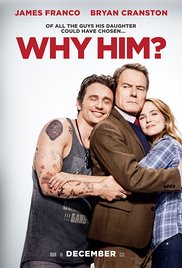
Film Review: WHY HIM? (USA 2016). James Franco. Bryan Cranston.

why_him_movie_poster.jpgDirector: John Hamburg
Writers: Jonah Hill (story), John Hamburg (story/screenplay), Ian Helfer (screenplay)
Stars: Zoey Deutch, James Franco, Tangie Ambrose, Bryan Cranston, Cedric the Entertainer, Megan Mullally

Review by Gilbert Seah

There are smart dumb comedies and there are dumb, dumb comedies. WHY HIM? directed and co-written by John Hamburg (who wrote MEET THE PARENTS, MEET THE FOCKERS and the ZOOLANDER movies) falls into the latter category. But all is forgiven for like the hit comedy DUMB AND DUMBER, WHY HIM? is quite funny.

As in MEET THE PARENTS and MEET THE FOCKERS, it is the story of the guy trying to impress his future in-laws. The hitch in WHY HIM? is that the guy is a weird monstrous hip games designer millionaire who swears in every sentence he utters. So will Laird (James Franco) be able to charm his future father-in-law Ned (Brian Cranston) so that he can give him permission to wed Stephanie (Zoey Deutch).

The audience is set up for an all-out gross film with the beginning scene where Laird is close to show Stephanie his almost black blue balls in a video chat. The scene shifts to Stephanie’s dad’s birthday celebration where she is video chatting him when Laird suddenly appears in the background and takes off his pants. There is nothing highly original about this comedic set-up but it still brings on the laughs.

Stephanie (Zoey Deutch) invites her father Ned Fleming (Bryan Cranston) and mother Barb (Megan Mullally), along with their 15-year old brother Scott (Griffin Gluck), to stay with her wealthy and famous boyfriend, Laird Mayhew while visiting her at Christmas. Laird’s vulgar, gregarious, and blunt personality is slightly overwhelming for Barb and Scott, but causes Ned to downright despise him. However, Stephanie insists that Laird is a nice person, and that he makes her happy. But when Laird reveals he plans to propose to Stephanie in only five days, the race to prove himself worthy of her love so Ned can give them his blessing begins. Laird goes out of his way to win over Barb and Scott, while Ned schemes to make sure Laird goes down in flames.

Laird throws a Christmas party for the Flemings that goes out of control. But the three minute Christmas party segment puts OFFICE CHRISTMAS PARTY to shame. The segment moves on fast, furious and funny and generates more laughs in the three minutes that the entire party section in OFFICE CHRISTMAS PARTY.

For a film about a wild person, the film stays away from lewd scenes. There are no hard core drugs only marijuana and no smoking is shown – only the after effects (the horny mother inching her husband for sex in the bedroom). Swearing, however is plentiful but done in a humorous manner. There are also bukkake and double dicking jokes (but nothing seen) – which the gays in the audience should be familiar with. The film also steals from the Kato and Inspector Clouseau fights in the PINK PANTHER films with Laird’s man-servant, Gustav (Keegan-Michael Key) always laying in wait to fight him. But these scenes are still funny.

Where the film starts to slack is when it gets emotional with the different relationships (father/boyfriend; father/daughter and boyfriend/girlfriend). The ending 20 minutes drags too long and is a bit of a let down considering the fast pace of the rest of the film. There is a surprise appearance of a famous band at the end of the film. Still WHY HIM? succeeds as quite a hilarious though quite a dumb comedy.

Trailer: https://www.youtube.com/watch?v=CO6qLC4cL8E
 

Watch Winning Best Scene Readings:

TV CONTESTSUBMIT your TV PILOT or TV SPEC Script
Voted #1 TV Contest in North America.
FILM CONTESTSUBMIT your SHORT Film
Get it showcased at the FEEDBACK Festival
writing CONTEST1st CHAPTER or FULL NOVEL CONTEST
Get full feedback! Winners get their novel made into a video!
SCREENPLAY CONTESTSUBMIT your FEATURE Script
FULL FEEDBACK on all entries. Get your script