Film Review: KNUCKLEBALL (Canada 2017) ***1/2

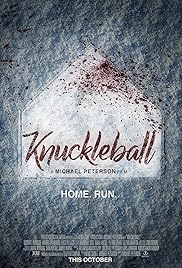
Knuckleball Poster
Alone, and targeted on an isolated farm, 12 year old Henry finds himself at the center of a maelstrom of terror, and a dark family legacy, when his secretive grandfather dies suddenly in the night.

Director:

Michael Peterson

KNUCKLEBALL is a Canadian horror thriller set in the U.S. in the dead of a winter storm.  It is advertised as an R-rated HOME ALONE in which a 12-year old boy must defend himself against a house intruder, in this case not only a killer but a pedophile.

As far as the story goes, it is a straight out too well-thread thriller plot with a few nasty bits added in.  By co-writer Michael Peterson knows how to put on the suspense in this exercise in terror.  Peterson understands the mechanics of a Hitchcockian thriller and applies it at best he can.

The film begins with a husband and wife dropping their son, a 12-year old Henry at his grandfather’s out in the woods while they fly out of the city.  It is clear from the dialogue that the relationship of the couple is estranged, which as expected (cliches occur quite a bit in the story) will improve later on, once they realize their boy is in trouble and they cannot get to him because of the storm.  

As the plot goes, the grandfather unexpectedly dies in the night.  Henry finds himself cut off and alone on an isolated farm.  When his nearest neighbour, Dixon, realizes that the boy has no one to protect him, Henry becomes a target for reasons he cannot understand.  With his parents at least 24 hours from returning and a massive snowstorm brewing,  Henry retreats into the house and prepares for a siege, HOME ALONE-style but so much more brutally violent.  We are talking barbed-wire here.   What follows is a desperate battle for survival that will also unlock the terrifying connection between his family and the killer next door. 

As in true Hitchcockian fashion, the terror does not arrive immediately.  In Hitchcock’s THE BIRDS and also Spielberg’s JAWS, the first attack occurs only after half the movie has passed.  In KNUCKLEBALL, the grandfather is alive with Henry for the first 30 minutes, with the film tending towards simple drama/comedy instead of a thriller.  Grandfather dies in bed at the 30-minute mark.

Peterson’s film contains lots of segments  that prompts audience anticipation.  When grandfather teaches Henry how to throw a knuckleball, one knows that Henry will eventually use his new craft at his intruder.  There is one point that grandfather collapses from a heart attack while climbing the roof.  He screams and utters to himself: “Get up you old sap. Time to call it a day”.  

When Henry is alone with the intruder, a local cop is dispatched to the house.  No need to guess what happens to her – the same thing when a detective or cop is dispatched (Hitchcock’s PSYCHO) to a residence when the occupant is under siege happens here.

KNUCKLEBALL suffers from an all too familiar story.  But Peterson improves this story by an engaging first third and and scary other two thirds.  Peterson’s talent is his ability to draw his audience into the story which results in a very satisfying and absorbing be it ultra-violent thriller.

Trailer: https://www.youtube.com/watch?v=nM-CpDkPOcM

Film Review: THE MAN WHO FEELS NO PAIN (India 2018) ***

The Man Who Feels No Pain Poster
Trailer

Tells the story of a young boy Surya who has a rare condition of incognito sensitivity to pain meaning he can not feel pain, and sets out learn martial arts and hunt down muggers.

Director:

Vasan Bala

THE MAN WHO FEELS NO PAIN is the kind of action comedy that used to be so popular back in the 70s.  Everyone who went to these (the Bud Spencer and Terence Hill western comedies, the SABATA series and the later 90’s Stephen Chow films) know that they were not in to experience a cinematic classic but in for just silly fun.  These comedies made a lot of money but seemed to have disappeared from the screens till this Bollywood-infused martial-arts action film.

The film begins with a saying that mind blowing stories have their origin from bad decisions.  It then goes on to attempt to prove this by the life of a character than was born unable to feel pain.

The doctor explains to the audience the medical ailment called ‘congenial insensitivity to pain’ (jokingly also telling the audience that they can google it later), then that this young boy, Surya is born with this disability.  I did google the term and found out that there is indeed such a disease that has affected maybe only 20 people or so in history.  Many suffer because they might bite their lips or tongue or undergo no pain without realizing the harm they are causing their body parts.  

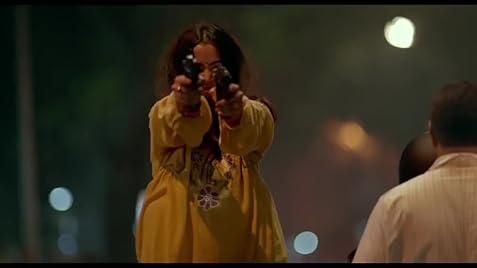
The film begins in flashback.  As a baby, Surya’s mother is killed, the result of a chain snatching incident.  His grandfather secretly trains Surya (Abhimanyu Dassani) by getting him a series of action videos cassettes like BIG TROUBLE IN LITTLE CHINA and STREETFIGHTER,  So he becomes the Karate Man.  The action involves him and a girl Supri (Radhika Madan) saving her one-legged karate master, Manni from his evil twin brother Jimmy (Culshan Devaiah playing both roles).  All the comedy and action high-jinx take place in the city of Mumbai, India – the birth place of director Bala.

Bala’s film moves breezily along and works very well bringing forth the laughs during the first hour or so.  It is during the second half that the film starts getting into trouble.  It is when the second story (and less interesting one) comes into play. The film is a lengthy 2 hour film, which is considered short for a typical Bollywood film.

At best, the film captures the Indian culture as the action comes along.  When Surya takes off on the roof of a building, it is comical to see dried chillies laid out in the sun for drying.   The grandfather and father are quite the clowns as well. The question “What has India learned from 70 years of independence?” is also comically posed.

Abhimanyu Dassani makes a good-looking, fit occasionally goofy-looking hero.  His kicking and punching look real enough to convey him a fighter to contend with.  The dance choreography and songs are not bad either.

THE MAN WHO FEELS NO PAIN premiered at this year’s Midnight Madness Section at the Toronto International Film Festival.  It won the People’s Choice Midnight Madness Prize.  THE MAN WHO FEELS NO PAIN definitely succeeds as an action packed hilarious crowd-pleaser.

Trailer: https://www.youtube.com/watch?v=pLMShjMlrlU

Full Review: ANTHROPOCENE: THE HUMAN EPOCH (Canada 2018) ***1/2

Anthropocene: The Human Epoch Poster
Filmmakers travel to six continents and 20 countries to document the impact humans have made on the planet.

ANTHROPOCENE – the current proposed geological epoch in which humans are the primary cause of permanent planetary change.

Filmmakers filmmakers Jennifer Baichwal and Nicholas de Pencier return with their latest and third of their trilogy after MANUFACTURED LANDSCAPES and WATERMARK, entitled ANTHROPOCENE: THE HUMAN EPOCH.  The doc, written by Baichwal and narrated by Swedish actress and Oscar winner Alicia Vikander is a disturbing doc that demands to be seen for it explores human’s impact on the Earth.  The term for this impact is terraframing – the resurfacing of land due to human needs.

Scientists believe that human beings have left the Holocene epoch (which started 11,700 years ago when the last ice age receded) and entered the Anthropocene (because humans 

now change the earth and its systems more than all other processes combined).  The film examines this awful age where the planet is altered for its worst.

Baichwal’s films are always stunning to look at, even when displaying the ugliness of the earth.  This is most evident with the landfill segment where the entire screen is composed to human garbage.  One can only imagine the stench of the place.

The film’s first scene is that of molten metal  The site on display is north of the Arctic Circle in what Baischwal describes as Russia’s most polluted city.  This is where the world’s largest metal smelting industry is located.  

Baichwal and her crew travel the world documenting evidence of human domination – from concrete seawalls that cover 60% of China’s mainland coast, to psychedelic potash mines in Russia’s Ural Mountains, to vast marble quarries in Italy, to surreal phosphate tailings ponds in Florida.  In each country, the voiceover is in the country’s languages (in English, Russian, Italian, German, Mandarin and Cantonese with English subtitles) so as to add to the segments’ authenticity.

Baichwal’s film provides a bit of distraction in the form of the segment on extinction.  She shows as well as educates on the extremely endangered species including the white cheek gibbon, the white rhinoceros, the Egyptian tortoise, the chicken frog and the okapi.  I never knew what a okapi was till now.

Baichwal does not provide solutions to the problems nor offers much hope to the saving of the planet.  Perhaps she hopes this document on film might serve the purpose.

Still, ANTHROPOCENE: THE HUMAN EPOCH is a spectacular film – Baichwal’s best of her trilogy.  She has spent an immense amount of time on research and travels resulting in this magnificent educational documentary.

The film is part of The Anthropocene Project that also comprises complementary exhibitions premiering simultaneously on September 28 at the Art Gallery of Ontario and National Gallery of Canada, new Burtynsky photographs, new film installations by Baichwal and de Pencier, experiences in augmented and virtual reality, a book published by Steidl, and education program.

Trailer: https://www.youtube.com/watch?v=44RYqgKwfSQ

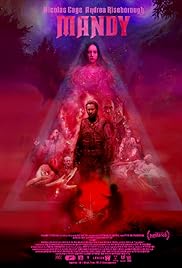
Film Review: MANDY (USA 2017)

Mandy Poster
Trailer

Mandy is set in the primal wilderness of 1983 where Red Miller, a broken and haunted man hunts an unhinged religious sect who slaughtered the love of his life.

MANDY a futuristic horror is director Panos Cosmatos second feature after his ultra-pretentious futuristic drama that I absolutely hated THE BLACK RAINBOW.  RAINBOW was exceptionally slow moving, like the beginning of MANDY as if the director wanted everyone to remember the comatose, rhyming with his last name.  Panos is the son of Greek director George Pan Cosmatos, whose films I also generally dislike.  His most successful film is one I hated THE CASSANDRA CROSSING that starred Sophia Loren.

Panos Cosmatos reaches one step higher in MANDY that it has well-known actors Linus Roache (PRIEST, THE WINSLOW BOY) and Nicolas Cage.

MANDY begins really slowly, so one must be fully attentive as it is easy to doze off.  Consider the inane dialogue.  “Are you ok?”  “I am not ok.”  “Is it my fault?”  “it is totally your fault.”  The dialogue goes on and on without making much sense.  

Cosmatos’ horror movie MANDY pals like an art house horror flick.  Art and horror do not not go well together, as this exercise and Cosmatos’ devious film THE BLACK RAINBOW have proven.

The film is set in at futuristic looking 1983. But this story is a little more steeped in demonic myth than microchips.  

 Red Miller (Cage) lives with his enamored girlfriend, artist Mandy Bloom (Andrea Riseborough), in a cabin near the lake. Red works as a logger, while Mandy has a day job as a cashier at a nearby gas station in the woods. She creates elaborate fantasy art, and Red admires her work greatly. They lead a quiet and reclusive life, and their conversations and behaviour hint at a difficult past and psychological hardship. Red appears to be a recovering alcoholic, and Mandy recounts traumatic childhood experiences.

The film shifts to a weird guy (Ned Dennehy) lying on a bed yelling at his mother , Mother Marene (Olwen Fouere) (with the inane dialogue above)  followed by his brother assuring him “consider it done” to a request he has made.  The film then follows Brother Swan as he tries to kidnap Mandy with the help of the Black Skulls, a demonic biker gang with a taste for human flesh and a viscous, highly potent form of LSD.  Red Miller saves the day.  Watch out for the duel the chainsaws.

Cosmatos loves to play with visuals.  A lot of his scenes are coloured bright red and accompanied with a thundering soundtrack like from an electric guitar.

MANDY’s story is incredibly difficult to follow and really frustrate got try.

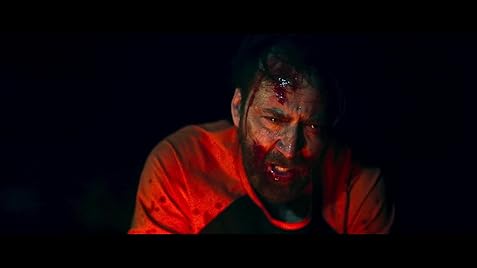
Nicolas Cage appears only after nearly half the movie has transpired.  Once he appears everything picks up.  He is at one point stabbed with a sharp knife through his sides with a crazy woman yelling: “Now you will legalize the the cleansing power of fire.”  Cage is so over the top, he adds the campiness that is seriously needed to life the film’s dreariness.

MANDY is not for everyone and it is also safe it is not for many.

Trailer: https://www.youtube.com/watch?v=rI054ow6KJk

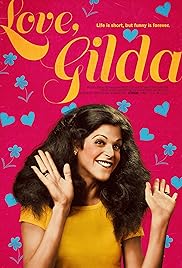
Film Review: LOVE, GILDA (USA 2018)

Love Gilda Poster
Trailer

In her own words, comedienne Gilda Radner looks back and reflects on her life and career. Weaving together recently discovered audiotapes, interviews with her friends, rare home movies and … See full summary »

Director:

Lisa Dapolito

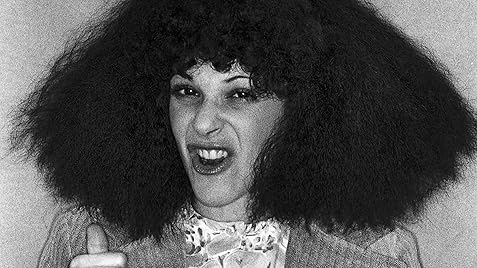
LOVE, GILDA is a documentary which as its title implies, a loving tribute to the late comedian Gilda Radner who passed away a decade or so ago from ovarian cancer,

D’Aplolito’s documentary is exactly what one would expect of what homages do – interviews from close firms and family, detail of the subject’s youth and influence, the rise to fame, the subject’s talent and perhaps some faults may it be alcohol or drug use.  This is the reason the doc is so unimpressive. There are no surprises.  In fact, none of Gilda’s flaws are mentioned.  One can either assume she did not use any or she did and the point left out.  It should be noted that Gilda hung around John Belushi in SNL, a heavy drug and alcohol user.  Belushi died from a drug concoction of heroine and cocaine.

The film traces Gilda’s influence coming from being inspired by Charles Chaplin and Lucille Ball (the doc includes a few short clips of Chaplin and Ball).  Gilda grew up with naturally born talent, first amusing her father when he came home from work.  Sadly he left her at the tender age of 14.  D’Aplolito provides a glimpse of her dad coming out of a swimming pool.

The multi-talented writer, singer and performer first shone at the Second City comedy club in Toronto.  She was an original cast member of Saturday Night Live (SNL), creating characters like personal advice expert Roseanne Roseannadanna and reporter Baba Wawa.  She performed her one woman Broadway show to rapturous audiences and left a modest mark on the movies with roles opposite her second husband Gene Wilder in the likes of Hanky Panky (1982) and The Woman In Red (1984).  The doc also mentioned her big flop comedy directed by starring her and Wilder, HAUNTED HONEYMOON.

The interviewees in the doc include her brother and other close friends.  Current SNL performers like Bill Hader, Melissa McCarthy and Amy Poehler also have they say.  There is quite a bit of archive footage with Gene Wilder, who the doc is quick to mention is not a comic but an actor in comedies.

But for a doc about such a lively artist, the doc does not match her spirit.  Her comedic routines on display are not her best and do not elicit laugh-out laughs.  They are mildly humorous at best.  This is best described to be similar to an SNL episode – a ht or miss, as in the case of many of the SNL’s skits.

So what did Radner contribute to the human race?  The doc is quick to point out that Radner made jokes out of her cancer.  There is a funny bit with her and Gary Shandling on the topic. Radner was unafraid of pushing the limits of her humour.

It is hard to fault D’Aplolito’s doc on Gilda Radner.  But one would have expected something more biting and funnier.  In the end, the doc creates a sadder cloud over the talented comedienne.  Death was always her enemy – taking away her loving after at the age of 14 and also taking her away at the early age of only 43.

Trailer: https://www.youtube.com/watch?v=1B44XRFotuo

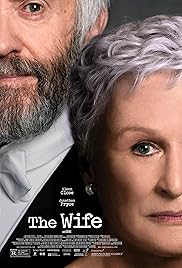
Film Review: THE WIFE (USA 2018) ***1/2

The Wife Poster
Trailer

A wife questions her life choices as she travels to Stockholm with her husband, where he is slated to receive the Nobel Prize for Literature.

Director:

Björn Runge

Writers:

Jane Anderson (screenplay by), Meg Wolitzer (based on the novel “The Wife” by)

THE WIFE is the story of the neglected long-suffering wife, Joan (Glenn Close) who when he film opens learns that her husband Joe Castleman (Jonathan Pryce) is to be awarded the Nobel Prize in Literature for his body of work.  

Both travel to Stockholm with son in tow.  But secrets soon surface.  As they say, behind the success of every man is a woman.  It turns out that Joan is the secret of Joe’s success.  She is the one actually writing all the books with the husband Joe claiming all the victory.  When Joe gets all smug about it, and worst still begins making advances to a female photographer, Joan finally loses it – with the husband’s pride, insincerely and dishonesty.

The story also flashes back to the 1950s when Joan (played by Close’s real-life daughter Annie Starke) was an eager student and Joe (Harry Lloyd) was a then married creative writing professor – and to the 1960s when Joan got a job at a publishing house.  Although Joan herself had writing ambitions in those days, a caustic encounter with a failed novelist (Elizabeth McGovern in an extremely effective and amusing cameo) warned of the obscurity awaiting the “lady writer” no matter how talented.  Her words determine Joan’s ultimate fate in life.  It is not that a writer needs to write.  A writer needs to be read.  A woman’s work, no matter how good will never be read.

A film about writers and this one about a Nobel Prize winner for Literature at that is expected to have exceptional writing.  Jane Anderson’s script achieves this but blows it in one unfortunate scene.  At best, the script reveals only bits of the wife’s secrets at a time, whetting the audience’s appetite for more in terms of anticipation.  Some of the best script involve unwritten dialogue.  When a tragic event occurs in the film (not  to be revealed as a spoiler), Joan’s sad face is shown but with no tears, the only water shown in images on each side of the frame.  But Anderson’s script blows it in the introduction speech when Joe is given the Noble Prize during the ceremony.  The phrase “most importantly,” is used.  Not only is this phrase considered incorrect grammar  by many, this phrase was only used in the last 5 years or so in North America and therefor never in the 1990’s (the film’s setting) and certainly not in a European city like Stockholm.

The script’s best line is uttered by Joe: “There is nothing worse than a writer with feelings that have been hurt.”  Yet Joe does not realize the truth in his words.  He has committed the offence twice in not acknowledging his son’s work and more important, his wife’s literary contribution.  The husband and wife’s final confrontation is also well written and well acted out.

Glenn Close is an exceptional actress who has been nominated six times for an Oscar.  She delivers a brilliantly understated performance a kind of reversal FATAL ATTRACTION that should finally garnish her the Oscar she deserves.  If her character, Joan never won any award, lets hope that this would be an example of life not imitating art.

Trailer: https://www.youtube.com/watch?v=d81IM0loH7o

TIFF 2018 Review: RETROSPEKT (Netherlands/Belgium 2018) ***1/2

Movie Reviews of films that will be playing at TIFF (Toronto International Film Festival) in 2018. Go to TIFF 2018 Movie Reviews and read reviews of films showing at the festival.

Retrospekt Poster
Puzzle-like psychological drama about a domestic violence support worker .

Director:

Esther Rots

Writer:

Esther Rots

Retrospeckt by definition is the Dutch word meaning the series of events that occurred in the past.  Director Ether Rot’s RETROSPEKT cleverly puzzles together a timeline-jumping narrative of protagonist Mette’s relationship to work, life, and motherhood culminating in catastrophic events.  

In many films, a non-chronological narrative is chosen at the director’s whimsy but in this film there is a reason for it.  Mette (Circé Lethem) has undergone an accident that has jolted her memory and psychical condition.  The story unfolds just as she is fitting her past together.  It is an intricate puzzle narrative where the stakes only escalate with every new shard of revelation.  Mette is happily married and works in an abuse shelter.  They have a new baby added to the family.

  When she takes in an abused victim into their home, disaster occurs.  Rots has created a scary suspensor made even more tense from her jump-timeline tactic coupled with the perfectly eerie soundtrack of operatic screeching songs by composer Dan Geesin.

Trailer: https://www.youtube.com/watch?v=IyLjZc1qgu8

TIFF 2018 Review: THE DIVE (Israel 2018) ***

Movie Reviews of films that will be playing at TIFF (Toronto International Film Festival) in 2018. Go to TIFF 2018 Movie Reviews and read reviews of films showing at the festival.

The Dive Poster
When a family patriarch dies, three brothers must put aside their differences to carry out their father’s last wishes, in Yona Rozenkier’s tender yet analytical debut examining what it means to be human.

Director:

Yona Rozenkier

When a family patriarch dies,  prodigal son Yoav (Yoel Rozenkier) returns to the sparsely populated kibbutz where he was raised.  He is greeted by his mother, his elder brother Itai (Yona Rozenkier), and his younger brother Avishai (Micha Rozenkier), who is about to ship off to perform his military service in Lebanon. Yoav is an ex-officer traumatized by his experiences, while Itai remains a serviceman and believes fiercely in a man’s patriotic duty. Their conflicting perspectives generate a deep rift in Avi. 

 The title THE DIVE refers to the act that the three brothers must perform – to deposit their father’s remains in an underwater cave, an excuse for the film to exhibit some superb underwater cinematography.  

Rozenkier (his first feature) successfully captures the male chauvinist world of the three bothers and how their lives are adversely affected

The film is ultimately about something much more profound: what it means to be human, made more believable as the story is autobiographical.

Trailer: https://www.youtube.com/watch?v=ysRi5yC2MRI

TIFF 2018 Review: THE OTHER STORY (Israel 2018) ****

Movie Reviews of films that will be playing at TIFF (Toronto International Film Festival) in 2018. Go to TIFF 2018 Movie Reviews and read reviews of films showing at the festival.

The Other Story Poster
Strong female protagonists have been the mainstay of many Avi Nesher films. In ‘The Other Story’, two rebellious young women – one fleeing the chaos of secular hedonism for the disciplined …See full summary »

Director:

Avi Nesher

Writers:

Avi Nesher (co-writer), Noam Shpancer (co-writer)

THE OTHER STORY is one of the BEST Jewish films I have seen, succeeding for the fact that it has quite a good story, and one related to Jewish mores.  The film follows two rebellious young women, one fleeing the chaos of secular hedonism for the disciplined comforts of faith, the other desperate to transcend her oppressive religious upbringing for sexual and spiritual freedom, cross paths unexpectedly in Jerusalem — with startling consequences — in this empowering drama from Avi Nesher (PAST LIFE). 

 The film begins with Yonathan returning from the U.S. to Jerusalem, called by his ex-wife to do whatever crooked means possible to prevent their daughter Anati from marrying by defaming the groom.  Meanwhile, Yonatan’s dad gets him involved in another couple’s dispute over custardy of their child.   It is fucked up people doing fucked up things to un-fuck up their lives – a sort of dysfunctional family with a thriller element thrown in for good measure.  

THE OTHER STORY is totally unpredictable, hilarious while remaining smart and believable.  The best surprise in this crown-pleaser is the happy ending that had the audience applauding at the end credits.

Trailer: https://vimeo.com/283720820

TIFF 2018 Review: JEREMIAH TERMINATOR LEROY (USA/UK/Canada 2018) **

Movie Reviews of films that will be playing at TIFF (Toronto International Film Festival) in 2018. Go to TIFF 2018 Movie Reviews and read reviews of films showing at the festival.

A young woman named Savannah Knoop spends six years pretending to be the celebrated author JT LeRoy, the made-up literary persona of her sister-in-law.

Director:

Justin Kelly

Writers:

Justin KellySavannah Knoop (memoir) | 1 more credit »

Laura Albert (Laura Dern) writes tough, insightful fiction under a pseudonym, JT LeRoy. Her JT is not just a pen name but a whole persona, a teenage boy from West Virginia living a dangerous life as a truck stop sex worker.  Laura was born in Brooklyn a generation earlier, and grew up in New York’s punk scene.  Writing books such as The Heart is Deceitful Above All Things as JT gives her complete freedom to explore the darker regions of human experience. Readers and the media love it so much that they begin to demand JT in person.  

As journalists press for interviews with JT, turmoil mounts with Laura’s husband Geoffrey (Jim Sturgess) and sister-in-law Savannah (Kristen Stewart).  Partly from desperation, partly for kicks, they conspire to have Savannah don a wig and sunglasses, adjust her voice, and become the teenage boy author.   Despite everything being based on a true story, Kelly’s film is extremely dull.  He makes no attempt to make the events authentic or to make Savannah believable as JT.  Whenever she appears as JT, she mumbles all along and the media and everyone takes it in from Cannes to Paris to the U.S. 

 Worst of all is the pretentious bit at the film’s end where Laura preaches to the audience that everyone has to be the person he or she is.