1997 Movie Review: LEAVING LAS VEGAS, 1997


LEAVING LAS VEGAS,   MOVIE POSTERLEAVING LAS VEGAS, 1995
Movie Reviews

Directed by Mike Figgis
Starring: Nicolas Cage, Elisabeth Shue, Julian Sands, Richard Lewis, Kim Adams, Emily Proctor, Valeria Golino
Review by Nina Katungi

SYNOPSIS:

After losing his family and then his job to alcoholism, Ben decides to pack up his life, head to Las Vegas, and drink himself to death. Sera, a worn and wasted prostitute crosses paths with Ben in Las Vegas. They find solitude in one another and soon enough an unconventional relationship starts to bloom.

WON OSCAR for BEST ACTOR (Cage)

REVIEW:

“Leaving Las Vegas” is based on a semi-autobiographical novel written by John O’Brian. John O’Brian was an alcoholic with the end in sight, just like his character, Ben. His fate arrived sooner than expected. O’Brian took his own life just two weeks after he found out his novel was going to be adapted into a film. O’Brian’s father believes that “Leaving Las Vegas” was his son’s suicide note. Mike Figgis adapted the novel into a screenplay and managed to maintain the dark undertones that the novel entails. Figgis succeeded in bringing this beautiful but extremely solemn tale onto the big screen. Figgis also composed the music for the soundtrack. What he put together was a rather haunting but delicately emotional sound.

Ben (Cage) works in the film industry in Los Angeles. It is a pivotal time in Ben’s life. His alcoholism has past the point of no return and his life is hastily withering away. His wife and son have left him and now, after tolerating his erratic behaviour for a while, Ben’s workplace finally let him go too. Ben packs up his life in LA, obliterates everything that is personal to him and heads to Las Vegas where he shall drink to his death. Once in Vegas, Ben stumbles upon an angel, Sera.

Sera (Shue) is a prostitute working on the streets of Las Vegas. She moved to Las Vegas with Yuri (Sands) her pimp/boyfriend and since has endured a life of using her body to make money. Sera has been in this business a long time and has experienced all the horrors she can imagine. Her body no longer seems a part of her rather a mere tool to make money. Yuri is in control of this tool, using it for his own personal needs as well as a form of income. Sera’s long lost a sense of herself but when she meets Ben things start to change for the better. In the meantime Yuri is in trouble with the Romanian mafia – it’s so far gone that a group of thugs have been sent to deal with the situation. Yuri is aware of his fate, he cuts strings with Sera and lets her go free.

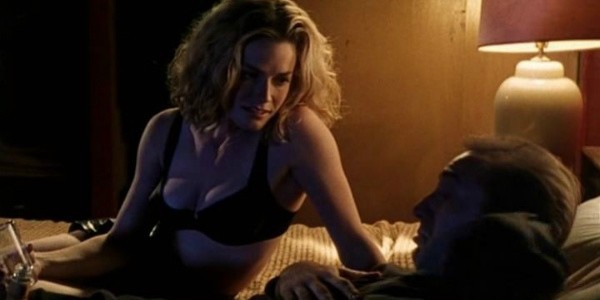
Ben almost runs Sera over at a stop light and being the tough girl she is, Sera struts to the car and gives Ben a piece of her mind. This is Ben and Sera’s first encounter. Ben later finds Sera on the street. Ben’s aware that Sera’s a prostitute, he offers her money to come back to his motel. Sera is prepared for yet another with a “client” but to her surprise it turns out to be the first bearable night that she has had in a long time. Sera encounters something that she’s never encountered before. Ben simply wants her to keep him company, not for sex but just to talk. Sera realises how lonely she’s is and has been for a long time. Ben is the void that Sera’s been missing for so long. With Yuri out of the picture Sara asks Ben to move in with her. Ben is hesitant but agrees on one condition – Sera must never ask Ben to stop drinking. This promise seems easy at first but as soon as Ben’s alcoholic world becomes real to Sera and as soon as Sera’s falls for him, this promise to allow him to kill himself, well the promise is broken almost as quick as it was made.

This is he last time I’ve seen Nicholas Cage play a great role. I think he’s talented but unfortunately there hasn’t been much proof of that since “Leaving Las Vegas”. Cage’s choice in roles, up until now have been terrible, bad films which have resulted in some very poor performances. When I think of the great films he’s been in like “Moonstruck” or “Raising Arizona” I get sad because I honestly miss what he was and perhaps what he won’t ever be again. He may find himself turning another corner soon, I hope, I really do. Cage won an Oscar for his performance in “Leaving Las Vegas” and it was well deserved. Elisabeth Shue played the role of Sera so well, she was also nominated for an Oscar but regretfully she didn’t win like her co-star. Before this film Shue was only really known as Tom Cruise’s love interest in “Cocktail”. She managed to turn a lot heads in “Leaving Las Vegas” but unfortunately after this role she fizzled away, which I also think is a shame. Perhaps she too will find another role that fits her just like a glove. “Leaving Las Vegas” wasn’t only a success with its two lead actors it received a generous amount of nominations for best director, screenplay, and film as well. This is not a classic love story with a happy ending. It’s a love story that ends as quickly as it begins but what it does is it leaves you with a compellingly emotional state of mind. It’s such a great piece of work.
LEAVING LAS VEGAS, 1997

1997 Movie Review: LAWN DOGS, 1997


LAWN DOGS (1997)
Clascic Movie Review
Directed by John Duigan
Starring Mischa Barton, Sam Rockwell
Review by Russell Hill

SYNOPSIS:

A young family move into an upmarket housing area, hoping to climb up the social ladder. Their daughter does not share her parents’ ambition and, instead of making friends with someone her own age, befriends a shy gardener.

REVIEW:

Almost unrecognisable from her role in The O.C., Mischa Barton here gives a matured performance for such a young person of only eleven years of age. Ably supported by Sam Rockwell, it seems at times that he is the star of the film, not Barton, and certainly relishes in what was his break-through role. Upon discussing this film with my loved ones, they didn’t even know this film existed! Such lack of acknowledgement should be rectified.

I guess you could say that Devon (Barton) is our protagonist, but then again Trent (Rockwell) might be in a number of scenes. Recently moved into what can only be described as a very affluent area, Devon with her mother Clare (Kathleen Quinlan) and father Morton (McDonald) are the new kids on the block. Morton is a very ambitious man, and always strives to better his social standing by inviting the neighbours over for a barbeque or discussing intellectual matters with them. Either way, he’s a man with a goal. Devon, on the other hand, couldn’t care less for her father’s aspirations.

Upon the chance discovery one day selling cookies, she meets Trent; a loner character who makes a living cutting the lawns in the neighbourhood where Devon lives. Looked down upon by his customers as his profession is not an academic one, Trent just carries on with life despite their resentment. Even the local idiots, the type who wouldn’t piss on you if you were on fire, give him slack but even this doesn’t bother him. Thick skinned? Yes, Trent is certainly that.

Upon their first meeting, Devon keeps appearing at Trent’s home; a shot-gun trailer in the forest that wouldn’t even make good firewood. Despite both being independently-minded characters they find friendship in each other. Theirs is a strange friendship, but a close one. In spite of her father’s wealth, Devon would rather live this semi-nomadic existence Trent has. I guess money doesn’t always buy you happiness. Both Devon and Trent are outsiders, and only seem to find companionship in each other. Trent’s isolation is self-imposed but Devon’s is due to her personality. Certainly not one to win a Miss Popularity contest, she finds herself more at ease with her pet turtle or joining in with the howling of the neighbourhood dogs. A character more suitable for The Twilight Zone than Disney.

There will always be anger in a movie when there is a somewhat questionable friendship between an adult and a young child. And boy, do the fireworks truly happen. It doesn’t help that Devon informs her father of this whilst crying. Similar to shooting someone whilst smiling, I guess. There always is something you’re not quite following. Think Heath Ledger’s portrayal of The Joker in The Dark Knight. You think he’s being sincere, but in fact is pure evil. Anyway, I’m rambling. Where was I?

Rockwell and Barton are supported by some fine actors. McDonald, one of the finest actors of our generation and otherwise known as Shooter MacGavin from Happy Gilmore, excels here. His over-the-top reaction to the friendship that Devon has with Trent is both understandable and believable. Although he is not an A-List actor, his ability in this film is worthy of that status. As with Mr Destiny, a previous review of mine that can be seen in the Classic Movie Review section and a movie not shown much on television in Great Britain, Lawn Dogs is, and I hate to use the phrase but certainly necessary here, an underrated film and certainly a modern-day classic. It doesn’t help that this film is difficult enough to obtain on DVD (I recorded this on VHS from the television) but when you do get a copy, boy, is it worth it.

As I mentioned, a number of my loved ones were not aware of this movie. But, upon showing them my grainy and worn copy on VHS, their eyes were opened to the aspects that make this movie a classic-great characters that you can believe might actually exist, great direction by Duigan and starring an actress that still has the potential to be a Hollywood great. I always root for British-born actresses to succeed, and hope that Barton won’t throw away talent that, despite her young age, is evident. What a movie to start your career in.

LAWN DOGS, 1997

1997 Movie Review: LA CONFIDENTIAL, 1997


LA CONFIDENTIAL MOVIE POSTER
LA CONFIDENTIAL, 1997
Movie Reviews

Directed by Curtis Hanson
Starring: Russell Crowe, Guy Pearce, Kevin Spacey, James Cromwell, Danny DeVito, Kim Basinger
Review by Brent Randall

SYNOPSIS:

The corruption existing within Los Angeles police force of the 1950s is exposed in this crime thriller.

WON 2 OSCARS – Best Supporting Actress (Basinger), Best Adapted Screenplay

REVIEW:

From the opening scene to the final credits, L.A. Confidential keeps you on the edge of your seat as it weaves through the murky waters of the Los Angeles police force. Set in the 1950s, the movie opens with discussing the wonders of Hollywood by showing a series of shots of the beach, the grand strand, and Hollywood, and how life in L.A. is better than anywhere on the planet, much less America, and the Los Angeles Police Department is the pride and joy of the City of Angels. After about five minutes of praising the city with a marvelous voice over from Sid Hudgens (Danny DeVito), Hudgens shifts gears and begins shedding light on the mobster, Mickey Cohen (Paul Guilfoyle), and how Cohen is pushing heroine through the city and causing chaos in a clean and pristine town.

At first, it seems that the police force is dead set on snuffing out the crime with the arrest of Mickey Cohen in the opening sequence with their brilliant detectives, Bud White (Russell Crowe), Jack Vincennes (Kevin Spacey), Ed Exley (Guy Pearce), and Captain Dudley Smith (James Cromwell). However, it is merely an illusion, and the corruption within the famous police department is quickly exposed. As the viewer, you get the sense early, all is not right within when a brawl breaks out between the inmates and the policeman on Christmas Eve. Personally, I thought it was brilliant to stage the fight on Christmas Eve, a time known for peace and joy, and the fight is one of the most vicious, realistic fights I have seen in recent films. Shortly after the fight, the event that sends everything in motion is a horrific set of murders that occurred at the infamous “Night Owl” restaurant. A blood bath that took place over a failed robbery attempt in Captain Smith’s account. Captain Smith, who is always trying to get justice, in his own words, “swiftly and merciless”, pins the murders on three young black men who had previous records . Smith feels no one would raise too many questions regarding these suspects, and they could shut the case for good.

However, Bud White and Ed Exley, while not choosing to work together for most of the film, know something stinks about The Night Owl investigation, and desire to find some air freshener to eliminate the “smell.” They employ the help of Detective Jack Vincennes, which is brilliantly performed by Kevin Spacey, and Lynn Bracken, a high class hooker, played by Kim Basinger in her best performance ever, in my opinion. We quickly learn that Bud White believes in justice, cares for women, has a major temper, and is loyal to the department. Exley, on the other hand, is a kiss up, but also believes in justice. Throughout the movie, it is easy to see why these two do not get along, but one quickly learns they have much more in common than originally thought, and they both prove to be honest and men of integrity. Russell Crowe (playing Bud White) and Guy Pearce (playing Ed Exley) both give brilliant performances, and makes one realize the line between right and wrong is very, very, complicated and sometimes justice is found on both sides of this proverbial line.

Bud White is probably, in my opinion, Crowe’s best roll to date. Not to take away anything from the movie Gladiator, but in L.A. Confidential, his character is not always right, he is not always wrong, but his quest for justice and righteousness gives the viewer a real sense of hope. Bud White is a character, as a human being, I can relate to. He is real, honest, has major flaws, but genuinely seeks the good in all and more importantly, the good within himself.

In fact, Bud White and the other character is what makes this film great. The story line is solid, but as the film progresses, you find yourself loving some, hating others, and not sure how to take the rest. Some represent the good in the world, Bud White. Others represent the evil in the world, Captain Dudley Smith. Some represent the people who look out for themselves as in Jack Vincennes, and then there is Lynn Bracken. In my opinion, she represents the hope we all have as humans for a brighter future, and that hope along with her brilliant acting might be why she took home the best supporting actress Oscar.

From scene to scene, and character to character, this film keeps probing deeper and deeper into corruption and darkness in search of hope, justice, and peace. It grips your the viewer’s emotions and takes you on a roller coaster ride. The acting is brilliant, and the stars (Kevin Spacey, Russell Crowe, Danny DeVito, Kim Basinger -just to name a few) are even brighter. It is a film that makes you want to search within yourself, question your own morality, and makes people realize that some of the worst enemies are the ones who appear to be friends, and vice versa. While it did not win best picture, (it was nominated and in my opinion, should have won!) it definitely qualifies as one of the best crime thrillers of all time.


LA CONFIDENTIAL, 1997

1997 Movie Review: JURASSIC PARK 2, 1997


JURASSIC PARK 2 MOVIE POSTER
JURASSIC PARK 2 The Lost World, 1997
Movie Reviews

Directed by Steven Spielberg
Starring: Jeff Goldblum, Julianne Moore, Pete Postlethwaite, Vince Vaughn, Richard Attenborough, Peter Stormare
Review by David Hammond

SYNOPSIS:

Set several years after the teething problems that occurred at the worlds first biological prehistoric amusement park, a second island full of dinosaurs is revealed to the public after an incident involving a small girl being attacked by its previously extinct inhabitants. Millionaire John Hammond has come under public scrutiny and his company has been taken away from him. He enlists the help of a team to document and study the animals that have been allowed to develop in their ‘natural’ habitat before the island is interfered with. Dr Ian Malcolm reluctantly joins the team when he discovers his girlfriend is on the island. Soon after they arrive they soon discover they are not the only people on the island when a team lead by Hammond’s nephew has come to extract the dinos in order to populate another Park in San Diego.

REVIEW:

After the overwhelming success of Jurassic Park which is rightly regarded as one on the seminal points in filmmaking due to the technological advances that were made in the creation of the creatures and the amount of realism that was injected into them; a sequel was always inevitable. The Lost World is ultimately missing the thing that made Jurassic Park so special, which isn’t dinosaurs because there’s loads of them wandering about.

Four years after the incident at Jurassic Park, a wealthy family stumble across a beautiful island and decide to take a break on its picturesque sandy beach. Soon after the tea, cakes and indeed sandwiches are unpacked the families little girl is attacked by a mob of small dinosaurs. The attack proves that not only should you never feed luncheon meat to a dinosaur but also the genetically engineered inhabitants of the island are a danger to the public. With “Site B”; the breeding ground for Jurassic Park in the spotlight, beardy millionaire John Hammond (Richard Attenborough) has had to relinquish control of his company to his nephew Peter Ludlow (Arliss Howard) who plans to remove the dinosaurs from the breeding ground and open a new park in San Diego in order to keep his newly acquired company from bankruptcy. With previous experience of the potential pitfalls of such a business venture, Hammond is naturally worried about the potential dangers involved.

In order to protect Site B from being pillaged Hammond has put together a scientific expedition to record the animals in their natural habitat, and asks Dr. Ian Malcolm (Jeff Goldblum) to be a part of it. Understandably he is reluctant due to the somewhat jarring experience that he had the last time he did Hammond a favour, but is quickly roped in when he discovers his girlfriend Sarah (Julianne Moore) is already there. Soon after the team (along with Malcolm’s stowaway daughter Kelly (Vanessa Lee Chester) arrive they are soon joined by Ludlow’s mercenaries who begin to capture dinosaurs to transport them to America. However after both the factions equipment is destroyed the rival teams must work together in order to survive the predators on the island.

Once again the creature effects in the Lost World are completely believable and therefore should be applauded. But Lost World suffers from the same problems as Jurassic Park did, but does so on a grander scale. The characters once again seem to have been put to the side in favour of the dinosaur effects. Ian Malcolm serves as both the main protagonist and the comic relief in the Lost World, but is lacking many aspects that made him such an enjoyable character in the first film. Malcolm is much more embittered in the Lost World due to they way he was treated after the Jurassic Park incident, which essentially robs him of any of the likeable characteristics that he had in the first film. Julianne Moore and Arliss Howard are lumbered with thankless roles as is true with the majority of the supporting cast; who you can identify from very early on who is and who isn’t going to be eaten and or stepped on. Only Pete Postlethwaite portrayal of big game hunter Roland Tempo who’s only desire is to hunt a T-Rex seems to raise above the materials limitations. The deep performances once again are credited to the dinosaurs.

The poor characterisation in the film is obviously a product of a shaky script. In the worst cases it makes the characters act with the shocking absence of any form of common sense. For example unbalanced hunter Dieter Stark (Peter Stormare) wanders off into the jungle to relieve himself and asks his friend to wait for him. His friend is listening to his Walkman and therefore fails to hear his friends cries for help when his is eventually attacked and eaten. Even for downtime personal cassette players should always be left at home when you plan to be navigating harsh jungle environment hunting prehistoric animals. The lack of common sense even extends to the more educated characters like Dr. Sarah Harding. After treating the infant T-Rex of its injuries Sarah’s jacket is stained by its blood, she later mentions that the T-Rex has exceptional scent detection, but is later shocked when the disgruntled mother T-Rex sneaks into camp to investigate said jacket with questions. Having theorised and witnessed the Rex’s fierce paternal instincts first hand there was only one outcome, and it should’ve been something that a behavioural palaeontologist would’ve predicted and avoided.

The aforementioned lack in judgement the characters often display lead to some impressive set pieces. One of the highlights is where panicked mercenaries run into a field of long grass, they are stalked by raptors. Spielberg shows a strange amount of restraint in the scene only showing their tails and the trials left behind as the grass is separated as they approach their prey; proving like he did with Jaws that less is more. But as with most of the Lost World while some things work brilliantly others fall flat. The climatic T-Rex rampage in San Diego feels tacked on and like a lot things in the film doesn’t make a lot of sense and seems as it’s just there for the sake of it.

What you come to realise with the Lost World is that we have seen it all before. The dinosaurs are still brilliant, but because we’ve seen them before you find yourself focusing on other aspects of the film that weren’t so important when you first watched Jurassic Park. The lack of the initial reaction of wonder to the animals means that the Lost World has to rely on the story and the script, both of which are mediocre. Even John Williams classic score fails to resonate the same epic feelings that were attained with the original and sometimes feels out of place. Spielberg falls short of topping his 1993 classic by making the same mistakes again but on a grander scale. The usually reliable Spielberg makes some strange decisions with the Lost World and the special effects fail to support this somewhat jumbled sequel.


JURASSIC PARK 2, 1997

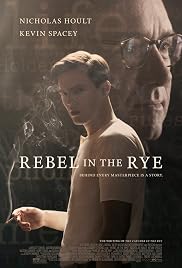
Film Review: REBEL IN THE RYE (USA 2017)


Rebel in the Rye Poster
Trailer

The life of celebrated but reclusive author, J.D. Salinger, who gained worldwide fame with the publication of his novel, “The Catcher in the Rye”.

Director:

Danny Strong

Writers:

Danny StrongKenneth Slawenski (biography “J.D. Salinger: A Life”)

REBEL IN THE EYE is an American biographical drama film based on the author of the famous ‘The Catcher in the Rye’.  It is directed and written by Danny Strong, who adapted the book J. D. Salinger: A Life by Kenneth Slawenski.  Director Strong bought the book rights with his own money which must mean that the book really fascinated him.

A film about successful creative writing appeals to many particularly film reviewers who could learn a thing or two about their writing.  The spill on voice in writing illustrated by a passage read by Whit Burnett (Kevin Spacey) in a William Faulkner novel is especially engaging.  He reads a passage in a monotonous tone to illustrate the fact that it is the incidents will make the writing and not the tone.  But if the author’s voice or impression is added, that would be inspiring.  Unless the voice comes across as pompous instead of sincere.

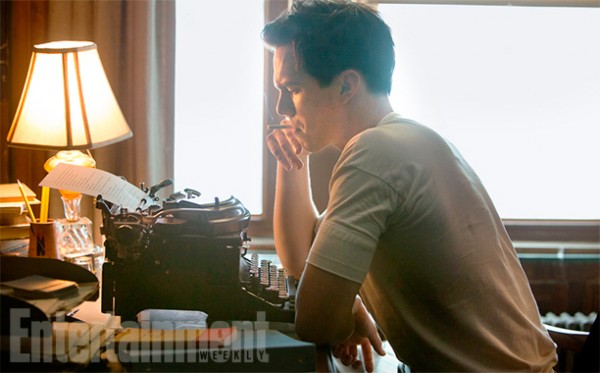
The film follows the life of Jerome Salinger (Nicholas Hoult).  He attends writing at Columbia University where Professor White Burnett grinds him to be a successful writer.  His devastating experiences during the War watching many die during the D-Day beach landing earn him the maturity that finally gets the fame he seeks with ‘The Catcher in the Rye’ but not after suffering mentally.  He is aided by an Indian Swami (Bernard White).

The message in the film is quite obvious – the importance of truth in writing.  Salinger refuses to compromise changing his story to the notes of the New York Times in order to be published.

Besides the story of J.D. Salinger as a writer from budding writer to published author, the film has several major subplots that undermine the film’s goal.  One is the relationship between Salinger and his mentor Whit Burnett.  The second is the failed love affair between Salinger and Oona (Zooey Deutch).   All the action takes place during World War 2 with Salinger himself going off to fight in the war.  The segments with the Indian Swami are more laughable than credible,

In Strong’s attempt to put his voice into his film, he gets too obvious.  One example (too in-your-face metaphor) is the blurred image of Salinger’s face as seen through the glass of his mother in the homecoming dinner.  This also comes across as an attempt to be too pompous instead of sincere – advice that he should have taken himself from the film.

For a film that stresses about voice in a story, Strong falls again into the trap of not following his own advice.  He resorts in too many familiar filming formats.  One is the over-use of voiceover.  Another is obvious at the start of the film when a scene is shown and then the film flashes back to years earlier (in this case 6 years) to the events that precede the scene.  The over use of music, as if to force the audience to feel a certain way (Indian music during the Swami advice segments and a musical interlude when Salinger gets published) is yet another.  Every character in the film speaks the same way – with sarcasm and with anger. 

REBEL IN THE EYE ends up a flawed biography in which director Strong commits all the mistakes the writing professor Burnett in the script warns Salinger never to make.

Trailer: https://www.youtube.com/watch?v=VWRhXMMb7CY

rebel in the rye

1997 Movie Review: THE ICE STORM, 1997


THE ICE STORM, 1997
Movie Reviews

Directed by Ang Lee
Starring: Kevin Kline, Joan Allen, Sigourney Weaver, Janey Carver, Henry Czerny, Tobey Maguire, Christina Ricci, Elijah Wood, Adam Hann-Byrd
Review by Russell Hill

SYNOPSIS:

Set just before the Watergate Scandal was exposed to the world, a group of neighbours live the 1970’s lifestyle in the most hedonistic way possible.

REVIEW:

Responsible for bringing together a stellar cast of true Hollywood greats, some even not that recognised at the time of the movies release, THE ICE STORM has all the hallmarks of a well-made independent movie; great script, good character development and amazing direction. But what’s this? It’s actually a Hollywood release?

Based on the 1994 novel of the same name by Rick Moody, the main bulk of the movie revolves around an actual ice storm that hit Connecticut in 1973 that turned the nutmeg state into an overnight icy Armageddon. The main family of the movie are the Hoods, with husband Ben (Kline) and wife Elena (Joan Allen) along with their kids Wendy (Ricci) and Paul (Tobey Maguire) and they seem as normal as any other. But not all is what it seems. Ben and Wendy aren’t exactly getting along, with Ben having an affair with the neighbour’s wife Janey (Weaver). Elena isn’t the happiest sandwich in the picnic hamper of the world either and always suspects of her husbands infidelity. What of her children? 14-year old Wendy is growing up fast, and starts to find other things to do with the neighbours’ kids, such as Janey’s son Mikey (Elijah Wood), than play monopoly. Even Mikey’s brother Sandy (Adam Hann-Byrd) is fond of Wendy, but too shy to do anything about it. I’m sure we can all relate to Sandy when we were his age. Paul lives away from home, but remains on good terms with his family. Even he has his own problems in his love life. Unsuccessfully vying for the affections of his school mate Libbets (Katie Holmes), Paul too isn’t getting the best ride life can offer.

These people are not exactly poor, and shower themselves with all things expensive that was available in the 1970’s. But, despite this wealth, they’re still not happy. Their depression of being in this situation they have found themselves in is masked over by alcohol and an obscene amount of extra-marital sex. The phrase that children follow in their parents footsteps can sure be applied apply to Wendy and Mikey. Wendy, confused by the unfolding events of Watergate and her home life, finds solace in the arms of a very nervous-looking Mikey. What a shit storm of a world these families are in. By the time the ice storm has hit town, the accumulation of the actions that all involved partake in result in quite a dramatic and upsetting scene that is bound to distress even the more placid of viewers.

Applauds to all cast here must be made. Kline, as in all roles I have seen him in, is quite the professional here. He is known as a joker on set, but you couldn’t tell it from his performance here. Allen too shines here once more. Over the past decade or so, she has appeared in some sublime movies with PLEASANTVILLE being one of her best. Allen’s solemn looks throughout really do portray the depressed housewife well. It seems at times that just one look from Allen could be painted onto canvas and be the backdrop for a Dali painting, but instead her figure is limited to celluloid but it sure is great to see her in a role she was born for. Weaver too excels here. It is strange to see her playing this adulterous character, with not one alien in sight, and shines in every scene she appears in. Her inability to cope with her current predicament of cheating on her husband with her children growing up quicker than she would like to have had them do is a credit to Weaver’s talents and, as with Allen and Kline, acts in a role it seems as though she was born to play.

It may be shocking to say, but I believe the more-younger actors outshine the senior members of the cast. Before the movies release, Ricci was seen as a child actor who could not cope with more mature roles. Her role of Wendy is delivered with maturity that seems a long way from the days of Wednesday Adams. Wendy is not your innocent character and, despite Ricci being only 17 years old at the time of this movies release, deals with more grown-up aspects life very respectfully. Despite appearing for only a brief amount of screen time, Maguire too is given the opportunity to excel and succeeds beyond all expectations. Before THE ICE STORM, he was restricted to appearing in lacklustre made-for-television movies, but soon after the release of this 1997 classic he was appearing in films such as THE CIDER HOUSE RULES, PLEASANTVILLE and more recently as your friendly neighbourhood Spiderman. His on-screen persona as the unlucky-loser-in-love started with his part here as Paul. It always seems odd to see Maguire playing anything else but this type of character and long it may continue. Just like Maguire, I have to commend Adam Hann-Byrd for his role as Sandy. His nervous character that is madly in love with Wendy is played to perfection. Since his role as Sandy, he hasn’t been given the roles like the other’s he acted alongside. A shame really. Over the past decade or so, there have been a number of quite excellent independently made movies that have made it onto the mainstream market and reaped rewards. It was due to THE ICE STORM that several doors were opened for Ricci and Maguire, and to this day they have gone onto bigger and better roles. Even the more senior members of the cast have continued this success. If it wasn’t for THE ICE STORM, then who knows who would have played Peter Parker and Frodo to perfection. A highly recommended movie for those aged thirteen and up.


the ice storm

1997 Movie Review: GUMMO, 1997

GUMMO, 1997
1990s Drama Movie Review
Directed by Harmony Korine
Starring Jacob Reynolds, Chloe Sevigny
Review by Alex Haight

SYNOPSIS:

Lonely residents of a tornado-stricken Ohio town wander the deserted landscape trying to fulfill their boring, nihilistic lives.

REVIEW:

“When I sit down to eat, I get sexy! When I go to bed, I get hungry! I saw a man lying in the street, and I said, “Can I help you?” He said, “No. I just found a parking space. Now I’m waiting for my wife to go buy a car!” – Tummler (played by Nick Sutton)

There is no preparation possible before viewing the directorial debut of Harmony Korine’s follow up to “KIDS” (which he wrote it at the age of 19). With the latter he provided an honest and abrasive script about the affect of underage sex and drug use in America- and the spawn such acts breed.

His follow-up seems like a De Sade horror show.

By way of “Gummo”, Korine instead offers a nightmare-fairytale of nihilism and faithlessness set against the desolate backdrop of Xenia,Ohio. Set between a mirage of sideshow characters, non-actors, and troubled underage youth’ (this stuff would make John Waters shutter) it plays out like vignettes hand made to disrupt most sensibilities. Anyone who relies on a strong moral fiber, should be warned…this is hard stuff to swallow. There are images here that will be burned into your mind for days, weeks, dare I say-years later.

It’ll be that film that you compare to every other “shocking” one made to.

It sets the bar…then sets it again…then makes a new bar…only to set it. He goes about crafting this voyeuristic sophomore effort by stitching together absurd images and storylines, ie. bacon on the wall, clogging in a mirror, dead cats, homosexual midgets, mentally handicapped prostitutes etc…to subject the viewer to answer the same questions he asked in KIDS-the nature of good and evil and the persuaded path life leads you on towards each one.

This time around however, he tips that thesis on its ear and adds a large heaping spoonful of broken glass disguised as sugar. That is his method…to wash the audience with frames of intense subject to the point of nausea , then bring you down with careful intent.

He himself has even said that the movie was about jokes sans the punch lines.

Try and keep that fact in mind and see how far that gets you.

1997 Movie Review: GROSSE POINT BLANK, 1997


GROSSE POINT BLANK, 1997
Movie Reviews

Directed By George Armitage

Starring John Cusack, Joan Cusack, Minnie Driver, Dan Aykroyd, Jeremy Piven
Review by Christopher Upton

SYNOPSIS:

Finding himself dissatisfied with his life as a professional killer, Martin Blank returns home to take stock of his life, visit his high school reunion and make one final hit. Nothing could ever be simple though and while he attempts to make it up to his jilted date before the big reunion, he has to contend with a large collection of men trying to kill him.

REVIEW:

Contract killers aren’t known for being the warmest of characters. As such you’d think it’d be difficult to get a whole load of laughs from them, unless of course Dan Aykroyd and John Cusack play them. Sarcastic and silly combine to create a hilarious situation comedy with the added bonus thrill of knowing that either of the two leads could be killed at any moment. Talk about edge of your seat comedy.

Martin Blank (Cusack) is having an existential crisis; he’s girlfriendless, childless, his therapist is scared of him and he’s lost the taste for his work, which just so happens to be shooting people in the head. All of this is bought home to him when he receives an invitation to his ten-year high school reunion. Though he refuses to go fate conspires to send him back to Grosse point to face the music for abandoning the town and its inhabitants.

It’s not all existential though as he has a very real crisis to contend with. His colleague Grocer (Aykroyd) is trying to get him to join his killers union and he’s very insistent that they join forces. So insistent in fact that he has hired government-contracted killers to take him out if he refuses. On top of this there is a bounty on his head for a job gone wrong involving an over friendly dog and some explosives.

Being killed strangely becomes the least of Martin’s worries though, when he runs into an old flame that he abandoned on prom night ten years ago and feelings are reignited. So now he must win back the girl and re-evaluate his life while at the same time trying to remain bullet hole free. Not many people would be able to tie so many strings together so convincingly but John Cusack as Martin Blank is such a brilliantly sarcastic and quick-witted performance that you know if anyone can, he can.

The character maintains a near constant narration of his life telling everyone his anxieties, almost Woody Allen-esque. While this might seem like an annoying trait if handled by anyone else, Cusack manages to make it endearing, making Martin Blank very relatable if you ignore the killing part.

Outside of Pulp Fiction professional killers are all portrayed in a pretty similar way; they have some variety of deep inner torment and they are remorseless, lonely, psychopaths. In Grosse Point Blank the killers have personalities and ingratiate themselves to the audience; something that is particularly difficult to do when your job is to get rid of people. In fact, Grocer and Blank don’t just make you feel comfortable with them; you actually end up in a bizarre way emphasising with them because of their charisma. As Martin Blank says, “If I show up at your door, chances are you did something to bring me there.”

It isn’t just the leads that perform excellently though. The shockingly overlooked Jeremy Piven plays an old friend of Martin Blank, still living in the town that he hates and is hilariously bitter because of it. The blasÈ government guns for hire, in the form of Hank Azaria and K. Todd Freeman, are so laid back that the only thing that can get them out of their job inspired stupor is making fun of these violent killers. This makes them equally funny and monstrous and every bit as bad as the people they are after.

One of the most impressive things about Grosse Point Blank is there isn’t really a bad performance in it. Even the smallest characters are perfectly formed little caricatures that manage to squeeze laughs out of every inch of the film. This also has a lot to do with the script, which is frenetic in it’s pacing, rarely passing a scene without inserting some kind of witty one liner or aside. This means that if you aren’t paying attention a lot will go past you, but it also means that if you miss one joke there’ll be another one along in a second.

The script excels in making mockeries of some very dark situations and deriving a lot of laughs from things you really shouldn’t be laughing at. It’s not just through assassinations where the guilty laughs come either. You can’t help but laugh as the reunited lovers insult all their old classmates, most of which have become depressing caricatures of small town life. The coked up bully who runs his own dealership, the small town cop desperate to enforce some variety of law or the girl desperate for approval are easily what you could imagine your old classmates turning into.

Mention must also be made of the incredible soundtrack. Put together in part by the late Joe Strummer, the music flows throughout the entire film creating a solid backbone and allowing for some of the most memorable scenes; like a fight to the death to the tune of 99 Luftballons. The addition of the radio station playing hits of the day is a great choice, not only in terms of story but also in allowing the directors obvious love of music come through.

There aren’t a lot of bad points to aim at Grosse Point Blank, but if you were looking for them then the immediate one is the fact that this is very much a nineties film. In terms of look, scripting and storyline it is very much of its time, but this is an exceptionally small complaint against such a strong film. The combination of quality soundtrack, outstanding performances and a viciously tight script means that this is one of the best, is not one of the most overlooked, romantic comedies of the decade.

grosse point blank


1997 Movie Review: GOOD WILL HUNTING, 1997


GOOD WILL HUNTING MOVIE POSTER
GOOD WILL HUNTING, 1997
Movie Reviews

Directed by Gus Van Sant
Starring: Matt Damon, Ben Affleck and Robin Williams
Review by David D

SYNOPSIS:

Will Hunting, a janitor at MIT, has a gift for mathematics which is discovered, and a psychologist tries to help him with his gift and the rest of his life.

REVIEW:

If you can put aside the rumor that William Goldman doctored the Oscar winning script for Good Willing Hunting AND that it features funnyman Robin Williams in a serious role, you are in an excellent two hours of viewing.

Written by a young Matt Damon and Ben Affleck, the story focuses on a young prodigy named Will Hunting. Will (aptly played by Matt Damon and nominated for an Academy Award) is a genius foster kid that works as a janitor in a prestigious university (MIT) in South Boston. Ben Affleck plays his best friend, Chuckie.

The plot focuses on the discovery of Will’s genius and other people attempts to either use or save him from himself. Will Hunting, on the other hand, has plans of his own.

Robin William pulls in a great performance as Will’s therapist (Sean), pushing him past the anger and sarcasm, to discover what his life is really all about.

This film works on couple of levels. As a viewer, we admire Will’s photographic memory and his uncanny ability to solve incredibly complicated math problems with ease, but at the same time resent the fact that he takes these abilities for granted. The audience musters the requisite ‘If I had that kind of ability I would…’ rhetoric but the script and director ask a much harder question ‘How do we define happiness?’

Will wants a simple life; he doesn’t want the complications of his genius. His actions betray his words as he voluntarily studies late into the night on various subjects, espouses classic lines from English texts and solves mathematical problems on a university blackboard without being asked. Inside, there is a person wanting to break free.

The another level is questioning whether a person is chained to their past. Will was shuffled & abuse from foster home to foster home, and because of this, very wary of human closeness and contact. It is akin to the sting we feel when we fall in and out of love. He is chained to his past because of the anger he still feels towards these betrayals.

His session with Sean (Robin Williams) also belies his true desires. With Sean as his therapist, Will is critical, confrontational and always on the defensive. Fortunately, Sean never pushes too far and because of this understanding, a critical bound is formed between them. Will has a distrust of adults because of the abuse he suffered at the hands of a foster father – one of the many reasons he distances himself from figures of authority.

Will spends most of his time with his friends who would ‘lay down their life for him’. They provide the only human closeness that Will feels towards anyone. When a mathematician Gerald Lambeau (Stellan Skarsgard) saves Will from a stretch in prison, Will can only thank him with harsh words and scorn.

During Will’s sessions with Sean, he learns that it is ok to take a chance and falls in love with Skylar (Minnie Driver). This relationship has all the hallmarks of defeat as we learn that Will cannot deal with the closeness that comes from trusting someone.

This last plot point is truly what the film hinges on: Will’s inability to trust because of his past. The final reel is emotional and satisfying. We see the journey that Will takes both on an emotional and physical level; from a wounded, cornered animal to a person that realizes hurt is a part of life. As an audience we feel for Will and participate in his struggle to reconcile his past feelings with his chance at a better future and happiness.

GOOD WILL HUNTING.jpg

1997 Movie Review: THE GAME, 1997 (David Fincher, Michael Douglas, Sean Penn)

THE GAME, 1997
Movie Reviews

Directed by David Fincher
Starring: Michael Douglas, Sean Penn
Review by Mike Peters

SYNOPSIS:

Nicholas Van Orton (Douglas) is an investment banker who is always in control of the situation. He is cold, calculating and always on his game. Nicholas lives a well-ordered life-until an unexpected birthday gift from his brother, Conrad (Sean Penn), destroys it all.

Review:

David Fincher has once been quoted as saying “I don’t know how much movies should entertain. I’m interested in movies that scar”. Whether he is referring to the scarring of the characters within his films or of the audience voyeuristically partaking in his dark and twisted tales is unclear. What is definitely accurate about Fincher’s films is that they leave an undeniable mark on each and everyone involved.

It is hard to mistake a Fincher film. They usually contain very little natural light and the atmosphere will be extremely unsettling. This will then force the audience to share the protagonists’ feelings of unease and paranoia. As well, by the end of the film, Fincher’s “hero” has usually undergone some sort of life-changing trauma.

The Game is a film that may be the least known of Fincher’s. It arrived in between Seven (1995) and Fight Club (1999) and has seemed to have been overlooked as a great film. This is a great film. The manipulative control Fincher seems to possess over his audience is mastery in its calculation and concoction.

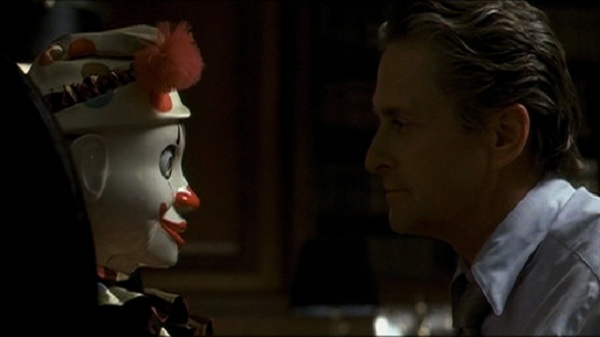
The story is simple. A man is given a present that will eventually drive him to the depths of depravity and despair by turning him into the character he has always deemed offensive and unimportant. It is a well known story cliché. He will then become a better person as a result of his journey which will be expressed through his change in character and his thoughts and actions towards others. However, Fincher beautifully makes this simple story his own. Fincher is a master of brooding and depressing atmospheres. There is no life in his films. Oh, there are people alive but his focus seems to be on reanimating the dead that exists within the body. Nicolas Van Orton is a character who lives alone. He is rich, powerful and most of all, successful. But yet, he is dead within. He rarely smiles and seems to have become who he is now as a result of witnessing his father’s suicide at a young age. Other than talking to his housekeeper and his lawyer (which he still does to a limited degree), he is a man who keeps to himself. He does not want to be bothered and will only bother another if there is progress to be made. He is sort of a 90’s version of Gordon Gekko from Wall Street (who Douglas played as well) who is more in touch with control and intimidation then he is with emotional contact.

The idea that Nicolas was unable to prevent his father’s suicide left him in a state of shock. He was unable to control the situation and thus he felt pain for the very first time. The film starts off with images of Nicolas as a child and his father and it is clear that this event was crucial in the shaping of Nicolas as a man. He lost a very important person in his life and as a result, he became a closed off and emotionally detached human being. He feels that being in control will prevent him from ever feeling pain again but yet (unaware to him until after the “game” begins) he yearns for closure in regards to his father’s death. It is only when the “game” begins that he slowly begins to exist once again and to reemerge as a living entity.

Douglas is masterful in his performance. He refuses to break character at any moment until it is deemed necessary by the script. Even when this “game” begins, Douglas portrays Nicolas as a character who still believes he is in control of the situation. He believes he has it all figured out until, of course, he doesn’t. When things do not go as planned, he panics as a result. He does not know how to control the situation which leaves him vulnerable and confused (feelings he has cut himself off from). He has never had to cope with change because he has never attempted to change himself. He must rediscover his inner self before there is any chance of redemption or rebirth.

Within moments of the films’ commencement, we come to identify with Nicolas. He may not be the most friendly and admirable protagonist in film history but yet we still attempt to identify with him. As a result, we form some sort of control over the narrative. We believe that we understand the simple structure of the story and will not be undermined by it in any manner (as Nicolas feels when the “game” begins). However, as this film progresses, we, the audience, become lost and confused. We, as Nicolas, are unaware of our surroundings and have become paranoid and fearful of the people within the narrative. Who do we trust? Where do we go from here? It is now the blind leading the blind.

This film may not be noted as one of Fincher’s more important pieces of work but yet it is a beautifully crafted piece of entertainment. The writing is taut and the acting is superb. Yes, many of the events are implausible and rely heavily on coincidence and chance but it is told and shot in such a high octane sort of way that the audience is quick to forgive the filmmakers for these insignificant and basically pointless quibbles.


the game.jpg